Unknown's avatar

About carriegelson

Elementary teacher passionate about all things literacy.

Predator Showdown

Yes, of course we know that predators have few reasons to fight each other. They are too busy hunting for prey to ensure their survival. But if they did battle each other . . . Well, wouldn’t we all just love to know what would happen? Lucky for us, Scholastic has published this very cool book about exactly that: Predator Showdown (30 Unbelievably Awesome Predator vs. Predator Face-offs!)
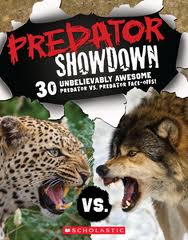
We are currently exploring this book with our Reading Group. It allows us to interact with non-fiction text features such as bar graphs to compare stats about speed, strength, defence, brains, etc or charts that tell us about predator style, range and sample prey. Students are asked to decide between two predators – First Instinct: Who would win? Justify. Some students are very familiar with the predators and find this easy, others are guessing just by looking at the pictures. Either way, it’s okay. There will be an opportunity to read more and make a more informed decision.

Today Catriona was thinking about a battle between a lion and a spotted hyena. Her first instinct? Who would win? She wrote:  “A hyena because male lions are lazy. Female lions do all of the work. And this is a picture of a male lion.”  She shared this thinking with me and then went on to explain, “I happen to know this. I’m taking my background knowledge and putting it into the paper.” (How much do I love when students are able to articulate exactly what they are thinking like this?)

We have been looking at three Predator Showdowns in more detail.

  • The Lion vs. Spotted Hyena
  • The Raccoon vs. North American River Otter
  • Tasmanian Devil vs. Dingo

After students have a chance to read the information page, they answer specific questions. Some questions have answers easily found on the page like: Look at the Stats section. Where is the raccoon superior? Other questions ask the students to include their own thinking. Can you think of a real life situation where these two animals might actually battle each other? Explain why you think this might happen?

We are also asking students to read a section and identify what was important to them about what they just read. For example, What is something you found particularly interesting about otters? Student answers varied. Some were intrigued that otters can stay underwater for up to 8 minutes. Others thought it was interesting that otters could dive up to 60 feet in search of prey.

After reading, students are asked to again think about who would win in a showdown. Many students changed their initial answers and provided lots of evidence from the text to support their thinking.
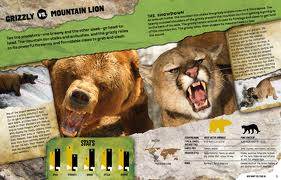
An inside page from Predator Showdown

Such a great book to engage children in learning and discussions. Answering questions allowed the students to build their confidence about forming an opinion based on evidence. Everyone wants to read this book when I put it out on the new non-fiction shelf! It will be a battle – a Student vs Student Showdown. Who will win and get to read it first?
The Raft

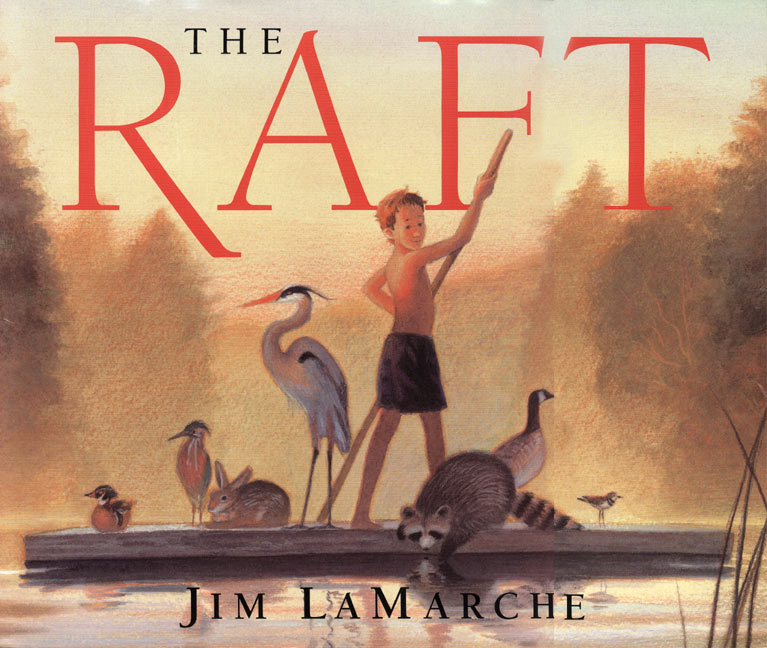
This week we read The Raft by Jim LaMarche and practiced asking deep thinking questions vs. quick questions (inspired by Adrienne Gear‘s Reading Power). We know that a quick question is quick to ask and usually we find the answer in the text. With deep thinking questions, we are often inspired to ask new questions and our thinking goes on long after we have closed the book.

the raft

The Raft tells the story of Nicky who has come to spend the summer with his grandmother. He isn’t very eager to do this (bemoaning being away from television and any kids all summer) but it doesn’t take long before Nicky finds himself fascinated by his summer locale. A raft covered in leaves and branches floats up and bumps against the dock Nicky is fishing on. It is covered in drawings of animals and it completely captures Nicky’s imagination. Where did it come from? Who painted the animals? What does it mean? Soon he and his grandmother are spending lazy days poling down the river. An array of animals keep Nicky company – foxes following him along the shore, birds hitching a ride, a great blue heron snacking on crayfish. Nicky often takes the raft out alone and sketches all of the animals he sees. Somehow the raft seems to draw the creatures to him.

The students noticed the changes in Nicky.

Miami: “He’s been transformed. He was so grumpy when he came to his Grandma’s and now he’s not.”

Hajhare: “I think he was set up. Do you know what I mean Ms. Gelson? His Dad tricked him into liking his summer. His Dad knew he was going to like it all along.”

Finally,  Nicky adds his own animal to the raft for a very special reason. Students were lulled by the beauty and magic of this book and eagerly wrote down questions as I read.

I then gave the students a task: Choose 2-5 of your deep thinking questions and list them in your notebook. Choose one and try to answer it (You will need to infer)

Kevin put his hand up. “But I can’t just put 5. Each question leads to another question so I’ll need to write 10. I “inferenced” as I thought them so I included them when I did my writing.” (Yippee! Learning!)

Some samples of student thinking.

Jena: Are all of the drawings adventures of how people saved animals? Maybe yes and the raft was made and passed on from generation to generation.

Lisa: One of my questions before was that are the animals from the raft going to come alive. Maybe if Nicky visualizes, they will come alive to him.

Ricky: Who drew all of these animals on the raft? Why is Nicky’s Grandma called a river rat? Did she also save an animal on the river? Maybe a rat? Is Grandma part of nature?

At the end of the book, Scott sat back and said, “That book was awesome.” When I asked him why, Eddy piped up. “It’s really making me think thinking stuff.”

I think this should be our new measure of success when we judge a reading experience – did we think thinking stuff? Does book really inspire our thinking voice? The Raft did and then some. It left us talking with each other, following a question into an inference and going back into the story to try and find clues, having “but what if. . . ” discussions all around the room. A wonderful book.

Those Darn Squirrels and the Cat Next Door

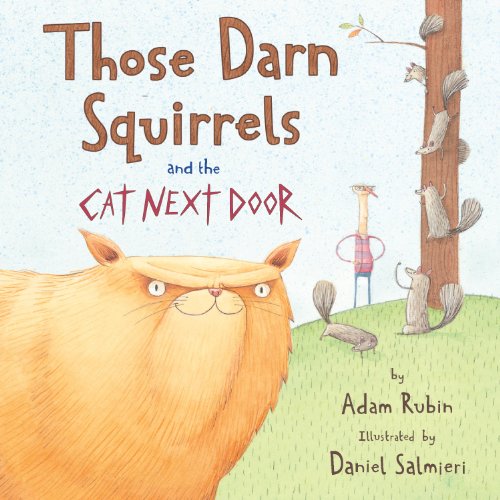
Bill, our BLG reader this week, brought in a very amusing book – Those Darn Squirrels and the Cat Next Door. This book is written by Adam Rubin and illustrated by Daniel Salmieri who collaborated on an earlier title Those Darn Squirrels.

cat


This book starts out with Old Man Fookwire, a grumpy bird enthusiast who is sitting in his living room waiting for winter to pass so he can get out into his garden and paint the beautiful birds that visit his yard. He is harassed by a group of pesky, but extremely clever squirrels who sneak into his house, eat his food and generally annoy him. When a new neighbour moves in next door (Little Old Lady Hu) with her cat Muffins, it seems that things may change in the neighbourhood. Squirrels may be champions of the forest but perhaps in Muffins, they have met their match.

My confession? I’m rooting for the cat! Is that terrible? I was silently cheering when the squirrels got ambushed. I was more than amused when Muffins gave them wedgies (you need the illustration to understand the wrapped around and twisted tails) But, I have good reason. My backyard is inhabitated by a bunch of squirrels – they chase away birds, fight in my flowers and try heroic gymnastics to leap onto the bird-feeders and eat my expensive seed. I don’t like these squirrels.  At all.  So basically I don’t like squirrels in general. In this book, I was really hoping that Muffins would show them who was boss. But let’s just say that the squirrel brain power was more of a factor in this story than I had hoped it to be . . .

Adam Rubin tells a very funny tale (check out his interesting blog Tickling the Brain) and the illustrations by Salmieri are hilarious. Old Man Fookwire’s nose, a soggy Muffins the cat, squirrels with wedgies . . . Daniel Salmieri engages his viewers with clever details. The perfect book to read when you need to laugh a few times over.

Our student reviewers report:

Hajhare: I liked this book because it reminds me of Chester the Cat. This cat in this book is really funny!

**Hajhare is referring to Melanie Watt’s fictitious feline.

Alyson: I like the part when the cat got karma and H2O spilled on him.

Ricky: This was a very funny book. It made me laugh out loud in myself. Bill what made you read this book? I really liked it.

Kevin: There was karma in that book that Bill read because the cat always scared the squirrels away. One day they decided to make a plan to get rid of the cat. They used yarn and tied it on to the birds. They used really cold water and put it in a bucket and put it on three branches and tied it onto the bucket. The next day the cat came to the birds and scared them. The cold water spilled on the cat and the cat turned wet, soggy, skinny, scared and mad. The cat went home and never came back. I liked that book!

It was spatial awareness day! How did we do?

Part 1

First, it was all about fractions. These activity sheets are from Math to the Max 3.

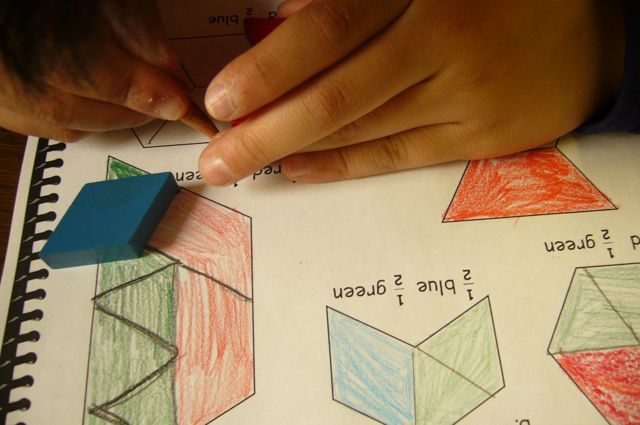
P1020905We have continued using pattern blocks to cover figures on the page and then trace what we’ve done. Students are being asked to think of covering a figure with blocks that represent a specific fraction but this doesn’t mean you can tell from the fraction how many of each block you will need. It is necessary to visualize the figure in thirds to complete this task. Look closely.

P1020910On this page (pictured right) students were asked to visualize the shape split in half. If a figure is half blue and half green, it might be one blue block and two green blocks, because two green blocks cover one blue block. When adding a red block, you then must add three green. So a figure can be covered in two red blocks and six green blocks and be 1/2 red and 1/2 green. Some of these took multiple attempts before they were figured out.

Part 2

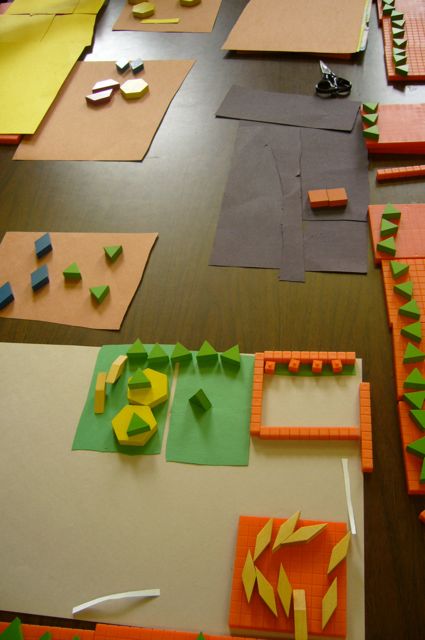
Then, in the afternoon, we moved on to making a maps. The task? Create a map of the school yard from a “bird’s eye view” perspective. The criteria?

  • work cooperatively within a small group
  • use any flat objects you can find in the classroom to represent buildings, places, objects (Students used paper, base ten materials, rulers, pattern blocks, lego, etc)
  • no pencils or crayons allowed
  • be prepared to explain any parts of your “map” at any time
  • anything you take out, must be put away at clean up time
  • have fun!

The results were fascinating!

P1020938These students were able to “visualize” certain areas of the school grounds very easily. In the foreground of this photo you can see their earthquake shed, the garden, the garden bench.

The only problem? They couldn’t orient themselves clearly. Their garden area is actually where the brick building should be and on the other side.

There was lots of talking, lots of discussion, lots of flexibility around new ideas within this group but nobody could get a vision happening that everyone could understand. This task was harder than it first seemed!

P1020929This group worked very well together. If you listened to them, they kept cheering each other on. “We have to really work together here!” “Good idea!” “Why don’t we try . . ?” In this picture you can see that the pieces of paper represent both school buildings and the large grey paper represents the gravel field complete with goal posts.

P1020936Here is the same group again from a different perspective. These students had thought out breaks in the fence (for entrances, parking lot, etc.) They had included the playground, the basketball court, the concrete soccer area, the stairs to sit on and watch, the spinners, etc. etc.

Anytime somebody said, “What about. . .?” everyone stopped and figured out a way to adjust the map. This was the beauty of building this rather than trying to draw and continually erase.

This group even cut out green circles of paper to represent trees as they would look circular from above. Clever

P1020940I love this version of a parking lot spaced out using lego pieces. The problem for this group is that it was too big compared to the scale of their buildings, etc. How could they take this idea and modify it? Unfortunately we ran out of time before they could think this through. The little green triangles represent the grass on the sidewalk surrounding the school.

Why did we do this? Well, for many reasons. We are beginning a mapping unit to look at Canada in North America. I wanted students to understand that the drawing on a paper of a map is a representation of the world we actually live in. This is very hard for some students to grasp because of course we don’t inhabit a flat two dimensional world. I thought if we tried to represent our “little world” of Seymour School on a map (built, not drawn and from a bird’s eye view perspective) it might open up our thinking when we try to visualize how a map represents places we live. If nothing else, it was an awesome hands on, creative, student centred activity. Lots of thinking. Lots of discussion. A little bit of arguing (of course 🙂 ) Some new perspectives. Well done Division 5!


Rainbow Bird

Sometimes, in a busy week, students will do some writing about a book we’ve read or an activity we’ve done and I don’t get a chance to read it that same day. When I open up the Response and Ideas books a few days later, I sometimes find absolute undiscovered treasures. The same feeling like when I find money in my pocket. It was there all along; I just hadn’t uncovered it. And when I do, wow! This writing has been hidden away in notebooks for a week and now must be shared!

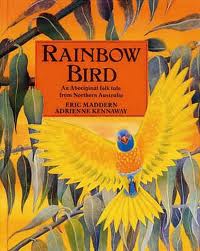
Today, I began reading student responses to Rainbow Bird – An Aboriginal Folktale from Northern Australia by Eric Maddern and vibrantly illustrated by Adrienne Kennaway. Thank you to our Teacher Librarian, Ms. Sheperd-Dynes for recommending this title.

Rainbow Bird is a “pourquoi” tale explaining how humans acquired fire.

Long ago, Crocodile Man had fire and refused to share it with any of the other creatures. Bird Woman was able to trick Crocodile Man and steal fire from him. Proudly, she asserts, “Now I shall give Fire to the people.” She flew around the country putting fire into the heart of every tree. From this day onward, people could make fire using dry sticks and logs from a tree.

Students in our reading group loved this dramatic story and were eager to write and draw about it.

A few samples:

Gary is in Grade 2. His writing shows that he has learned to summarize stories using specific and descriptive language.

“Crocodile Man could blow fire. He said he is the boss of fire. The animals begged for fire but he won’t give them fire. Bird Woman asked Crocodile Man for fire but he still won’t give her fire. Then crocodile man went to sleep. Bird Woman took the fire and shared it. She put fire on herself and became Rainbow Bird. Now Crocodile Man is stuck in the swamp forever.”

Truman is a Grade 1 student who has delighted in learning idioms. These idioms snake their way into his writing and show that he understands their meaning very clearly. I laughed out loud reading this!

“Crocodile Man says he is the boss of fire. It was the time of dreams. Bird Woman is cold at night because she doesn’t have fire. One day, Crocodile Man was dog tired. Then Crocodile Man was green with envy because Bird Woman took his fire stick. Now Bird Woman is happy as a clam. She put fire in the heart of trees. Now Crocodile Man lives in the swamp forever. Bird Woman said, “If you come up here, you will die!”

Catriona is a confident thinker and writer in Grade 1. I love how she shares her predictions and questions in her response. It is evident that Catriona utilizes all of the reading powers when she reads or listens to a story.

“I predicted that Rainbow Bird would steal Crocodile Man’s fire and I was right. But Rainbow Bird wasn’t always Rainbow Bird. She used to be Bird Woman. I am still wondering if that story could be true if they took all the fiction out and replaced it with real life stuff. Then, where would Rainbow Bird put the fire?”

All such different responses to the same story shared together. I am delighted by them all!

Sunday Musings

Sunday afternoons, for teachers, are often a bit of a place of limbo. It is still the weekend and there is time for relaxation and family but a little place in the back of our brains starts asking “What about Monday morning. . . ?” For me, part of the Sunday routine is often filling up my school bag with recent treasures from the library that I am excited to share with my students. Often there are more books than my schedule will allow but it is always a priority to find a place for books.

Why?

I believe that the two most powerful things I can do in my classroom each day are reading aloud to my students and providing time for them to read independently. Nothing else exposes them to new vocabulary, new ideas or new perspectives as quickly, as easily and as powerfully as a book. Reading aloud to a class pulls all of us into a magical place, an intimate learning community where words and visual images help us make meaning of our world. We discover something new. We think differently about something. We question ideas. We find support for a perspective. We are changed, often dramatically, by a few pages. Our interactions with these books shape us, constantly. How lovely that I can have this experience be part of my life daily just by reading to children?

Sometimes, it is hard to remember that not everyone shares this philosophy. In educational climates that measure student learning in test scores vs. engagement, reading aloud has no place in the everyday of classroom life. I came across this article on read aloud champion, Jim Trelease’s site. Seems impossible to imagine! More fuel to support the argument that an educational system characterized by high stake’s testing has no place in B.C.’s schools.

Read Aloud Handbook

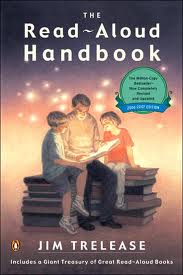
My copy of The Read Aloud Handbook, discovered in a used book store is probably the book, of all the books I own, that I have read and reread most often. I quote sections of it to anyone sitting near me. I shake my head as study after study and story after story is described that makes the book’s main point again and again:

Reading aloud to a child is the single most important factor in raising a reader.

And it doesn’t stop when they can read by themselves!

Why doesn’t everyone know this!??

An ode to books, to libraries, to reading. A must read for every parent and every teacher. Jim Trelease‘s website contains a lot of interesting information. But owning his book for constant reference is a must.

But back to Sunday. And my pile of books. Because it is always all about the books . . .

Books that might make their way to school with me this week:

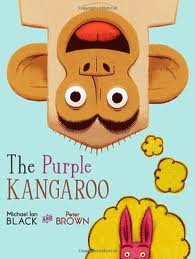
The Purple Kangaroo is written by Michael Ian Black and illustrated by Peter Brown. This book is narrated by a clever monkey that asserts he can read minds – your mind, dear reader, in fact. And he is pretty sure that you are thinking about a purple kangaroo. If you weren’t thinking about a purple kangaroo, you certainly will be by the time this book is finished. One that blows rainbow bubble gum out of his nose. A delightful journey with a book that you can’t help but interact with.

I imagine some very noisy listening to this story. Possibly some shouting! A lot of giggles.

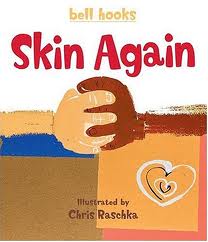
The first line of this book says so much: The skin I’m in is just a covering. It cannot tell my story.

But with this book, every line is a line to read, savour and repeat. How about this one:

Be with me inside the me of me, all made up of stories present, past, future . . .

Skin Again by Bell Hooks is brilliant. And Chris Raschka illustrates! Perfection.

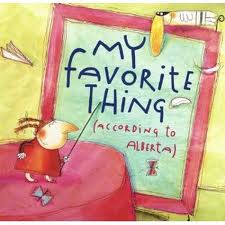
My Favourite Thing (According to Alberta) is written by Emily Jenkins and illustrated by AnnaLaura Cantone. This book is all about Alberta, a little girl of particular tastes. She has some very specific opinions. Her favourite ice-cream? Peppermint. Favourite vegetable? Potato chip. 🙂 And you must read to the end to find out exactly what her actual favourite thing is. This book goes on my must use as a springboard for writing list. I have big plans for this book.

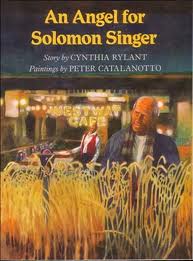
I picked this book off the library shelves because it is illustrated by one of my new very favourite illustrators Peter Catalanotto. He doesn’t illustrate books, he paints amazing scenes which accompany text. Then I saw that it was written by Cynthia Rylant. This book just had to be great. An Angel for Solomon Singer did not disappoint.

A book about dreams. About yearning. About finding comfort in a big bustling city. Finding happiness when things are not really the way they ought to be.

A small treasure to inspire big discussion.

So as I move from Sunday, into Monday I take the cozy comfort of reading and books with me and keep it all through the week. It’s all about the books . . .

Rocket Art (Finished Pieces)

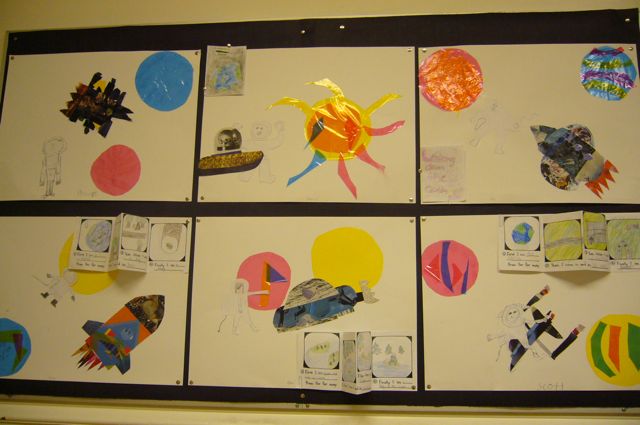
Ms. Chen has posted our finished Rocket Art pieces in the classroom and on the bulletin boards which surround our classroom. Displayed all together, they look amazing! If you haven’t seen our work in process, read more about how these pieces were created here.

P1020879

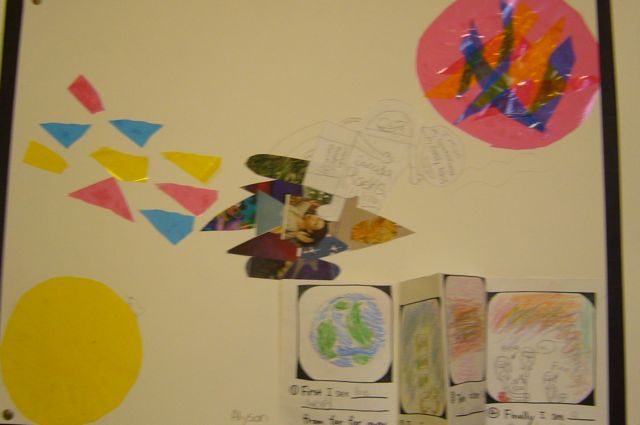
This week students were able to complete fold out panels about looking back to Earth. Ms. Chen used Steve Jenkins’ book Looking Down to illustrate zooming in to a specific object – from looking at Earth and then zooming in possibly to a specific street, then maybe a particular house and then finally to a single window within the house.

This is such a fantastic book to illustrate zooming in on a particular object – first from far away and then getting closer and closer.

A very interesting journey in looking at the world from a different perspective.

Closer and closer and close

Read about how this book was conceived on Steve Jenkins’ site.

What is amazing about this book is that it is “told” strictly through visual images – as a wordless picture book.

P1020882This is Jena‘s art. Now in addition to her rocket ship, planets and drifting astronaut, she has attached her mini fold out book which depicts looking back to the Earth.

First she drew a portion of the Earth – oceans and land covered by forest. In the subsequent drawings she zooms closer and closer into the forest scene.

P1020883Here is Alyson’s completed work. We loved how she used the cellophane to represent the emissions coming from her rocket as it zoomed through space.

Her mini booklet zooms in to a single room in her building.

Such a colourful piece!

P1020886Hailey isn’t quite finished her mini zoom in booklet but her art so far, is wonderful.

Her astronaut’s suit is extremely detailed and she was able to create a very efective planet by layering her cellophane pieces.

Beautiful.

Such a fun and successful project. Thank-you Ms. Chen!

Off on a rocket ship!

Our class has been working with Ms. Linda Chen, a student teacher from UBC on a multi-step art project and we are almost finished!

By the end of the week, we hope to have our finished pieces hanging up in our classroom and on outside bulletin boards. But for now, a sneak peek!

Students made collage rockets, drew astronauts and today worked on the composition of their pieces – placing rocket and astronaut in a space scene along with planets. Such fun!

Inspired by some images from this book: Joey and Jet in Space by James Yang.

joeyandjetinspace

Check out our room today!

P1020843Bird’s Eye view of a table busy creating!

Students are placing rocket ships in specific places on their page, thinking about where to put the astronaut and how they want to organize the planets in their space scene.

Everyone was on task and engaged!

If you look closely at the bottom left hand corner of the picture below, you can see that Eddy has placed his astronaut astride his rocket.

Talk about riding a rocket to the moon!

P1020847

Students are using colourful planets cut from cellophane. Very effective!

Ms. Chen cut scraps of cellophane for students to use to decorate. She did a mini lesson on colour theory and had the students think about how the colours placed together might mix.

Some students used the pieces to decorate a planet. Others used the pieces to create a feeling of movement in space or as gasses or dust floating around the planets.

P1020871

We were pleasantly surprised at how unique each piece was!

Students loved working with such bright colours.

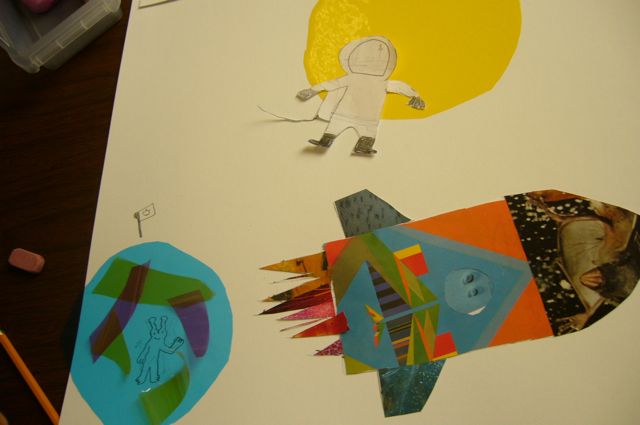
Here is a piece where you can see the details of the rocket made using a collage of magazine images. The rockets are all absolutely gorgeous!

In this image the lone astronaut floats next to a planet as the rocket zooms by. An alien seems to be peeking at us from the blue swirly planet.

P1020861

Keep checking for our finished pieces!

If I could go to Kindergarten . . .

I love reading to the Ks at Seymour. I get to do it at least a few times a month at our primary Social Responsibility Gatherings. The Ks sit right up in front, eyes wide, serious expressions, taking it all in. They listen intently, little hands raise in the air to tell me connections and ideas. Then when they leave, they wave, they smile, they whisper, “I’ll miss you.” One of my favourite things to do is to read to the Kindergarten class.

So I got to thinking what if I could go to Kindergarten everyday? And read? What would I read?  During my last few visits to the public library I found some wonderful possibilities.

Saber-toothed tigers. Wooly mammoths. Sleepy dinosaurs. A little boy exploring the world around him. Boy by James Mayhew explores a little guy’s yearning for independence while at the same time honouring his deep connections to home (and the happy snuggles from Mom and Dad). Where in the world do we find warmth? In the security and love from our own family.

A beautifully illustrated story inspired by the author’s love of his own son.

Marie-Louise Fitzpatrick wrote There – as a series of questions. A story about growing up and celebrating the journey as much as the destination. When will I get there? How will I know? And will I know everything, There? The little girl then wonders Can I change my mind and go Elsewhere instead? She then decides that she will go There tomorrow – after she does all the things she needs to do.

A book that begs to be explored with children. Winner of the Bistro Awards in 2010.

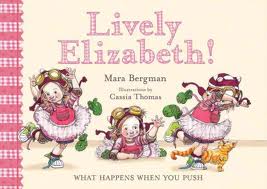
I think this book by Mara Bergman and illustrated by Cassia Thomas Lively Elizabeth is especially appropriate for kindergarten. Life when you come to school is all of a sudden a lot about lining up. Going here, going there, hands to yourself, “shh!” Several times a day. What happens when you have a little extra energy and it kinda spills over into a push? Well in a kindergarten line, it is full on domino effect! Bergman does a lovely job of playing out the whole scenario – from upset to apology and then forgiveness and moving on (and quickly – after all, little ones have the important business of play to get back to)! Cassia Thomas’ illustrations are absolutely delightful! A book, I predict, that will get many “Read it again!” requests.

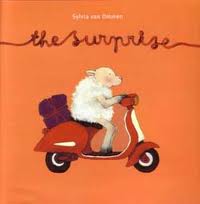
Okay who doesn’t love surprises? And guessing what will happen next? Little ones do especially. What a treasure is The Surprise by Sylvia van Ommen! Wordless so there is a lot of space for interactions. Predictions. Inferring. Questions.  Sheep zips here and there on her moped on a mission. She dyes her wool, when it seems long enough, a brilliant red. Then she brings it to poodle who spins it into yarn. She then knits something special and wraps it up and delivers it to . . .  Well, not going to spoil the surprise here but how fun would this be to do with a class of Ks?

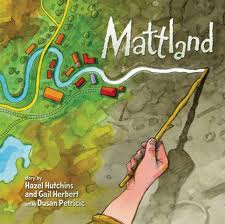
Mattland coauthored by Hazel Hutchins and Gail Herbert and illustrated by Dusan Petricic is a wonderful book to explore with children stressed by moving. The scary sadness of someplace new followed by the gentle, spontaneous introduction of new playmates and new activities. But this book is also ideal to celebrate imaginative, outdoor play. Building a place – roads, rivers, houses, prickly trees and getting some quiet help from someone with their own treasure trove of discoveries – a flattened penny, some popsicle sticks, four pine cones . . . To be fair, you can only read this book with intended outside play planned next. Lots of it. And it should probably involve some mud!

Now I just need a plan to sneak in and share some of these with the Ks!

Why Do I Have to Make My Bed?

Our BLG reader this week Deborah brought us the informative, engaging and very funny story – Why Do I Have to Make My Bed? (Or a History of Messy Rooms) written by teacher and playwright Wade Bradford and illustrated by Johanna van der Sterre.

We were connecting with this book right from the cover. Ahh kids and messy rooms! In my house this question sometimes sounds a little different: Why do I have to make your bed? (That would be me, the Mom, asking it)

We start with a little boy asking his Mom why he has to make his bed. He lists the chores he just completed and bemoans, “So why do I have to make my bed? It’s just going to get messed up again.”

“Yes.” “That’s true!” students shouted out.

The little boy’s mother tells her son that this reminds her of a story about his grandmother when she was a little girl and asked that exact same question (but her chore list was slightly different and included putting away Hula-hoops and dusting her rock’ n’ roll records) This little girl’s mother said “That reminds me of a story about your grandfather when he was a little boy. And . . .”

Miami predicts: “Oh! I think this book is going to go on and on and on until they get to the dinosaurs!”

We move back in time – learning about different chores completed by children at different times in history (from fetching water from the pump to dusting a printing press to picking out rats hiding in the pickle barrel . . . ) We also learn funny expressions through the ages:  “cantankerous as an old sea dog” “more thunderous than Thor” “ill-tempered as a caged lion” etc. Students delighted in searching for the date woven into the illustrations and noticed “It’s a boy, then a girl, then a boy. A pattern.” Everyone joined in with Deborah on the lines that repeated “That reminds me of a story about . . .” and “So why do I have to make my bed?”

Meeting the Vikings was very exciting (as were the chores! This little girl had to stoke the fire for a sword maker, dust off the sacred blowing horn, pick up broken spears and patch her father’s war wounds) “Whoa the Vikings!” “Vikings! Are you serious?”

Seeing children from the Roman times was also pretty dramatic in our room.

“121!”

“That’s a billion years ago!”

“That’s Heavens time.”

And then Egyptians, cave people . . . Oh my!

Finally, we do learn why these children do have to make their beds: “Because I said so.”

Of course!

At the back of the book is a section titled Chores Through the Ages which tells us about both the chores children had to do in each time period but also about children’s play. For example, in Ancient Egypt, children might build toy boats to sail along the irrigations canals. Deborah didn’t read this whole section but pointed out that students could read it independently at a later time. Plans were quickly made: “I’m totally reading that.” “Me too” “Cool”

This book was a big hit!

Our student reviewers report:

Alyson: I like when the story went on and on and on!

Josiah: I like the book because it kept repeating: Why do I have to make my bed to the year 40,000 B.C. to cave men. It was funny.

Hajhare: My favourite part was when they were in the Vikings. It was funny how the boy talked. The Egyptians were cool too. I don’t like making my bed either. I hate it!

Ricky: This was a very long book. It’s the longest BLG book read I think. I liked that it was so long. This book was just like karma.