Some great new books from Scholastic

Some popular picture books in our new book displays – purchased through Scholastic book orders.

Mouse was Mad by Linda Urban and illustrated by Henry Cole. How is little mouse going to express his anger? His stomping can’t shake the trees like Bear. His screaming doesn’t echo through the woods like Bobcat. This makes him so mad that he stands perfectly still. He breathes. The other animals join in, breathing too. Suddenly mouse is no longer mad. Hmm. . . Look what breathing can do for you! For a MindUp classroom, this book made a whole lot of sense!

The Very Itchy Bear by Nick Bland is very amusing. The Very Cranky Bear returns – this time bothered by a troublesome little flea.

Biting high and biting low,

This is flea biting Bear under here and over there

Absolutely annoying until Bear flicks flea into the ocean and finds himself all alone and flea finds himself almost dinner for a hungry bird. In the end, these two become appreciative friends.
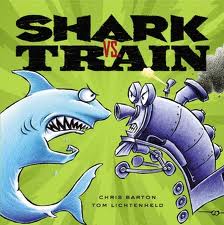
Chris Barton and Tom Lichtenheld bring us the award winning bestseller Shark vs. Train. This book is pulled off the shelf almost daily. It is pretty hilarious. In the hands of little toy box raiding boys, shark and train come to life to battle. Who will win in these very imaginative scenarios? In a hot air balloon? Roasting marshmallows? (hint – shark is all wet!) Giving rides at a carnival? Playing hide and seek? (Really they both fail miserably on this one – steam and fins are just too obvious!) Who wins in the end? The call for lunch!

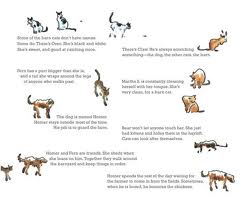
What a book! Details of what happens on a farm day in and day out. Who lives there? The farmers, the cattle, the chickens, countless cats, etc. What do we find? Barns, sheds, tractors, trucks, plenty of equipment . . . And what exactly happens? Enough great details to fill a book that you have to really settle into to finish reading. A great read aloud but also a great book to explore with a friend. Elisha Cooper‘s Farm is a must for the primary classroom.

Today it was a book to read and chase me with, recounting new facts learned. “Ms. Gelson did you know that cats eat grasshoppers? “Ms. Gelson, dirt can look like dark chocolate!” On and on!
I love new books! Happy reading!
What’s it like to be sister number three?

We seemed to be all about girl power this weekend at the library – maybe because it was just my daughter and I, but our big stack of books seemed to include a lot of books about very cool girls – some books new to us and some old favourites.

Two books to talk about featured the youngest sister in a family of three girls. Not fairy tale stories where everything comes in threes including sisters – but books from the here and now that explored themes of identity, self-esteem, and acceptance.

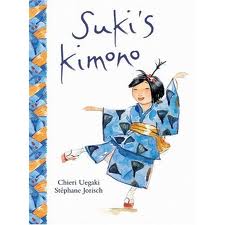
Award winning, Suki’s Kimono is a family favourite at our house. We love how Suki possesses a joyful inner spirit and how she lives in the moment not worrying about what the world might think.  Suki adores her blue cotton kimono – for the memories that it holds and the way it makes her feel. She vows to wear it on her first day of school despite the disapproval of her older sisters and manages to maintain the magical happy feeling of wearing this special kimono throughout her day even when questioned and taunted by classmates.  Written by Chieri Uegaki and illustrated by Stephane Jorisch.

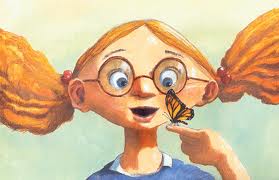
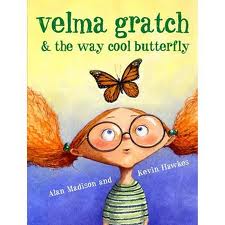
Look at that cover. Aren’t you just rooting for Velma before you even know her issues or struggles? Kevin Hawkes, illustrator, helps create a wonderfully unique character in Alan Madison’s Velma Gratch & the way cool butterfly. Velma arrives in first grade in the shadow of her two older sisters known for their seemingly perfect qualities – athletic abilities, spectacular spelling and marvelous math. Velma wanted to be noticed but for what? She chooses some quite foolish ways to stand out: running the slowest, singing the loudest, muddling her math . . . None bring quite the effect she is hoping for. Slowly, Velma learns to recognize a passion – science. When her class begins to learn about butterflies she twists wonderfully new words around in her mouth – metamorphosis, conservatory, migration. Not only does Velma come into her own as a butterfly expert, but on the class field trip to the conservatory, Velma is noticed by a monarch who lands on her finger and doesn’t leave for days.

Velma releases her monarch with the others from the conservatory a few days later, waving goodbye as they begin their journey south. Velma has gained a little power of flight herself as she floats home between her sisters, happy and confident.

Isn’t it wonderful when the youngest members of a family can teach everyone a thing or two?

The Juice Box Bully

This week we read a fantastic book that looked at the difficult subject of bullying and what it means to stand up together against bullying in a school community.

juice-box-bully-empowering-kids-stand-up-others-9

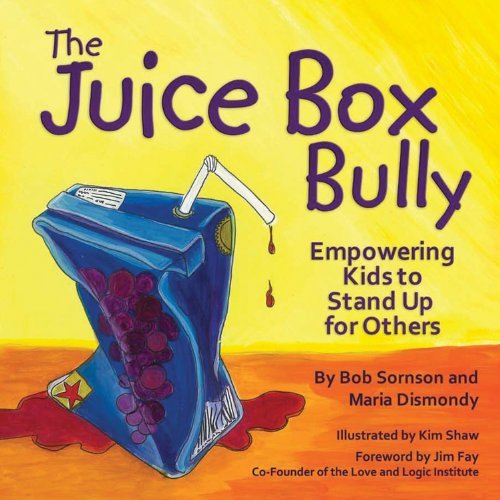
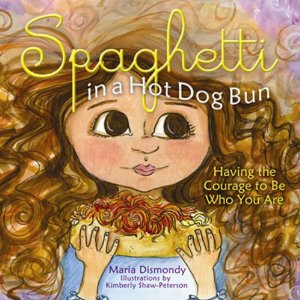
The Juice Box Bully: Empowering Kids to Stand Up for Others is coauthored by Maria Dismondy and Bob Sornson and illustrated by Kim Shaw. Many of the characters from Dismondy and Shaw’s Spaghetti on a Hot Dog Bun return in this story about a classroom that takes a stand against bullying.

spaghetti

In The Juice Box Bully we meet Pete, a new student at Mandell Elementary in Mr. Peltzer’s class. Pete has come in with a strategy he believes will work for him – bully others before they can bully him. But he doesn’t realize that he is the newest member of a classroom that has made a Promise – nobody will stand by and accept bad behaviour. When someone is mean, hurtful or disrespectful, everyone speaks up. So nobody accepts his behaviour but they also don’t accept when a classmate, in anger, tries to exclude Pete. This is shocking to Pete – “No one’s ever done that before, why did you stand up for me?” Ralph explains, “I’m not a bystander. I don’t stand by and let mean things happen.”

This book prompted a lot of very thoughtful discussion in our classroom. Students noticed that students teamed up together to speak out against mean behaviour. They were also pretty shocked at how mean Pete could be! When he continued to be cruel to students, it was pretty upsetting. “He should be expelled!” someone shouted. But one student didn’t think so, “NoWhen I was in trouble, I remember how you dealt with it. You talked to me and then talked to the other student. I learned why what I did was wrong.” Whew, good to know we do some things right!

When Pete admitted that in his old school he had been bullied, things began to make sense.

Ricky: “Bullying can be like a disease. It can spread.”

Miami: “He was acting like that to protect himself. But it was not in a good way protecting.”

Seriously, read children a great book to get them thinking and they are absolutely brilliant.

We were pretty impressed with the Promise that this fictional classroom had made.

Kevin: “If you bully it spreads but it doesn’t work in this class. They stand up for others.”

Jena: “We are learning about bystanders. That’s when you are just watching the bullying happen and not saying anything. In this book, they won’t be bystanders.”

Alyson: “Just watching is not helping – your tummy tightens up and it feels like you are turning into a bad person.”

Ricky: “It’s kinda hard though and sometimes it doesn’t work. It worked here because they were in a group.”

Kevin: “So they had more power!”

We discussed how this teaches us that we have to work together and be serious to create a community that will not tolerate bullying. Not easy. But absolutely essential. Big question: How do we create that feeling of community – starting in classrooms and spreading throughout the school?

Tyrannosaurus Drip

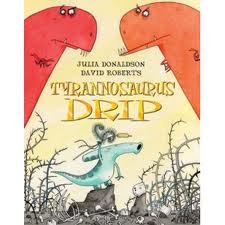
Sam, our BLG reader this week, brought in the very fun book Tyrannosaurus Drip by Julia Donaldson (of Gruffalo fame) and illustrated by David Roberts. Rhyming text, dinosaurs, lots of humour. What is not to like?

The story? A duck billed dinosaur egg ends up in a T-rex nest. Mommy and Daddy Tyrannosaurus are not too impressed with this little vegetarian offspring that hatches. The feeling is mutual and little Drip (cruelly named) decides to run away. He discovers some amazing things. One, he can swim! Two, he seems to look a lot like these lovely creatures who celebrate weed eating over meat eating. Clever little Drip outwits the tyrannosaurus family and is celebrated as a hero!

Watching everyone join in with Sam on the repeating parts was pretty cute! Some students definitely got the rhyming – some not so much.

And spluttering, and clinging to the branches of the tree,

They went whooshing down a waterfall and all the way to sea

Student ” You mean the ocean?”

Sam (gently) “Yes, but ocean doesn’t rhyme.”

Our student reviewers report:

Gary: “I liked the story because it rhymes. The story was funny when the mother jumped and broke the tree!”

Jeremiah: “I liked the book. It was cool. I like dinosaurs a lot.”

Jena: “I thought the part was funny when the tyrannosaurus sisters saw their reflection and got scared.”

Lisa: “I like this book because it rhymes like a poem. It was funny when Drip refused to eat meat.”

Josiah: “I like the book when the small dinosaur stole the egg and brang it to the Tyrannosaurus and then it hatched. When they gave him chicken, he said,”No I am a plant eater!”

Two goldfish? Or . . . your Dad?

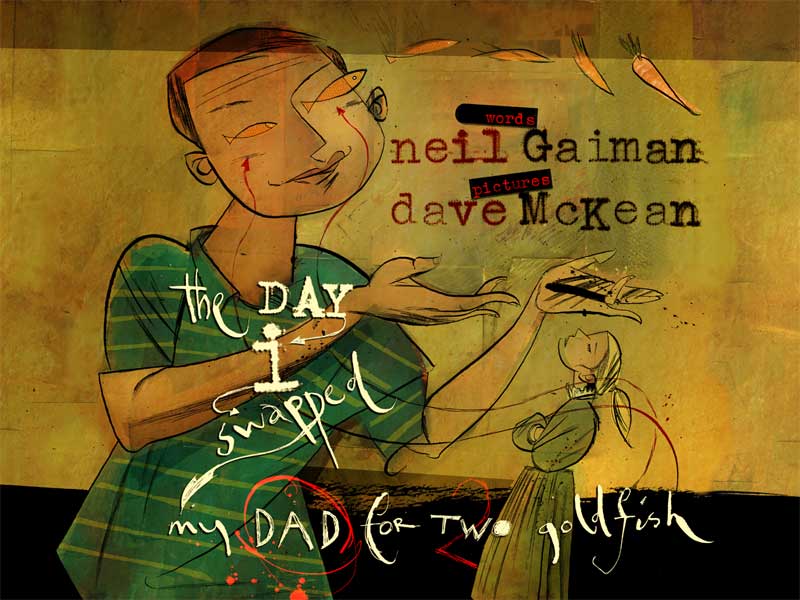
Author and illustrator Neil Gaiman and Dave McKean are a brilliant team. Their book, The Day I Swapped my Dad for Two Goldfish had that amazing silencing power over my classroom – so engrossing that at times there was not a word! And then at other times, volume turned high in discussion and debate – on task talking! Yippee!

Day I Swapped

This book in and of itself is pretty darn amusing. The conversation and comments it inspired in the classroom – hilarious!

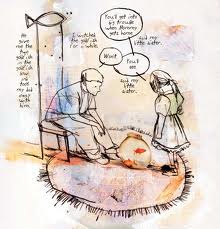
Nathan comes over with two goldfish in a bowl. They were pretty neat – reddy-gold and beautiful swimmers. A swap is proposed. The problem – Nathan isn’t interested in anything offered, not the transformer robots, the annoying penny whistle or the punching bag. So some deep thinking happens: “I’ll swap you my Dad.”

Whoa!! This caused quite the commotion in our room. Nathan, back in the book, was sceptical. One Dad for two goldfish doesn’t seem quite right until it is pointed out that a Dad is as big as a hundred goldfish. And he can swim (“Can’t” protests the little sister) So Nathan leaves with a newsparer reading Dad and the two goldfish remain.

So I ask: What do you all think? Is it a fair trade? I love how they take this question absolutely seriously!

Kevin: “No! A Dad is more useful than goldfish.”

Hajhare: “A Dad is more valuable, he grew up with you.”

Jeremiah: “But he still has his Mom.”

Hajhare: “Nope a Dad is not available.”

Alyson: “Without the father, you can’t have another baby.”

Lisa: “The Mom will be pretty surprised when she gets home.”

And of course Mommy says, “You can take these goldfish over to Nathan this minute, and don’t you come back without your father.”

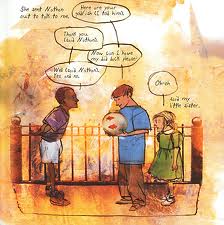
But this is a little bit more difficult than first seems because Nathan has done some more swapping.

Alyson: “My Dad is more expensive.”

My important clarifying question: “How much is a Dad worth?”

Hajhare: “Love!!”

Ricky: “Dads have mastercards.”

Kevin: “Why don’t you ask a Dad to buy you goldfish?” Indeed!

We began to think this swapping might not end. There was much more searching following the trail and a gorilla mask, Galveston the rabbit and the Queen of Melanesia enter the story. Finally the Dad is recovered still reading the paper and sitting in a rabbit hutch.

Hajhare: “I think the message is Moms are all about love and Dads are about newspapers.”

Manny: “No that’s not the message. It’s – don’t let kids trade people.”

Whatever the message, this book is an adventure worth reading. (Preferably out loud to some opinionated children 🙂 )


Moms are Supergirls!

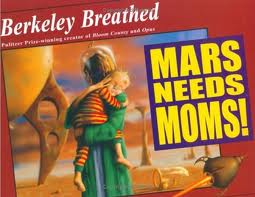
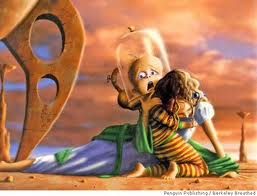
The movie trailer is out – Berkeley Breathed’s Mars Needs Moms! is now a movie. I felt a little bit of pressure to get this book read before my students had no idea that the movie was based on a book. Because it really is such a great book! Almost always, in my opinion, books trump the movies even without the special effects! There is an intimacy that happens when we share a book that a movie just can’t touch. And you are allowed to interrupt with comments and questions and nobody says SHHHH! At least not in our class!

So I asked for some predictions before we started reading. Look at the cover – What do you think this book is about? (predictions especially appreciated from those people who hadn’t seen the trailer!)

A boy needs a Mom to go to space with him!?” “No, it is the Martians that need Moms to take care of them.” “Yeah because Moms are superheroes!” “No – they are Supergirls!” Absolutely!

Really what happens is that Martians have been keeping an eye on Earth and have realized that since they have grown up motherless, they will need to send Martian Raiders (with a big net) to capture some Moms. Milo, who has been doing some pretty serious Mom bashing (using terms like bellowing broccoli bully and carrot-cuddling cuckoo to describe his loving mother) watches his Mom be grabbed and rushed into a waiting spaceship. (“Do aliens eat Moms?” Scott wondered.) Milo follows, stowing away on the ship. Exiting the spaceship on Mars, he trips and falls and his helmet smashes to bits. Breathing Martian air – Milo is doomed! Until . . . a figure appears and gives up her helmet so Milo can survive.

Milo’s Mom places her helmet on his head and tells him, “I’ll love you to the ends of the universe.” And then she passes out. “She is sacrificing herself,” Jena explains knowingly. “What does that mean?” “It is when you give up something you really need.” “Oh,” says one of the boys nodding, “that’s what Moms do.

Yep, Supergirls!

Read the book before you see the movie! It’s worth it!

Friends (Mostly)

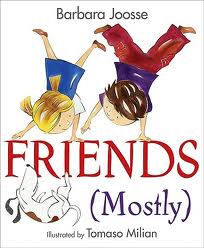
Oh – thank goodness there are so many books written about friendship because friendship struggles are an inevitable part of every elementary school day. Friendships mean everything but they can sure be hard! Bill, our BLG reader today, brought in a sweet little story by Barbara Joose called Friends (Mostly).


Cheerfully illustrated by Tomaso Milian, this book explored the relationship between Henry and Ruby. Best friends –  but like any friends, they have the power to upset the other. Sometimes they are friends and sometimes “unfriends.” Friends worry.

Henry: last night, I had worry thoughts. What if Ruby finds another best friend? Nothing would be funny. Nothing would be regular. What would I do without Ruby?

Apologies soothe upsets and they can get back to being friends – for always and forever!

Our student reviewers report:

Alyson: I like this book because I have a friend in this class and he is nice. But sometimes we get into fights.

Jena: I have a friend and yesterday we got into a fight. But then the next day we forgave each other and found out that there was nobody like best friends!

Hajhare: I like this book because it was about friendship. I have a connection when Henry told a secret. When my friend told my secret, I was very angry so I told his secret. Then he was very mad too and he called me a name so I called him a name. You can sometimes be very mad at a friend.

The Great Apes

Apes. Orangutan, Chimp, Bonobo, Gorilla – these great apes are fascinating. They are so like us!  At this time in the world we need to protect them to ensure they have places free from being hunted and free to live in peace. What did we learn about these great apes today? What are we still wondering? What do we want to research?

ape

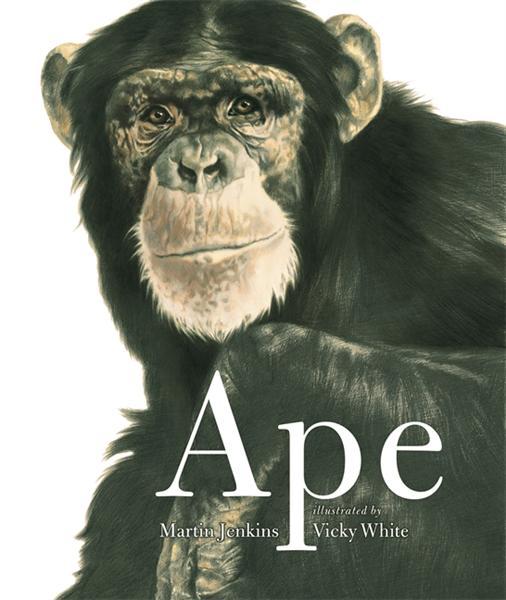
Ape is a visually stunning book! A book to pore over again and again marvelling at the details – both visual and written. Vicky White’s close up portraits and lifelike illustrations fascinated us while Martin Jenkins’ text provided so much new information it was difficult to turn a page without endless questions being tossed around the room.

This was the perfect text to practice questioning with non-fiction text in small groups. First we listened to the story and listed key questions on our individual notepads. Some very fascinating facts that sparked a lot of discussion:

  • Chimpanzees poke a hole into a termite mound with a long blade of grass and then lick off the termites! Some people thought they were using the grass kind of like a straw. Other people wondered if they shared. Many people thought it would be pretty gross to have bugs crawling around in your mouth!
  • Orangutans love to eat the smelly durian fruit!
  • Chimps travel in gangs and hunt down monkeys. “Gangs!?” This seemed very dramatic. “Do they just chase the monkeys or do they actually eat them?” one little horrified voice asked.

We then took our questions to share in a group of four. Each student took turns sharing a question and the group helped decide where to include it on our questioning sheet. Was it a question we found the answer to? Was it a question where we thought we could infer using the schema we already have about animals and the world? Or was it a question where we felt that more research was needed?

Which questions made the lists? A sample below . . .

Questions we had but then found out the answer as we read on:

  • How long do gorillas live? At least 40 or 50 years.
  • Where do the apes sleep? In nests on the ground or in trees
  • What do apes eat? Some eat fruit, some eat termites.
  • Are any of these apes extinct? No!
  • How many species of apes are there? Five species in the world – including us!

Questions that we didn’t find the answers to but we can try to infer:

  • What are the predators of apes? We think humans who hunt them and big cats because they run fast and can catch them.
  • When the chimps fight with other chimps, do they die? We think they might if they get really hurt. Maybe they could get an infection from a bite or bad scratch.
  • What kinds of parasites do they have? Maybe fleas because they have fur.

Questions which need more research:

  • Which of the apes is most aggressive?
  • How are Apes related to people?
  • Can a chimp sense its predators?
  • Can apes swim?
  • What are the differences between males and females?

It was fantastic to see students so engaged with their questions and talking together to make inferences and discuss new learning.

Thank you to BLG who sent in this book to another primary class a few weeks ago. This book will be a very popular book in our library!

How do you show your inner beauty?

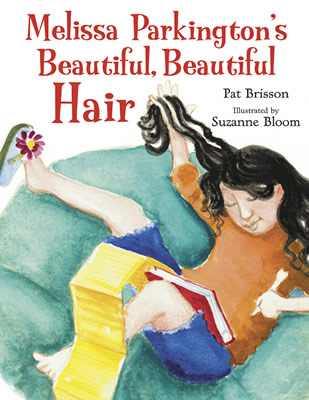
We have been talking a lot lately about qualities we respect – in our friends, in our classmates, in ourselves. Today we read a fantastic picture book written by Pat Brisson and illustrated by Suzanne Bloom. Melissa Parkington’s Beautiful, Beautiful Hair inspired us to talk about the qualities in ourselves that are really important. Who do we want to be? What do we want to be known for?

melissa-parkington1

Melissa Parkington has always been recognized for her gorgeous hair. However, she begins to recognize that she doesn’t want to be recognized for something that just simply grows out of her head. What is really special about her?

This book really affected us! Some beautiful writing below helps tell the story:

Annie: Melissa Parkington had beautiful beautiful hair. Everyone around the neighbourhood noticed her hair. But Melissa wanted people to like her for what she did.

Jenny: A lot of people called Melissa’s beautiful hair gorgeous and stunning and then she thought that she doesn’t want people to just call to her – your hair is beautiful . . . she wants people to compliment her for what she does. She helped Maddy and Jake on something and someone said to her – you are nice. So she thought – I can be a nice girl.

Jena: She decided to be the kindest girl in the whole town and she helped a lot of people. At the mall, there was a beauty salon and it said share your hair. And Melissa cut her hair for children who didn’t have hair.

Gary: She decided to donate her hair to kids. So the lady washed her hair and put it on ponytails and started cutting it and put it in envelopes. Now she is known as beautiful heart.

In the end – Melissa’s father changes the way he says goodnight to her. He now says. “Goodnight Melissa of the beautiful, beautiful heart.”

What a wonderful story of generosity, kindness and recognition of true inner beauty.

Let’s Do Nothing . . . (but read?)

Favourite books I found at VPL today. The public library is a perfect place to hide out with one (frozen) child while the other plays soccer (in this snow!!? Only in Vancouver!) What did we find?

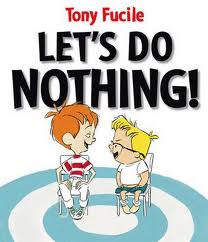
Animator Tony Fucile’s first picture book Let’s Do Nothing has a very alluring title. Nothing? Ah, such a comforting idea after a busy, busy week.

Frankie and Sal are two bored boys. What to do? How about nothing? Great idea! They each sit in a chair committed to exactly that – the act of doing nothing. But, how possible is it?  I read this to my son who hooted at Frankie’s hopeless attempts at doing nothing as his overactive imagination always caused him to do something. (There’s a part about a tree and a dog with a raised leg . . . that was absolutely hilarious to him)  Can’t wait to try this book out on my class. Will they think it is impossible to do nothing? We practice mindful breathing three times a day. Is breathing something or does it count as nothing?  This will be an interesting conversation . . .

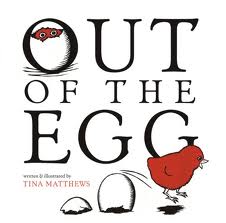
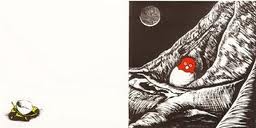
Tina Matthews is the author and illustrator of Out of the Egg, the Little Red Hen story – reinvented. We still have all of our “Not I” animals, too busy being lazy to help out. But in this story our Little Red Hen not only plants and nurtures a beautiful shade giving tree, she also has a lovely little chick hatched out of a perfect white egg.

Out of the egg hatched a little red chick.

And this little chick has something new to offer the story – a dose of forgiveness. My daughter read the book and announced to me, “I thought this was going to be a what comes around, goes around story, but the little chick didn’t let it be.”

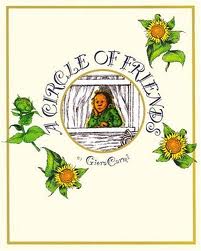
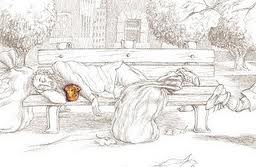
Giora Carmi made a beautiful book – A Circle of Friends – all the more powerful in its simplicity because it is wordless. A little boy shares his snack with a homeless man sleeping on a park bench.

A shared snack for someone who might need it

The man sprinkles crumbs on the bench for the birds nesting in the tree above him. In the end, the little baby bird drops a seed in the window box of the boy. And soon, a beautiful sunflower grows. Each page is sketched in black and white with one highlight of colour.  All about the circle of kindness inspired from one gesture. My daughter commented, “Mama, this is also a what comes around, goes around book, but in a nice way.” Absolutely!

Happy Reading!