Lots and lots of birds . . .

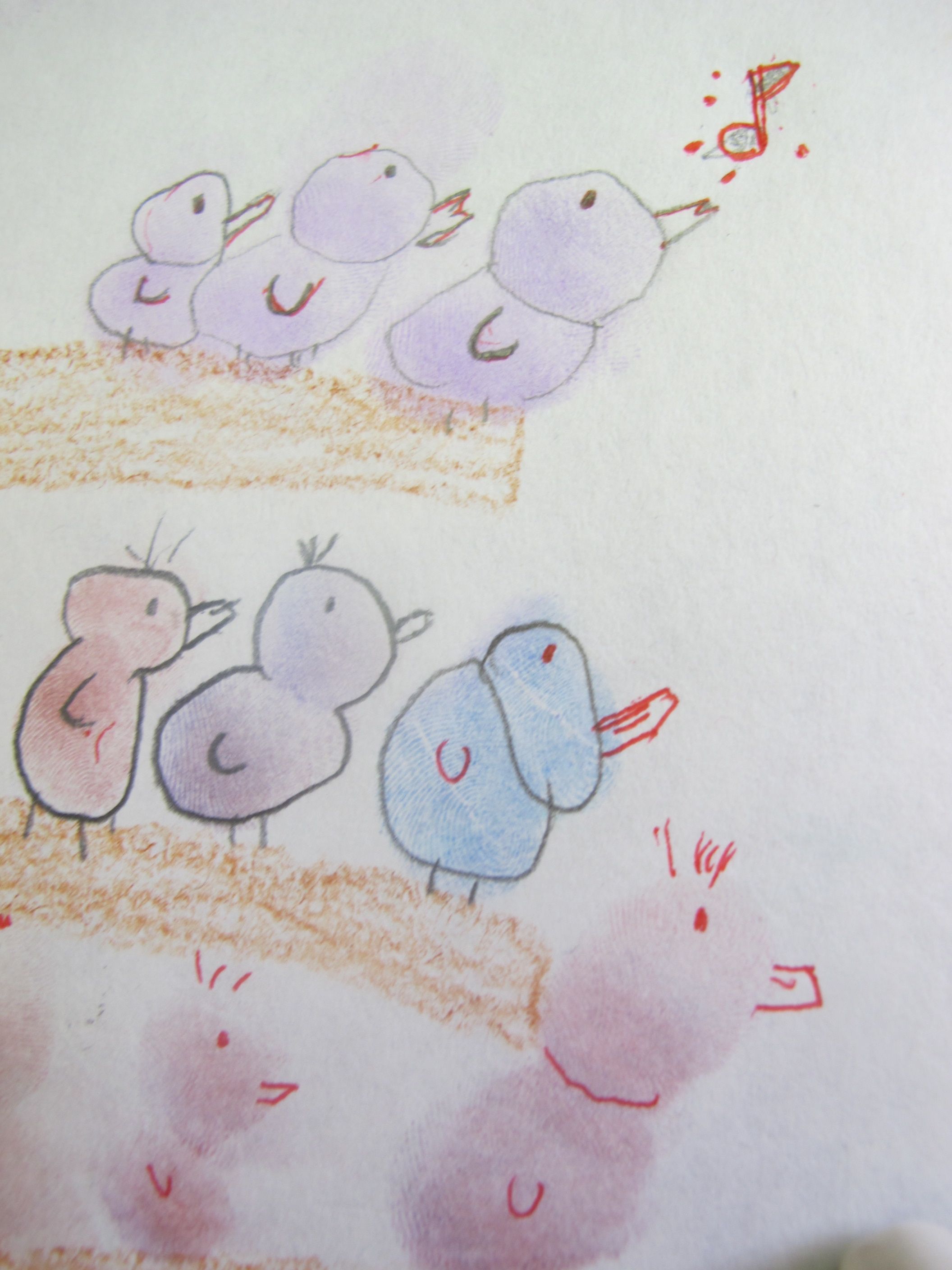
Because we are studying birds, because I happened upon Ed Emberley’s Fingerprint book on my shelf, because we have been talking about estimation in math . . .

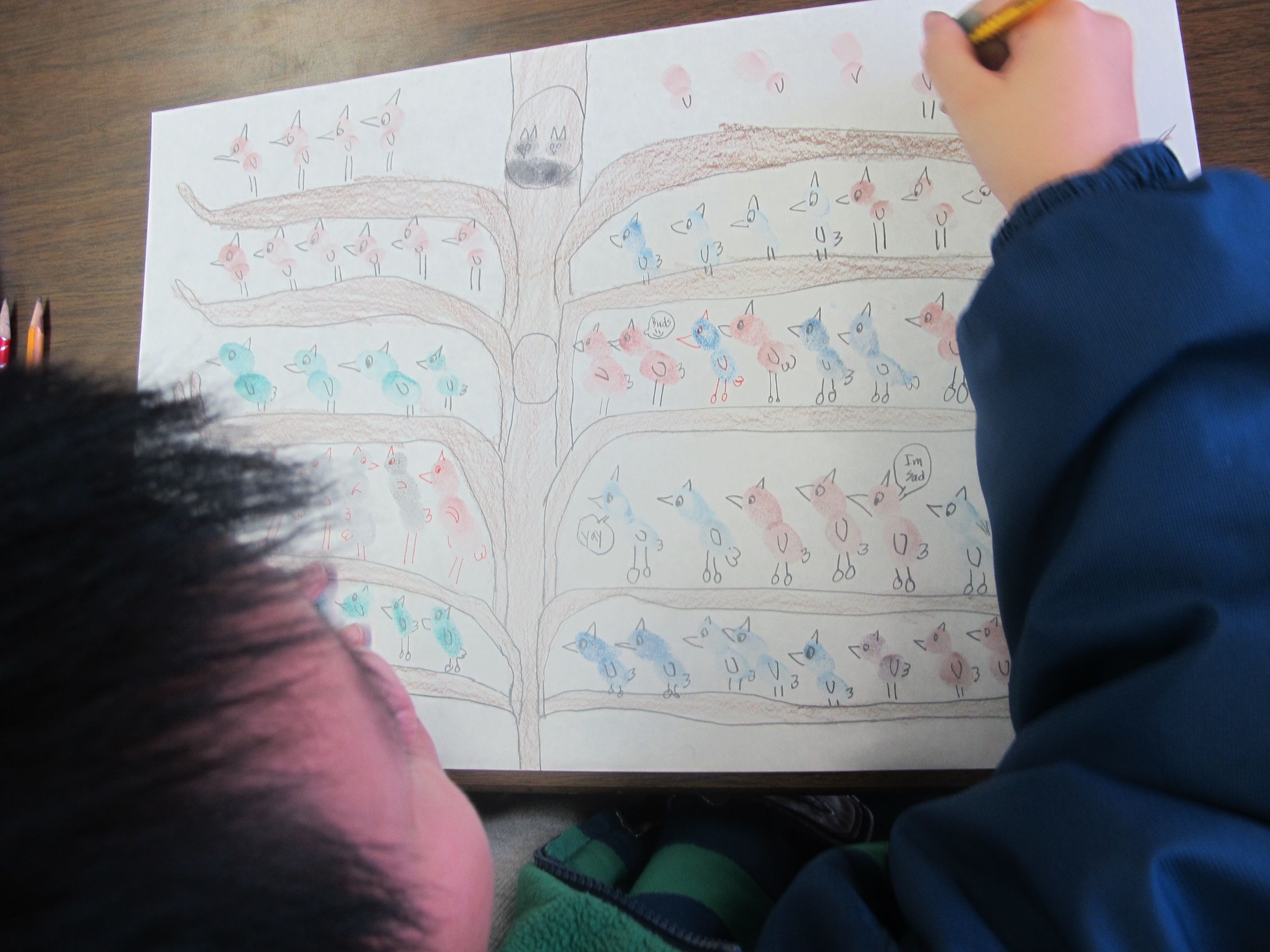
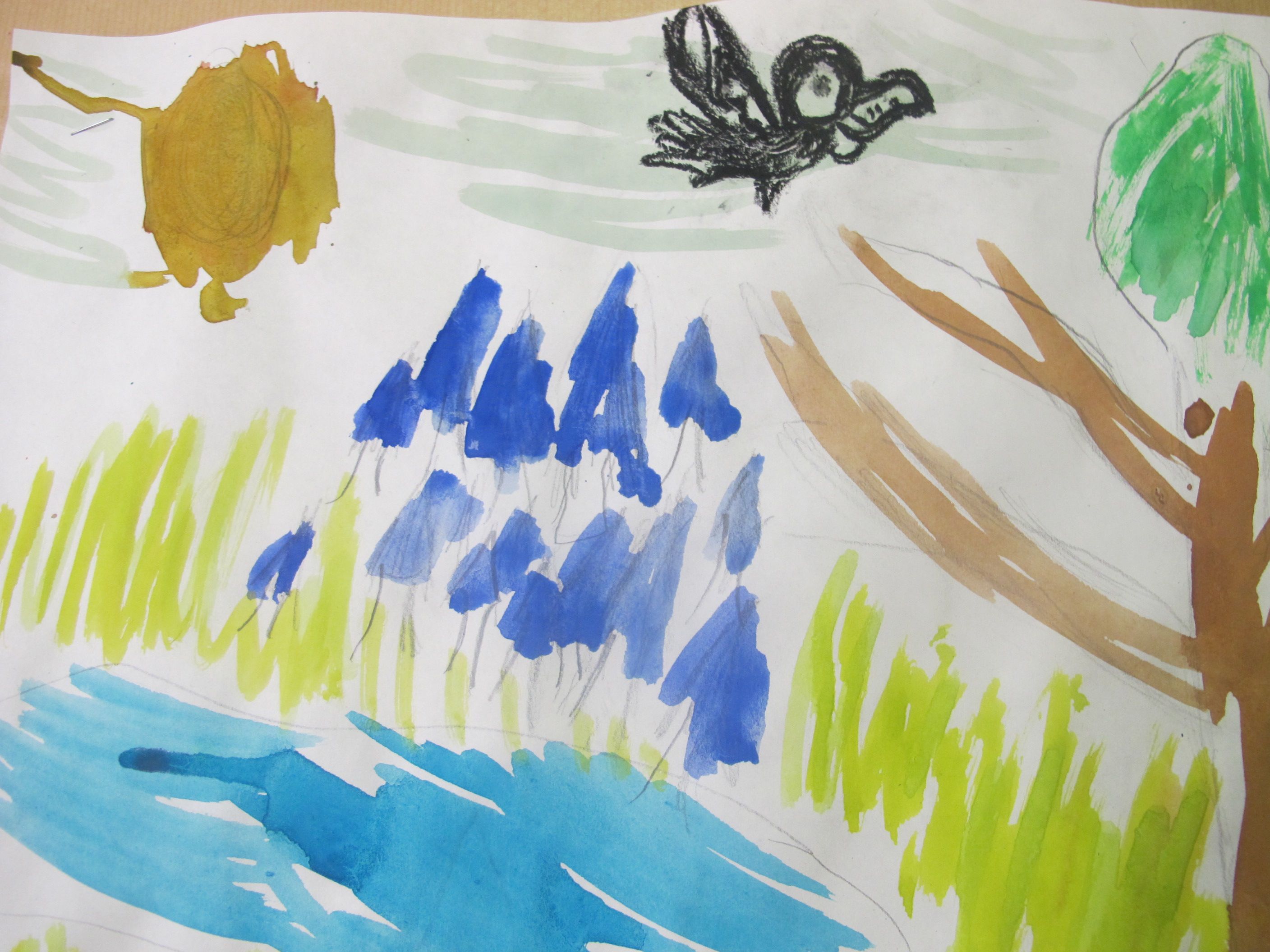
This fun art activity happened. . . Make a picture with a whole bunch of birds (know how many there are please) and the rest of us can admire the creativity of your picture and . . . practice our estimation skills. Just how many birds are there?

Markus made a beautiful picture of some very social birds hanging out together.

IMG_2370

Lots of fun details in Truman‘s piece.

IMG_2377

Beautiful colours as Raelyn builds a page of birds. “Tweet, tweet”

IMG_2378

Khai filled many branches of a tree with birds – really tested our estimation abilities!

IMG_2381

More detailed birds from Hailey.

IMG_2383

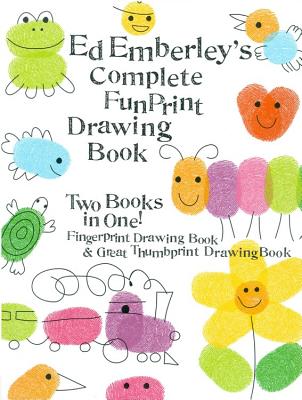
Thanks for the inspiration: Ed Emberley’s Complete FunPrint Drawing Book


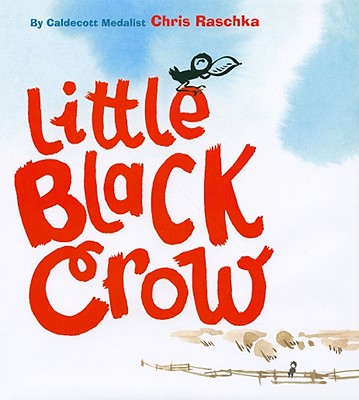
Little Black Crow

We were very inspired by the gentle repetitive text and muted art in Chris Raschka‘s book Little Black Crow. This book begins with the question Little Black Crow, Where do you Go? and goes on to ask 26 more questions all inspired by the wondering of a little boy who spies a crow up in the sky. Simple, engaging, lovely to read again and again.

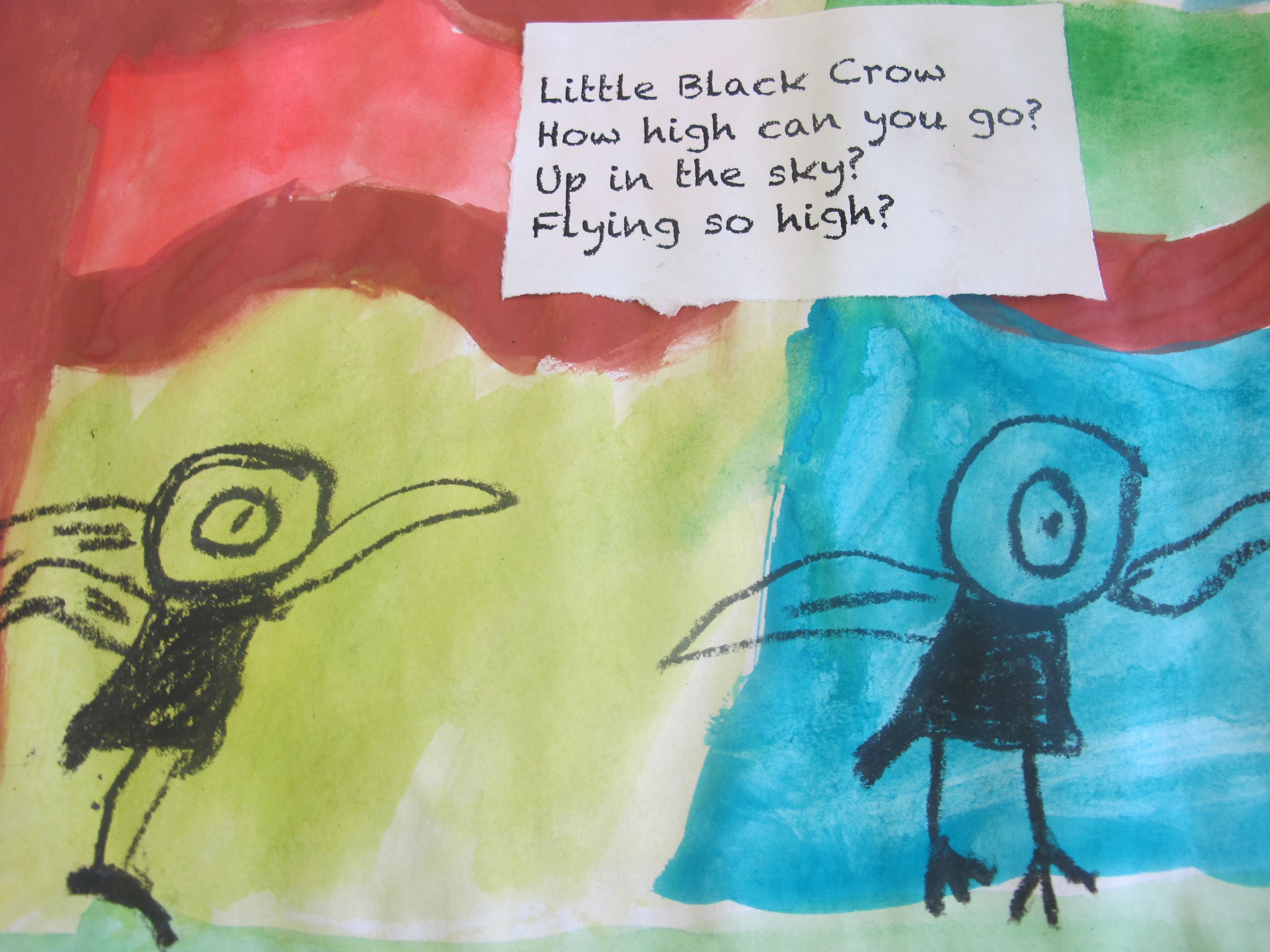
We took pencil to paper and practiced making crows in Raschka’s style and went on to create art pieces and added our own “mini poems” also borrowed from Rashka’s style of wondering verse. Finished pieces look gorgeous.

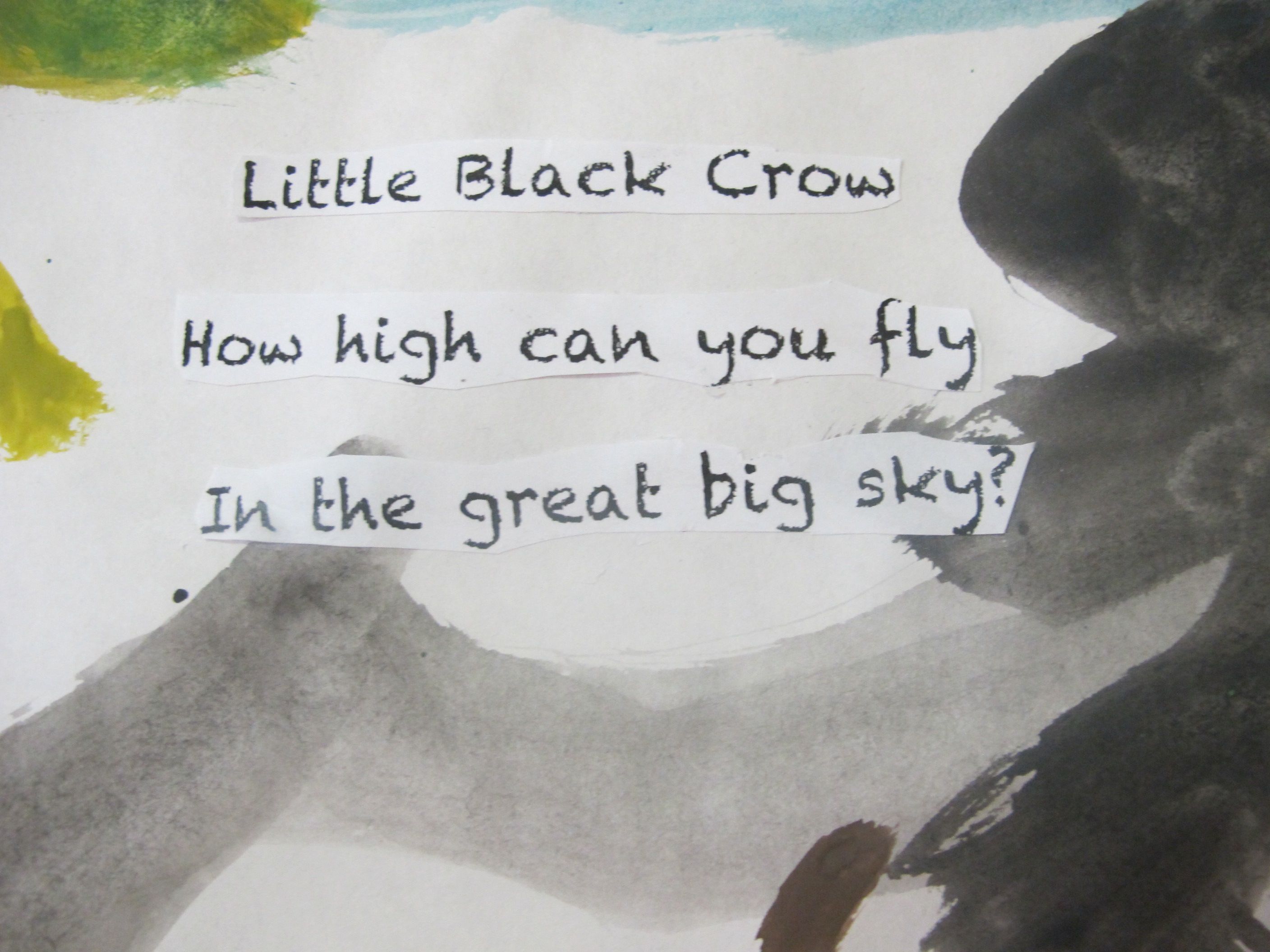
Below is Sergio‘s poem.

IMG_2273

Some students, like Khai, chose to use bright colours as a background.

IMG_2255

Others were inspired by the paler colour scheme Raschka used in his book.

IMG_2278

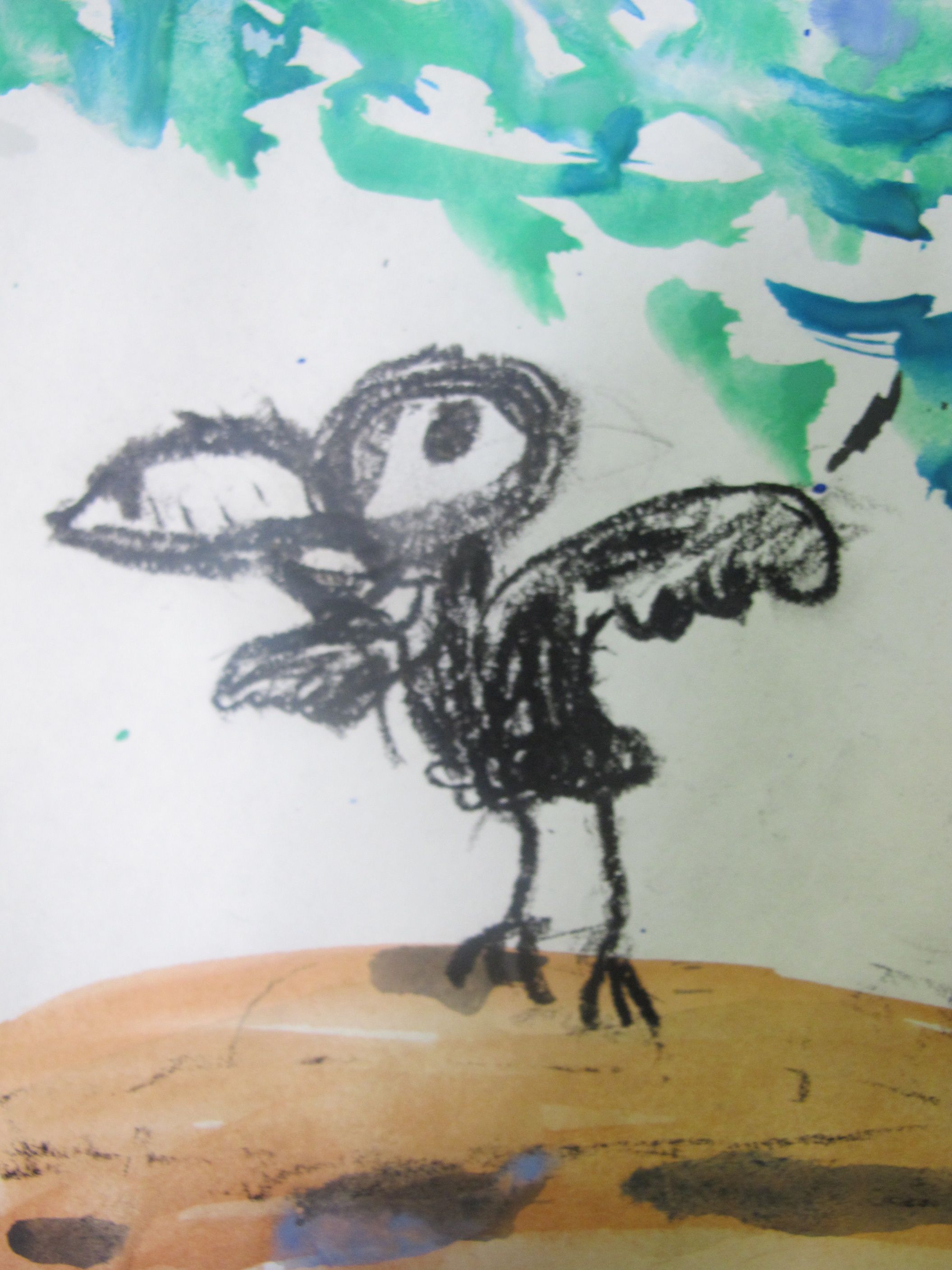
Truman really captured the loose lines that come together to create a charming crow in Raschka’s style.

IMG_2276

Tickle Trunk Players – Mask Making Workshop

On Tuesday, December 13th, the Tickle Trunk Players came to Seymour school and put on an afternoon performance. Wonderful!

Students in Division 5 were very fortunate to participate in a mask making workshop in the morning. Such success!

First, students learned about shapes that are frequently used in First Nations masks. Khai actually made a picture out of all of his shapes.

IMG_1956

Then students chose either a bear, a wolf or a raven shape to make a mask.

IMG_1982

Masks were striking keeping to just the colours of white, red and black.

IMG_1966

This wolf mask was very detailed.

IMG_1990

In animal groups, students were able to move to the beat of the drum around the room. But we did come together for a group photo!

IMG_2002

Thanks to Christine, our workshop leader! Such a positive experience for the children!

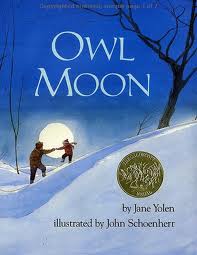
Owl Moon and inspired Owl Artists

One of my favourite books to read aloud in the cold dark days leading up to winter is Owl Moon, the 1988 Caldecott Medal winner written by Jane Yolen and illustrated by John Schoenherr. This book fits in with our theme of Courage that we are exploring through various picture books but also allowed us to have a wonderful springboard for some gorgeous owl art.

A little girl goes owling with her father for the very first time and we, the readers, get to creep along with this pair over hard packed snow illuminated by the moon. We breathe the cold air, feel our own cheeks burn and marvel at the wonderful sound of crying out “Whoo-whoo-whowho-who-whoooo,” and then feeling the silence (heavy and full of wonder) surround us. Yolen’s text is poetic and the illustrations magical. A treat for the senses! When an owl is finally discovered, all of us gasped at the huge wing span and bright yellow eyes depicted in the pictures. A gorgeous book and one I never tire of reading with a class.

We discussed why the little girl in the picture was so courageous even though she was out on a dark night deep in the forest. Some insightful suggestions from the group:

  • She was too excited to feel fear
  • Being with her Dad made her feel safe and secure
  • Watching and listening for the owl distracted her
  • She pushed her fear away because she was doing something (going owling) that she had been waiting a long time to do

After the story, Ms. Gelson led a mini “how to draw an owl” lesson inspired by this wonderful blog post from Art Lessons for Kids.

And wow, did students get engaged with making beautiful owl scenes to fill up our room!

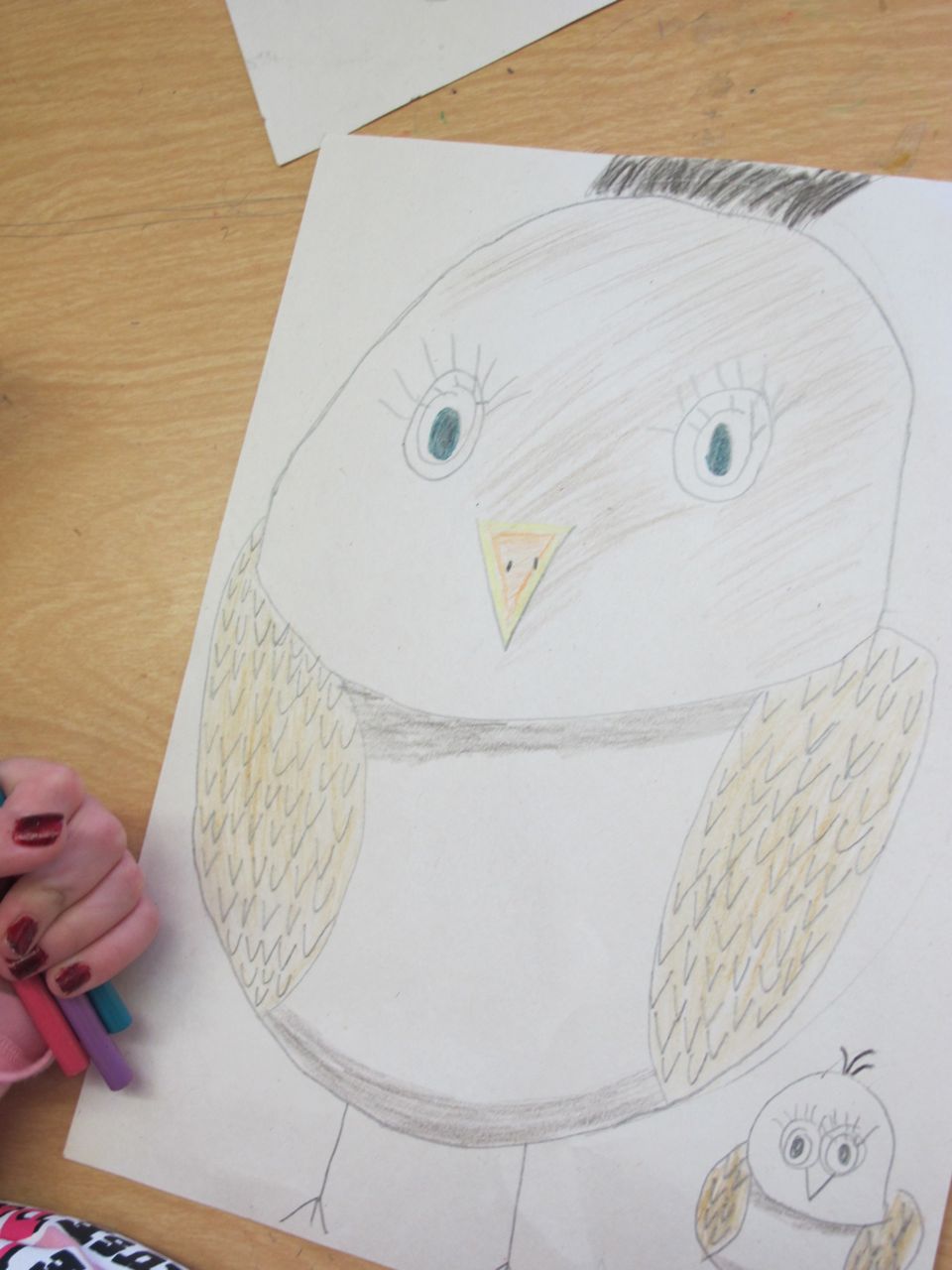
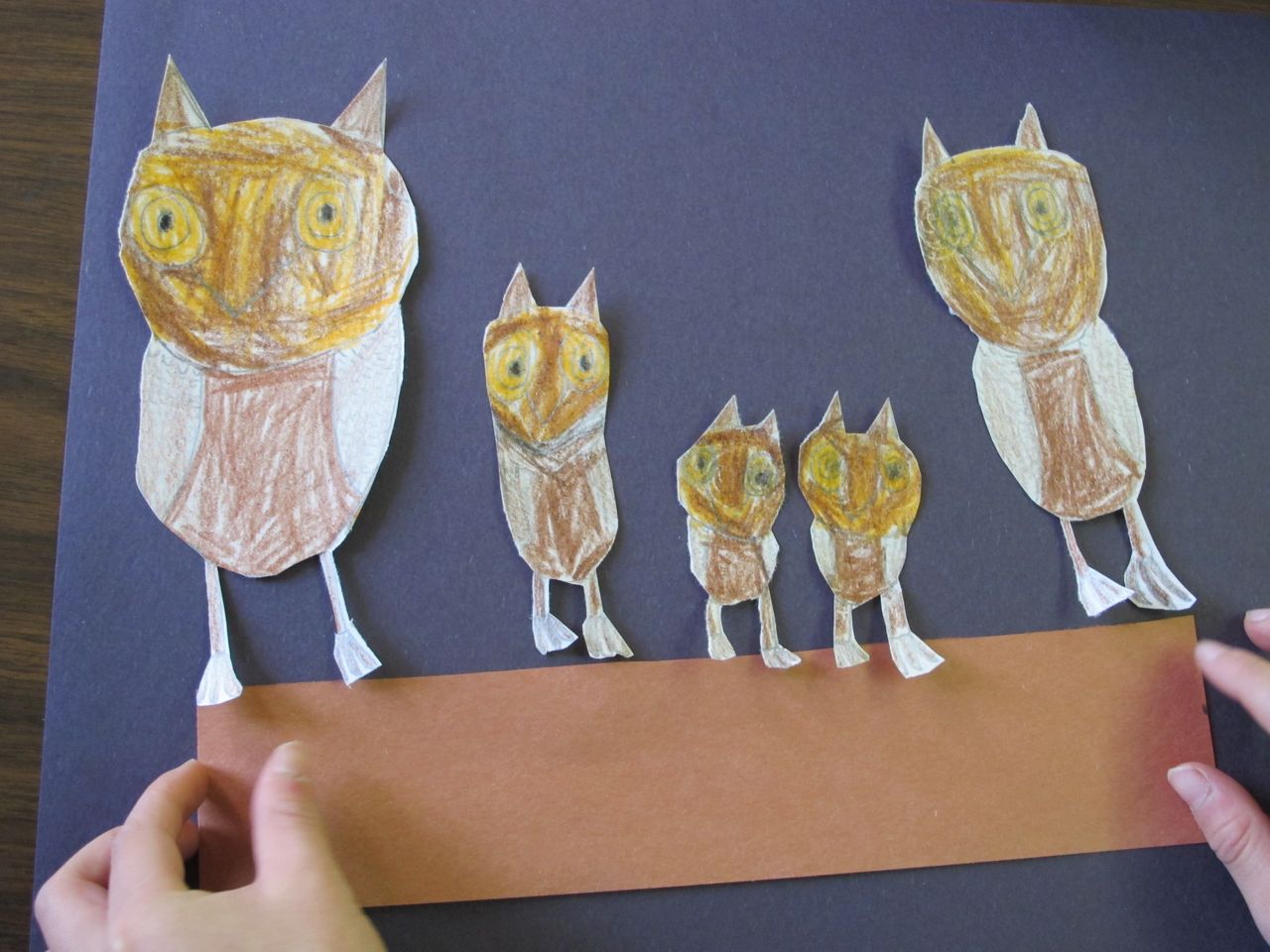
First we drew owls on plain paper and added details and colour. Hailey did a lovely job of filling up her whole page with an adorable looking owl and baby.

IMG_1658

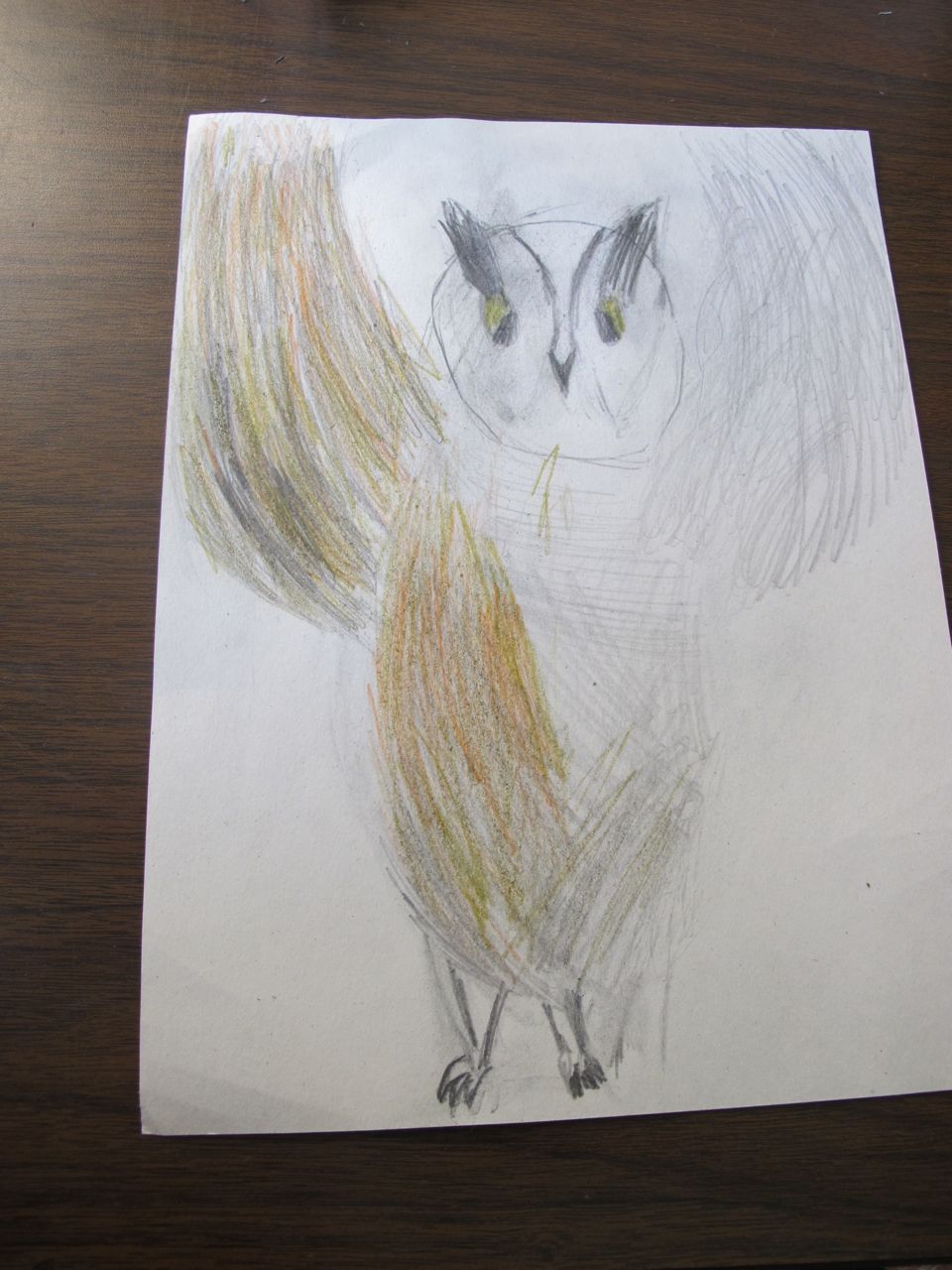
Catriona drew her owl in flight!

IMG_1655

Some owls seemed to be waiting to jump into a picture book as the main character of an exciting story. Purity‘s owl is very dramatic.

IMG_1662

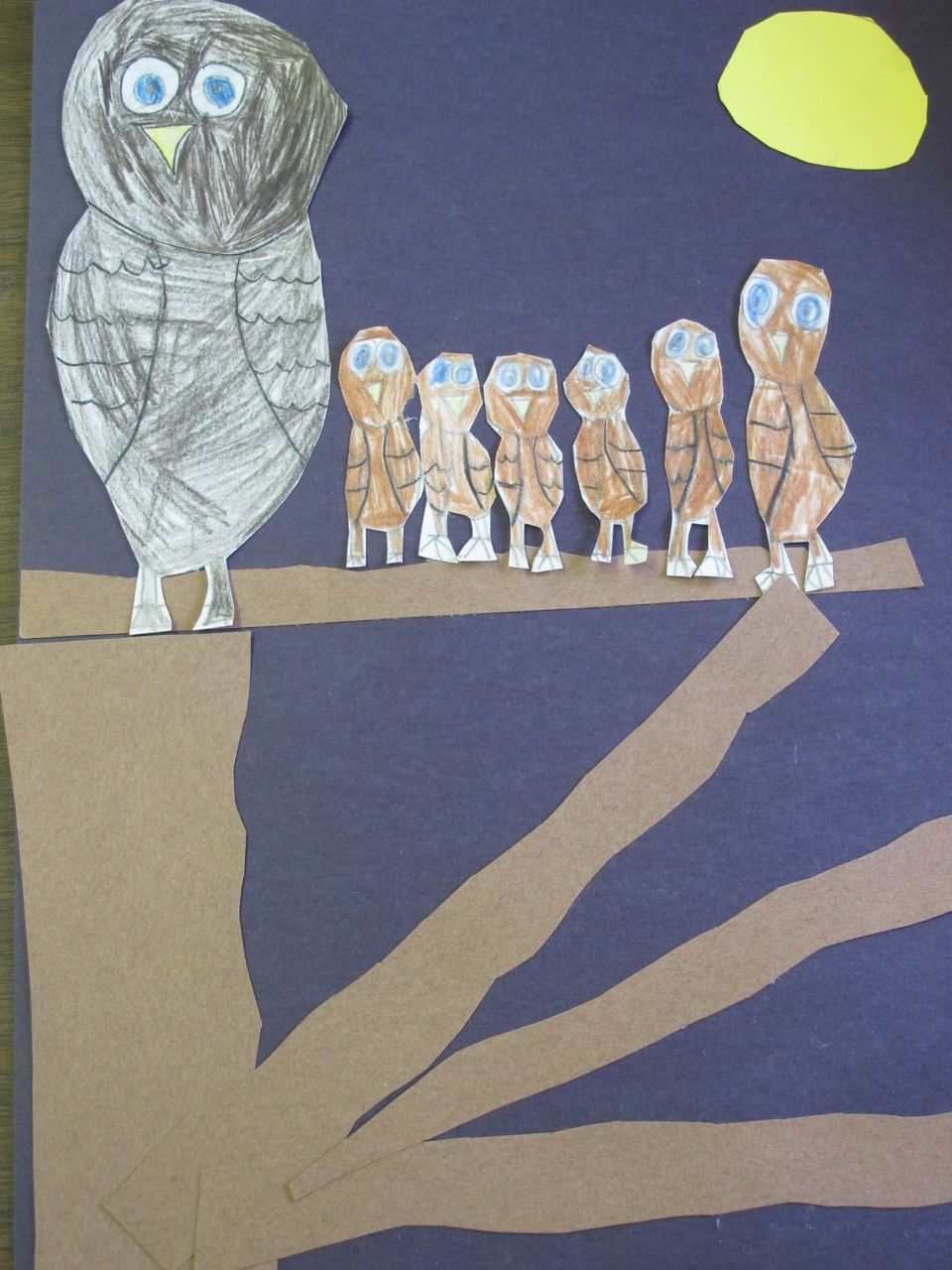
Students then cut out their owl (s) and glued them to black paper making a scene. Khai made a whole family of owls perched on a branch.

IMG_1657

Carefully positioning owls on the page.

IMG_1660

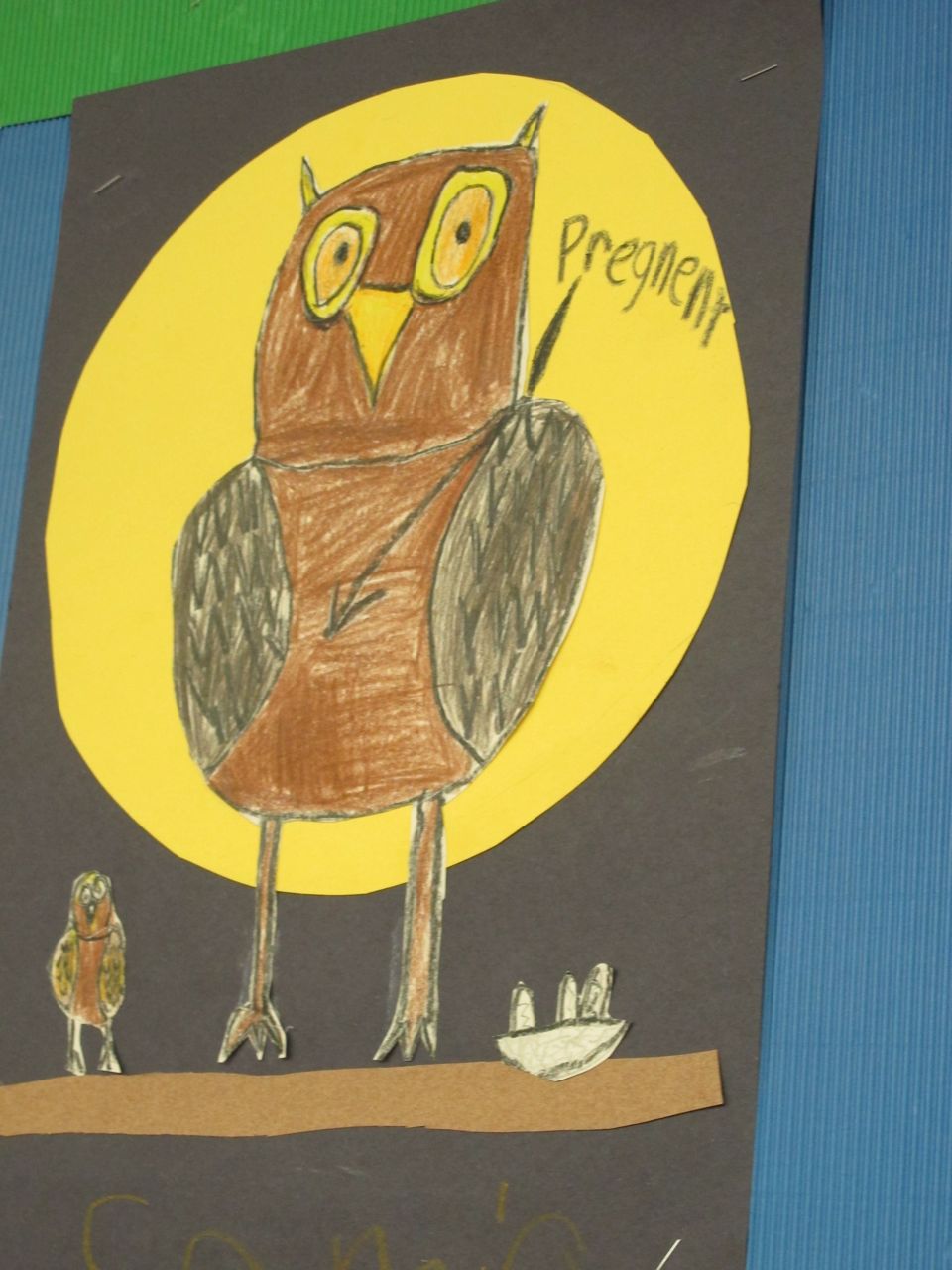
Sergio was very clear that his owl was pregnant and put an awaiting nest on the branch. Many debates began whether an owl could be pregnant if it lay eggs. Some people thought an owl should be called “ready to lay eggs” and not pregnant. Sergio made it clear he liked his idea best and made a label on his picture pointing to the owl’s belly “pregnent” 🙂

IMG_1666

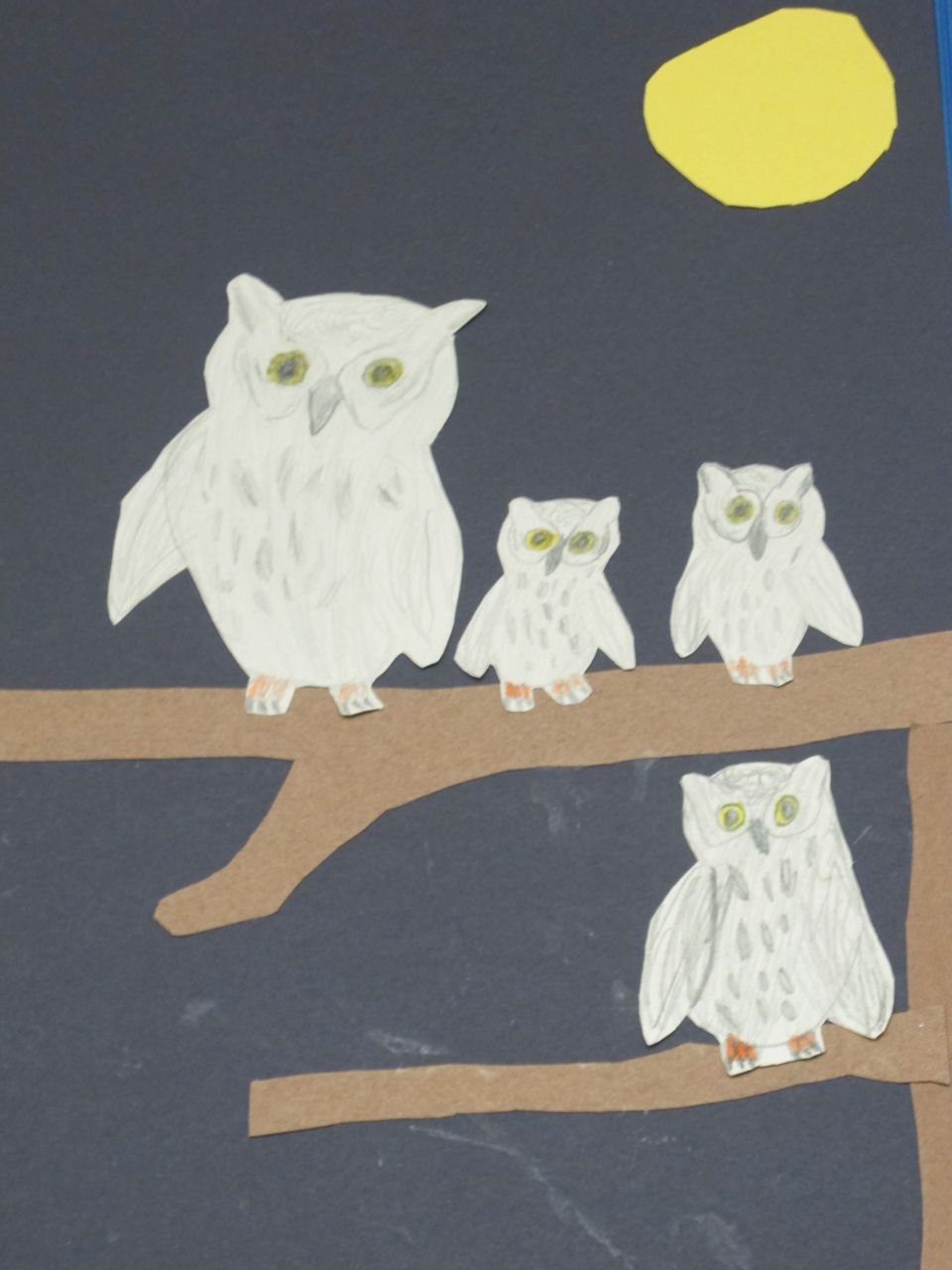
Truman made lightly grey owls with beautiful ear tufts. Striking against the black background and yellow moon.

IMG_1663

Cowboy hats and Country dancing!

We knew a big party was coming! So we started getting ready!

Decorating hats

A fun afternoon of decorating hats got us into the mood for talking about cowboys, country music, horseback riding and just what happens at the Grey Cup anyway . . .

Decorating Extravaganza!

Many of us added our names and walked around the room admiring how we all looked in our fancy hats.

Some of us are extra cool!

But who could have predicted this?

Grey-Cup-Dancing

Thanks to the Calgary Grey Cup Committee for bringing us a party we won’t soon forget! The band High Steppin’ Daddy had everyone kicking up their heels and twirling with our guests including Charlie Horse who managed to not step on any toes! Read Janet Steffenhagen‘s story in the Vancouver Sun  here. Photos by Ward Perrin.

via Vancouver Sun

via Vancouver Sun

Georgia O’Keefe inspired art

Oh the beautiful flowers Georgia O’Keefe painted. Her images and some flowers from the garden inspired these gorgeous oil and chalk pastel pieces. Inspiration also came from this amazing blog.

We brainstormed what we noticed about Georgia O’Keefe’s work:

  • huge, magnified flowers
  • bright colours
  • petals that travelled off the page
  • curvy lines that gave depth to the paintings
  • a feeling of movement

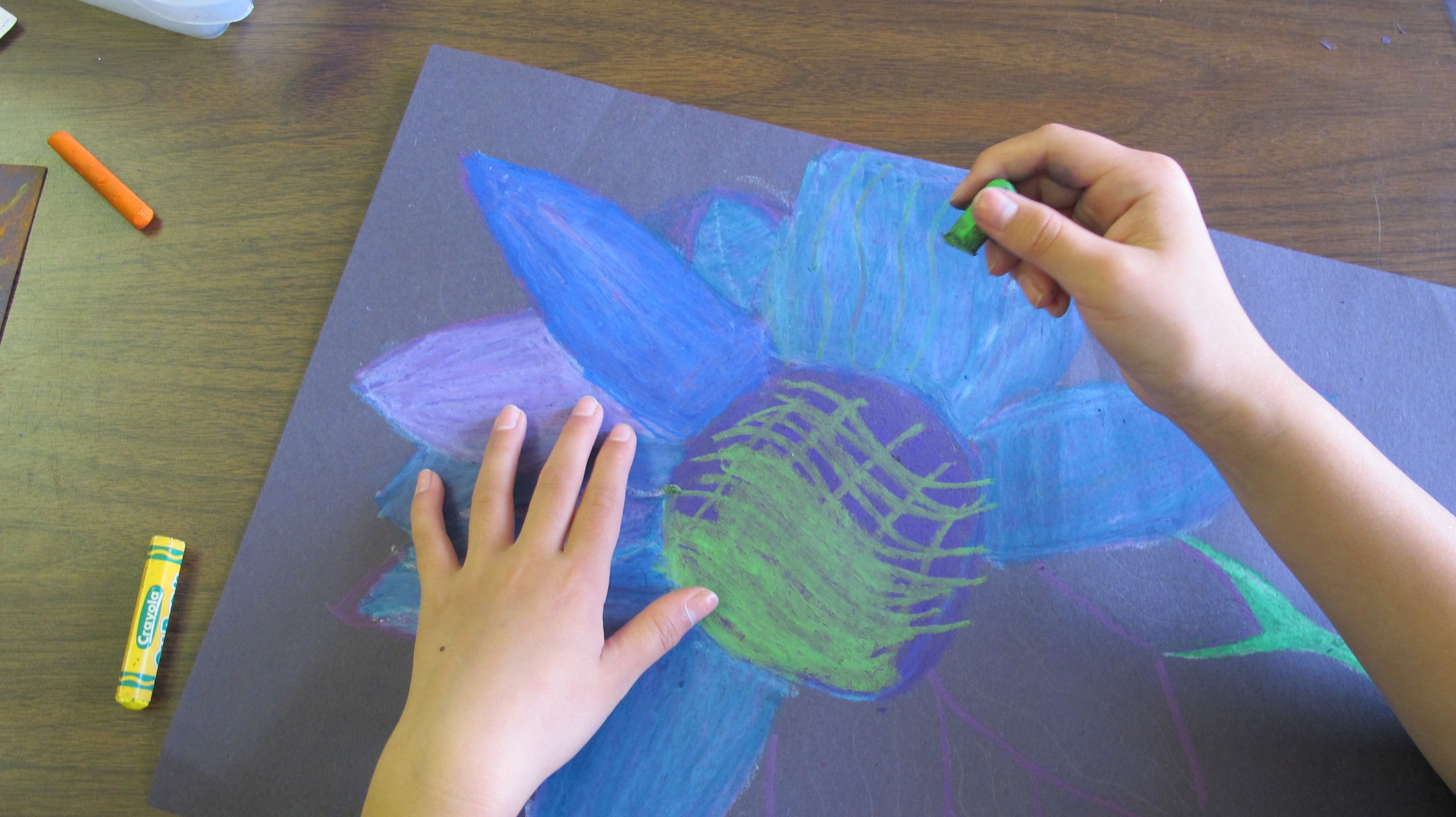
We drew first in pencil and then started using pastel to create our outlines.

Here are the beginning stages of our work.

IMG_0985


IMG_1006


IMG_1007


IMG_1046


Students then began to blend and layer colour.

IMG_1047


IMG_1049

IMG_1056

Then we thought about our background – some students used chalk pastel to make their flowers stand out more.

IMG_1118

Some finished (or nearly) pieces.

IMG_1110


IMG_1115


IMG_1052

Come see our gallery of flowers posted outside of the classroom!

Rocket Art (Finished Pieces)

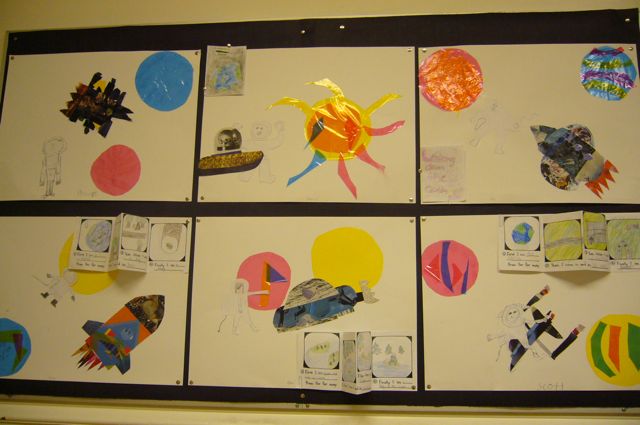
Ms. Chen has posted our finished Rocket Art pieces in the classroom and on the bulletin boards which surround our classroom. Displayed all together, they look amazing! If you haven’t seen our work in process, read more about how these pieces were created here.

P1020879

This week students were able to complete fold out panels about looking back to Earth. Ms. Chen used Steve Jenkins’ book Looking Down to illustrate zooming in to a specific object – from looking at Earth and then zooming in possibly to a specific street, then maybe a particular house and then finally to a single window within the house.

This is such a fantastic book to illustrate zooming in on a particular object – first from far away and then getting closer and closer.

A very interesting journey in looking at the world from a different perspective.

Closer and closer and close

Read about how this book was conceived on Steve Jenkins’ site.

What is amazing about this book is that it is “told” strictly through visual images – as a wordless picture book.

P1020882This is Jena‘s art. Now in addition to her rocket ship, planets and drifting astronaut, she has attached her mini fold out book which depicts looking back to the Earth.

First she drew a portion of the Earth – oceans and land covered by forest. In the subsequent drawings she zooms closer and closer into the forest scene.

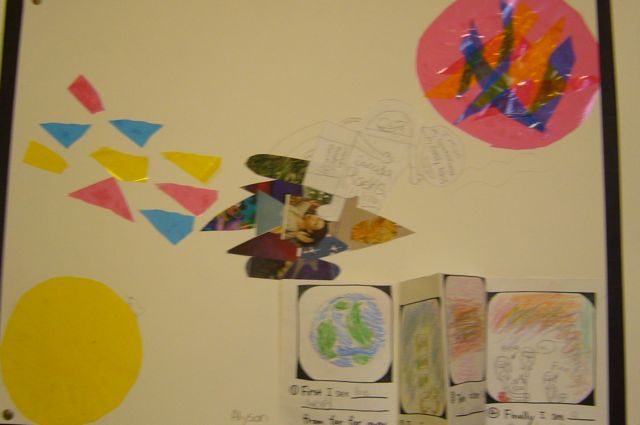
P1020883Here is Alyson’s completed work. We loved how she used the cellophane to represent the emissions coming from her rocket as it zoomed through space.

Her mini booklet zooms in to a single room in her building.

Such a colourful piece!

P1020886Hailey isn’t quite finished her mini zoom in booklet but her art so far, is wonderful.

Her astronaut’s suit is extremely detailed and she was able to create a very efective planet by layering her cellophane pieces.

Beautiful.

Such a fun and successful project. Thank-you Ms. Chen!

Off on a rocket ship!

Our class has been working with Ms. Linda Chen, a student teacher from UBC on a multi-step art project and we are almost finished!

By the end of the week, we hope to have our finished pieces hanging up in our classroom and on outside bulletin boards. But for now, a sneak peek!

Students made collage rockets, drew astronauts and today worked on the composition of their pieces – placing rocket and astronaut in a space scene along with planets. Such fun!

Inspired by some images from this book: Joey and Jet in Space by James Yang.

joeyandjetinspace

Check out our room today!

P1020843Bird’s Eye view of a table busy creating!

Students are placing rocket ships in specific places on their page, thinking about where to put the astronaut and how they want to organize the planets in their space scene.

Everyone was on task and engaged!

If you look closely at the bottom left hand corner of the picture below, you can see that Eddy has placed his astronaut astride his rocket.

Talk about riding a rocket to the moon!

P1020847

Students are using colourful planets cut from cellophane. Very effective!

Ms. Chen cut scraps of cellophane for students to use to decorate. She did a mini lesson on colour theory and had the students think about how the colours placed together might mix.

Some students used the pieces to decorate a planet. Others used the pieces to create a feeling of movement in space or as gasses or dust floating around the planets.

P1020871

We were pleasantly surprised at how unique each piece was!

Students loved working with such bright colours.

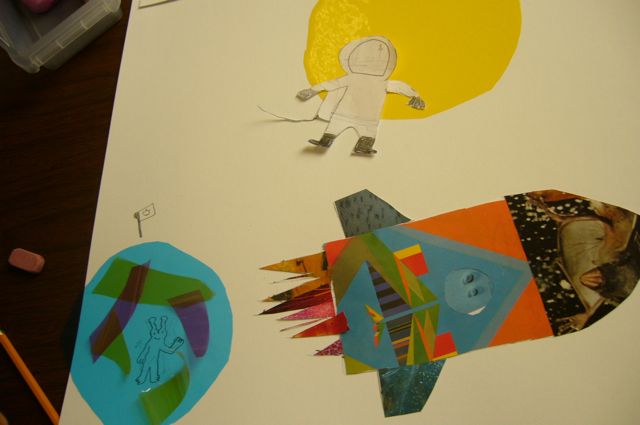
Here is a piece where you can see the details of the rocket made using a collage of magazine images. The rockets are all absolutely gorgeous!

In this image the lone astronaut floats next to a planet as the rocket zooms by. An alien seems to be peeking at us from the blue swirly planet.

P1020861

Keep checking for our finished pieces!

It’s all about the Book

Recently we read Emily’s Art written and illustrated by Peter Catalanotto and he invited the students to send him some art. Well . . . Emily’s Art was such a special book that we wanted to “gift” Peter with something special in return. His paintings are truly majestic and we wanted to make something that might make him have a bit of that “glowy” feeling that he inspires in us as we look at his illustrations.

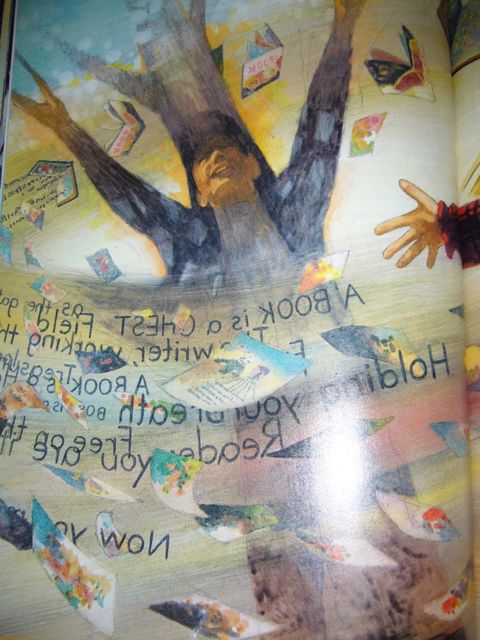
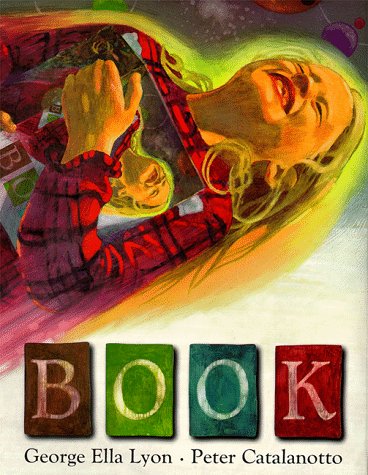
At the library, I found a copy of Book written by George Ella Lyon and illustrated by Peter Catalanotto. Sadly, this gorgeous book is out of print so we were lucky the VPL had a copy! Book is an ode to the magic and power of books. Lyon’s words and Catalanotto’s pictures invite us to escape to the magical place books transport us to simply by opening up the cover and stepping in . . .
book

We read this book a few times, marvelling at the images and savouring the words. We were delighted by the whirling words interacting with the images.  Students then wrote about what reading means to them.
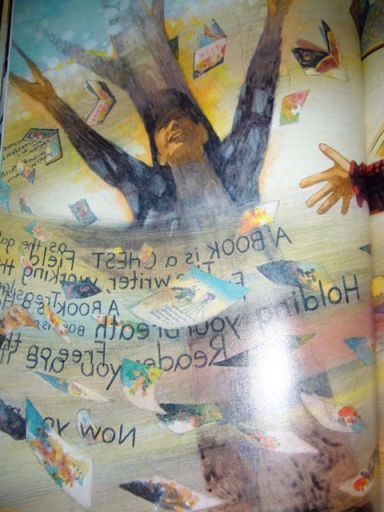
P1020560The next day, inspired by this image (left) in particular, we started creating images.

While the students worked, I called each child up and we looked at their personal writing – selecting a line or a few lines that really captured their relationship to reading.

I typed up the text and then students added their text to their art in a variety of ways – inviting our viewers to celebrate reading, language and learning with us! Framed pieces are on display in the main office and in the library. Enjoy!

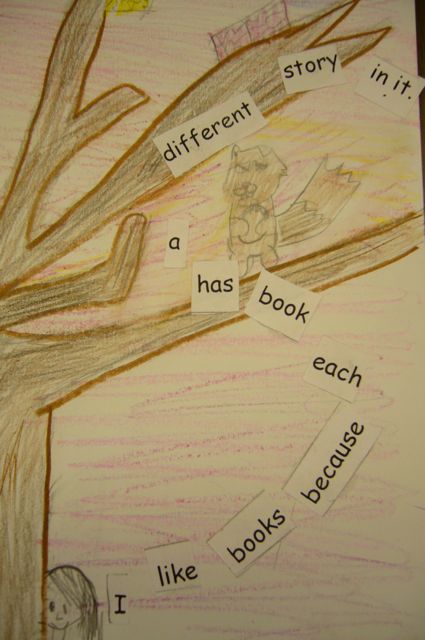
Lisa shared her feelings about books: I like books because each book has a different story in it.
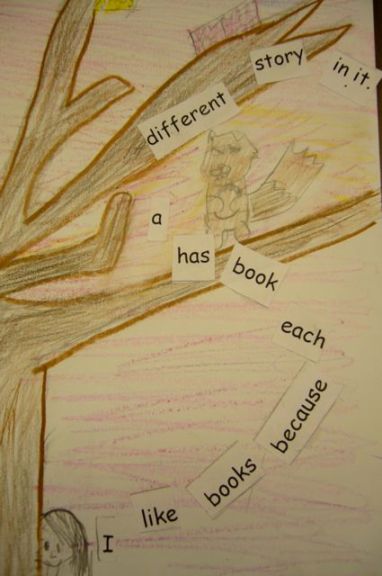
Lisa's work

Many students wrote about the way reading makes them feel. Gary wrote: Reading is fun and calm. When I read, I visualize the pictures.

Kevin shared: “If you get really into the book, you might even dream about it. When my Mom and my teachers read to me, I feel relaxed and happy.”

Alyson is passionate on the subject! “Books change the world and books change us.”

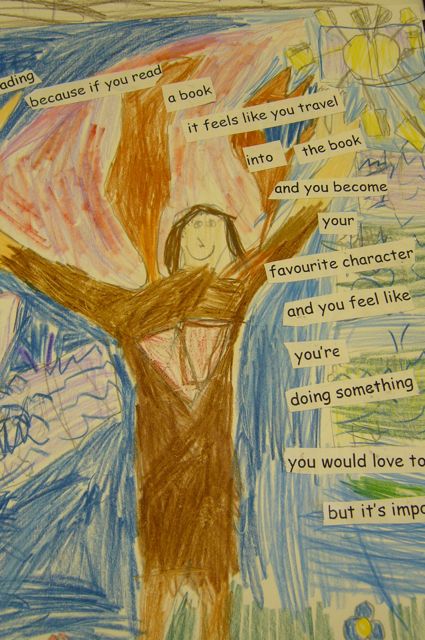
Catriona writes: “I like reading because if you read a book, it feels like you travel into the book and you become your favourite character and you feel like you’re doing something you would love to do but it’s impossible.”

Catriona's piece

Sigh 🙂 Is that not beautiful? And if you look closely at Catriona’s picture, you might notice that she has a book heart.

Josiah shared: “I like reading because I learn new words. I get all emotional when it’s exciting.”

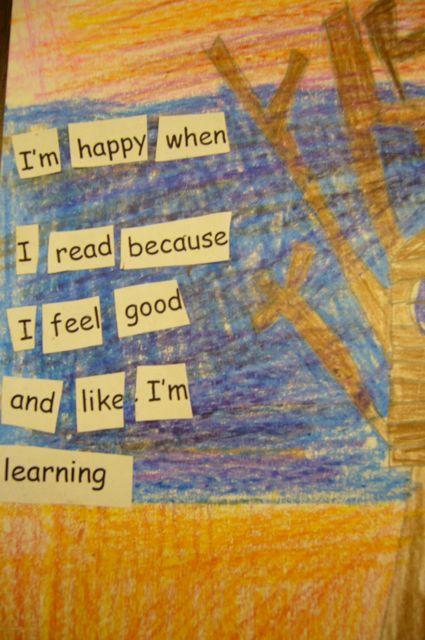
Eddy‘s picture is beautiful and bright and features a tree house up in a tree. He writes: “I’m happy when I read because I feel good and like I’m learning.”

Eddy's words

Learning while we read was a big theme! Jenifer says, “Books are telling things that we can learn.”

Jeremiah shares:” I like reading because it makes you learn stuff you need to learn. When I read, it feels like I’m in it.”

Sergio lays it out like only he can! “You know why I like reading? Because I will be smarter. And you know why I like being read to? Because the people that read to me, they will be smart like me.”

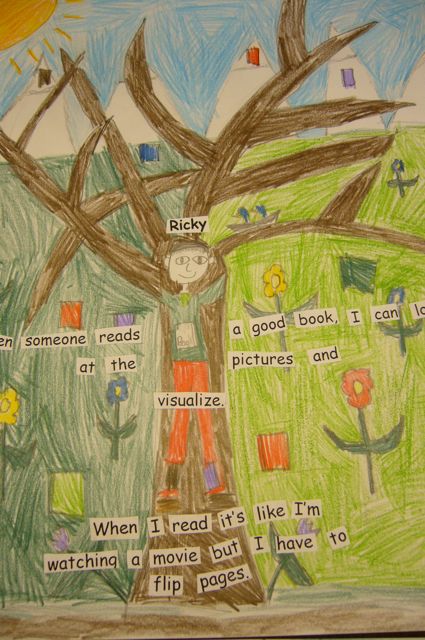
Ricky states: “When I read it’s like I’m watching a movie but I have to flip pages. When someone reads a good book, I can look at the pictures and visualize.”
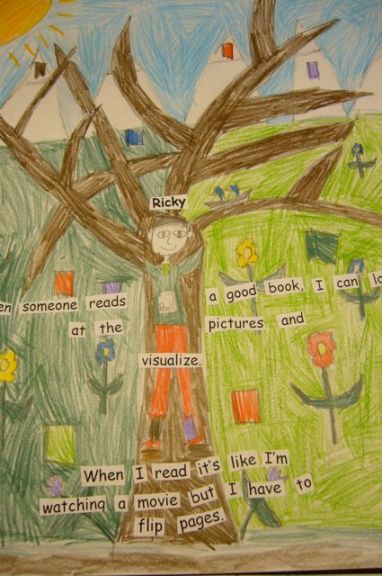
Ricky's work

Many children wrote about how they love being read to. Always, read aloud times throughout the day are a time to connect, learn and discuss themes and concepts from the books we read.

Hajhare shares: “I like getting read to because the teacher always uses expressions and they talk kinda funny.”

Scott agrees. “I like when someone is reading to me because I could learn more stuff. It feels exciting.”

Truman drew himself happily celebrating reading.

“When someone reads to me, I feel like in the book.”

Truman's piece

This was a common theme.

Annie writes: “Books make you feel like you’re actually inside the book. I like books because they teach you things that you want to learn.”

Jenny’s thoughts are lovely. “Books are my friends and books are like alive to me. Looking at the illustrations gets me ideas.”

This was such an enjoyable way for our reading group to celebrate our relationship to books and reading.

Inspired by Book!

Copies of these gorgeous pieces are on their way to Peter Catalanotto as thanks for the inspiration!

Jena’s words are very special and capture the feeling of the cover image of Book.

“I like reading because I get to think of mystical things. When I finish the book and I like it so much I hold on to it and if it’s really emotional my eyes start to water.”

Crocodile Safari Take 2

We finished reading Jim Arnosky’s Crocodile Safari today.

Some interesting things we learned?

crocodile safari

  • Crocodiles are not the only dangerous things in the mangrove swamp. Also beware of diamondback rattle snakes and poisonwood trees
  • Those large jaws are full of teeth! Humans have 28-32 teeth but crocs have 80 to 120 teeth!
  • Toothless crocodiles exist but still beware! These crocodiles still have powerful jaws that can crush bones!
  • Crocodiles can be huge! In the U.S.A. they might be up to 15 feet (almost 5 m) long but in Madagascar there are crocodiles up to 30 feet (over 9 m) long! These are the largest living reptiles in the world. Wow!

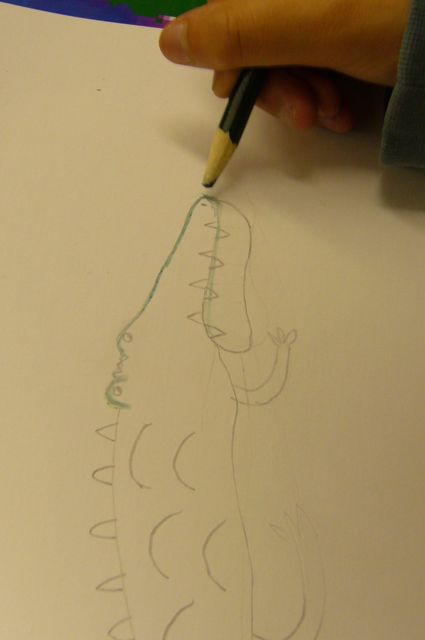
P1020645Crocodile Safari comes with a DVD that features Jim Arnosky discussing the differences between alligators and crocodiles and how important these differences are to a wildlife illustrator. At the end of the DVD, Mr. Arnosky gives us a drawing lesson. We watched this part twice! All of us brought paper, pencils, crayons and pencil crayons to the carpet to work on our crocodile drawings! Notice the scaly skin and lumps and bumps.

P1020680Arnosky showed us how to draw the mangrove roots at the side of the water where the crocs like to lurk unnoticed amongst the roots and branches. He mentioned that he likes drawing the mangrove trees because they seem like upside down trees. We learned that water birds sense when the crocs are not hungry and then it is safe to perch near them.

P1020676Jenifer has done a fantastic job of showing how large the teeth can be in a croc’s jaws. Inside the book there is a page with pictures of lifesize crocodile teeth. Some teeth were longer than our little fingers! Yikes! Suddenly those teeth seemed all the more real!


P1020669Crocodiles have long narrow snouts. We can see all of their teeth even when their jaws are closed. Alyson has done a lovely job of showing the shape of the croc’s head and all of its large sharp teeth. Many students brought their drawings home to share with family.

What fascinating creatures!

Students are already requesting more books by Jim Arnosky!