Rocket Art (Finished Pieces)

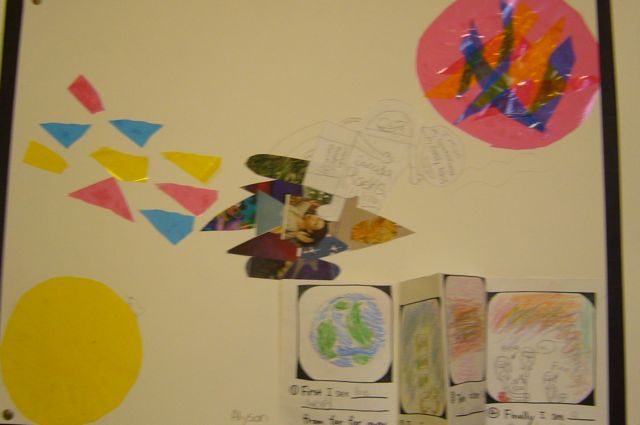
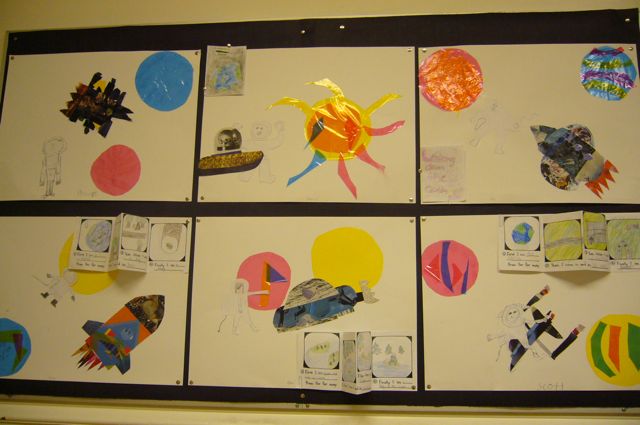
Ms. Chen has posted our finished Rocket Art pieces in the classroom and on the bulletin boards which surround our classroom. Displayed all together, they look amazing! If you haven’t seen our work in process, read more about how these pieces were created here.

P1020879

This week students were able to complete fold out panels about looking back to Earth. Ms. Chen used Steve Jenkins’ book Looking Down to illustrate zooming in to a specific object – from looking at Earth and then zooming in possibly to a specific street, then maybe a particular house and then finally to a single window within the house.

This is such a fantastic book to illustrate zooming in on a particular object – first from far away and then getting closer and closer.

A very interesting journey in looking at the world from a different perspective.

Closer and closer and close

Read about how this book was conceived on Steve Jenkins’ site.

What is amazing about this book is that it is “told” strictly through visual images – as a wordless picture book.

P1020882This is Jena‘s art. Now in addition to her rocket ship, planets and drifting astronaut, she has attached her mini fold out book which depicts looking back to the Earth.

First she drew a portion of the Earth – oceans and land covered by forest. In the subsequent drawings she zooms closer and closer into the forest scene.

P1020883Here is Alyson’s completed work. We loved how she used the cellophane to represent the emissions coming from her rocket as it zoomed through space.

Her mini booklet zooms in to a single room in her building.

Such a colourful piece!

P1020886Hailey isn’t quite finished her mini zoom in booklet but her art so far, is wonderful.

Her astronaut’s suit is extremely detailed and she was able to create a very efective planet by layering her cellophane pieces.

Beautiful.

Such a fun and successful project. Thank-you Ms. Chen!

A little taste of Africa

Bill, our BLG reader this week, brought us two very different picture books that allowed us to step into the African savannah for a small part of our day. First he read Help Me written and illustrated (beautifully!) by Paul Geraghty.
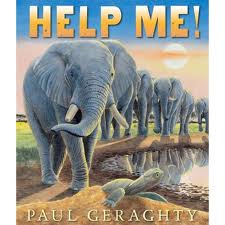
Before Bill began the story he read the students an important line from the summary on the back of the book: This extraordinary picture book is based on real, documented animal behaviour. Students were advised to listen carefully with this in mind. Help Me takes place in and around a waterhole in Africa. As a herd of elephants lumbers by in the moonlight, an old thirsty tortoise heads down to the waterhole for a drink. She trips on the steep bank and flips onto her back. When she feels the ground shudder with the movements of the elephants, she hides inside her shell. Yikes! The picture shows our tiny tortoise inside her shell and gigantic elephant feet all around her, one poised to come down right on top of her. “Oh no!” everyone shrieks. The text reads Then a great foot rose up and came down on top of her. . .

Nobody breathes. Bill flips the page and reads  . . . and carefully rolled her over onto her feet “Whoa!” “No way.”  Phew. Relief.

So starts a series of surprising animal interactions. A huge crocodile encloses a little hatchling turtle in its jaws. Amidst the gasps and sighs and covered eyes were mutterings from our new experts on crocodiles (“Are those really crocodiles?” “Check the teeth” “Yep”) The crocodile sets the baby free in the water. “What?” “That’s weird.”

An impala is chased by a pack of wild dogs and stumbles exhausted into the waterhole. The dogs started splashing toward him when a huge hippopotamus steps between them and bellows at the dogs. He comes in closer, jaws over the impala. Why? To help it get warm and strong again.

Someone called out “Why do they all help each other?” Everyone is quiet, thinking.

“Symbiosis!” Miami exclaims knowingly. Heads start to nod as we wonder if what we just experienced in this book is connected to the learning we have been doing as we’ve read Steve Jenkins and Robin Page’s book How to Clean A Hippopotamus. These are the moments we live for as teachers – where you can almost see inside heads and watch the thinking happening!

Next Bill read The Sticky Doll Trap by Jessica Souhami. This is a story based on the West African stories of the trickster hare and a sticky doll. The best known version of this tale is the Uncle Remus Story of Brer Rabbit and the Tar Baby told by Joel Chandler Harris. However Harris’ version is based on the stories that came over with the African slaves and it is this African “version” that Souhami honours with her retelling.
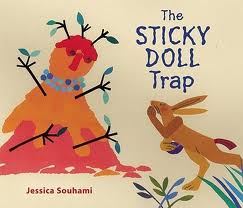
This is such a fun story and Souhami’s colours are bright and beautiful. Students were totally engaged from page one. This is the tale of the rascal Hare who is too lazy to help the thirsty animals dig a waterhole to quench their thirst in the midst of a drought. When the animals find the precious water they decide to protect it from thieving animals that did not help dig for it. Every day a different animal will stand guard. Hare hops up with his empty calabash and is told there is no water for him. But utilizing his trickster ways, he manages to fill his calabash and sneak away while the animal, eyes closed, awaits the treat Hare has promised.

What is the Sticky doll trap? The result of the annoyed animals creative thinking – a trap to trick the trickster! The perfect revenge. And how well it works! Yet, in the end that rascal Hare proves himself to be the ultimate trickster! The animals throw him into the spiny thorny bushes as he begs them not to, convinced that they are inflicting the ultimate punishment. Moments later, Hare is taunting them from up on the hill. Off he hopped to continue his tricks!

At the end of the story Ricky clarifies, “Hares can’t be hurt by the thorns?” Bill reiterates that no, the hares are used to the thorns. “Okay,” says Ricky, “So this is kinda nonfiction?”

I love how we are trying to bring meaning to how these stories are created and understanding that facts are interweaved throughout fictional tales. Ah, the wonder of books! Thanks Bill for choosing such great titles this week!

Our student reviewers report:

Jena: I liked the book Help Me because first one of of the animals are in danger by another animal and then a totally different animals comes and saves the animal that was in trouble. It was like they had a symbiotic relationship.

Annie: I like the part in The Sticky Doll Trap where he got stuck when he touched the doll but got away because he was tricky.

National Geographic Kids

We’ve been able to pick up some fantastic non-fiction titles through Scholastic Books this year. Published through the National Geographic Society, these books include all the non-fiction features necessary to make navigating through the pages a wonderful experience. Hundreds of full colour photos, maps, labelled diagrams, comparisons, an interactive glossary and more! Recently, we used Everything Big Cats to practice asking questions before we read and to answer questions about the text by interacting successfully with the features.

This past week our Reading group learned about the differences between the big cats, what the big cats eat and how they hunt and how the bodies of big cats are built to survive.

Some of our pre-reading questions:

  • Do big cats hunt together in a pack? (Jena)
  • Do they have super smell for food? (Jenifer)
  • Why do cheetahs have dots? (Hajhare)
  • Do they eat human beings? (Truman)
  • Why do tigers need whiskers? (Sergio)
  • Do they eat in groups? (Lisa)
  • Does their fur keep them warm? (Eddy)
  • How big is their brain? (Jeremiah)
  • How strong is the force of a big cat’s bite? (Ricky)

Students answered questions about what the big cats eat using a chart called What’s For Lunch? Some surprising discoveries? Jaguars eat small crocodiles (large crocodiles would be too dangerous). Leopards hunt (very carefully) porcupines! We also discovered that tigers can eat the equivalent of 80 pounds (36 kg) of meat in one sitting. Wow!

P1020694

Students also found it interesting to compare the bodies and fur patterns of the four big cats by reading Who’s Who? The largest of the big cats? The tiger who can weigh up to 660 pounds (300 kg)! We also learned that the stripes on a tiger are like fingerprints. No two stripe patterns are the same. And what about black panthers? They are actually either jaguars or leopards with dark fur. Who knew?


Crocodile Safari Take 2

We finished reading Jim Arnosky’s Crocodile Safari today.

Some interesting things we learned?

crocodile safari

  • Crocodiles are not the only dangerous things in the mangrove swamp. Also beware of diamondback rattle snakes and poisonwood trees
  • Those large jaws are full of teeth! Humans have 28-32 teeth but crocs have 80 to 120 teeth!
  • Toothless crocodiles exist but still beware! These crocodiles still have powerful jaws that can crush bones!
  • Crocodiles can be huge! In the U.S.A. they might be up to 15 feet (almost 5 m) long but in Madagascar there are crocodiles up to 30 feet (over 9 m) long! These are the largest living reptiles in the world. Wow!

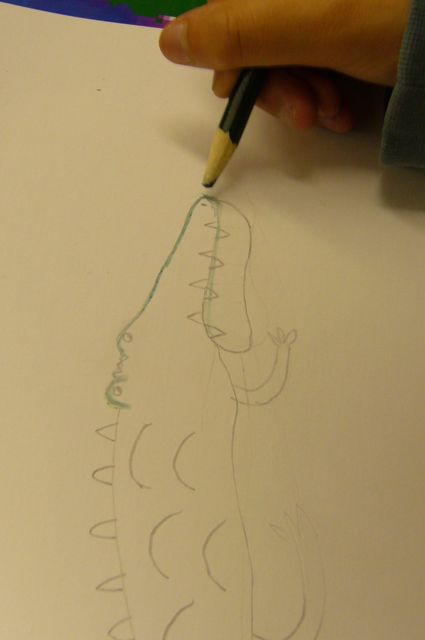
P1020645Crocodile Safari comes with a DVD that features Jim Arnosky discussing the differences between alligators and crocodiles and how important these differences are to a wildlife illustrator. At the end of the DVD, Mr. Arnosky gives us a drawing lesson. We watched this part twice! All of us brought paper, pencils, crayons and pencil crayons to the carpet to work on our crocodile drawings! Notice the scaly skin and lumps and bumps.

P1020680Arnosky showed us how to draw the mangrove roots at the side of the water where the crocs like to lurk unnoticed amongst the roots and branches. He mentioned that he likes drawing the mangrove trees because they seem like upside down trees. We learned that water birds sense when the crocs are not hungry and then it is safe to perch near them.

P1020676Jenifer has done a fantastic job of showing how large the teeth can be in a croc’s jaws. Inside the book there is a page with pictures of lifesize crocodile teeth. Some teeth were longer than our little fingers! Yikes! Suddenly those teeth seemed all the more real!


P1020669Crocodiles have long narrow snouts. We can see all of their teeth even when their jaws are closed. Alyson has done a lovely job of showing the shape of the croc’s head and all of its large sharp teeth. Many students brought their drawings home to share with family.

What fascinating creatures!

Students are already requesting more books by Jim Arnosky!

Crocodile Safari

We have begun to explore the fact – question – inference continuum using non-fiction books and information storybooks. This process is inspired by Adrienne Gear’s Non-Fiction Reading Power book. When we learn a new fact, what question does it prompt and using our background knowledge (schema), what can we infer? We practiced this today using Jim Arnosky’s Crocodile Safari. This is a detailed account of American crocodiles. Crocodiles were photographed and sketched while Jim Arnosky and his wife Deanna were on their crocodile safari through the Florida Everglades. This book is illustrated with the detailed paintings inspired by the images collected on safari. Stunning!

Today we read about a third of the book learning about the crocodile population in the U.S.A., the differences between crocodiles and alligators (finally, a book that makes this totally clear through text and drawings!), crocodile habits and hunting strategies (a page called Ambushed from Below was quite thrilling!).

Fact/Question/Infer: (some examples)

1. We read that in the late twentieth century there were just 300 crocodiles left in the U.S.A. Now there are approximately 2,000. This led us to question: How were they counted? As we tried to answer this question, more questions arose. What if the same crocodile was counted more than once? Maybe they tagged them. But if they tagged them, how would they get close enough to tag them? We were all fairly worried about those sharp teeth! Perhaps they shot tranquilizer darts at them to put them out long enough to attach a tag. Obviously, some of our background knowledge was helping us think this through. We read on and found out that they were counted when someone flew over their habitat in a helicopter.

2. One page in the book is titled One Famous Croc and it talks about a crocodile famous for migrating hundreds of miles from the Everglades to Sanibel Island. When it was captured and returned to the Everglades, it migrated for a second time to Sanibel Island, where it now lives. Our question was an obvious one: What made it return to Sanibel Island? As we talked this question through, students shared different ideas based on their thinking and background knowledge. Someone knew that birds migrate to warmer places. Why else do birds migrate? Someone shared it was so they could find food more easily. Did this crocodile migrate because of food? Someone pointed out that there was a picture of this crocodile hunting a bird so this seemed logical. Our consensus was that the crocodile migrated to Sanibel Island because it was a great source of water birds (great hunting grounds). A very sensible inference we thought and since we can’t ask this particular crocodile, it’s the answer we are going with! 🙂

Students shared new learning, unanswered questions and some of their own inferences in their writing.

Jenny: I learned today that the difference of a crocodile and an alligator is that the crocodile has teeth sticking out of its mouth when it’s closed and an alligator doesn’t. A crocodile’s mouth is longer and an alligator’s mouth is wider.

Eddy: At night crocodiles hunt. In the day, they like to suntan. They mostly eat fish but they also eat birds and snakes.

Lisa: I have a question about how they communicate with other crocodiles. Maybe they move their tail back and forth in the water.

Jena: Crocodiles eat anything they find. They ambush their prey. They go underwater at night (mostly) to hunt. They rise up to the prey and pull it down and eat it. For example, if you saw a duck and then it just disappears. That’s what just happened to it!

Gary: There are questions I still have. How heavy are crocodiles? How big are alligators? Are alligators stronger than crocodiles?

Questions and new learning about the Moon

We continue to study the moon and have been keen to learn new information. However we realize that the more we learn, the more questions we seem to generate. Our wondering seems endless  – kind of like space!

This week we read Moon by Steve Tomecek and illustrated by Liisa Chancy Guida. This is a Jump into Science National Geographic book.

First, we filled out an anticipation guide Ms. Gelson had written based on the book. Did we think a list of statements were true or false. For example: 1. Earth is about four times bigger than the moon. 2. The air surrounding Earth helps protect us from falling meteors because it makes them burn up 3. The sun and the moon are about the same size.

Then we listened to the story to verify which statements were in fact true and which were false. (In case you aren’t sure – with the previous statements 1 and 2 are true and 3 is false 🙂 )

After this, we returned to our desks to work on sheets that summarized some of our learning. What new things were learned from this book? What questions still exist?

P1020522Jena talked about Galileo and his telescope. Students were fascinated that this was the first time people had a sense of what the moon actually looked like. She also noted that the moon is not a star like the sun is. Many people didn’t know the sun is a star.

Her questions centred on space travel. What were the names of the twelve astronauts that visited the moon? Did any animals go to the moon? And a very interesting thing to find out: Were any of the astronauts there when meteors came?

P1020523


Jenny thought it was very interesting that the only way a crater can be filled up on the moon is when dust from a new crater forming (from a falling meteor) fills it up. Many students thought that this was pretty cool.

Jenny had questions about space generally

  • Why is the sun so warm?
  • Why can’t there be air in space?


She also wondered about how the footprints from visiting astronauts could remain on the moon forever. It is pretty hard to fathom a place with no wind and no rain.


P1020525Eddy had some great questions about the moon’s shape and how it formed in the first place.

Many students wondered if the Earth and the moon formed at the same time or different times and why we are so connected. Many thought it was strange to talk about ages of planets, moons and stars and wondered if they had birthdays!

Some other interesting questions students had:

  • If there is no gravity, wouldn’t the planets float away? (Annie)
  • When did the moon appear in space? (Kevin)
  • Is rock the only thing on the moon? (Ricky)
  • Why is the sun so hot when it looks so small? (Edwin)
  • What would happen if you started to dig on the moon? (Gary)
  • Will the moon have volcanoes again? (Manny)
  • Why is the moon grey? (Jenifer)

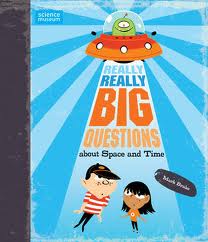
On a quick visit to the library this evening, I found this book: Really, Really BIG Questions about Space and Time by Mark Brake. Illustrated by Nishant Choski.

I plan to read it carefully this weekend to become a space expert! I will also bring it in for students to explore during independent reading. It addresses questions like:

  • When did the universe start?
  • Do stars live forever?
  • Why is the night sky so dark?
  • What’s the difference between me, a planet and a star?
  • Do black holes turn you into spaghetti?

A week of reading

It’s nice to live in a house full of avid readers. All of this time off at Spring Break has provided lots of time to get lost in a book or two (or three. . .)

What have we read so far?

My daughter’s list:

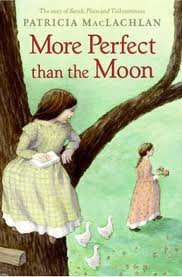
1. More Perfect than the Moon by Patricia MacLachlan

This is the fourth book in the Sarah Plain and Tall series. (Sarah Plain and Tall, Skylark, Caleb’s Story) In this story, Cassie, Sarah’s youngest child journals her feelings about her mother’s pregnancy. All four books were a gift at Christmas.

2. Dragon’s Slippers by Jessica Day George

This is the first book in a trilogy by Jessica Day George. Creel’s aunt plans to sacrifice her to a dragon. Creel takes her rescue into her own hands and walks into the King’s City ready to find her fortune. A pair of blue slippers that she wins in a bargain with a dragon hold more mystery and power than she could possibly realize. Not in any way a damsel in distress story!

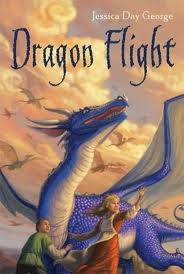
3. Dragon Flight by Jessica Day George

The Dragon Wars are now over. Settled into her life as a seamstress, Creel is finding life a little bit dull. When Prince Luka sends word of dragons being trained for an invasion, Creel is ready for another adventure! This means reuniting with her dragon friends and leading them into battle. A wonderful fantasy series full of suspense and adventure. The third book in this trilogy is Dragon Spear.

My son’s list

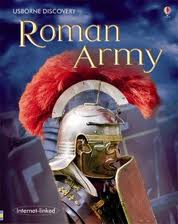
1. The Roman Army (an Usborne Discovery Book)

We have some obsession with Romans and battle in our house (just my son actually, but he is intrigued enough for all four of us!) This book has internet links to various websites on each page. All of the Roman heroes and leaders. Diagrams of battle plans, explanations of soldier life and training, siege tactics and much more. The perfect book to get lost in.

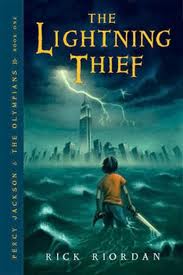
2. The Lightning Thief by Rick Riordan

The first book in the Percy Jackson & the Olympians series. Percy Jackson thinks he is just a boy. A boy who mixes up letters and can stay underwater for an unusually long time. A boy who always seems to find trouble and if not, it finds him. But still just a boy. But when Percy gets sent to Camp Half-Blood, he discovers that he is much more than an ordinary boy. Zeus (yes, that Zeus) is convinced that Percy has stolen his lightning bolt and he only has ten days to make things right. A wonderful merging of modern day and Greek mythology. My son didn’t come up for air.

3. The Sea of Monsters by Rick Riordan

Book 2 in the Percy Jackson & the Olympians series. The magical borders that protect the special camp for the demi-gods have been poisoned.  In order to save Camp Half-Blood, Percy and his friends must retrieve the Golden Fleece from the Sea of Monsters. Rick Riordan has much more adventure awaiting readers who love this series. This series is being quickly devoured in our house.

Why do you think you should never smile at a monkey?

Wow, did we enjoy interacting with Never Smile at a Monkey (*and 17 other Important Things to Remember) by Steve Jenkins.

never smile at a monkey

We used this book to practice questioning, predicting and inferring – when you encounter some of these creatures, what should you not do? And why exactly?

Jenkins explains that certain large creatures are “well known threats” – of course we aren’t going to get too close to tigers or crocodiles. Sharp teeth. No thanks! We also know to avoid “rattle snakes, black widow spiders, and piranhas” Their danger is well known. But what about the creatures we don’t know so much about. Creatures with “teeth, claws, spines and venom that can be deadly” That’s what this book is all about. A very clever idea brought to us with a combination of Jenkins’ gorgeous torn paper collage animals and just enough text to teach us new information related to this theme.

Jenkins organizes this book with a picture of a creature on each page or 2 page spread, Accompanying this is a Never . . . . warning in larger text and then an explanation of why. At the back of the book, more information is provided about each creature as well as a list of books for further reading. In the example here, we are warned to never collect a cone shell. Why not? Yikes. Well, a cone shell has poisoned barbs that it uses when hunting. They can be launched like harpoons. Potentially deadly if they stab you. Makes one think twice about collecting shells!

How did we use this book in the classroom?

Students brought notepads and pencils to the carpet to listen to the story. I would show them a picture and read the Never . . . warning without showing them the rest of the text. Students then wrote their prediction/inference about why we should never . . . We shared a few out loud and then I read the explanation provided in the book.

Some very funny conversation happened. Amazing predictions. Lots of arguing! “Not everything has venom you know!” “How could it bite you, it doesn’t even have teeth?” “What are you talking about? Be more specific!” My favourite line: “Ms Gelson I’m using my schema!”

So  . . . want to learn something new?

Why should you never smile at a monkey?

Our predictions:

  • it might scratch you when it gets excited
  • it will get really mad
  • it will yell at you and bite you with its sharp teeth
  • it will get loud, jump up and bite you

And the real reason. . .

“If you smile at a rhesus monkey it may interpret your show of teeth as an aggressive gesture and respond violently.”

Why should you never jostle a jellyfish?

Our predictions:

  • it can release venom that can kill you
  • it might shock you
  • it might pop
  • it will start to vibrate and kill you

And the real reason. . .

A box jelly fish is in a class by itself . . . even the smallest contact with its stinging tentacles causes intense pain . . . you can die very quickly.”

Later, students chose one creature, wrote their prediction and the real explanation and included a picture. Sometimes our thinking was very close – other times, not a bit. Which was great – real learning happened! We also liked celebrating when we did have background knowledge about a particular creature and could make an inference that made a lot of sense. At one point, as I was reading a little voice piped up. “This is so fun!

Love, love, love Steve Jenkins’ books! His website includes an interesting explanation of how he makes his books.

On Earth . . .

On Earth by G. Brian Karas is a wonderful book to introduce how the Earth moves through space, why we have night and day and what causes the seasons.

I was curious about what the students already knew. We examined the front cover which folds open to reveal the image above as well as part of the earth in darkness, surrounded by space.

What do we know? Let’s access our background knowledge! And pose some questions. . .

  • In one place it is day and another it is night (Edwin)
  • The Earth spins around once in 24 hours (Ricky)
  • What happens if the sun and moon come together? Would the moon melt? (Jeremiah)
  • That’s an eclipse! (Josiah)
  • The sun can only shine on half at once (Edwin)
  • At different places on Earth, there can be different times (Jena)
  • Why can’t we feel the spinning? (Scott)
  • Space never ends! (Ricky)
  • Why when you face the sun, you can’t see the planets? (Alyson)

As we read, more thinking and questions happened.

  • How does the Earth spin? (Ricky)
  • If planets were more away from the sun, are years longer? (Alyson)
  • Does the Earth also go around the sun? (Jenny)
  • What happens if the sun got sick? (Scott)
  • If there was no gravity on Earth, we would float out into space (Josiah)

Lots of great learning happened with this book and students were able to use new vocabulary in their writing: axis, orbit, gravity, seasons, equator.


Salmon Creek

Salmon Creek, written by Annette LeBox and illustrated by Karen Reczuch mesmerized us this week.

Nothing is quite as amazing as the life cycle of the Pacific salmon. I still remember the sounds of rushing water, the visuals of a stream bed of red and the smell of cool, damp earth as I stood watching the salmon spawn in my own childhood. We aren’t studying salmon right now but we have been reading from a large variety of information picture books with themes of Canadian animals and endangered species to practice questioning and inferring and this book seemed an ideal pick. I couldn’t have predicted its powerful effect in the classroom. The poetic text and gorgeous illustrations lured us quick and fast into the amazing journey of Sumi from the beginning stirrings in her egg to her life as a fry, then a smolt and eventually to her own return journey to the spawning grounds of her birth creek as an adult female.

We learned about how Sumi laid thousands of eggs and the male salmon fertilized them. “Sumi flicked her tail, and the gravel drifted into the nest, covering her eggs like secrets.”

Sumi circled the creek, guarding her eggs. She bared her curved teeth, slapped her tail, scared off pairs of spawners from her redd.”

And later, as she drifted gently downstream, Sumi sang to her eggs . . .

Home is the scent of cedar and creek. Home is the journey’s end.

We manage the sadness when Sumi dies as LeBox does such a wonderful job of explaining the full circle of life and with our new understanding of the amazing salmon life cycle, we feel peaceful and wise. This book includes a glossary in the back to help with new vocabulary, more information about threats to Pacific salmon and suggestions for further reading and viewing.

Some of our unanswered questions from our very long lists!

  • How fast does a salmon travel? Especially when they are travelling against the current?
  • Are salmon fry see through?
  • Do salmon ever interact with their siblings?
  • How many eggs survive when the mother lays them?
  • If salmon are now endangered, how many are left?
  • What is in the yolk sac?
  • How could they survive if the water freezes?
  • Do they eat different things at different ages?
  • When salmon are injured in the rapids, how do they heal?

This book is one of my new favourites in the information story book category.