Unknown's avatar

About carriegelson

Elementary teacher passionate about all things literacy.

April and Esme Tooth Fairies

Our BLG reader Bill walked into an eager pyjama wearing audience today. It was a mini Camp Read at Seymour school. Bill might have been dressed in a suit but he had the perfect book to fit right into our pyjama theme! It featured sleeping people, comfortable beds and lots of characters dressed in their PJs! The book? April and Esme Tooth Fairies by Bob Graham.

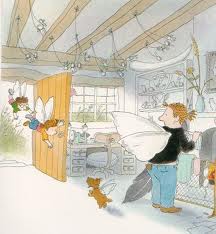
This is a story about two little tooth fairies and their first tooth fetching venture. Graham has created a completely modern setting and feel to the story while at the same time giving us a whimsical sense of magic. We have cell phones, texting fairies and a ponytailed Dad doing the laundry. Yet, this is intermixed with pictures of toadstools, dandelion flowers and floaty white wings.

April and Esme spring the news on Dad

Despite their parents concerns about their “tooth fairy readiness”, April and Esme head off to claim Daniel Dangerfield’s lost tooth. When they find his room, they realize that Daniel has left his tooth in a glass or water and April has to dive down to the bottom to retrieve it. Oh dear – soggy wings! Daniel stirs and the girls panic. April texts Mom for advice! What to do? Whisper in Daniel’s ear: “We’re spirits of the air Daniel. You dreamed us. You did not see us.”

Scott blurted out: “That’s freaky! Is this non-fiction?  I wish it is!”

When Daniel woke up, he was convinced it was a dream. Meanwhile, our little fairies drift off to sleep exhausted from their tooth/coin exchanging adventure.

Such a fun story.

Our student reviewers report:

Kevin: It was a great book! It was funny because everyone had wings – even the dog!

Alyson: I liked the part where they were dreaming. It seemed like they were really doing it. Or . . . was it a dream?

Ricky: That was a great book you read! I always dream of being a fairy. I could make the things I want. Thank- you Bill for reading that book.

Crocodile Safari Take 2

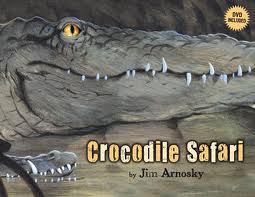
We finished reading Jim Arnosky’s Crocodile Safari today.

Some interesting things we learned?

crocodile safari

  • Crocodiles are not the only dangerous things in the mangrove swamp. Also beware of diamondback rattle snakes and poisonwood trees
  • Those large jaws are full of teeth! Humans have 28-32 teeth but crocs have 80 to 120 teeth!
  • Toothless crocodiles exist but still beware! These crocodiles still have powerful jaws that can crush bones!
  • Crocodiles can be huge! In the U.S.A. they might be up to 15 feet (almost 5 m) long but in Madagascar there are crocodiles up to 30 feet (over 9 m) long! These are the largest living reptiles in the world. Wow!

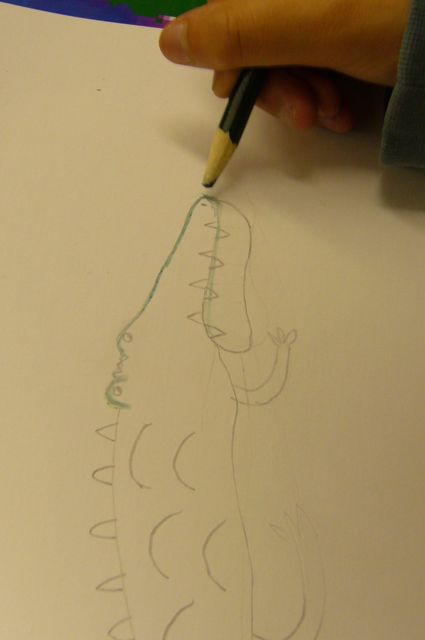
P1020645Crocodile Safari comes with a DVD that features Jim Arnosky discussing the differences between alligators and crocodiles and how important these differences are to a wildlife illustrator. At the end of the DVD, Mr. Arnosky gives us a drawing lesson. We watched this part twice! All of us brought paper, pencils, crayons and pencil crayons to the carpet to work on our crocodile drawings! Notice the scaly skin and lumps and bumps.

P1020680Arnosky showed us how to draw the mangrove roots at the side of the water where the crocs like to lurk unnoticed amongst the roots and branches. He mentioned that he likes drawing the mangrove trees because they seem like upside down trees. We learned that water birds sense when the crocs are not hungry and then it is safe to perch near them.

P1020676Jenifer has done a fantastic job of showing how large the teeth can be in a croc’s jaws. Inside the book there is a page with pictures of lifesize crocodile teeth. Some teeth were longer than our little fingers! Yikes! Suddenly those teeth seemed all the more real!


P1020669Crocodiles have long narrow snouts. We can see all of their teeth even when their jaws are closed. Alyson has done a lovely job of showing the shape of the croc’s head and all of its large sharp teeth. Many students brought their drawings home to share with family.

What fascinating creatures!

Students are already requesting more books by Jim Arnosky!

Crocodile Safari

We have begun to explore the fact – question – inference continuum using non-fiction books and information storybooks. This process is inspired by Adrienne Gear’s Non-Fiction Reading Power book. When we learn a new fact, what question does it prompt and using our background knowledge (schema), what can we infer? We practiced this today using Jim Arnosky’s Crocodile Safari. This is a detailed account of American crocodiles. Crocodiles were photographed and sketched while Jim Arnosky and his wife Deanna were on their crocodile safari through the Florida Everglades. This book is illustrated with the detailed paintings inspired by the images collected on safari. Stunning!

Today we read about a third of the book learning about the crocodile population in the U.S.A., the differences between crocodiles and alligators (finally, a book that makes this totally clear through text and drawings!), crocodile habits and hunting strategies (a page called Ambushed from Below was quite thrilling!).

Fact/Question/Infer: (some examples)

1. We read that in the late twentieth century there were just 300 crocodiles left in the U.S.A. Now there are approximately 2,000. This led us to question: How were they counted? As we tried to answer this question, more questions arose. What if the same crocodile was counted more than once? Maybe they tagged them. But if they tagged them, how would they get close enough to tag them? We were all fairly worried about those sharp teeth! Perhaps they shot tranquilizer darts at them to put them out long enough to attach a tag. Obviously, some of our background knowledge was helping us think this through. We read on and found out that they were counted when someone flew over their habitat in a helicopter.

2. One page in the book is titled One Famous Croc and it talks about a crocodile famous for migrating hundreds of miles from the Everglades to Sanibel Island. When it was captured and returned to the Everglades, it migrated for a second time to Sanibel Island, where it now lives. Our question was an obvious one: What made it return to Sanibel Island? As we talked this question through, students shared different ideas based on their thinking and background knowledge. Someone knew that birds migrate to warmer places. Why else do birds migrate? Someone shared it was so they could find food more easily. Did this crocodile migrate because of food? Someone pointed out that there was a picture of this crocodile hunting a bird so this seemed logical. Our consensus was that the crocodile migrated to Sanibel Island because it was a great source of water birds (great hunting grounds). A very sensible inference we thought and since we can’t ask this particular crocodile, it’s the answer we are going with! 🙂

Students shared new learning, unanswered questions and some of their own inferences in their writing.

Jenny: I learned today that the difference of a crocodile and an alligator is that the crocodile has teeth sticking out of its mouth when it’s closed and an alligator doesn’t. A crocodile’s mouth is longer and an alligator’s mouth is wider.

Eddy: At night crocodiles hunt. In the day, they like to suntan. They mostly eat fish but they also eat birds and snakes.

Lisa: I have a question about how they communicate with other crocodiles. Maybe they move their tail back and forth in the water.

Jena: Crocodiles eat anything they find. They ambush their prey. They go underwater at night (mostly) to hunt. They rise up to the prey and pull it down and eat it. For example, if you saw a duck and then it just disappears. That’s what just happened to it!

Gary: There are questions I still have. How heavy are crocodiles? How big are alligators? Are alligators stronger than crocodiles?

Cottonwool Colin – a lesson for Moms

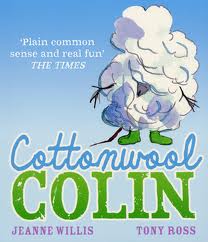
The fabulous team of Jeanne Willis and Tony Ross have brought us a fantastic story to read to our Moms! Yep, our Moms. By the time we finished laughing and gasping through Cottonwool Colin, the consensus was – this is a book for Moms!

This book is all about tiny mouse Colin Smally, the youngest and smallest of ten mouse siblings. So small that his Mom only agrees to allow him outside into the great big world if she can wrap him in cottonwool. Now he would be safe from the elements, from falling, or worse, having something landing on him! All would be well. But when Colin (wrapped in cotton) gets mistaken for a snowball and tossed into a freezing river, everything suddenly seems very dangerous. And it is – he is chased and needs to swim to escape and then chased again . . .

When Colin, (sans cottonwool) ends up back at his mouse cave, his mother is very upset.

“Colin, ” she shrieked. “Anything could have happened to you!

Everything did happen to me, ” he whooped.

Colin’s Mom begins to grant him more freedom to explore the world. And Colin ventures out ready for many more adventures (the fear, the hurt, the risks?  All worth it!!)

So I asked our listeners: “So, what do we think?”

Lisa: “His Mom learned a lesson. His Mom should not worry so much and let him play.”

Oh yes, without hesitation we agreed! “Don’t be scared Moms!” ‘Don’t be too worried!” “Let it go!” “Let them have fun.” “Don’t keep your kids right with you.”

Jena: “Trust them because one day they’ll get older and they won’t know how to take care of themselves.”

Lisa: “Yeah. Kids need to go around in the world to know what’s out there.”

“My mom doesn’t need that book though,” said Scott. “Because I’m bigger than a mouse.” 🙂

I am a teacher but I am also a Mom and I have to admit that, like Colin, my students are probably smarter than me on this one! Breathe, let it go, don’t worry so much . . .

Selecting Picture books to read

Students in our morning reading group continue selecting books based on their background knowledge (schema) – realizing that they will have a better chance of connecting to a book when they have some shared experiences with the theme/topic of the book.

Students quickly selected three books from a huge selection of picture books. Then they ordered their choices #1, #2, #3 . Why did they choose the book they did as their first choice? After reading, students then shared any text to self or text to text connections.

Some book selections:

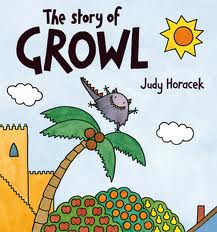
Gary chose The story of GROWL by Judy Horacek. Why was this his first choice? “Sometimes I growl when I’m angry. It makes me feel like a monster.”

After reading the book, did he have any connections?

“I used to hop, skip and jump around my garden. Sometimes I growl for fun. My Dad told me to stop growling because it’s loud. But I still was growling! I stopped one day.”

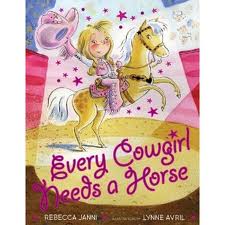
Lisa read Every Cowgirl Needs a Horse by Rebecca Janni. Why was this her first choice? “I know that if a horse wants to say hi, they rub their noses together. I learned that in a chapter book.”

After reading, what were her connections?

It was easy to connect to this book because at home when I’m riding my bike, I reel like I’m riding a horse with the wind blowing in my hair like the girl in the story.”

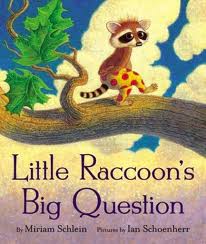
Jenny chose to read Little Raccoon’s Big Question written by Miriam Schlien and illustrated by Ian Schoenherr. This book is all about a little raccoon wanting reassurance about his mother’s love. Jenny chose to read it because: “When I was little I saw a raccoon.  I know a lot about what raccoons do and they are one of my favourite animals.”

Her connections were about much more than what she knows about raccoons.

“When I was little I was thinking how much my mom loves me most. I was thinking does she love me when I eat, sleep or play with her.”

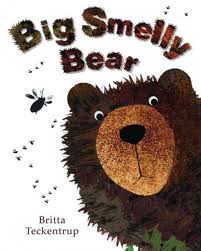
Josiah picked the book Big Smelly Bear by Britta Teckentrup. Why was this his first choice? “Everytime I go to my Mom’s home town, I always see bears and flies buzzing around.”

After reading, what connections did he have?

“When the big fluffy bear scratched the big smelly bear, I connected to it because I always see bears scratching trees and each other on the way to my Mom’s hometown Port Hardy. It is so fun there because I see my uncles, aunties and the big bears.”

Isn’t it great that there are so many picture books out there to interest everyone?


Questions and new learning about the Moon

We continue to study the moon and have been keen to learn new information. However we realize that the more we learn, the more questions we seem to generate. Our wondering seems endless  – kind of like space!

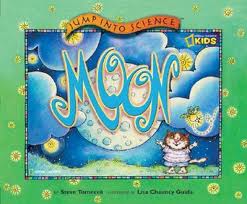
This week we read Moon by Steve Tomecek and illustrated by Liisa Chancy Guida. This is a Jump into Science National Geographic book.

First, we filled out an anticipation guide Ms. Gelson had written based on the book. Did we think a list of statements were true or false. For example: 1. Earth is about four times bigger than the moon. 2. The air surrounding Earth helps protect us from falling meteors because it makes them burn up 3. The sun and the moon are about the same size.

Then we listened to the story to verify which statements were in fact true and which were false. (In case you aren’t sure – with the previous statements 1 and 2 are true and 3 is false 🙂 )

After this, we returned to our desks to work on sheets that summarized some of our learning. What new things were learned from this book? What questions still exist?

P1020522Jena talked about Galileo and his telescope. Students were fascinated that this was the first time people had a sense of what the moon actually looked like. She also noted that the moon is not a star like the sun is. Many people didn’t know the sun is a star.

Her questions centred on space travel. What were the names of the twelve astronauts that visited the moon? Did any animals go to the moon? And a very interesting thing to find out: Were any of the astronauts there when meteors came?

P1020523


Jenny thought it was very interesting that the only way a crater can be filled up on the moon is when dust from a new crater forming (from a falling meteor) fills it up. Many students thought that this was pretty cool.

Jenny had questions about space generally

  • Why is the sun so warm?
  • Why can’t there be air in space?


She also wondered about how the footprints from visiting astronauts could remain on the moon forever. It is pretty hard to fathom a place with no wind and no rain.


P1020525Eddy had some great questions about the moon’s shape and how it formed in the first place.

Many students wondered if the Earth and the moon formed at the same time or different times and why we are so connected. Many thought it was strange to talk about ages of planets, moons and stars and wondered if they had birthdays!

Some other interesting questions students had:

  • If there is no gravity, wouldn’t the planets float away? (Annie)
  • When did the moon appear in space? (Kevin)
  • Is rock the only thing on the moon? (Ricky)
  • Why is the sun so hot when it looks so small? (Edwin)
  • What would happen if you started to dig on the moon? (Gary)
  • Will the moon have volcanoes again? (Manny)
  • Why is the moon grey? (Jenifer)

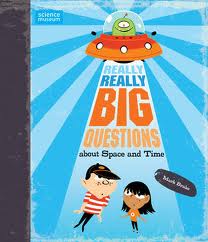
On a quick visit to the library this evening, I found this book: Really, Really BIG Questions about Space and Time by Mark Brake. Illustrated by Nishant Choski.

I plan to read it carefully this weekend to become a space expert! I will also bring it in for students to explore during independent reading. It addresses questions like:

  • When did the universe start?
  • Do stars live forever?
  • Why is the night sky so dark?
  • What’s the difference between me, a planet and a star?
  • Do black holes turn you into spaghetti?

So few of me

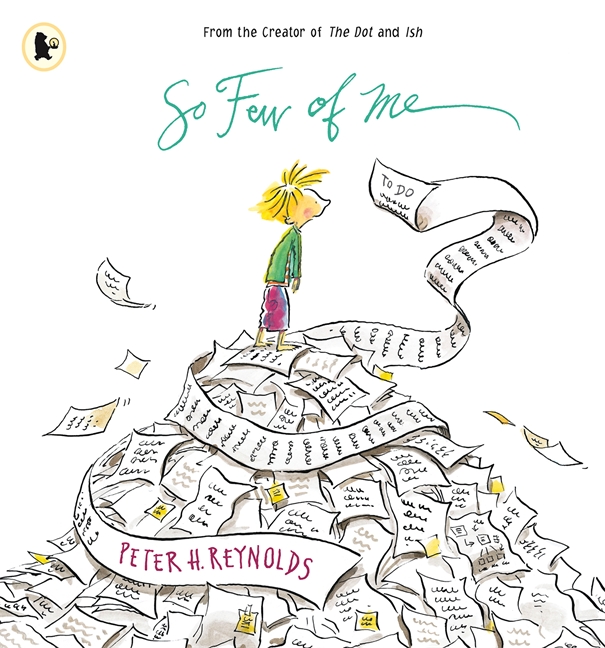
Oh – the never ending to do list! The reader doesn’t need to move past the inside cover and the overwhelming feeling sets in – that big long list that never ever seems to get shorter . . . The one here has some doozies on it – fix leaks, go to dentist, wash the windows, put dishes away, cancel Saturday (??!) Sigh, aren’t you tired already? And then we meet Leo. Leo has that problem that many of us share – no matter how hard he worked, there was always more to do. As his list expanded, he wished there were two of him to better handle things. And poof! There were.

When Leo opened the door and found “another him” we were pretty impressed in Division 5. “Awesome!” “Is that his clone?” “Wha. . . he must be dreaming!” “It’s fiction!” “Yep, it’s a book.”

(Now, this is the one time I don’t need to wish there were more of me. When responding to books – my students have it covered – they have the most brilliant things to say. I just need to do my part and read!)

The strange thing is two Leos doesn’t seem to make it better, there just seems more to do. So what about three? Four? Five? As more Leos come on the scene, the workload seems to increase. Hmm . . . of course! More people means more laundry, more cleaning, more organizing, more strategizing about being better organized. By the time nine Leos arrived on the scene, I had students with their mouths hanging open in amazement.

“This is soo fiction!” someone exclaimed. (Were we believing it up to this point?)

Ten Leos on the scene. Cooking, list making, brewing tea, grocery shopping, sweeping, climbing ladders, it doesn’t stop.

One student got that hold on here look suddenly, “Wait! Wouldn’t a Mom do this stuff?”

I was about to retort, “Hey, are you kidding with ten kids? No way.” But then I realized that this child comes from a family with children in the double digits! And he is asking that question? Oh poor Mom!

“Hey, if there’s more of you, you can’t get smarter!” someone ( quite a smart someone, I might add) shouted.

The last pages show us a lesson that so many of us keep forgetting. Do less. Leave time to dream. You really can’t do it all, so pick and choose and do what you love really well!

A lovely excuse to ignore the laundry pile and go read a book. Thank you Peter H. Reynolds!

Gilbert the Hero

Deborah, our BLG reader this week, read us Gilbert the Hero – a sweet little story exploring sibling dynamics, written by Jane Clarke and illustrated by Charles Fuge.

Having to look after his little brother Finn is a real nuisance for Gilbert the shark. Finn is too small for everything! Too light to weigh down the sea-saw (an  old oar). Too small to leap out of the water without “splash” landing. Too tiny to flick the sea urchin for a game of finball. Just a bother. So Gilbert and his friends decide to put Finn in a seaweed swing and play their own adventurous games. Oh . . . don’t you just know this is going to lead to something bad? A student piped up, “Remember at the beginning – the Mom said don’t leave your little brother!”

When a large orca bursts out of nowhere with a mouth full of fish, Gilbert realizes that Finn is vulnerable. Instantly, he is a protective older brother zooming into action – reminding us that underneath all of that sibling rivalry, the connections are strong!

Our student reviewers report:

Eddy: I liked the part when Gilbert and Finn were playing on the sea saw and Gilbert hit the ground because he was big and heavy.

Kevin: I was scared when orcas came. I was afraid if the orca will eat Finn up.

Annie: It was scary when the orca was about to eat the baby shark who was strapped on a swing but Gilbert saved him. I was relieved.


Bird Child

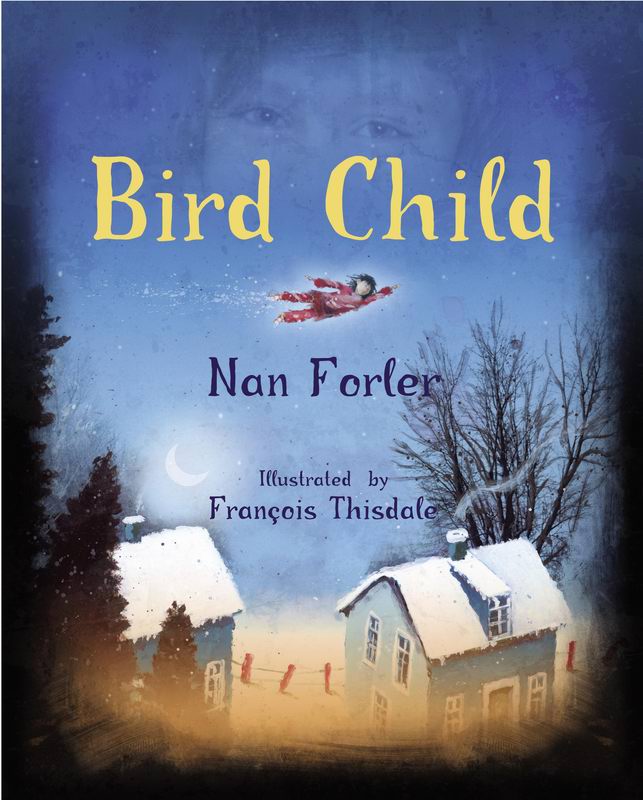
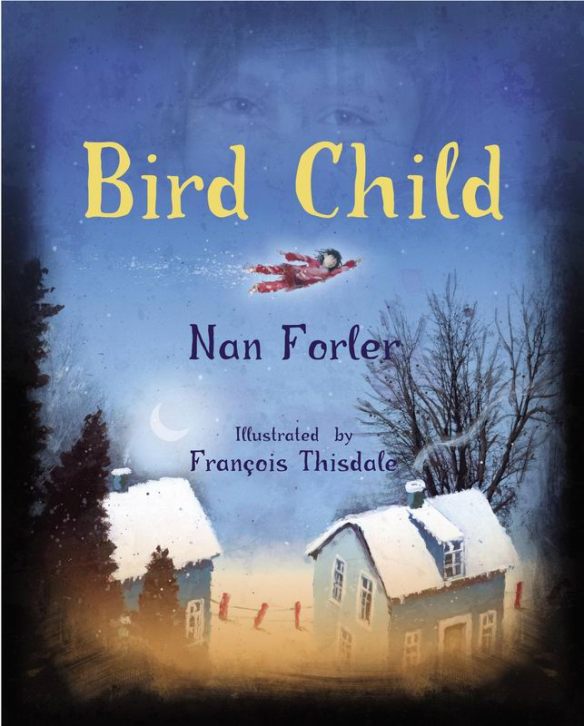
Today we read Bird Child by Canadian teacher, parent and writer Nan Forler. I came across this book at the public library and was thrilled to discover that it also touched on the active role of the bystander in the bully/bullied/bystander dynamic. We have been talking about this topic a lot using  powerful literature to inspire our discussion.
bird-2

Eliza is a tiny girl – skin and bones with hair as black as a raven. She was raised in a very special way – she was taught to fly. Wow! There were hands in the air instantly.”Is this true?” “Really?” When I asked the students what they thought, I got some very interesting answers:

Alyson: “It said her hair was black like a raven so maybe she got that skill from birds.”

Kevin: “Maybe she can fly because her bones are hollow.”

Hajhare: “Maybe she can turn back and forth between a bird and an animal like Eagle Boy.” (We have been reading a lot of Aboriginal literature lately with this theme)

I suggested that maybe the author was implying that she could fly in her mind. “Oh like visualizing,” said Kevin. “Yeah, she means it like an expression,” Ricky agreed. As we read further, we hear the words that Eliza’s mother always tells her, “Look down and see what is. Now, look up and see what can be.” Thoughtful words to always encourage Eliza to focus on possibility and with a positive perspective, to take an active role in changing situations to make them better.

A new girl, Lainey, starts school and rides the bus each day with Eliza. Lainey quickly becomes the target of teasing and exclusion. My students explored reasons that she might be bullied: Were others jealous of her beautiful drawings? Her hair?Are they making fun of her because she is new? Because of what she wears? Why are they so mean?

Soon the teasing escalates to stealing Lainey’s hat and burying it in the snow. A boy smushes snow into her face “wiping away what was left of the smile she’d had on her first day of school.” Silence in my classroom. Silence in the story. “Eliza said nothing. She stood like a statue her boots sinking deeper and deeper into the snow, her voice dry as a mouthful of wool. and watched it happen.” Such a heavy emotional scene. Illustrator Francois Thisdale makes the mood even more sad and somber with the smirking children laughing at Lainey, frozen Eliza in the background and Lainey with her eyes squished shut all alone in the wintery schoolyard with the barren trees and a pink skyline behind. There was a little bit more silence in my class and then the “Oh! Oh! Oh!’s and the waving hands started. We had things to say about this.

Jena: “Eliza is like a bystander and kind of like bullying her too. If she doesn’t tell, the bullying won’t stop. It’s like the Juice Box Bully.”

Alyson: “Eliza should stand up for Lainey.”

Lisa: “Eliza might be worried – that people would think she was a tattler.”

Miami: “This is like something that happened to me. My Grandma fell and people just walked by her. Nobody helped. Two men were sitting on a bench and they just kept sitting. I felt so bad.”

Children see everything we do and everything we don’t do. Sometimes it is not so much our actions but when we fail to act that haunts us. Eliza felt shame. She told her Mom everything and her Mom listened. “It sounds like Lainey needs someone to help her fly.” Eliza knew what she had to do. Alyson commented thoughtfully, “Maybe flying means helping her get through it.”

The next time Lainey is bullied, Eliza acts. She “reached down inside herself and found her wings” When she shouts at a boy to return Lainey’s hat, other children join in “Yeah give it back.” The bullies’ power bubble is popped and they walk away.

Scott: “She’s taking care of Lainey now.”

Miami: “You know what I think? I think she couldn’t stand watching her be bullied anymore so she just yelled.”

Jena: “Maybe Eliza did that thing – you know, putting herself in her shoes?”

Lisa: “It’s like the Juice Box Bully – maybe they will have a rule, that everyone needs to help others.”

Alyson: “Oh I know! It’s like a chain reaction – helping it to stop, standing up.”

Kevin: “It’s like that dance we saw on the movie at Pink Day (referring to the flash mob anti bullying video)

In the end, Eliza and Lainey play together building a snow castle to the sky. I ask: Why do you think this book was witten?

Ricky: “It’s a lesson to stand up for each other!”

Alyson: “Don’t be a bystander! Just stand up!”

Emilio: “Probably they made this book so people won’t copy other bullies and be mean.”

Bird Child: so much beautiful writing and visually, it is absolutely gorgeous. This book should have a special place on the shelf in every school library and should be read and discussed with students again and again. There are not enough picture books that so thoughtfully explore the active role of the bystander in changing the way a bully might act and the way a peer is treated.


Off along the road to learn

It’s been a two week break and we will all return to school tomorrow ready again – to learn. A perfect evening to read John Burningham’s John Patrick Norman McHennessy – the boy who was always late. This book has been a favourite of mine for many years and every time I read it again, it establishes itself as one of the best books ever (according to my list!)

The premise of this book is a simple one: John Patrick Norman McHennessy is often very late for school and his teacher never ever believes the reasons (dramatic as they are) that explain his tardiness.  The teacher gets quite distraught – shouting, becoming red in the face, leaping about as he doles out ridiculous punishments. Standing in the corner. Writing out lines. Repeating “I must not tell lies about. . . ” On and on. Finally, when John Patrick manages to arrive on time, his teacher is being held up on the roof by a big hairy gorilla. Hmm . . .

I must not . . . .

Lines, lines and more lines. This must be the answer for deceptive little boys with overactive imaginations! What I love about this book is that it is not actually simple at all. What a delightful boy to come to school each day with stories of trouser tearing lions, sweep you off your feet tidal waves and crocodiles who play tug of war with your school satchel. And yet, he is punished day after day after day.

But, each morning he gets up and sets off on the road to learn. What exactly is he learning, one might ask?

On the road to learn. . .

I look forward to third term in the classroom. Celebrating imaginations. Inspiring ideas. Thinking outside of the box! Off along the road to learn!