Unknown's avatar

About carriegelson

Elementary teacher passionate about all things literacy.

Canada From Above

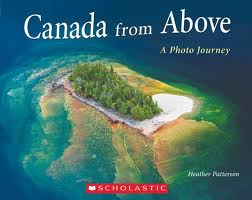
We spent time in the last week of school interacting with this amazing book, Canada from Above, by Heather Patterson.

We have been studying maps of Canada to learn about the provinces, territories and major bodies of water. But this book was something different. It took us off the page – high above Canada on a photographic journey from a bird’s eye view. Stunning photography of a majestic country. We liked guessing if a photo showed something natural or made by humans. Lots of times we had no idea what a photo was until we read the accompanying text. Belugas in Hudson Bay that looked like birds flying through the trees. Ice roads through the northern territories like nothing we had ever seen. A visual treat.

Books by Peter Brown

On my last visit to the library I picked up two new titles by Peter Brown. His books have big time kid appeal and I must admit, reading them out loud is pretty delightful.

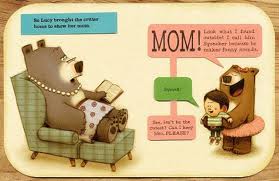
Children Make Terrible Pets is a lovely twist on the “Look what I found Mom and can I keep it?” story. In this story the “it” is a boy who Lucy the Bear names Squeaker because of the strange sounds he utters. Those children quick to infer realized that probably the boy was actually speaking but Lucy couldn’t understand his human language. Squeaker is lovely to play with, eat with and nap with but “potty training” him doesn’t go so well. When Squeaker goes missing, Lucy follows his scent and discovers that he has his own family and his own home. This leads her to do a lot of thinking and to finally conclude that yes, children DO make terrible pets!

Can I keep him PLEASE?

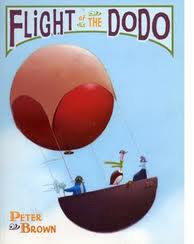
Brown’s Flight of the DoDo is an extremely amusing tale about a group of flightless birds (The Waddlers) who dream of being Flappers (birds that can fly). Why is it so delightful? Well, watching a penguin, an ostrich, a cassowary and a kiwi bird try to invent a flying machine is quite funny. Cassowary attempting to eat the fluffy white clouds brings a lot of smiles. But it is penguin’s determined (and then necessary) target pooping that steals the show. The DoDo is certainly one amazing flying machine. But it is really fantastic with a bunch of birds poised on its edge with bottoms aiming carefully at the ground below!

The Ice Bear

This past week, Bill read us The Ice Bear by Jackie Morris. The illustrations in this book beg to be looked at over and over. Absolutely gorgeous! When Bill showed the first picture there was a collective “Whoa!’ and Hajhare exclaimed, “Now that’s what you call Art!”

This book begins with a mother polar bear and her two cubs. They snuggle close to keep out the icy cold. Then trickster raven steals one cub and leaves him in a bundle of white fur for a hunter to find. When the hunter unwraps the bundle, he and his wife discover a baby boy. They were a childless couple who had longed for a baby and they treasured this child, a gift found in the snow. Raven always kept a close watch from above. At the end of the boy’s seventh year, he was lured away from home by a trail of shining amber in the snow. He thought the amber pieces were fallen stars and followed them until he was lost and alone. He was discovered by a group of polar bears who carried him to the mother bear who had once lost a cub. This boy was her stolen son. The curious idea of the boy/bear appealed to the students and they were hard pressed to think of where this boy should truly belong. A loved little boy with his heart pulled in two directions. In the end, he makes a decision that seems exactly right. Jackie Morris pulled us into this magical Arctic world – what a beautiful journey.

Student reviewers report:

Annie: It was sad when the baby bear got caught by the raven.

Hajhare: I like this book because it is interesting. This book is great! I like it because it is one of those books that are fantasy. I like fantasy books because they always have beautiful pictures.

Josiah: I liked this book and it was kind of an Aboriginal story. It was cool how the polar bear turned to a boy.

Scott: I have a question. How did the bear turn to a human? This book is the best. I love the drawings.

More on Poop

Well, yes, it is true we are addicted to Poop (the book Poop of course!) Every page of this little book is full of fascinating facts on poop. We have been reading and learning in every spare minute and just have to share our new learning. (For Poop Part 1 read here) Nicola Davies and Neal Layton have created a book to keep you busy learning, reading and stopping to say “Really? Wow!” all on the topic of poop.

We learned that many predators use poop as clues to where to find their prey. So many animal parents get rid of their young’s poop to keep their babies safe and hidden. Jenny had a connection. “So it’s just like you can follow footprints, poop can be like a trail to lead them to the prey.”

We learned that golden moles in Africa stay underground all of the time to avoid being eaten. So they make one chamber in their large burrow just for pooping in. This prompted much discussion.

Ricky wondered, “But if that chamber gets full . . . do they just make a new one?”  Jena suggested that the moles could fill that chamber, close it off and then dig a new one. Kevin pointed out “This is just like we make a bathroom place in our houses.” (Unfortunately moles don’t have that flush feature that is so handy for us!) Miami asked, “Do they eat their poop to get rid of it?” This is not a farfetched questions as we had just read about rabbits eating their feces to get more nutrients out of it.

We then read about latrines (animal toilets) of the giant otters in South America. They use their latrines as more than just a toilet. They make a large flat area on the riverbank and poop all over it. This big smelly area is like a sign that says stay away: we made all of this poop, it is our area! The students found this quite amusing. “Like a big sign to say stay away!” “It’s a poop shield. You can’t get to us!”

We continued to read more intersting poop facts and Ricky piped up. “Scientists want to know things and they learn a lot of them from poop. They even studied dinosaur poop – prehistoric poop!” “I want to be a poop scientist,” said Eddy. “A poopologist,” suggested Josiah.

We then read about sloths and how they climb down their tree and poop every four days. Jenny wondered if they poop really slowly too. Good question!

At the end of our reading I asked students to share their new learning. Here is some of what they said.

Miami “Sloths eat lots and lots of leaves.”

Lisa “If sloths poo, they go down the tree to do it in a big pile and then back up every 4 days.”

Kevin “Sloths sniff other sloths poo to see what’s happening.”

Edwin “It’s weird that sloths have poo piles near each other. If they made them together, it would be huge.”

Jena “Some animals sniff other animals poo to know what is going on like who is pregnant.”

Ricky “Male hippos wiggle their tail when they poo to tell other hippos they are fierce and strong. The poo sprays everywhere.”

Have we tempted you yet to go and read this book?

So Many Days

Sometimes I read a book and I don’t know what to do. Sigh and savour? Read it again instantly? Pack it into my school bag to share? Just stop and think . . .?

So Many Days by Alison McGhee and illustrated by Taeeun Yoo is exactly that book.

I want to read it again. But I might cry. Or maybe not. Maybe I will just smile. This book is all about potential. Possibilities. Choosing a path and following it. Being loved. Succeeding. Falling flat. Who will you be and where will you go?

I found this book at the library. But I think I need to own it. A book to give as a gift. To someone graduating from something. Someone on the eve of parenthood. Someone who needs to be reminded: You are loved more than you know.

Lovely.

Argus

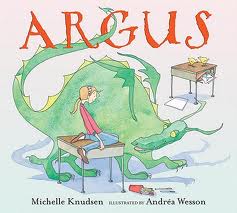
Maria, our BLG reader this week, brought in Argus written by Michelle Knudsen and illustrated by Andrea Wesson. When Maria sat down, holding the book to her, students spied the back cover and started oooing and oh, oh, oh – ing! They had spotted a picture of 3 little chicks crawling around a classroom floor. “Maria we have chicks! 3 of them! Just like the picture!”

This is a story about Sally and her charge, a “little” egg that was supposed to be a fluffy little chick but turns out to be a green scaly dragon. Right from the beginning when Mrs. Henshaw hands out eggs to all of the children to begin their science projects, Sally’s egg looks different. The children kept the eggs in their desk top incubators. Little beaks begin to poke through the cracked shells. But Sally’s egg splits open to reveal a scaly green back. Mrs. Henshaw keeps assuring Sally that some chicks look a little different but Sally wasn’t so sure. She tries to go along with it, names her “chick” Argus and begins to document his growth and development in graphs and pictures just like all of the other children. Our students kept grinning big knowing smiles – they had also weighed and measured and charted our little chickens and their growth. So much connecting!

Sally needs to be an active guardian of Argus. The other chicks peck for seeds or beetles and Argus tries to eat the other chicks! This behaviour ended when he grew bigger and attempted to eat the children instead! Sally worries that her “chick” is not working out. She is envious of the others who can pet the heads of their little chicks. She can’t even reach Argus’ head unless he is lying down. Then Argus goes missing. Sally panicked and then stopped herself. Wasn’t this a good thing maybe? Now she could share another chick and stop being so different. She should be happy, she thought. But happiness never reahed her. Sadness did. And worry. And anxiety. Where could Argus be? Ricky suggested he might have gone to a meat store! Soon Sally could contain her emotions no longer and her classmates help her search for Argus.

This story has a very lovely ending and the students were glued to the final few pages. Then somebody looked over at our little chicks who were snuggled together in their brooder, asleep. “It’s a bedtime story for the chicks!”

A wonderful story about accepting diversity and celebrating friendship even with things big and green.

Our student reviewers report:

Scott: I have a connection when we have three chicks just like the book. I like this book because I really like the dragon.

Jena: I like this book because Sally lost Argus which is a dragon. But everybody else had chickens. When Argus is gone, Sally thinks she will share a chicken. But really she misses Argus.

Alyson: I like this book because it was funny and sad. It was the best book ever!

Hajhare: I like this book. It connects to this book called Clifford where a girl loses her huge dog and her friends help her find it. I like this book because it’s about chicks and we have chicks!

Eddy: Why did the teacher think Argus the dragon was a chick?

Josiah: I like BLG. No!! I LOVE them. I liked Argus and I felt sad for him because he didn’t fit in with the chicks. How can he eat a whole block of grass?

The Lion’s Share

One of our read aloud stories this week was The Lion’s Share – A Tale of Halving Cake and Eating it, too written and illustrated by Matthew McElligott

A little ant is invited to a special dinner hosted by lion and she wants to make a great impression. She is appalled by the manners and behaviour of the other guests who all arrived late and ate their way sloppily through the meal. After dinner, lion brings out a large iced cake and tells his guests to help themselves.

Students were suspicious. “He is just going to fatten them up and then he’ll eat them all,” suggested Jeremiah. Ricky agreed but added, “He will need a pack to bring down that elephant!”

The animals each took half of the cake and passed it on. The pieces became smaller and smaller (1/2 became 1/4 then 1/8 etc.) until the ant received her piece and crumbled it while attempting to slice the tiny sliver into two. The animals all appeared offended, accusing the ant of not sharing. The ant, wanting to make up for her supposed transgression, offered to bake a special cake for the lion. Well . . . none of the other animals wanted to be outdone by the ant and begin to promise cakes as well – each offering to bake twice as many as the last offer.

“Wow! This is like math!” exclaimed Jenny as students began doubling the numbers to predict what the next offer would be. After each animal had made his or her offer, we added all of the promised cakes together using a variety of addition strategies. 511 cakes! (1 + 2 + 4 + 8 + 16 + 32 + 64 + 128 + 256)

“Why was each animal promising to bake twice as many?” someone asked. (It’s great when students get to use math vocabulary in a meaningful context as it is often the language and not the operations which throw them with word problems)

Students answered. “To show off.” “To beat the others.” “They are competing.”

“But the ant was just calm.” said Scott.

The rest rushed it and the ant’s cake was the best.” observed Kevin.

“The ant wanted to make it special but the rest were competing.” Jena agreed. We had a great conversation about quality vs. quantity.

Then the math thinking just began to flow. Alyson noted, “511 cakes would take more than a year to eat if you ate one cake a day.”

“But less than 2 years,” said Ricky. “Because if you double 365 and you get 300 and 300 – that’s 600 so you already know it is more than 511.”

A lovely read aloud that led to some spontaneous math thinking. Fractions. Doubling. Addition. And some pointers on table manners! What could be better?

Highly recommended.


Poop. Everything you ever wanted to know. And then some

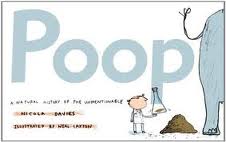
Our current read aloud is a non-fiction title. On a kind of gross but okay, let’s admit it, kind of a lot of fun to talk about topic: Poop – A Natural History of the Unmentionable written by Nicola Davies and illustrated by Neal Layton.
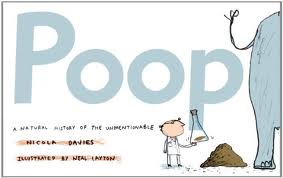
How can you not love this book? The cover shows a huge elephant behind with a pile of dung and a little scientist carefully examining the specimen. Open up the cover and notice that it is all brown and smeary coloured. “Eww! Is that real poo on there?” someone asked. (No, it’s artistic suggestion 🙂 )And then on the first page you get to learn that feces is the proper name of poop and that if we were speaking scientifically, we would know that all animals defecate (meaning to poo). So it seems that reading this book will make us into scientific experts on poop. Excellent!

Today we decided to use Adrienne Gear‘s Questions and Inferences sheet from Nonfiction Reading Power to record some of our questions and what we were inferring as we listened to the text.

The level of engagement was pretty high. Poop is an interesting topic! Near the end of the lesson, Jena commented, “Who knew poo could be so interesting?” Indeed.

We practiced asking some questions/inferring together when we looked at the first few pages titled – A Tour of Poop

We noticed that tapir poop seemed to have hair in it. Nobody knew what a tapir was so it seemed to be the perfect question to do some inferring.

Question:  Why does some poop have hair in it?

Our inferences:

Jenny: It must mean they are predators. The hair is from their prey.

Eddy: Maybe they have furry bums. When the poo comes out, it gets covered in their own fur.

Miami: I’m thinking that – perhaps, they licked their babies’ fur to clean them and stuff. So that’s how hair got into the poop.

Manny: Maybe it’s not hair. Maybe it is grass and they eat grass. Maybe it just looks like poop. If it is hair, why doesn’t the stomach acid eat the hair?

As we read on, we found out that meat eating animals (carnivores) have poop that contains hair, fur, feathers and bones. But I love all of the thinking we were doing to come up with different possibilities!

Most conversation and discussion was related to the text but as I read and we shared our thinking some students just couldn’t help sharing. A few hilarious statements I overheard: “I feel better when I poop.” “Do you think everyone pees a bit when they poop?” “Do you think we would explode if we never pooped?” “My Dad got diarrhea when he ate spicy pork.” Poop is a great topic of conversation! Maybe not to use at your next dinner party but when hanging out with primary students, it rates pretty high!

During our sharing someone asked this question: “Why do we fart?”

Kevin happily shared his thinking. “Maybe when your body has no more poop in it, there are still poo smells that need to get out so you need to fart.”

This was a very popular suggestion. One student responded. “Oh! Oh! Kevin may I write that down on my sheet?” “Yeah me too,” someone else said. We love to share our thinking! 🙂

Some other questions/inferences from our sheets:

Hajhare: Does poo have food in it? I think it does because the food all combines together to make it brown.

Edwin: Why is animal poo smaller? Maybe the animals don’t have big tummies like people.

Kevin: What happens if you poop a lot? I think you live longer.

The students can’t wait to learn more about poop! Stay tuned!


Sophie Simon Solves Them All

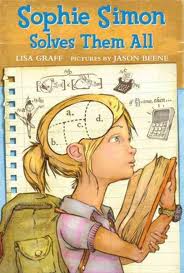
Ms. Gelson is currently reading Sophie Simon Solves Them All, a novel by Lisa Graff. Illustrated by Jason Beene.

Our class has been quite intrigued by the character, Sophie Simon. Her parents absolutely do not understand her and keep calling her strange food names as terms of endearment. Her classmates who try to befriend her, baffle her. All she wants is an expensive ($100) graphing calculator and for everyone to leave her to her thick textbooks on calculus or civil disobedience. When her classmates, who are also hopelessly misunderstood by their parents, ask for her help, she agrees. She will help if they pay her – she really wants that graphing calculator. Her plan seems foolproof. One that will help everyone get what they want. But . . . things, as they often do, turn out a little differently.

Sophie’s plans involve a hilarious sit in at a ballet recital, an observant student journalist and a ring tailed lemur who (with Sophie’s help) destroys a birthday party (a poolside adventure involving diving boards, salt water taffy and grasshoppers).

Lots of laughing in this book. Especially at adults and their ridiculous ways. Sophie’s teacher, Mr. St. Cupid,  has more rules than you can possibly imagine and is constantly adding to his list. (No sighing! No reading books fatter than your head! No dropping three things at once!) Parents also come across as clueless. But when you are 6-9 years old (the intended audience of this book), this is pretty cool.

A short read. Perfect for June! But also perfect for students wanting a great book to kick off their summer reading. Themes of resourcefulness, teamwork and friendship.

Gunner, Football Hero

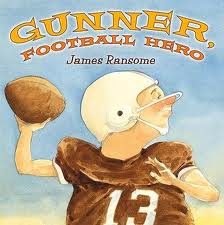
Our BLG reader this week, Deborah, read us Gunner, Football Hero written and illustrated by James E. Ransome.

Gunner, Football Hero

A gorgeously illustrated story about an unlikely hero – rotund little Gunner with an amazing arm makes the cut for the football team – as third string quarterback. At first Gunner happily warms the bench but then, when injuries take out the first two quarterbacks on the team, Gunner gets to play! Does the game work out? Does his team win? Does it really matter? A book about sportsmanship, great attitudes and the twists and turns of team play. Read this little gem carefully – the ending might surprise you!

Our student reviewers report:

Josiah: I liked Gunner because when he wasn’t on for a while, he was still happy and he got two touch downs!

Kevin: Gunner loves football. He always played football at the field and he “leaved”very late!