Fairy tales, Anthony Browne style

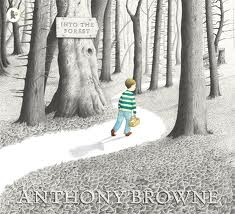
Recently I read our class Into the Forest by award winning author/illustrator Anthony Browne.
into the forest

A boy is awakened by a terrible sound and so some upsetting days begin. Dad is missing from the breakfast table, Grandma is sick and he must take a cake to her. “Don’t go into the forest,” his mother warns. But anxious not to miss his father’s return, the boy decides to take a shortcut through the forest and his strange adventures begin. We certainly connected to the anxiety and suspense along the way to Grandmother’s house. The students expressed feeling worried. Someone said that his tummy felt weird. There was a lot of gasping and held breath. Such suspense. As we came across oddly familiar fairy tale characters, students were eager to shout out their connections. “That must be Goldilocks!”, “That’s not that candy one where the witch takes them is it? It is?!” One student described the feeling the book gave her as a “tingling in your brain” because it seemed like we knew the story but we kept worrying about what might happen. Finally, all is well. Our happy ending finds Dad and a recovered Grandma and boy and father return home to Mom.

Watching the students connect, predict and infer, I was reminded about how important it is to develop rich story schema with our students. They need to know their fairy tales, fables, favourite rhymes and be exposed to literature from a variety of genres. When they bring this rich experience to “new to them” books, they are able to interact with the book on a much deeper level as they pick up on nuances, allusions and references to other stories. As parents and teachers, we must read, read read and then read some more!

A few days later, I found another (new to me) Anthony Browne book at the public library – also giving a new twist to a well known fairy tale, Goldilocks and the Three Bears. Me and You does an amazing job of telling simultaneous stories, letting us into the world of Goldilocks while at the same time we revisit the familiar story about the bears.
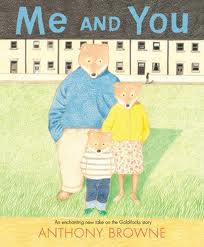
As we flip through this book, we find two stories. On the left, sepia images of the little girl, out on an errand with Mom and then suddenly, lost.

Her story is wordless, told just through the images. Lost. Afraid. Alone. Finding a cozy home, a snack, a warm bed. Being discovered and racing away. Walking through rain, empty streets and then finally, into the arms of a searching Mom.
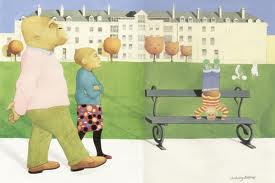
On the right, we follow little bear and his Mummy and Daddy as they head out for a walk and then return home to find a stranger in their home. A version of the Goldilocks story that we are very familiar with. Full of comforting colours. Lots of happy yellow, soothing blues, calm greens. I love the last line of the book. Little bear looks out of his window, thinking about the girl. “I wonder what happened to her.” This story definitely blurs the absolutes of fairy tale right and wrong and introduces a lovely element of empathy.

I am a big, big fan of Anthony Browne!

Willoughby & the Moon

Greg Foley‘s Willoughby & the Moon takes us on many adventures – a trip to the moon with Willoughby and a giant snail, a space adventure on a moon buggy and a space pod and an amazing visual journey in deep black, white and silver – glowing pages full of shimmery snails, shadowy images of the craters on the moon and detailed moon maps that make us all the more curious . . .

Willoughby cannot sleep. In his dark, dark room, he assures his mother that he is not afraid of the dark – he is just wondering where the moon has gone. Later he spies a light under his closet door and discovers that inside his closet a giant snail is standing upon the moon. So begins an adventure with his new, tentative friend the snail who is in search of his lost ball. Willoughby helps in the search, as snail is afraid of many things. They search rocks, craters and mountaintops. Eventually, it is Willoughby who must face his own fear (psst it actually is the dark that scares him!) in order to help his friend. A wonderful moon experience with absolutely stunning images. We had to break out the silver crayons to illustrate our responses!

Some responses in need of  sharing:

Hailey: The snail was scared of heights, rocks and craters. The boy was scared of the dark cave.

Jenny: I liked the part when Willoughby did a brave thing for his friend.

Alyson: The boy should encourage the snail that everything is not so scary. The snail encouraged the boy to go in the dark.

Ricky: I’m curious about the moon. I want to go there and when I get back, I’m going to tell all about my adventure. But, I’m not old enough to go. I’ll just visualize it. I wish I could see how big the moon and craters are.

Kiss me! (I’m a Prince!)

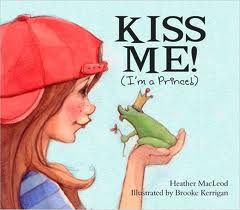
Maria, our BLG reader this week, read us a very different kind of fairytale. Kiss me! (I’m a Prince!) written by Heather McLeod and illustrated by Brooke Kerrigan,provided many surprises. Not your typical frog turns into prince and all live happily ever after by any means!

kiss me I'm a prince

So okay, first of all, you have got to know if you say the word kiss to a bunch of 7 and 8 year olds, it is going to get some giggles. Have that word repeated often in the story – “Kiss me! Why won’t you kiss me? Hey, hey, hey!” and you have everyone’s attention!

Our poor frog in this story is truly a prince and to get turned back – yep you guessed it- he needs to be kissed! He finds Ella and begs, “Kiss me. If you kiss me, I’ll turn into a prince.” He’s pretty persistent. Ella, though, is not so sure. “You’ll turn into a prince, but then what?” When the princely and promised princess life is described, she is definitely not impressed. Studying? Horsemanship? Suits and gowns? This life seems pretty devoid of play. She would rather have a talking frog.

So the frog gives up on getting kissed.

Maybe he’ll take a hug? suggested Miami.

Then Ella shows him the wonderful world of play time and he actually forgets about being a prince until a royal courtier arrives and takes him back to the castle.  When he returns to visit Ella, he is still a frog. He needs the true kiss of a friend to be transformed back. Ella wonders if this is what he really wants? He assures her that he has convinced his parents that a prince needs some down time in his day and they have agreed. “So yes, Ella, I want you to kiss me. Please?”

How does the story end? Well . . . they played happily ever after.

Our student reviewers report:

Josiah: I thought the book was very funny. The frog kept saying it over and over – Kiss me, I’m a Prince!

Ricky: Maria, that was a really great book you read! It was funny when the girl imagined that she was going to kiss the frog but she didn’t.

Jena: At the end, I thought it was very interesting because when she told the frog about having fun and playing hopscotch and swimming and Simon Says, the frog and Ella (the girl) turned out to be really good friends.

A great choice Maria!


On Earth . . .

On Earth by G. Brian Karas is a wonderful book to introduce how the Earth moves through space, why we have night and day and what causes the seasons.

I was curious about what the students already knew. We examined the front cover which folds open to reveal the image above as well as part of the earth in darkness, surrounded by space.

What do we know? Let’s access our background knowledge! And pose some questions. . .

  • In one place it is day and another it is night (Edwin)
  • The Earth spins around once in 24 hours (Ricky)
  • What happens if the sun and moon come together? Would the moon melt? (Jeremiah)
  • That’s an eclipse! (Josiah)
  • The sun can only shine on half at once (Edwin)
  • At different places on Earth, there can be different times (Jena)
  • Why can’t we feel the spinning? (Scott)
  • Space never ends! (Ricky)
  • Why when you face the sun, you can’t see the planets? (Alyson)

As we read, more thinking and questions happened.

  • How does the Earth spin? (Ricky)
  • If planets were more away from the sun, are years longer? (Alyson)
  • Does the Earth also go around the sun? (Jenny)
  • What happens if the sun got sick? (Scott)
  • If there was no gravity on Earth, we would float out into space (Josiah)

Lots of great learning happened with this book and students were able to use new vocabulary in their writing: axis, orbit, gravity, seasons, equator.


If you Decide to Go to the Moon

We have been reading If you Decide to Go to the Moon, written by Faith McNulty and illustrated by Steven Kellogg. It begins: If you decide to go to the moon in your own rocket ship, read this book before you start.

if-you-decide-to-go-to-the-moon

We are taken on a journey (on a rocket ship 🙂 ) to the moon and back and learn all kinds of cool things about travelling in space and important facts about the moon along the way.

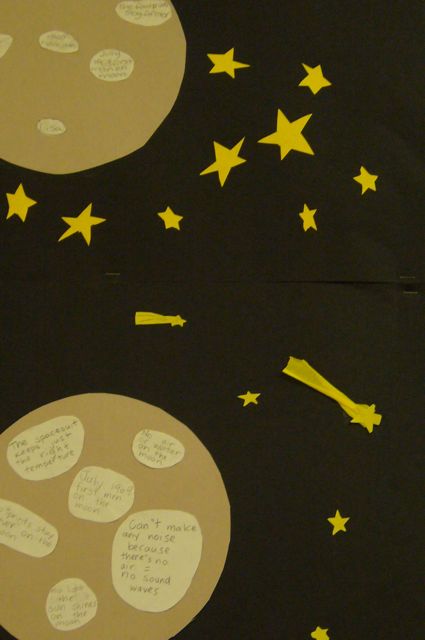
We represented our learning with large space pictures including stars, rockets and the sun.

art1

Facts and questions about the moon were included as fact craters or question craters and glued onto our pictures (inside the moons).

Some key facts we learned today?

  • there is no water on the moon
  • there is no sound on the moon because there is no air to carry sound waves
  • the moon is scorching from the sun’s heat or freezing when out of the sun’s heat
  • the moon has no light
  • the moon is covered in dust
  • craters on the moon are holes made by meteors that have landed on the moon throughout time

art 2

We also learned some pretty neat things about what it is like for astronauts to travel to the moon. Did you know it takes two and a half days to get there (by rocket)? Many people think it would be fun to try and walk on the moon where there is such little gravity. We found it fascinating that astronauts’ footprints stay on the moon forever because there is no wind or rain to wear them away. Most of all though, everyone wanted to look back to Earth from the moon and see what it would look like. Maybe some of us are future astronauts and will get that opportunity . . . .?

A fantastic book as an introduction to the moon and space travel.


Some great new books from Scholastic

Some popular picture books in our new book displays – purchased through Scholastic book orders.

Mouse was Mad by Linda Urban and illustrated by Henry Cole. How is little mouse going to express his anger? His stomping can’t shake the trees like Bear. His screaming doesn’t echo through the woods like Bobcat. This makes him so mad that he stands perfectly still. He breathes. The other animals join in, breathing too. Suddenly mouse is no longer mad. Hmm. . . Look what breathing can do for you! For a MindUp classroom, this book made a whole lot of sense!

The Very Itchy Bear by Nick Bland is very amusing. The Very Cranky Bear returns – this time bothered by a troublesome little flea.

Biting high and biting low,

This is flea biting Bear under here and over there

Absolutely annoying until Bear flicks flea into the ocean and finds himself all alone and flea finds himself almost dinner for a hungry bird. In the end, these two become appreciative friends.

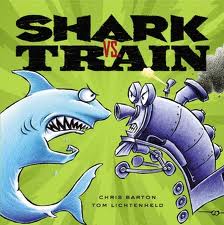
Chris Barton and Tom Lichtenheld bring us the award winning bestseller Shark vs. Train. This book is pulled off the shelf almost daily. It is pretty hilarious. In the hands of little toy box raiding boys, shark and train come to life to battle. Who will win in these very imaginative scenarios? In a hot air balloon? Roasting marshmallows? (hint – shark is all wet!) Giving rides at a carnival? Playing hide and seek? (Really they both fail miserably on this one – steam and fins are just too obvious!) Who wins in the end? The call for lunch!

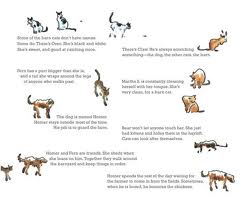
What a book! Details of what happens on a farm day in and day out. Who lives there? The farmers, the cattle, the chickens, countless cats, etc. What do we find? Barns, sheds, tractors, trucks, plenty of equipment . . . And what exactly happens? Enough great details to fill a book that you have to really settle into to finish reading. A great read aloud but also a great book to explore with a friend. Elisha Cooper‘s Farm is a must for the primary classroom.

Today it was a book to read and chase me with, recounting new facts learned. “Ms. Gelson did you know that cats eat grasshoppers? “Ms. Gelson, dirt can look like dark chocolate!” On and on!

I love new books! Happy reading!

What’s it like to be sister number three?

We seemed to be all about girl power this weekend at the library – maybe because it was just my daughter and I, but our big stack of books seemed to include a lot of books about very cool girls – some books new to us and some old favourites.

Two books to talk about featured the youngest sister in a family of three girls. Not fairy tale stories where everything comes in threes including sisters – but books from the here and now that explored themes of identity, self-esteem, and acceptance.

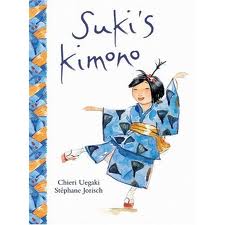
Award winning, Suki’s Kimono is a family favourite at our house. We love how Suki possesses a joyful inner spirit and how she lives in the moment not worrying about what the world might think.  Suki adores her blue cotton kimono – for the memories that it holds and the way it makes her feel. She vows to wear it on her first day of school despite the disapproval of her older sisters and manages to maintain the magical happy feeling of wearing this special kimono throughout her day even when questioned and taunted by classmates.  Written by Chieri Uegaki and illustrated by Stephane Jorisch.

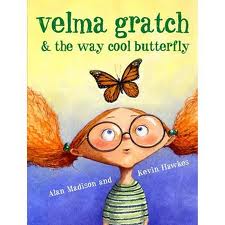
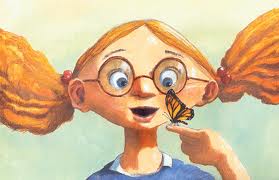
Look at that cover. Aren’t you just rooting for Velma before you even know her issues or struggles? Kevin Hawkes, illustrator, helps create a wonderfully unique character in Alan Madison’s Velma Gratch & the way cool butterfly. Velma arrives in first grade in the shadow of her two older sisters known for their seemingly perfect qualities – athletic abilities, spectacular spelling and marvelous math. Velma wanted to be noticed but for what? She chooses some quite foolish ways to stand out: running the slowest, singing the loudest, muddling her math . . . None bring quite the effect she is hoping for. Slowly, Velma learns to recognize a passion – science. When her class begins to learn about butterflies she twists wonderfully new words around in her mouth – metamorphosis, conservatory, migration. Not only does Velma come into her own as a butterfly expert, but on the class field trip to the conservatory, Velma is noticed by a monarch who lands on her finger and doesn’t leave for days.

Velma releases her monarch with the others from the conservatory a few days later, waving goodbye as they begin their journey south. Velma has gained a little power of flight herself as she floats home between her sisters, happy and confident.

Isn’t it wonderful when the youngest members of a family can teach everyone a thing or two?

Tyrannosaurus Drip

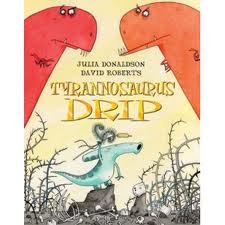
Sam, our BLG reader this week, brought in the very fun book Tyrannosaurus Drip by Julia Donaldson (of Gruffalo fame) and illustrated by David Roberts. Rhyming text, dinosaurs, lots of humour. What is not to like?

The story? A duck billed dinosaur egg ends up in a T-rex nest. Mommy and Daddy Tyrannosaurus are not too impressed with this little vegetarian offspring that hatches. The feeling is mutual and little Drip (cruelly named) decides to run away. He discovers some amazing things. One, he can swim! Two, he seems to look a lot like these lovely creatures who celebrate weed eating over meat eating. Clever little Drip outwits the tyrannosaurus family and is celebrated as a hero!

Watching everyone join in with Sam on the repeating parts was pretty cute! Some students definitely got the rhyming – some not so much.

And spluttering, and clinging to the branches of the tree,

They went whooshing down a waterfall and all the way to sea

Student ” You mean the ocean?”

Sam (gently) “Yes, but ocean doesn’t rhyme.”

Our student reviewers report:

Gary: “I liked the story because it rhymes. The story was funny when the mother jumped and broke the tree!”

Jeremiah: “I liked the book. It was cool. I like dinosaurs a lot.”

Jena: “I thought the part was funny when the tyrannosaurus sisters saw their reflection and got scared.”

Lisa: “I like this book because it rhymes like a poem. It was funny when Drip refused to eat meat.”

Josiah: “I like the book when the small dinosaur stole the egg and brang it to the Tyrannosaurus and then it hatched. When they gave him chicken, he said,”No I am a plant eater!”

Two goldfish? Or . . . your Dad?

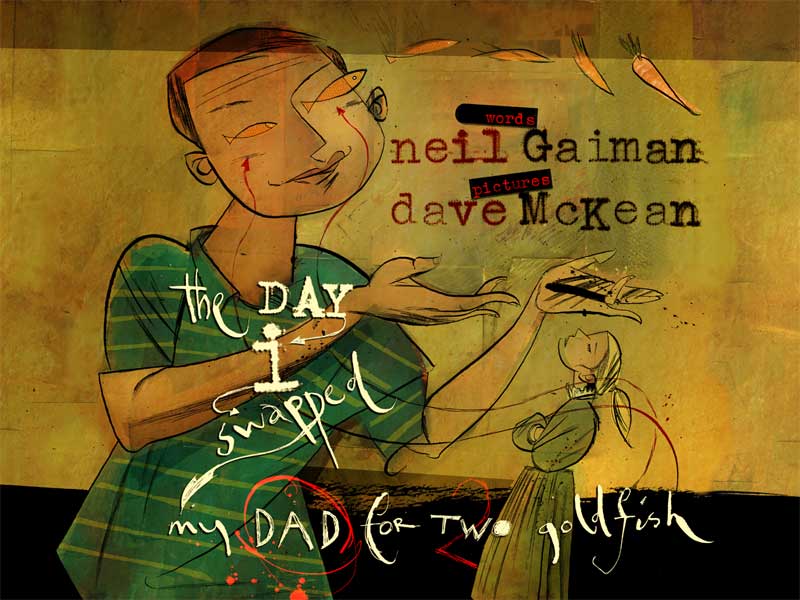
Author and illustrator Neil Gaiman and Dave McKean are a brilliant team. Their book, The Day I Swapped my Dad for Two Goldfish had that amazing silencing power over my classroom – so engrossing that at times there was not a word! And then at other times, volume turned high in discussion and debate – on task talking! Yippee!

Day I Swapped

This book in and of itself is pretty darn amusing. The conversation and comments it inspired in the classroom – hilarious!

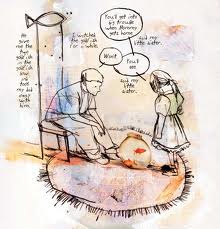
Nathan comes over with two goldfish in a bowl. They were pretty neat – reddy-gold and beautiful swimmers. A swap is proposed. The problem – Nathan isn’t interested in anything offered, not the transformer robots, the annoying penny whistle or the punching bag. So some deep thinking happens: “I’ll swap you my Dad.”

Whoa!! This caused quite the commotion in our room. Nathan, back in the book, was sceptical. One Dad for two goldfish doesn’t seem quite right until it is pointed out that a Dad is as big as a hundred goldfish. And he can swim (“Can’t” protests the little sister) So Nathan leaves with a newsparer reading Dad and the two goldfish remain.

So I ask: What do you all think? Is it a fair trade? I love how they take this question absolutely seriously!

Kevin: “No! A Dad is more useful than goldfish.”

Hajhare: “A Dad is more valuable, he grew up with you.”

Jeremiah: “But he still has his Mom.”

Hajhare: “Nope a Dad is not available.”

Alyson: “Without the father, you can’t have another baby.”

Lisa: “The Mom will be pretty surprised when she gets home.”

And of course Mommy says, “You can take these goldfish over to Nathan this minute, and don’t you come back without your father.”

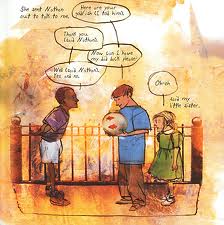
But this is a little bit more difficult than first seems because Nathan has done some more swapping.

Alyson: “My Dad is more expensive.”

My important clarifying question: “How much is a Dad worth?”

Hajhare: “Love!!”

Ricky: “Dads have mastercards.”

Kevin: “Why don’t you ask a Dad to buy you goldfish?” Indeed!

We began to think this swapping might not end. There was much more searching following the trail and a gorilla mask, Galveston the rabbit and the Queen of Melanesia enter the story. Finally the Dad is recovered still reading the paper and sitting in a rabbit hutch.

Hajhare: “I think the message is Moms are all about love and Dads are about newspapers.”

Manny: “No that’s not the message. It’s – don’t let kids trade people.”

Whatever the message, this book is an adventure worth reading. (Preferably out loud to some opinionated children 🙂 )


Moms are Supergirls!

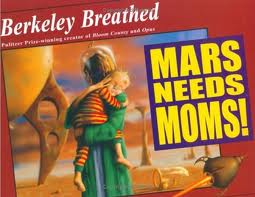
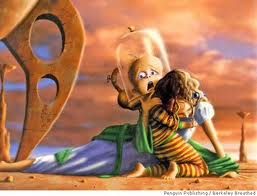
The movie trailer is out – Berkeley Breathed’s Mars Needs Moms! is now a movie. I felt a little bit of pressure to get this book read before my students had no idea that the movie was based on a book. Because it really is such a great book! Almost always, in my opinion, books trump the movies even without the special effects! There is an intimacy that happens when we share a book that a movie just can’t touch. And you are allowed to interrupt with comments and questions and nobody says SHHHH! At least not in our class!

So I asked for some predictions before we started reading. Look at the cover – What do you think this book is about? (predictions especially appreciated from those people who hadn’t seen the trailer!)

A boy needs a Mom to go to space with him!?” “No, it is the Martians that need Moms to take care of them.” “Yeah because Moms are superheroes!” “No – they are Supergirls!” Absolutely!

Really what happens is that Martians have been keeping an eye on Earth and have realized that since they have grown up motherless, they will need to send Martian Raiders (with a big net) to capture some Moms. Milo, who has been doing some pretty serious Mom bashing (using terms like bellowing broccoli bully and carrot-cuddling cuckoo to describe his loving mother) watches his Mom be grabbed and rushed into a waiting spaceship. (“Do aliens eat Moms?” Scott wondered.) Milo follows, stowing away on the ship. Exiting the spaceship on Mars, he trips and falls and his helmet smashes to bits. Breathing Martian air – Milo is doomed! Until . . . a figure appears and gives up her helmet so Milo can survive.

Milo’s Mom places her helmet on his head and tells him, “I’ll love you to the ends of the universe.” And then she passes out. “She is sacrificing herself,” Jena explains knowingly. “What does that mean?” “It is when you give up something you really need.” “Oh,” says one of the boys nodding, “that’s what Moms do.

Yep, Supergirls!

Read the book before you see the movie! It’s worth it!