Monday February 2nd, 2015

It’s Monday! What are you reading?

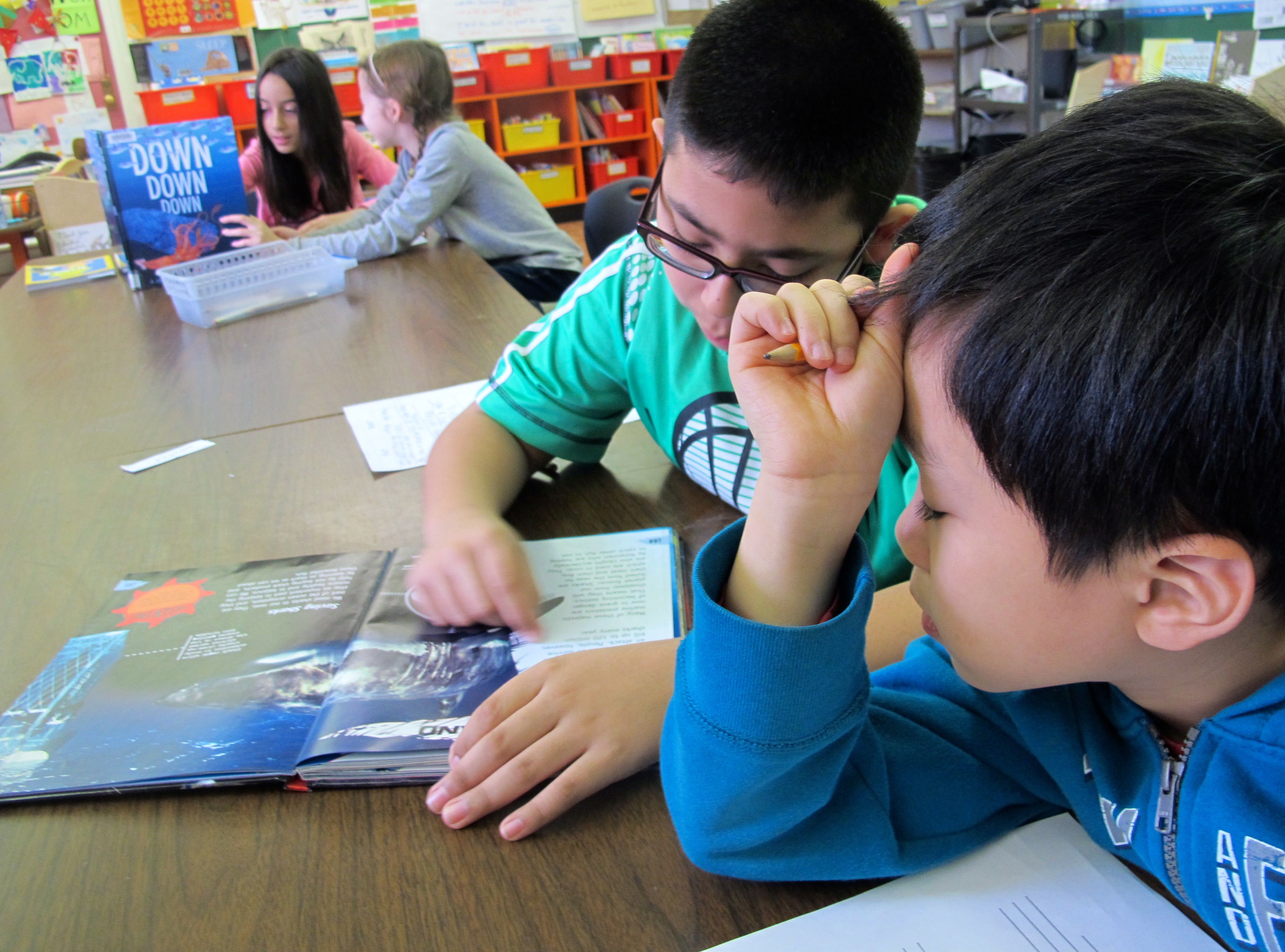
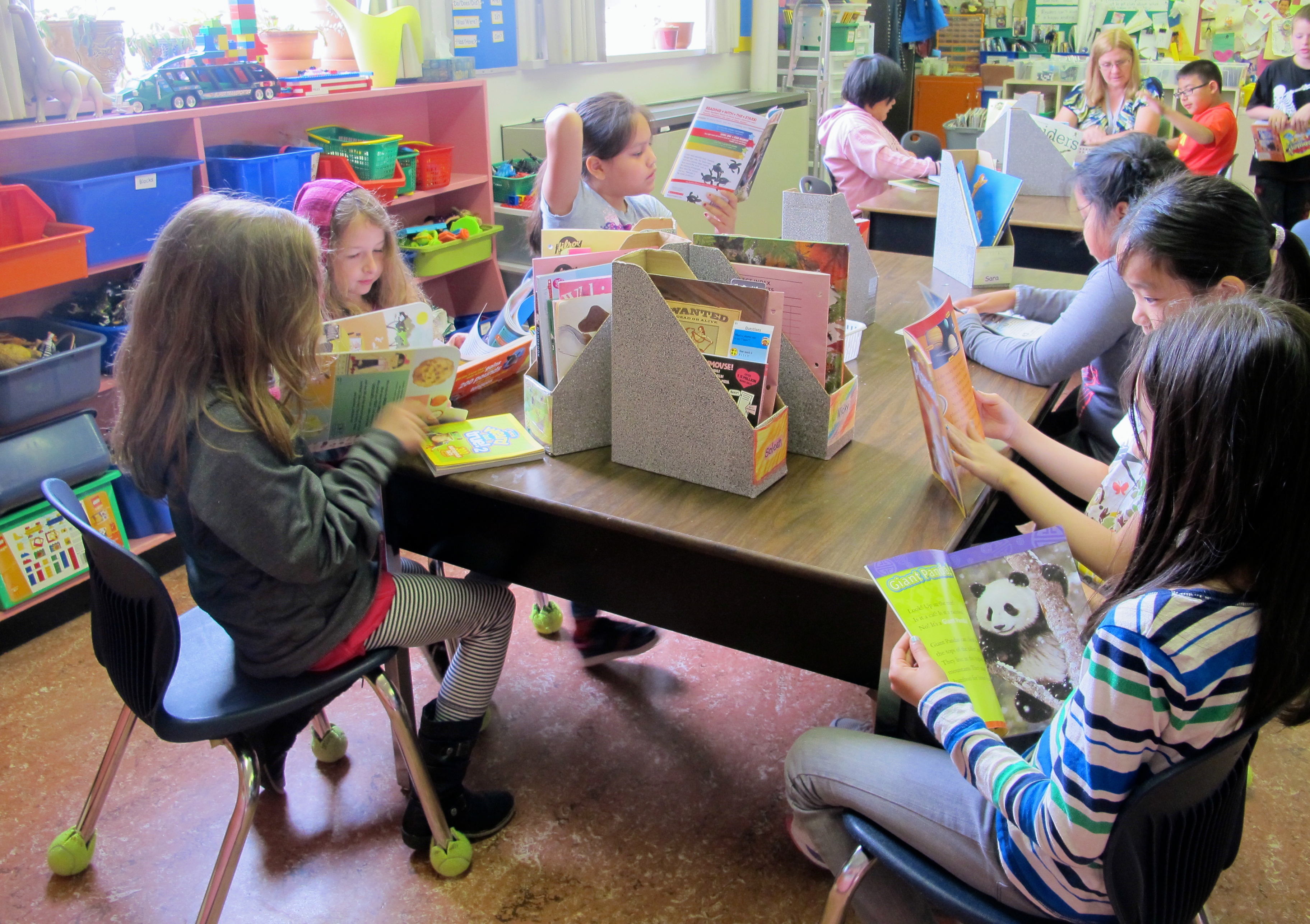
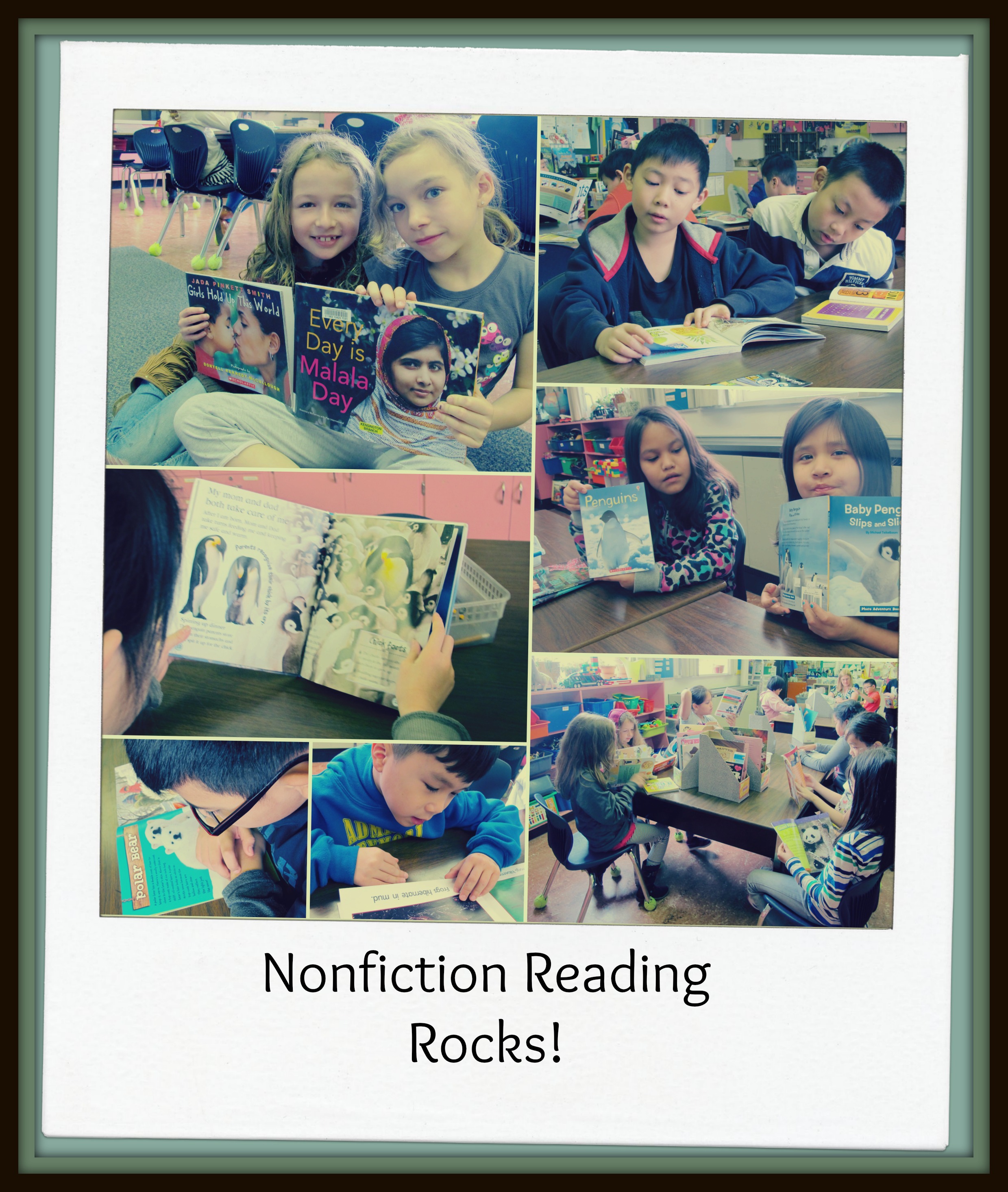
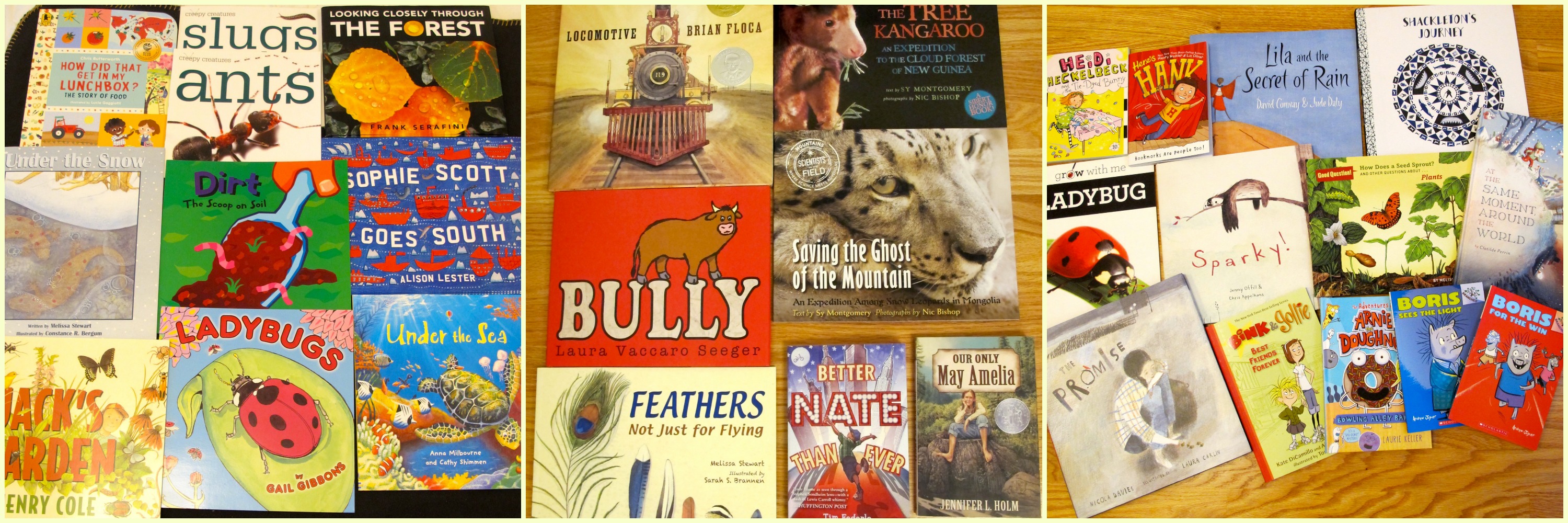
I have been sharing a reading photo of the week each week. This week I am sharing a photo of students engaged with a variety of nonfiction texts during “Nonfiction Reading Day” – where we devote our Reading Workshop time to reading nonfiction. Of course, for many readers, nonfiction reading happens all week but this focus allows all children to read more nonfiction, more widely.

Monday February 2nd 2015 #IMWAYR There's a Book for That

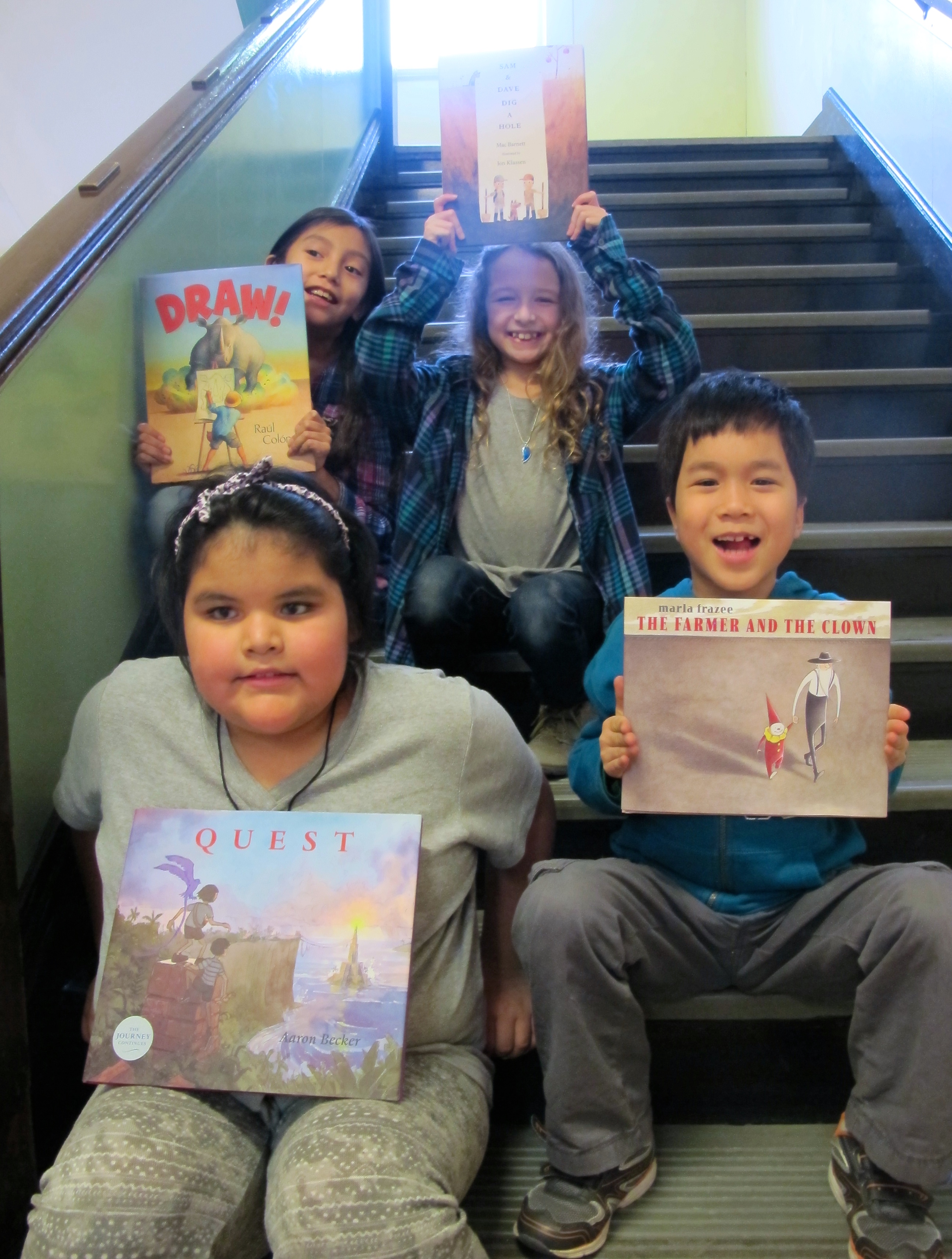
I was excited to share our #MockCaldecott results and reflections here. In mere hours, we will know the actual medal and honor winners. So excited!

Monday February 2nd 2015 #IMWAYR There's a Book for That

Join Jen from Teach Mentor Texts and Kellee and Ricki from Unleashing Readers and share all of the reading you have done over the week from picture books to young adult novels. Follow the links to read about all of the amazing books the #IMWAYR community has read. It’s the best way to discover what to read next.

imwayr

I realize that much of my reading this week was nonfiction picture books. Lots of variety and as usual, I learned so much. Some highlights:

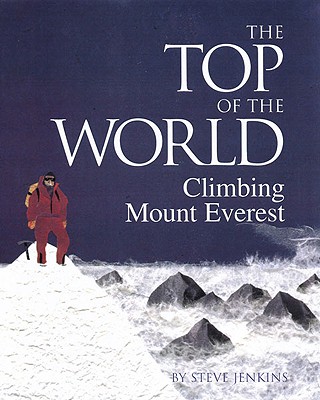
The Top of the World: Climbing Mount Everest by Steve Jenkins

If you want to climb Mount Everest, what would you need to know? This book is filled with facts about history, geography and the myriad of challenges that climbers might encounter.

The Top of the World Monday February 2nd 2015 #IMWAYR There's a Book for That

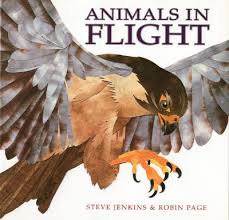
Animals in Flight by Steve Jenkins and Robin Page

An older Jenkins title that I found in my school library. I was most interested in the history of flying creatures and the different ways various wings function.

Animals in Flight by Steve Jenkins and Robin Page Monday February 2nd 2015 #IMWAYR There's a Book for That

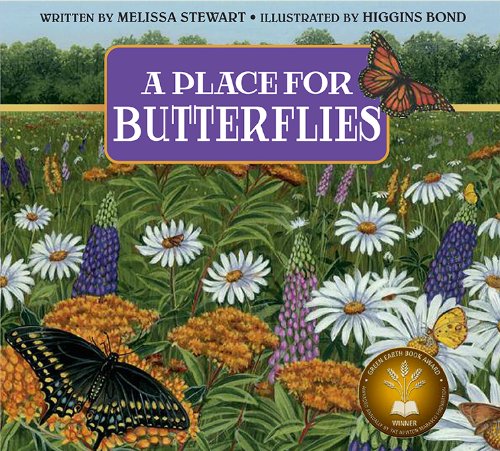
A Place for Butterflies by Melissa Stewart and illustrated by Higgins Bond

Focuses on a variety of butterflies and the threats to their environments. Framed with specific ideas about how to change human actions to make a difference to butterflies like planting native plants, protecting swamps and marshes and not trying to catch live butterflies for collections.

Place for Butterflies Monday February 2nd 2015 #IMWAYR There's a Book for That

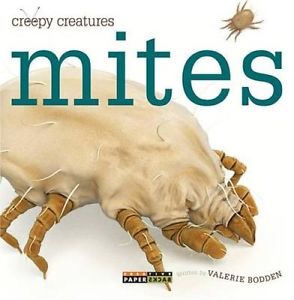
Mites by Valerie Bodden

Magnified things we never actually see in our day to day life are quite creepy – yet incredibly fascinating. Made me want to vacuum.

Mites Monday February 2nd 2015 #IMWAYR There's a Book for That

I also read

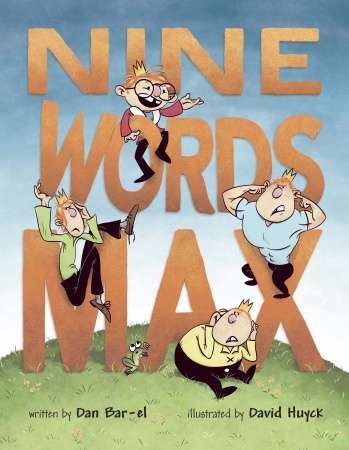
Nine Words Max by Dan Bar-el and illustrated by David Huyck

Max is too talkative – wouldn’t it be great if he could only say nine words at a time? Ideal, think his brothers. But is it? Clever.

 Monday February 2nd 2015 #IMWAYR There's a Book for That

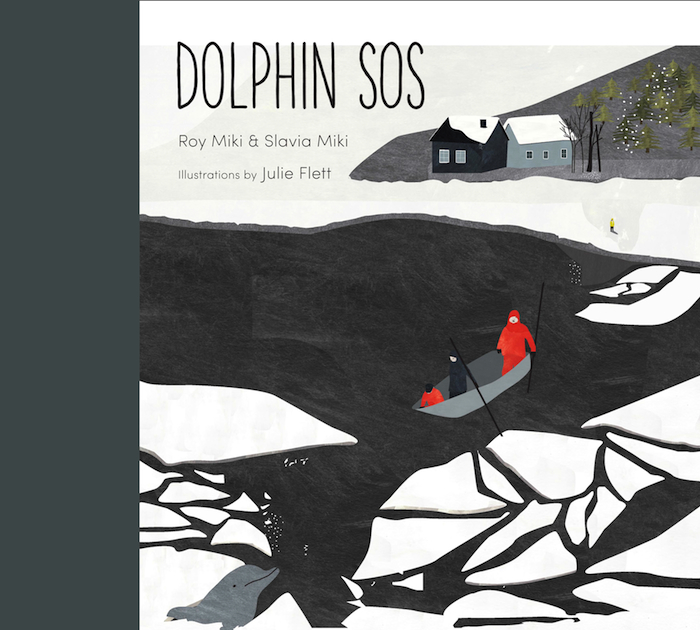
Dolphin SOS by Roy Miki and Slavia Miki with illustrations by Julie Flett

This was one of those read alouds where at one point the silence in the room was thick – surrounding us like fog – it seemed like we could see it and feel it all at once. Such a beautifully emotional book about three dolphins off the coast of Newfoundland who became trapped in the ice in a cove. The townspeople had to listen to their cries for days before they finally intervened when government wouldn’t help. There is a moment between a dolphin and one of the rescuers that is just awe inspiring. Based on a true story.

Dolphin SOS Monday February 2nd 2015 #IMWAYR There's a Book for That

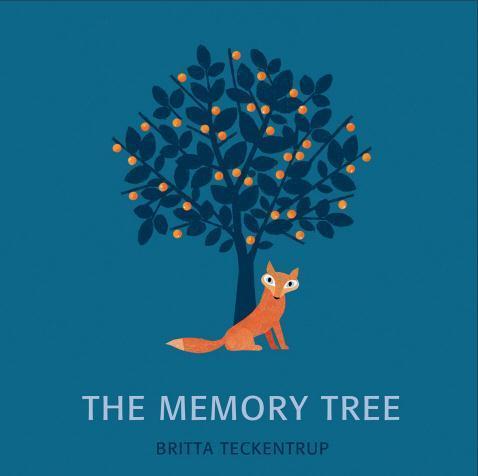
The Memory Tree by Britta Teckentrup

Death and grief healed by memories and community. A lovely, accessible picture book.

The Memory Tree Britta Teckentrup Monday February 2nd 2015 #IMWAYR There's a Book for That

A Gift for Mama by Linda Ravin Lodding illustrated by Alison Jay

I love Alison Jay’s illustrations and this book, set in Vienna, was an absolute visual and historical treat. A circular story about Oskar trying to find a perfect gift for his Mama for her birthday. Yet, he keeps encountering people in need of his gift and trades each of them for something new. Themes of kindness, generosity and optimism.

a gift for mama Monday February 2nd 2015 #IMWAYR There's a Book for That

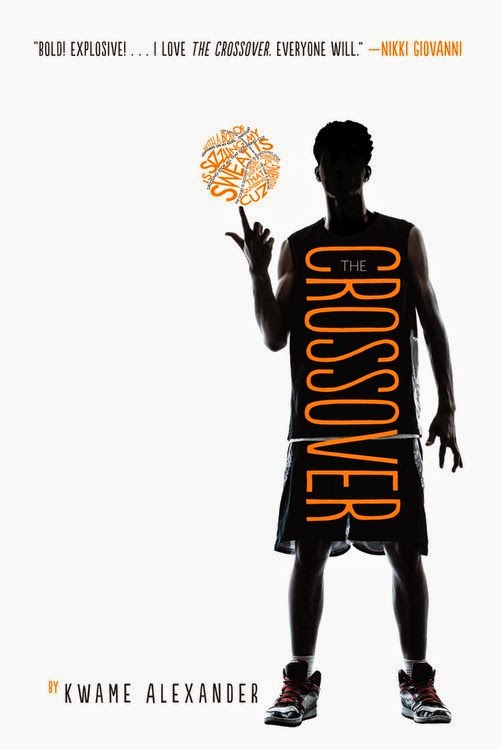
I also finished The Crossover by Kwame Alexander

I finished this morning. Incredible.

crossover Monday February 2nd 2015 #IMWAYR There's a Book for That

Up next?  My children and I continue reading The Shadowhand Covenant (Book Two of the Vengekeep Prophecies) by Brian Farrey. With my class, I have started Each Little Bird that Sings by Deborah Wiles. Oh, so very good!

I am starting The Misadventures of the Family Fletcher by Dana Alison Levy (one of my #MustReadin2015 titles)

Updates on my 2015 Reading Goals:

2015 Chapter Book Challenge: 6/80 complete

Goodreads Challenge: 43/415 books read

#MustReadin2015: 4/24 complete

Nonfiction Picture Book Challenge: 10/100 titles

Diverse Books in 2015: 3/50 books read

Wondering about butterflies: Nonfiction Picture book Wednesday

I am excited to once again highlight a recent title shared in my classroom and how we structured our read aloud experience. I am trying to share more of how these nonfiction books come alive in the classroom with kids!

The #nfpb2015 challenge is a great way to learn more about what nonfiction titles others are reading.

#nfpb2015

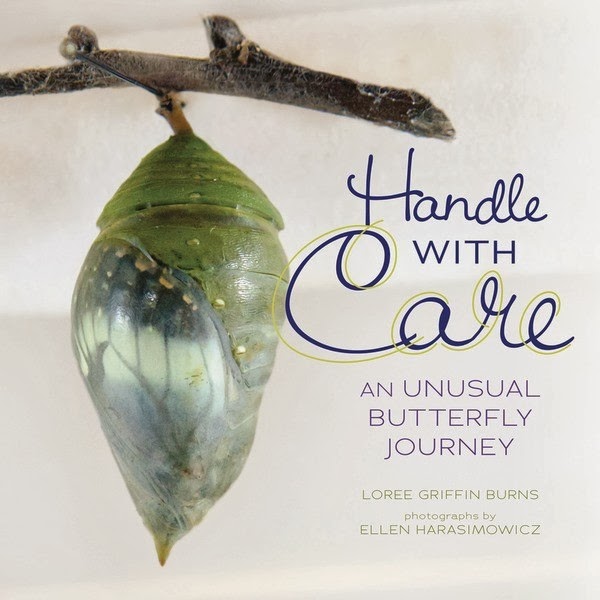
During the past week we have been reading Handle with Care: An Unusual Butterfly Journey written by Loree Griffin Burns with photographs by Ellen Harasimowicz (March 2014)

This title shares with the reader how a butterfly farm in Costa Rica prepares butterfly pupae for the journey to various museums and science centers in the north. It answers questions about how the farm functions, the connection to the rain forest habitat and how pupae are prepared for the long journey. Can you imagine getting a package of butterfly pupae in the mail?

My students wanted to begin making special orders immediately! 🙂

Photographs by Ellen Harasimowicz are stunning and help tell a story that many students would never have imagined. I have some students that just wanted to gaze at the end pages with photographs detailing various pupae. Students really appreciated the close up photography. One child commented:

“Human eyes wouldn’t even be able to see that (eggs on a leaf). But the camera zoomed up close so we can all look carefully.”

There is a detailed glossary at the back of the book and we appreciated the helpful hints provided about visiting a live butterfly exhibit. Many students in my classroom have been to the Vancouver Aquarium on a field trip with our school and had the opportunity to visit an area with live butterflies fluttering about. So this book had particular meaning.

Wondering about butterflies: Nonfiction Picture book Wednesday There's a Book for That

Note: I am currently reading Perfect Pairs: Using Fiction and Nonfiction Picture Books to Teach Life Science , K-2 by Melissa Stewart and Nancy Chesley I have been inspired by the way many lessons begin with a Wonder Statement and include writing, responding and drawing in a Wonder Journal. We already have a Wonder book that we write in regularly but I am trying to use it more often with our nonfiction read alouds.

 Perfect Pairs Wondering about butterflies: Nonfiction Picture book Wednesday There's a Book for That

Before I introduced Handle with Care, I asked the students to respond to this wonder statement:

“I wonder how butterflies get to Science Centers and museums all over the world.”

Students discussed this statement in Turn and Talk partners and then had an opportunity to share out. They then wrote about their thinking in their wonder notebooks.

Some samples:

“I think that some people found a butterfly in Brazil. They probably took them while they are in caterpillar form. They might catch them in a cage. Do they use a potion to lure them into the cage?”

“I think that they get special food to attract them or catch them as caterpillars and take them back. They would have to research butterflies to study the rare ones and the almost extinct ones. They would live in places that are hot and have nice rainforests.”

“I think they take a big truck and drive to California and catch the butterflies in a big cage and then drive to the airport and go on the plane with the caged butterflies with them and drop them off to the science centers. Maybe they get the science workers to do it. Perhaps they lure them into the cage with fruit and honey.”

“I think they catch the butterflies when they are eggs and grow them like that.”

When we learned on the first page that the pupae are sent in a mysterious package to the museums, students were hooked. They had all kinds of questions like:

  • How do they know they won’t transform into butterflies before they get there?
  • How do you touch the pupa without harming it?
  • Where do they get all of the pupae?
  • Are some of them damaged from the travel?
  • How much does it cost to order them?
  • How do they know about how to make a home for them when they arrive?

We continued reading throughout the day and by the afternoon, students were ready to summarize their learning about the important jobs of the butterfly farm workers in Costa Rica.

Some written summaries:

“Farm workers must help adult butterflies be healthy. The farm workers get trees for the butterflies. They crush bananas to feed them.”

“Farm workers have to look out for predators. In the green house, there is the butterfly larva, eating. Farm workers need to protect the greenhouse.”

“Farm workers must: fix holes in the screens so grasshoppers don’t eat food for the larva, go hunting for fresh leaves and trees, protect the larva and the butterflies from frogs, birds and snakes and put out sugar water everyday.”

“They have to keep all of those predators out of the greenhouse like grasshoppers, frogs, birds and snakes. They have to pick a herd of caterpillars off of an empty branch of leaves that they have eaten and move them to a different branch of leaves.”

So much learning in this book. Lots of discussion. Big questions and connections. I love that it allowed students to explore a question that they had never really considered. One of our bookshelves is now full of butterfly books and students are busy learning more about butterflies during independent reading.

Thanks to Alyson from Kid Lit Frenzy for the inspiration to read and share more nonfiction picture books in 2015. Follow the link to Alyson’s blog to read about more nonfiction books you need to read!

Nonfiction Picture Book Wednesday: Fourteen favourites of 2014 (Part 2)

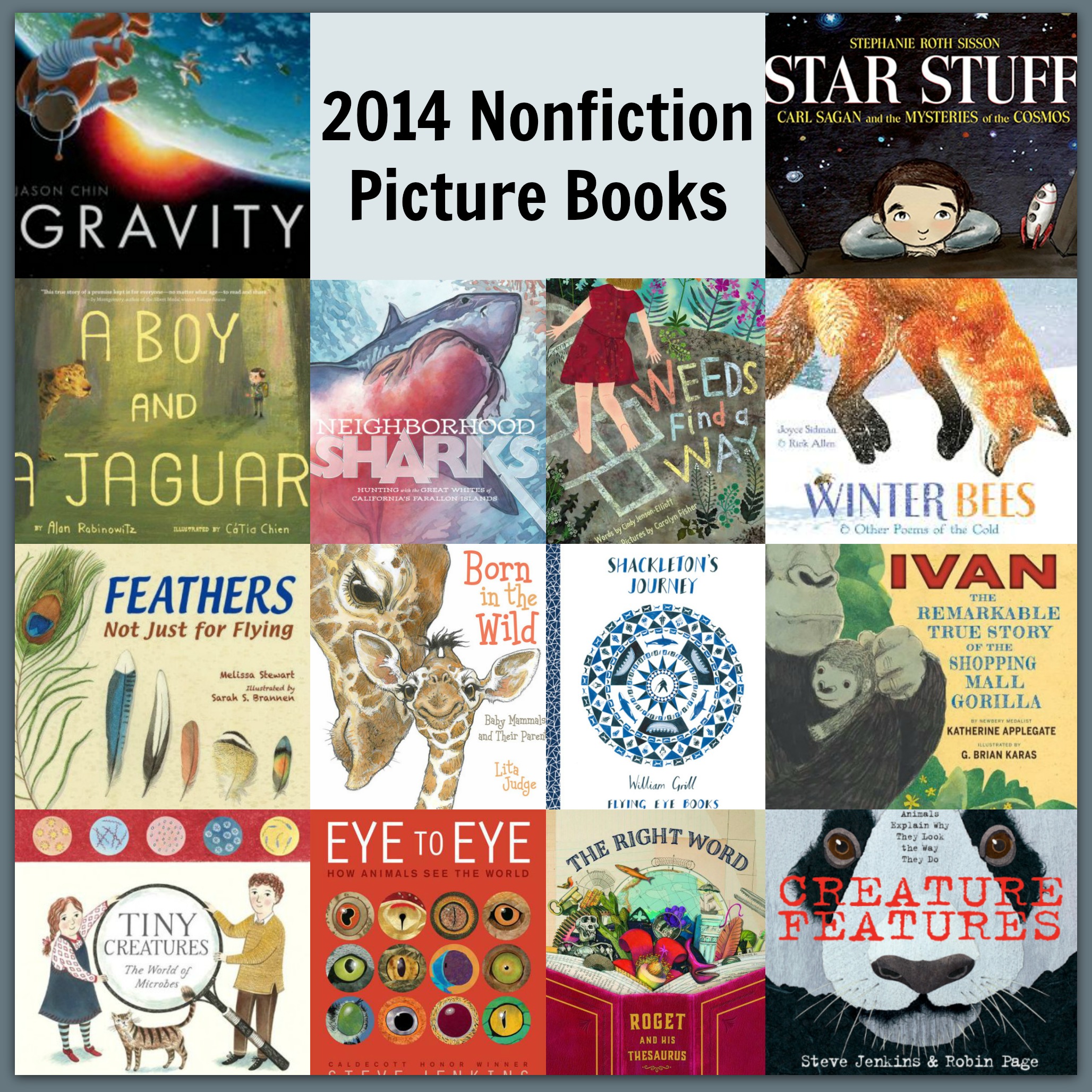
I am thrilled to share my favourite fourteen nonfiction titles of 2014!

2014 Nonfiction Picture Books

I love books. As in absolutely adore, frequently gush over, make piles, make lists, always reading kind of #booklove devotion. If you had asked me to talk favourites a few years ago, a nonfiction title would have made it on the list here and there. I have always appreciated the power of the nonfiction read aloud but . . . it wasn’t until I began participating in the nonfiction picture book challenges organized by Alyson Beecher (from Kid Lit Frenzy) that I have become absolutely smitten with nonfiction titles.

I have been busily tweeting about this as of late . . .

I am thrilled to renew my commitment to nonfiction reading by participating in the #nfpb2015 challenge! The more nonfiction I read, the more I learn and the more my students ultimately benefit.

#nfpb2015

More about my favourites of 2014. If these titles are not on your already read and loved or must read radar, consider adding them to the list!

Ivan: The Remarkable True Story of the Shopping Mall Gorilla written by Katherine Applegate and illustrated by G. Brian Karas

ivan

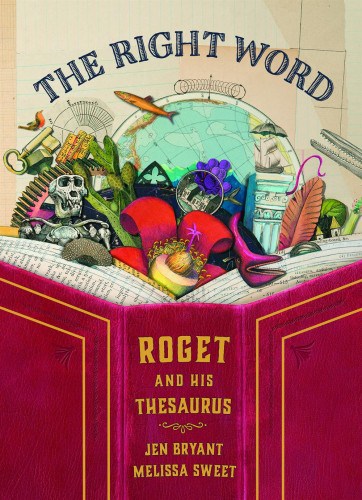
The Right Word: Roget and his Thesaurus written by Jen Bryant and illustrated by Melissa Sweet

The Right Word

Gravity by Jason Chin

gravity_chin

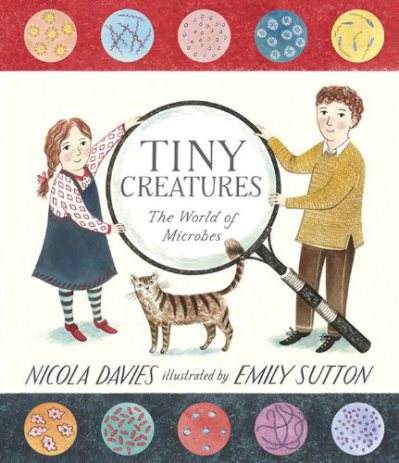
Tiny Creatures: The World of Microbes written by Nicola Davies and illustrated by Emily Sutton

tiny-creatures

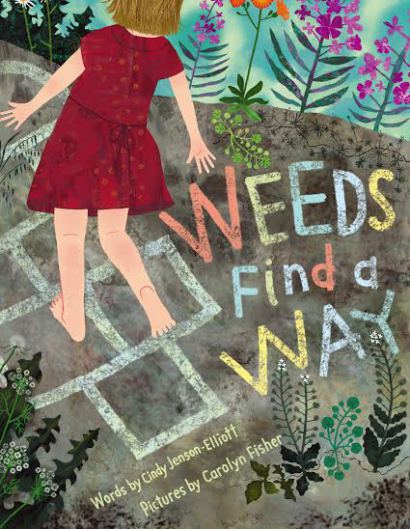
Weeds Find a Way written by Cindy Jenson-Elliott and illustrated by Carolyn Fisher

weeds-find-a-way

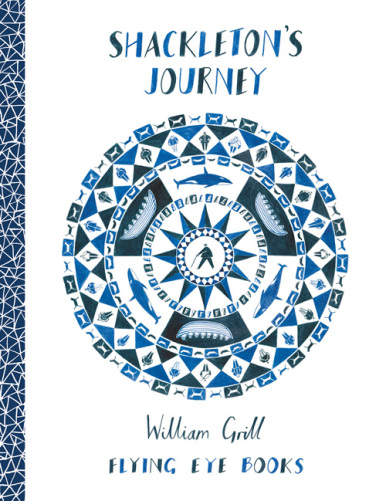
Shackleton’s Journey by William Grill

shackletons-journey

Eye to Eye: How Animals See The World by Steve Jenkins 

eye-to-eye

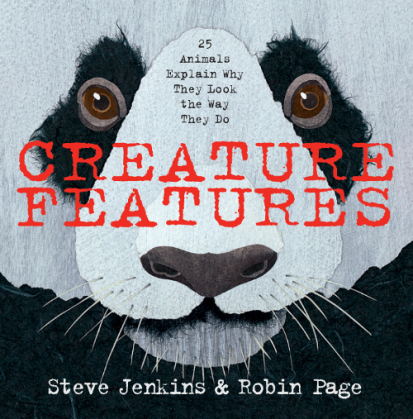
Creature Features: 25 Animals Explain Why They Look the Way They Do by Steve Jenkins and Robin Page

creature-features-coversmall

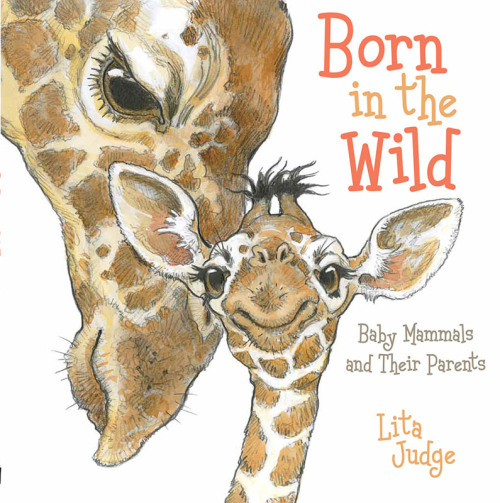
Born in the Wild: Baby Mammals and their Parents by Lita Judge

Born in the Wild

A Boy and A Jaguar written by Alan Rabinowitz and illustrated by Cátia Chien 

boyandajaguarcover

Neighborhood Sharks: Hunting with the Great Whites of California’s Farallon Islands by Katherine Roy 

neighborhood-sharks

Winter Bees and Other Poems of the Cold by Joyce Sidman and Rick Allen

winter bees

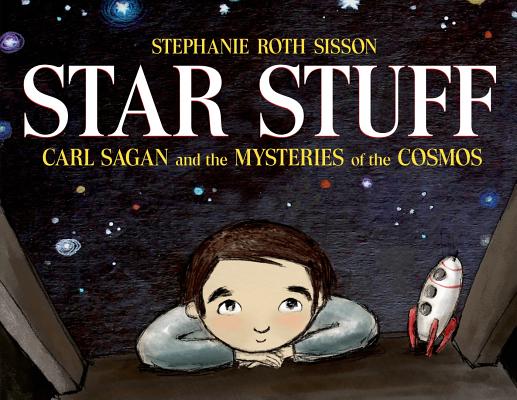
Star Stuff: Carl Sagan and the Mysteries of the Cosmos by Stephanie Roth Sisson

star stuff

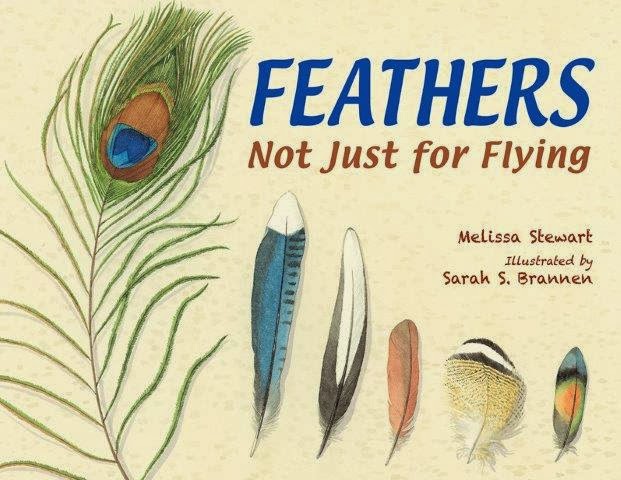
Feathers Not Just for Flying written by Melissa Stewart and illustrated by Sarah S. Brannen

feathers

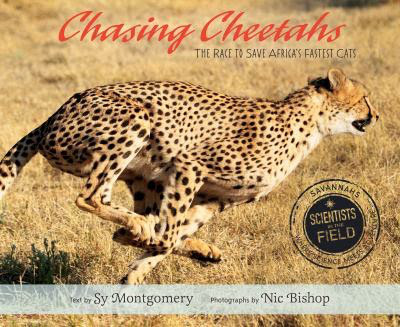
I have included picture books here but must also note that Chasing Cheetahs: The Race to Save Africa’s Fastest Cats written by Sy Montgomery with photographs by Nic Bishop was an absolute favourite of the year.

cheetahs

I am also pleased to report that I more than met my goal of reading 65 nonfiction picture books this year. Grand total: 144 titles! 🙂

What are your favourites of the year?

Nonfiction Picture Book Wednesday: Fourteen favourites (Part 1)

As 2014 comes to a close, avid book lovers and book bloggers start amassing favourites. As I looked over the close to 150 nonfiction picture book titles I have read this year, I realized that there are many to highlight. So, I have decided to do two top fourteen lists (in honour of 2014). This one contains my favourite titles read in 2014 but with a publication date of 2013 or earlier. Next week I will share my favourite fourteen titles published in 2014.

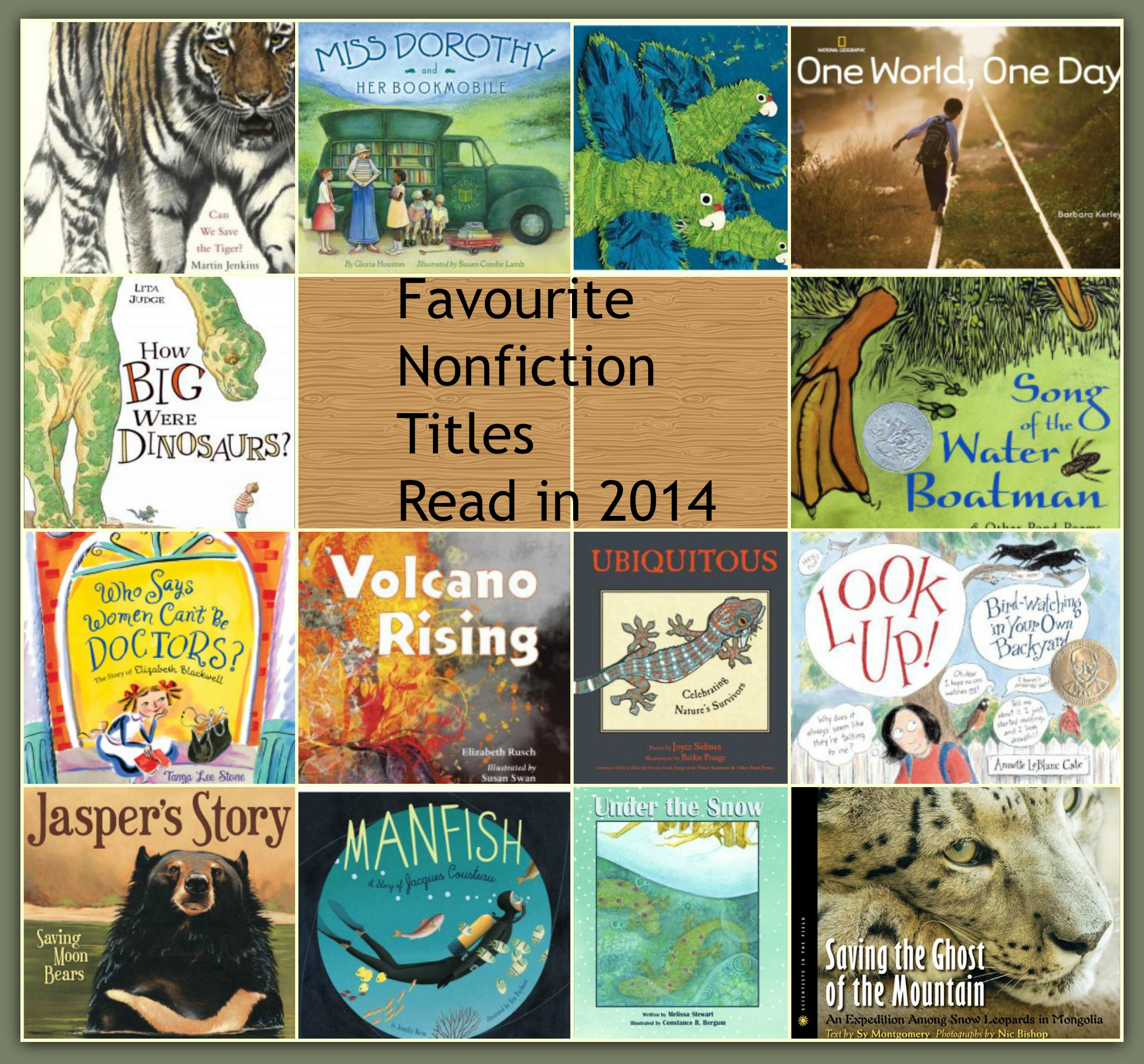
Favourite Nonfiction of 2014

Shared alphabetically by author:

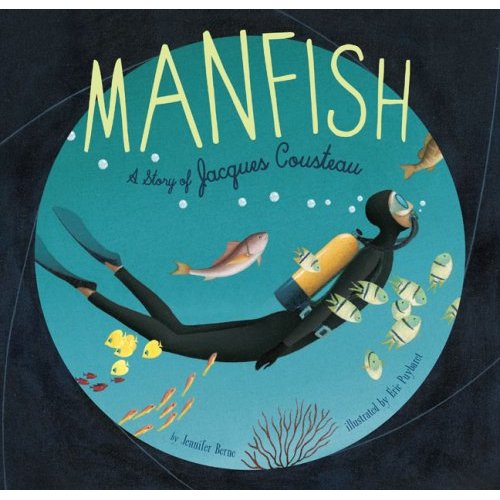
Manfish: A Story of Jacques Cousteau written by Jennifer Berne and illustrated by Éric Puybaret (published 2008)

A gorgeous introduction to Cousteau and his passion for the underwater world. I shared my students’ responses to this title here.

manfish

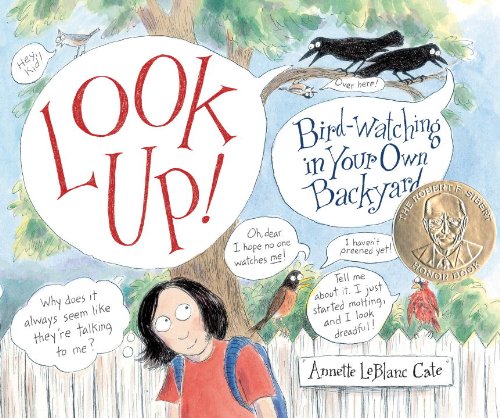
Look Up! Bird Watching in Your Own Backyard by Annette LeBlanc Cate (published 2013)

Written in conversational, humorous style, this title encourages us to pay a little more attention to the natural world in general and to the beauty of birds in particular.

look up!

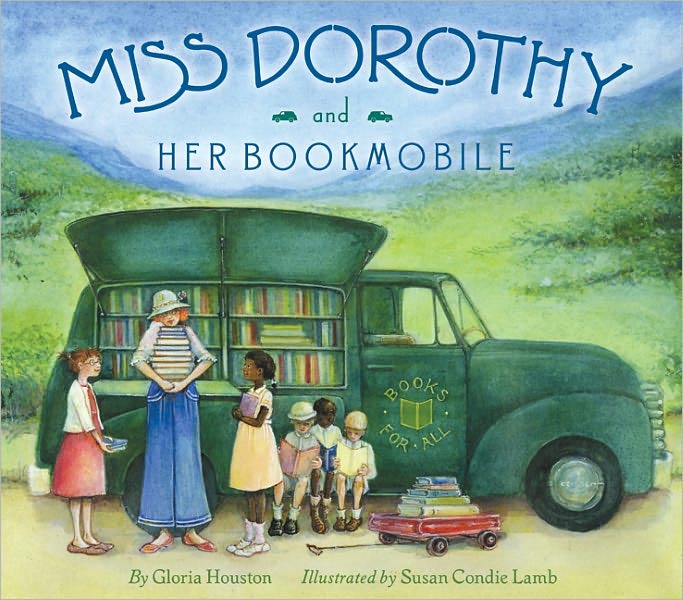
Miss Dorothy and her Bookmobile written by Gloria Houston and illustrated by Susan Condie Lamb (published 2011)

An inspiring story about Dorothy Thomas, an absolute book hero. True testament to how books change lives and connect community.

miss dorothy

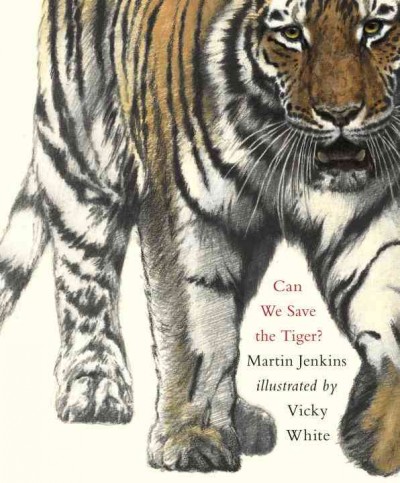
Can We Save the Tiger? written by Martin Jenkins and illustrated by Vicky White (published in 2011)

This book introduces students to a huge variety of endangered and extinct animals. With some creatures, like the tiger, more details are provided about the animal including reasons for its vulnerable status.

can we Save the Tiger?

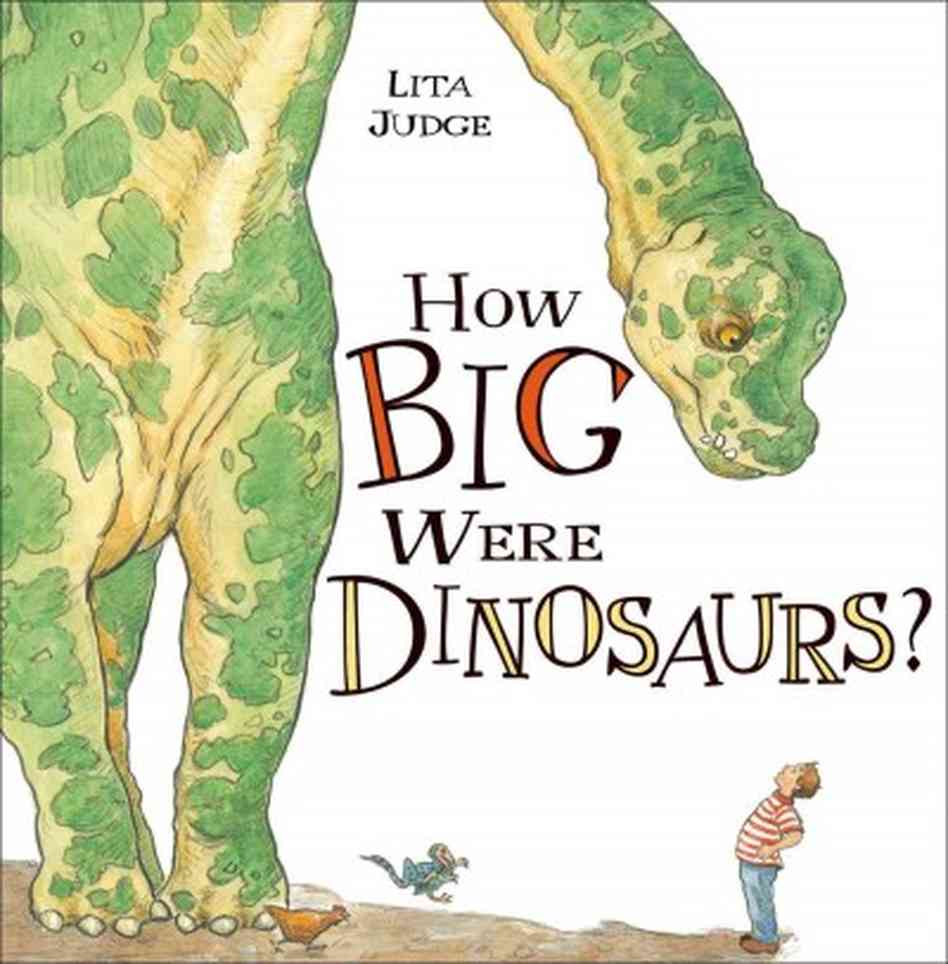
How Big Were Dinosaurs? by Lita Judge (published 2013)

Lita Judge’s illustrations are so rich. They inform. They amuse. And they delight. Each dinosaur featured here is drawn next to something that children already know to allow them to imagine the exact size of the dinosaur.

dinosaurs

One World, One Day by Barbara Kerley (published 2009)

Spectacular photographs showcasing the daily routines that many of us share – all a little different in different places but yet, so much the same.

one-world

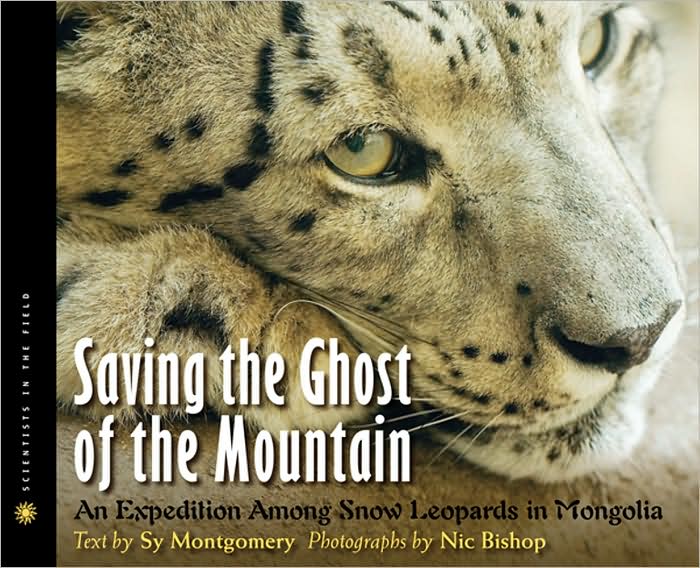
Saving the Ghost of the Mountain: An Expedition Among Snow Leopards in Mongolia written by Sy Montgomery with photographs by Nic Bishop (published 2009)

How can a book about searching for snow leopards be so amazingly interesting when the snow leopards are never actually seen? Montgomery and Bishop tell an incredible tale about these magical and elusive creatures and their champion, scientist Tom McCarthy who has devoted his life’s work to their conservation.

snow-leopard

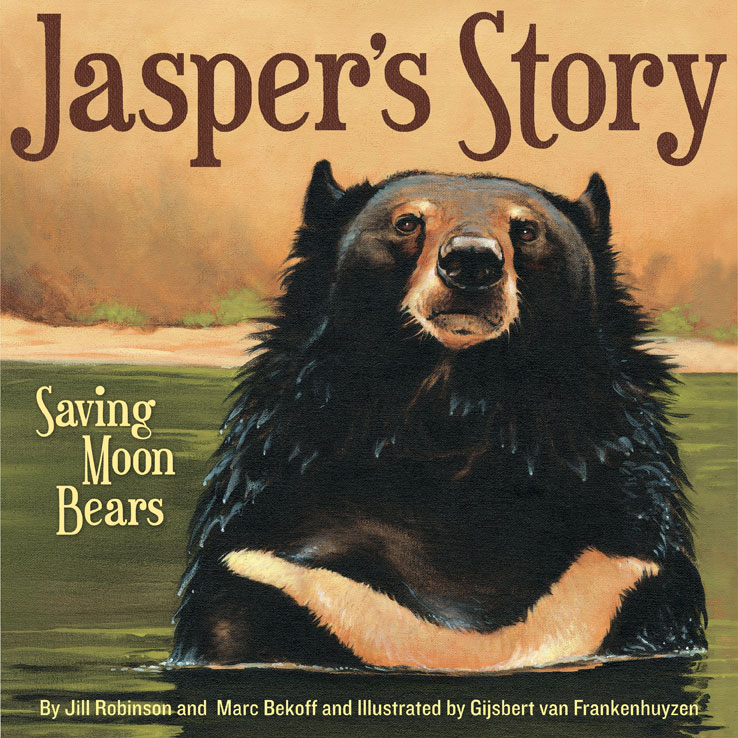
Jasper’s Story: Saving Moon Bears written by Jill Robinson and Marc Bekoff; illustrated by Gijisbert van Frankenhuyzen (published 2013)

Jasper is a bear that was rescued by Jill Robinson (the author) and her Animals Asia team and brought to a sanctuary in China. Jill describes Jasper as courageous and loving; a symbol of forgiveness and hope.

jaspersstory

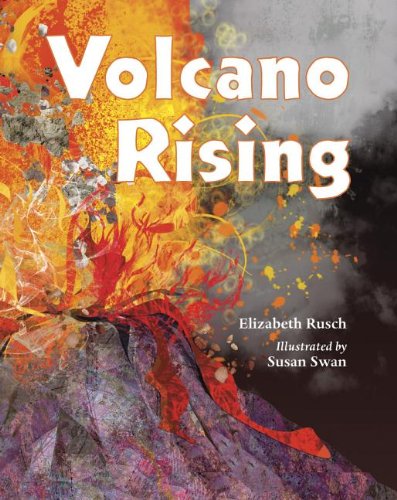
Volcano Rising written by Elizabeth Rusch and illustrated by Susan Swan (published 2013)

One of the very best, if not the best nonfiction picture book I have read on volcanoes. Two layers of text (one section with more details for those who want to read more information) and incredible illustrations.

Volcano Rising 2

Songs of the Water Boatman written by Joyce Sidman and illustrated by Beckie Prange (published 2005)

Come to the pond and experience it like you have never imagined through vivid images, fascinating facts and gorgeous illustrations.

Songs of the Waterboatman

Ubiquitous: Celebrating Nature’s Survivors poems by Joyce Sidman and illustrated by Beckie Prange (published 2010)

Poet and artist celebrate nature’s successes. Who has been around for a long time and continues to thrive?

Ubiquitous-Celebrating-Natures-Survivors

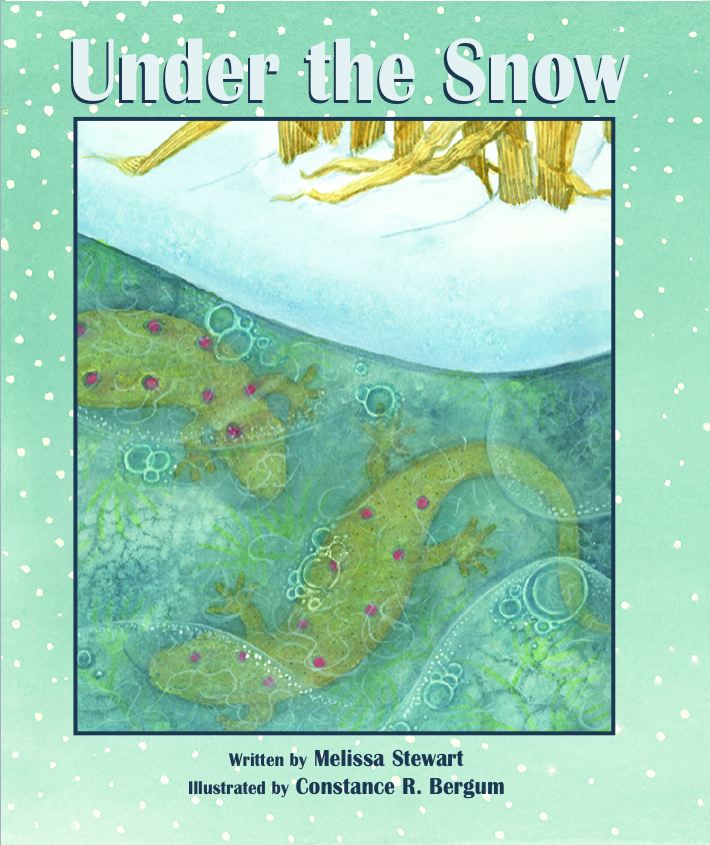
Under the Snow written by Melissa Stewart and illustrated by Constance R Bergum (published 2009)

Informative and beautifully illustrated. Feel like you are peeking into winter hiding places of animals and creatures that seemed to disappear.

Under the Snow

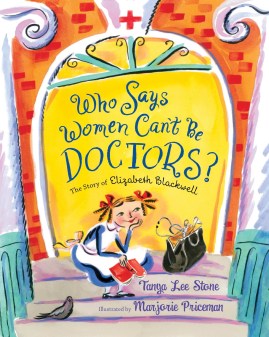
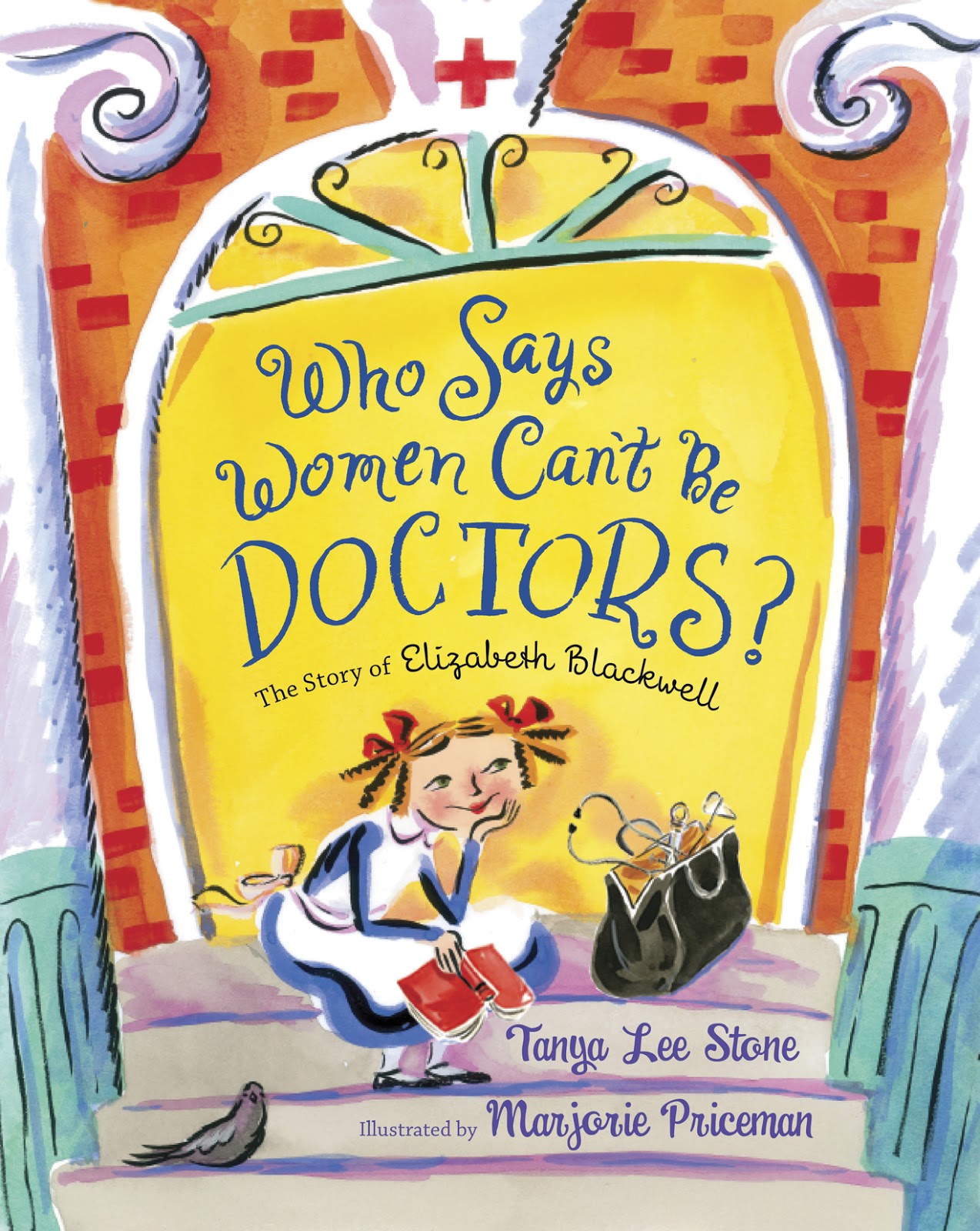
Who Says Women Can’t Be Doctors?: The Story of Elizabeth Blackwell written by Tanya Lee Stone and illustrated by Marjorie Priceman (published 2013)

This title inspired some amazing discussion in my classroom. An important biography about determination, changing general opinion and beliefs and following a dream.

WomenDoctors_cvr_lorez

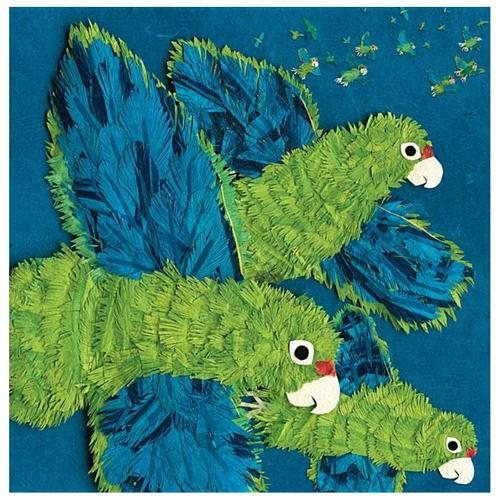
Parrots Over Puerto Rico by Cindy Trumbore and Susan L. Roth (published in 2013) Winner of the 2014 Sibert Meda

So often when we hear about animals on the brink of extinction, there is no happy ending story to share. Here, we have a story of hope and promise. Through much hard work the endangered parrots of Puerto Rico are once again flying through the treetops.

parrots

Thanks to Alyson from Kid Lit Frenzy for the inspiration to read and share more nonfiction picture books in 2014. Follow the link to Alyson’s blog to read about more nonfiction books you need to read!

klf_nonfiction2014_medium

My goal is to read 65 nonfiction picture books for 2014. Progress: 142/65 complete!

Next week I will share my top nonfiction titles for 2014. 14 of them 🙂

Nonfiction Picture Book Wednesday: Nonfiction “on the go” in our room

There are many ways you might know that nonfiction titles are important and well utilized in our classroom.

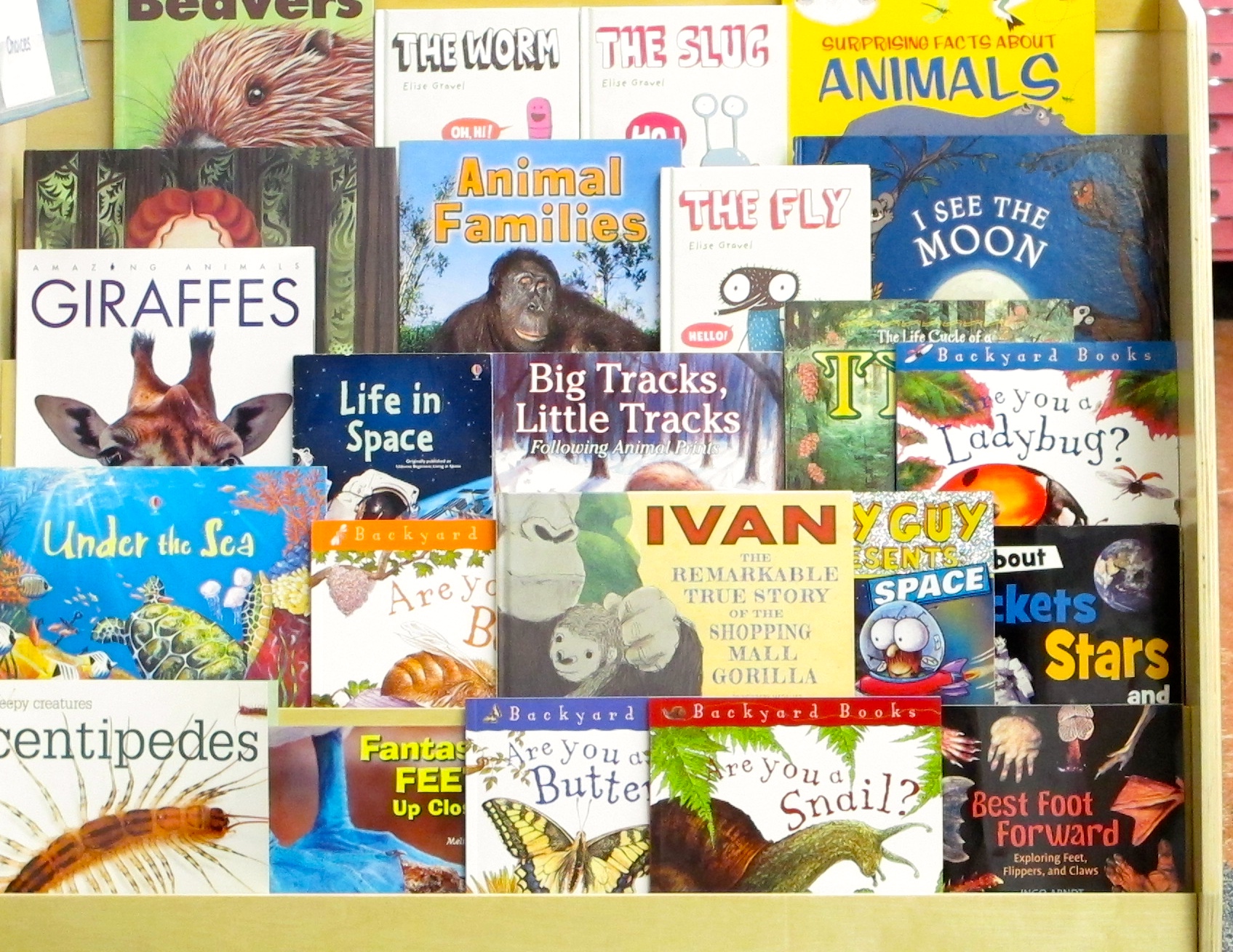
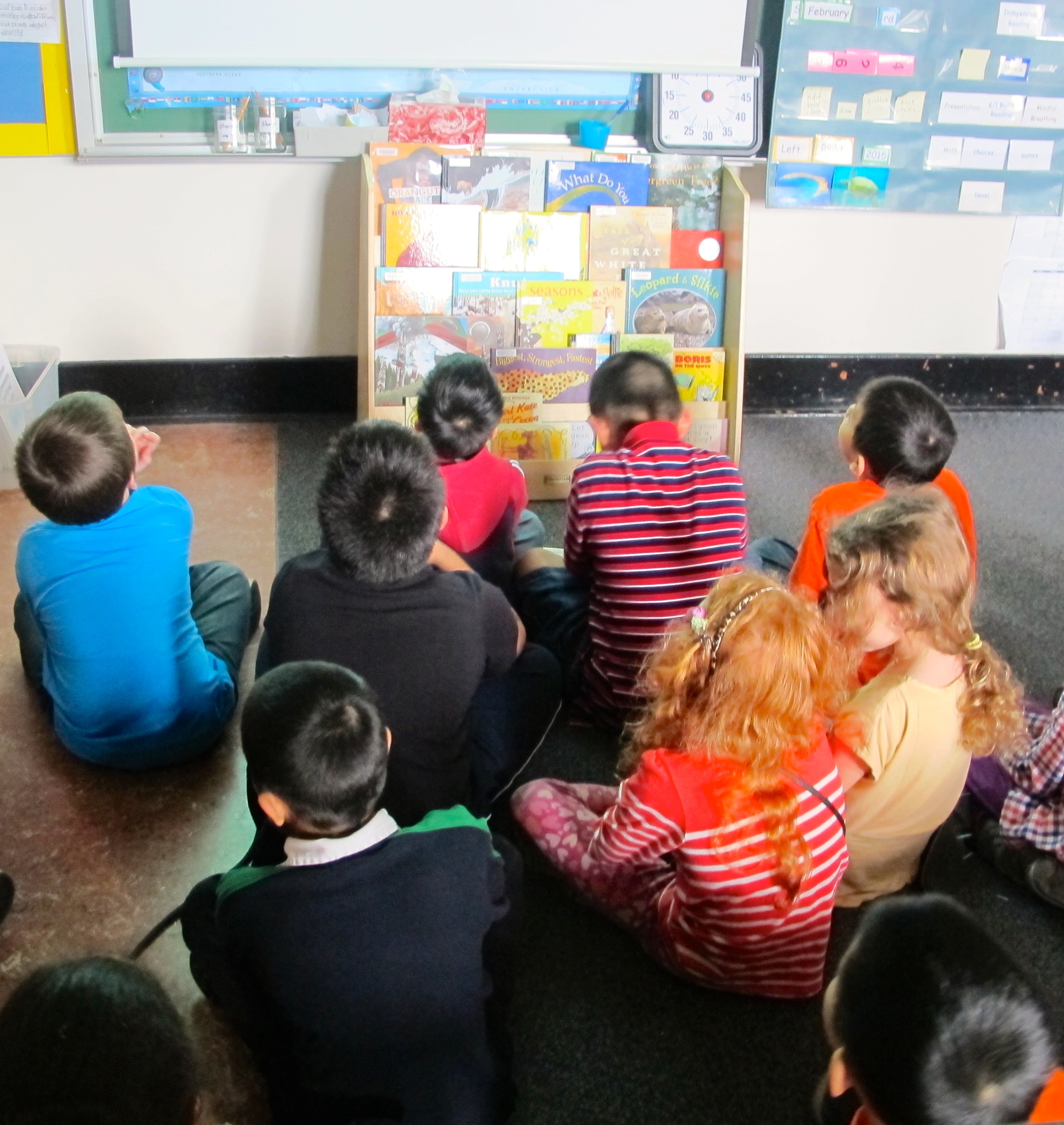
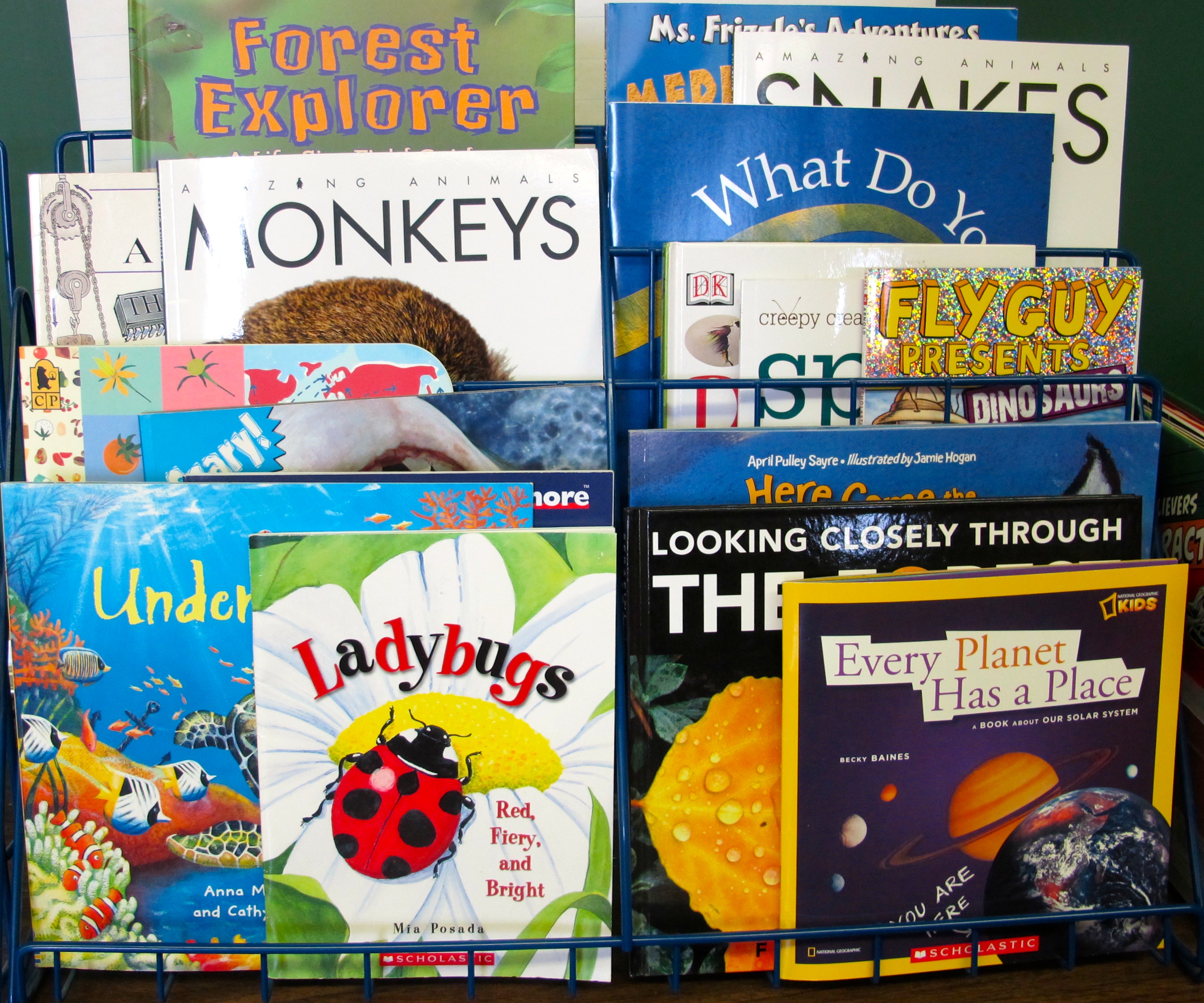
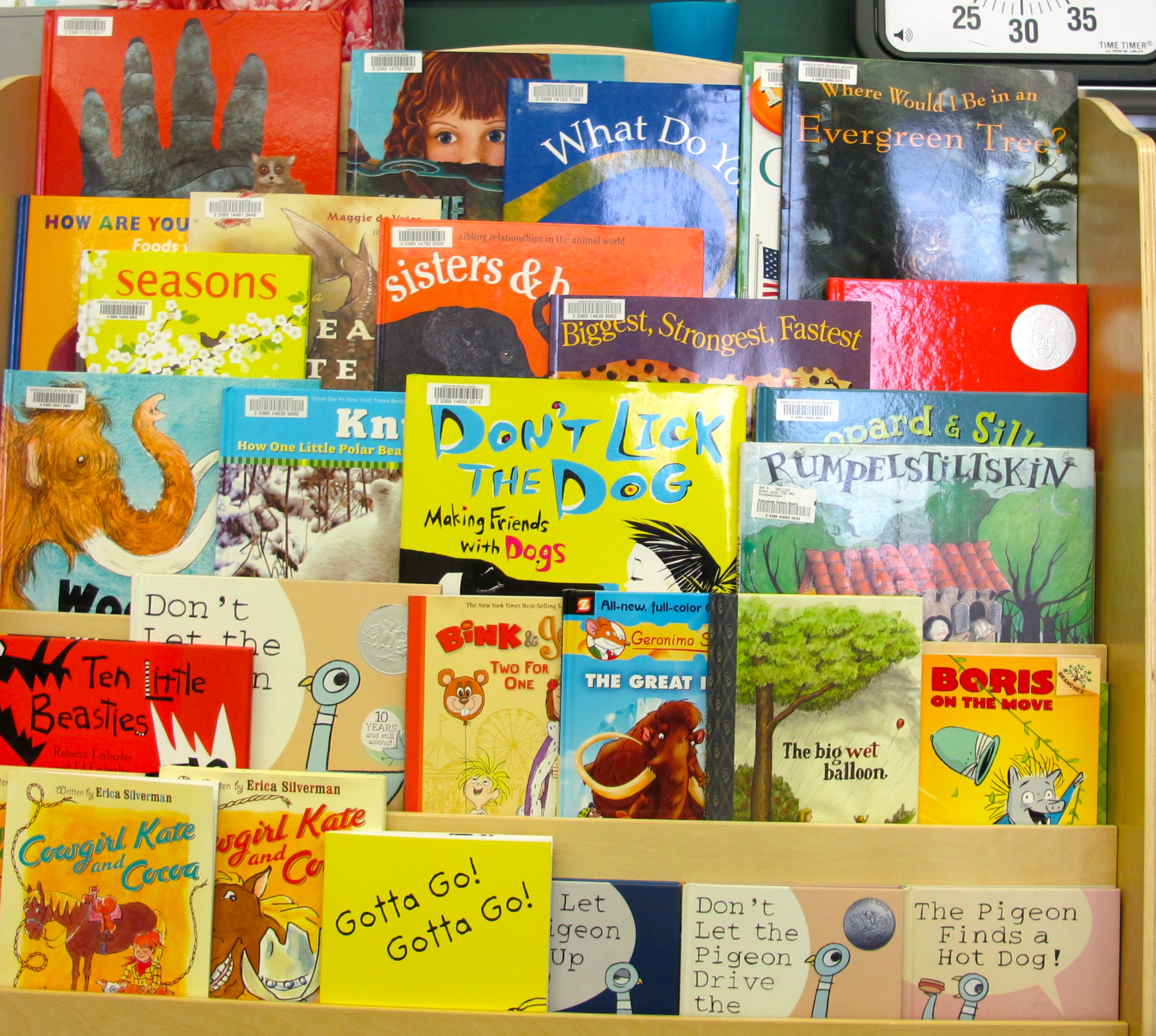
First of all, there are the visual clues. Some are organized by me – like our new book shelf full of titles on display that I have recently read or book talked. We add books here frequently and then switch them out and make room for more. Some live here for a while because they are very popular and students want to be able to find them easily. Some live here for just a little while – they are added when a reference comes up in a discussion for those students who want to read more. Centipedes came out when I read about a centipede in a silly poem and we talked about how many legs a centipede actually has and whether or not it was an insect. We talked about the word gnaw in word work and someone talked about how beavers and rats gnaw on things. I put a book about beavers on display. Fantastic Feet was a book by Melissa Stewart that I bought for the classroom recently. Lots of kids read it and started talking about animal feet and then animal tracks. We added books on these topics.

You can see how this shelf is well used!

We have a shelf like this for fiction titles too. 🙂

Nonfiction Picture Book Wednesday: Nonfiction "on the go" in our room There's a Book for That

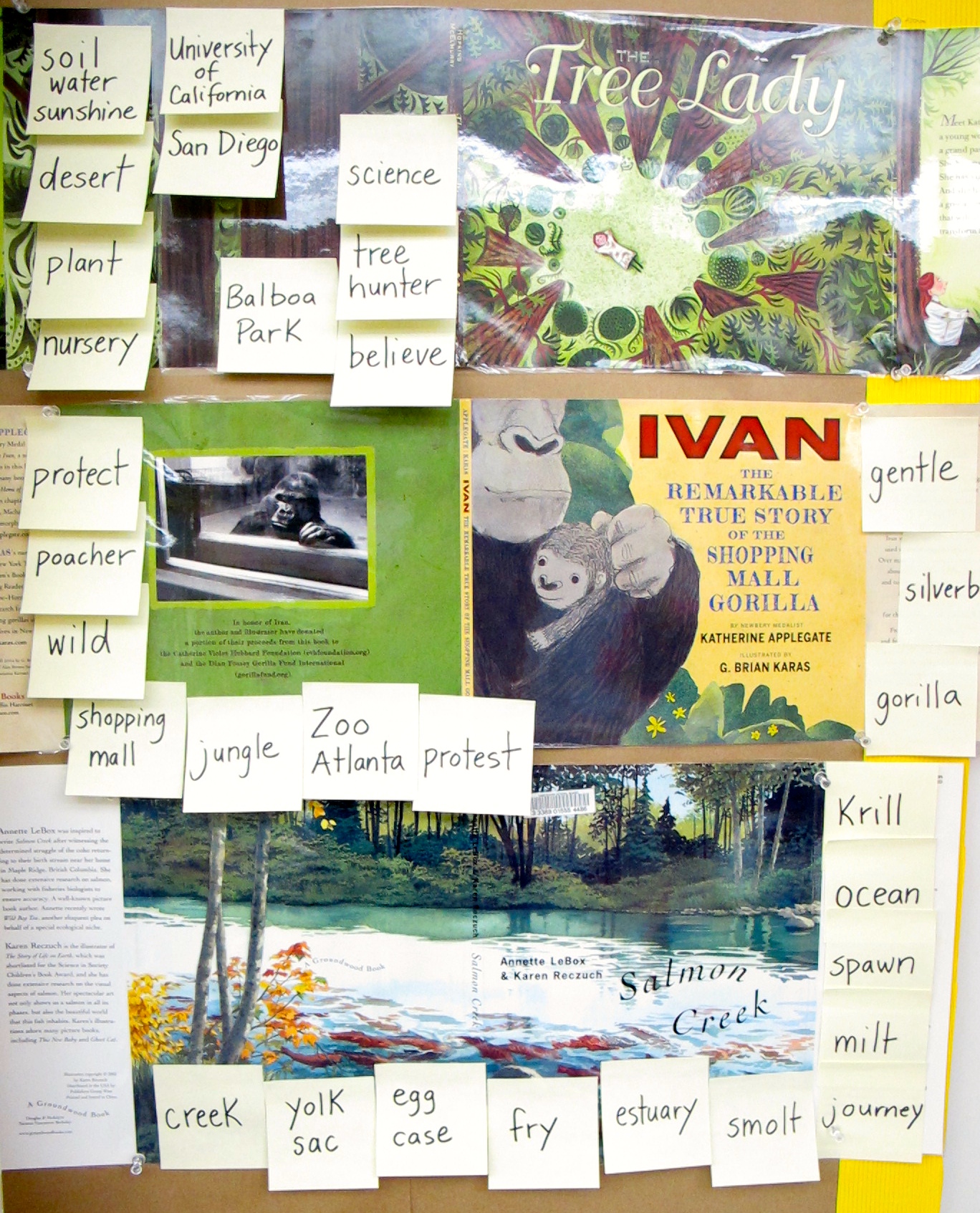
We also display book titles we have read with key words used so we can refer to them later. I keep a list of words on a sticky note on the inside cover as we read. These are great for those few minutes of waiting for announcements or when lining people up. For example,

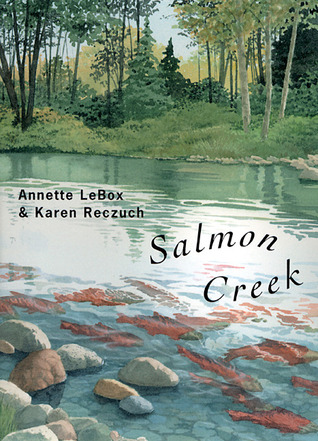
“Think back to the book Salmon Creek, who remembers what an estuary is. Tell the person beside you and then we’ll take answers.”

Nonfiction Picture Book Wednesday: Nonfiction "on the go" in our room There's a Book for That

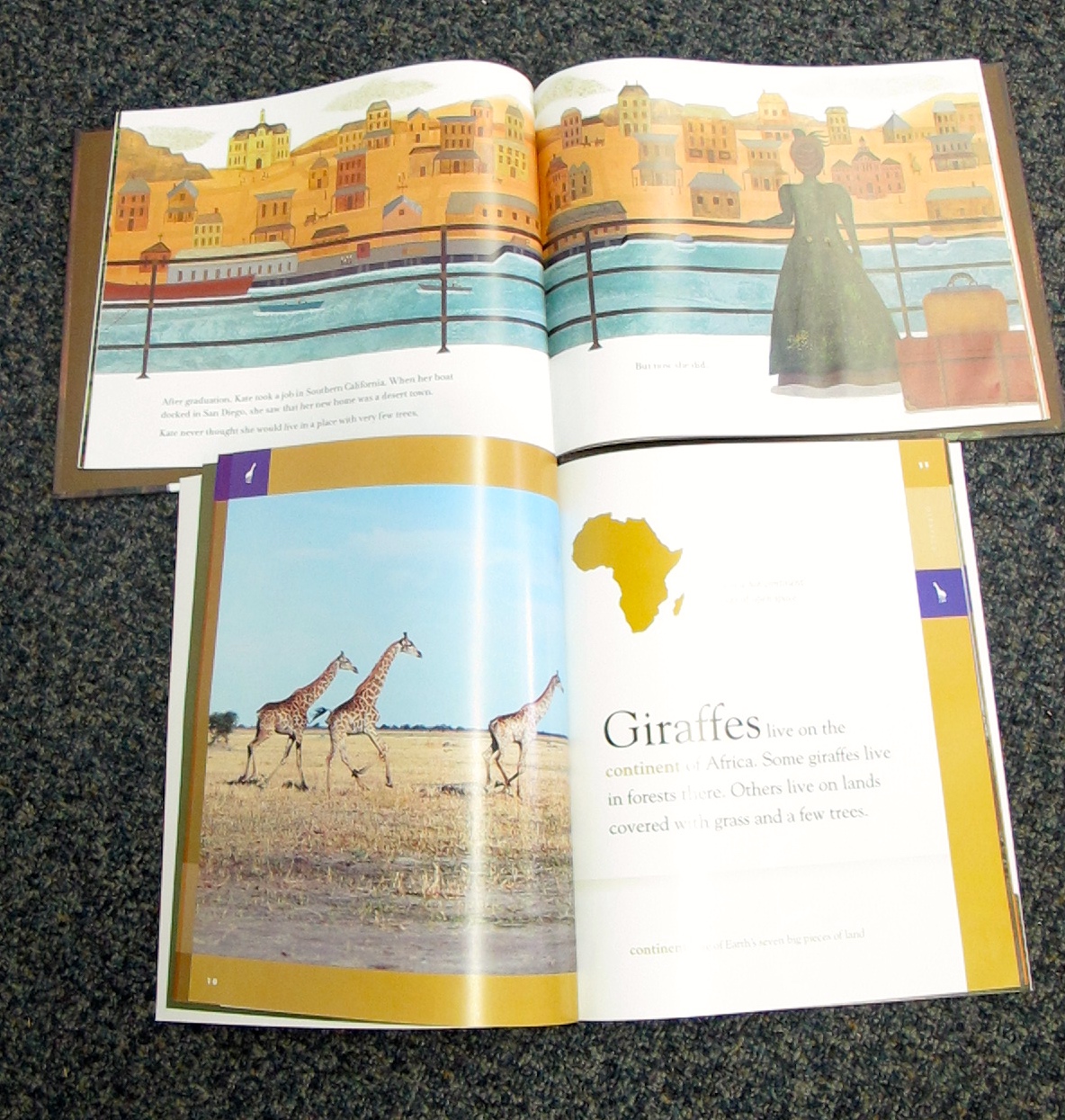
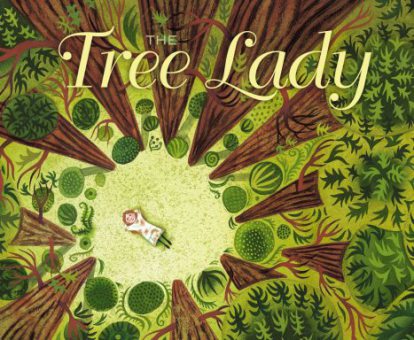
Some proof of our nonfiction love is highlighted by the students who find connections in the titles they are reading and want to share. This child thought that the African landscape in the book Giraffes was similar to the dry land in San Diego when Kate Sessions (from the book The Tree Lady) arrived in this seaside town and was shocked by the lack of trees.

Nonfiction Picture Book Wednesday: Nonfiction "on the go" in our room There's a Book for That

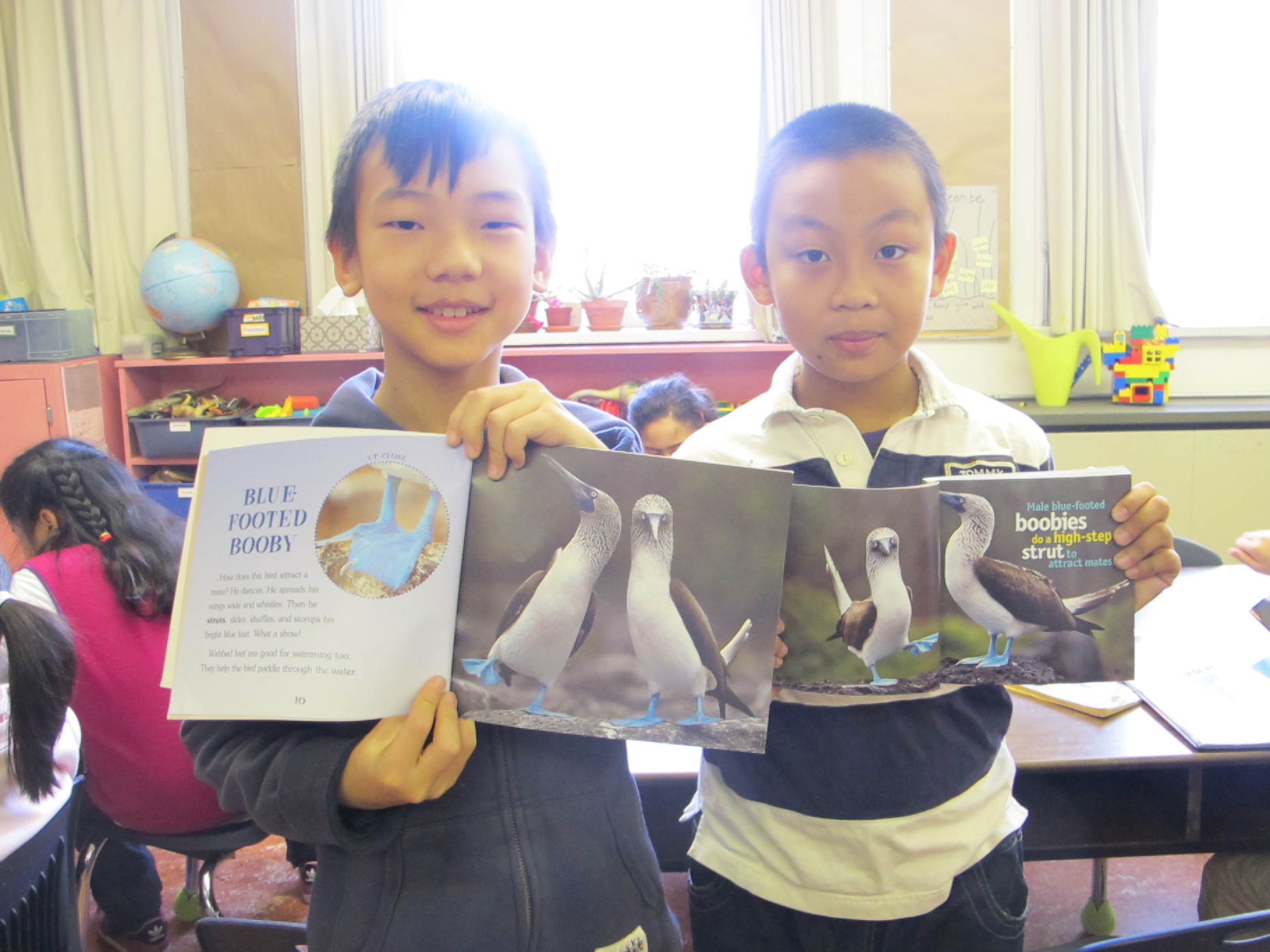
These boys were very excited to find blue footed boobies in two different nonfiction titles.

Nonfiction Picture Book Wednesday: Nonfiction "on the go" in our room There's a Book for That

But you would also know that we are a class who loves nonfiction titles because we have so many nonfiction read alouds “on the go”. Walk into our room throughout the day and you might find us engaged with a nonfiction text. Currently we are reading pages from . . .

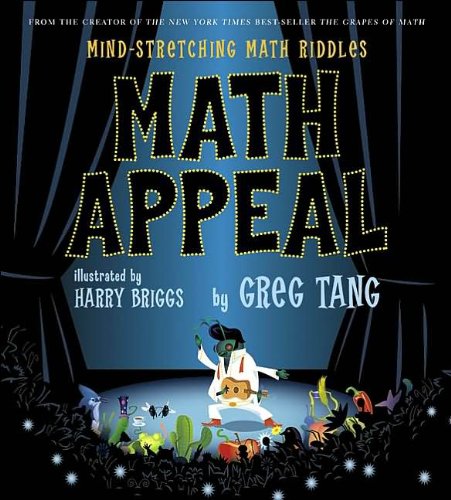
Math Appeal: Mind Stretching Riddles by Greg Tang Illustrated by Harry Briggs

My students love to try and solve a few of these riddles right after recess as we are waiting for students to get to the carpet. It’s great motivation to be on time!

If you aren’t familiar with Tang’s books, check out a sample page on his website.

Math Appeal Nonfiction Picture Book Wednesday: Nonfiction "on the go" in our room There's a Book for That

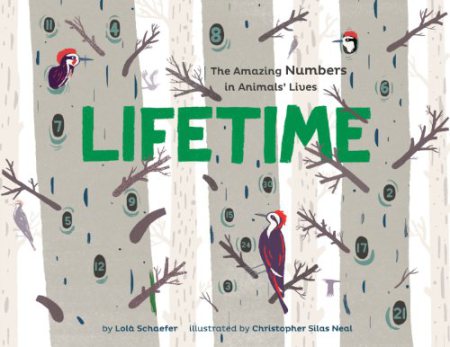
Another math title we have on the go is Lifetime: The Amazing Numbers in Animals’ Lives  written by Lola Schaefer and illustrated by Christopher Silas Neal

I read a page at a time and we try and come up with all of the questions we would need to ask to figure out how the statement was made. Lots of gathering of information via question asking. For example, we just learned that a kangaroo has 50 joeys in her lifetime. We came up with these questions:

  • How many joeys does she have at one time? Single birth? Twins? More?
  • How long do kangaroos live?
  • How old is a kangaroo when she can have babies?
  • How many babies does one kangaroo have in a year?

The detailed information in the back of the book gives us all of the answers and then we figure out the math!

Lifetime Nonfiction Picture Book Wednesday: Nonfiction "on the go" in our room There's a Book for That

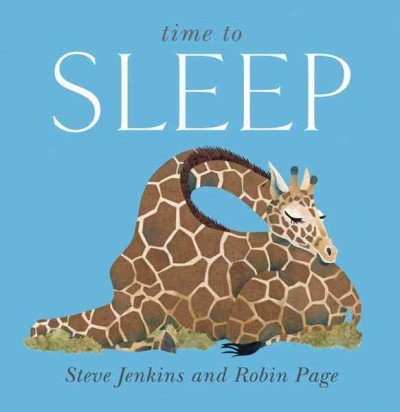
Time to Sleep by Steve Jenkins and Robin Page

We read this book every Thursday between Word Work and Reading Workshop. I read about the animal featured on the page and then ask the children to predict or infer to answer questions about the creature we are talking about. There is additional information about each animal in the back of the text. For example, we just read about how the flamingo stands on one leg to conserve energy. After we talked about how this is vastly different from the way we sleep, I then asked the children what they think flamingoes eat, where in the world we might find them and how tall they think they are. After they discussed their ideas with their turn and talk partners, I read the information in the back of the book. Listening for specific information is practiced as I share additional details.

time to sleep Nonfiction Picture Book Wednesday: Nonfiction "on the go" in our room There's a Book for That

Eye to Eye: How Animals See The World by Steve Jenkins 

This is our current nonfiction read aloud that we are reading in depth. We are talking lots, learning lots of new vocabulary and writing some quick summaries of our learning. Our favourite thing? Getting out our rulers and figuring out the actual size of each creature depicted on the page! In the back there is information about the size of each animal talked about. We love predicting and comparing.

“Who thinks a garden snail is smaller than 10 cm or larger than 10 cm? Get ready to mark its length on your ruler . . . Here is its length: ______”

 Eye to Eye Nonfiction Picture Book Wednesday: Nonfiction "on the go" in our room There's a Book for That

Nonfiction read alouds are never rushed in our classroom. They are springboards for further learning and discussion. When a book is finished, it has become part of our shared knowledge and who we are as learners.

Thanks to Alyson from Kid Lit Frenzy for the inspiration to read and share more nonfiction picture books in 2014. Follow the link to Alyson’s blog to read about more nonfiction books you need to read!

klf_nonfiction2014_medium

My goal is to read 65 nonfiction picture books for 2014. Progress: 132/65 complete! More than double my original goal!


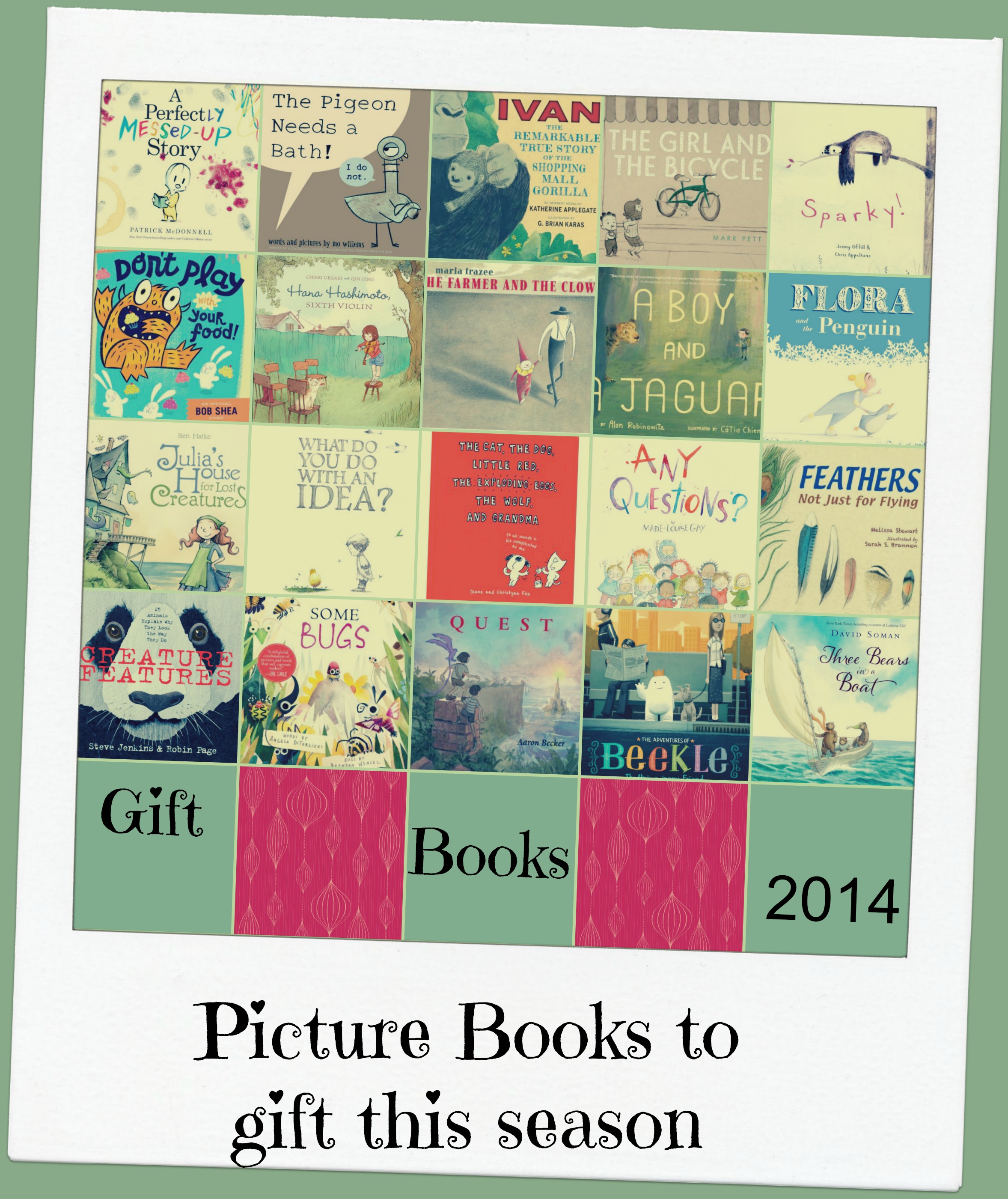
Gift Books 2014 – twenty picture books to give this season

Gift Books 2014 – twenty picture books to give this season There's a Book for That

What a year in picture books! There are so many amazing titles to choose from. I have certainly not read every book out there. But I have read a lot and there are some that have stood out. Here is my list of twenty. Twenty books I think are absolutely worth owning and therefore, worth gifting. Fantastic titles in both fiction and nonfiction. My criteria? Is it a book that can be shared multiple times? Does it inspire creativity, thinking, inspiration? Does it make the readers think differently? Does it celebrate something important? Is it a book that brings joy? Or does it simply make you laugh? A lot.

With those questions in mind, here is my list:

Listed alphabetically by author.

Ivan: The Remarkable True Story of the Shopping Mall Gorilla written by Katherine Applegate and illustrated by G. Brian Karas

This title is almost too special for words. After I read this book to my class, they wrote Ivan letters. Read more here. A book to inspire talk about how we treat animals and how we treat each other. Ivan’s story is a must read.

Gift Books 2014 – twenty picture books to give this season There's a Book for That

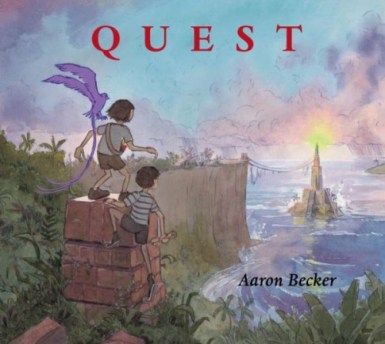
Quest by Aaron Becker

Experience the imaginative journey that Becker captures on the page. The reader is pulled through each illustration, all the while attempting to absorb every tiny detail. So wonderful that this is a picture book (wonderfully wordless) so that it can be experienced again and again.

 Quest Gift Books 2014 – twenty picture books to give this season There's a Book for That

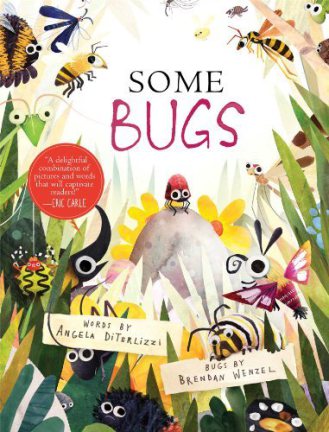
Some Bugs written by Angela Diterlizzi and illustrated by Brendan Wenzel

The text is delightful and the illustrations, divine! You will want to shrink down to insect size and crawl about this insect world.

Gift Books 2014 – twenty picture books to give this season There's a Book for That

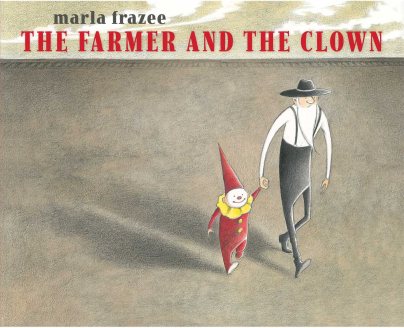
The Farmer and the Clown by Marla Frazee

This title surprised me with its tenderness, the sweet, the kind. All the more amazing of course, because it is wordless.

Gift Books 2014 – twenty picture books to give this season There's a Book for That

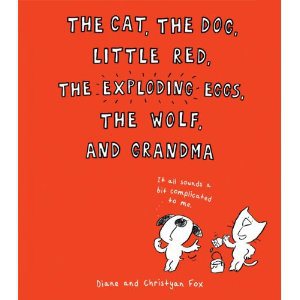
The Cat, the Dog, Little Red, the Exploding Eggs, the Wolf, and Grandma written by Diane Fox and illustrated by Christyan Fox

Funny, funny, funny – kind of like having a backseat driver “helping” tell a story. Annoying for the narrator. Amusing for the readers.

Gift Books 2014 – twenty picture books to give this season There's a Book for That

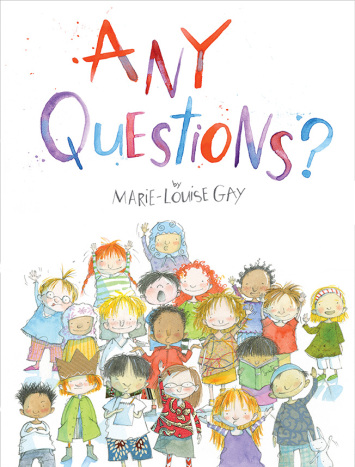
Any Questions? by Marie-Louise Gay

Enter Marie-Louise Gay‘s imagination, learn about her story conjuring process and hear a wonderful story . . . My class was completely spellbound by this book. More here.

Gift Books 2014 – twenty picture books to give this season There's a Book for That

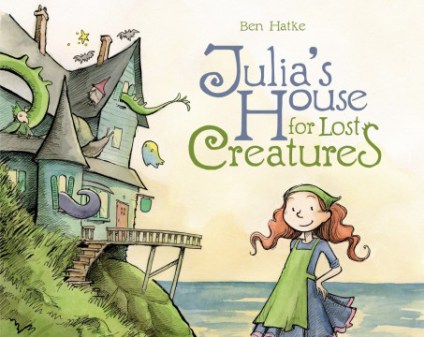
Julia’s House for Lost Creatures by Ben Hatke

Unique creatures and clever problem solving finesse. Speaks to loneliness and getting along with others with everyone pulling their weight.

Gift Books 2014 – twenty picture books to give this season There's a Book for That

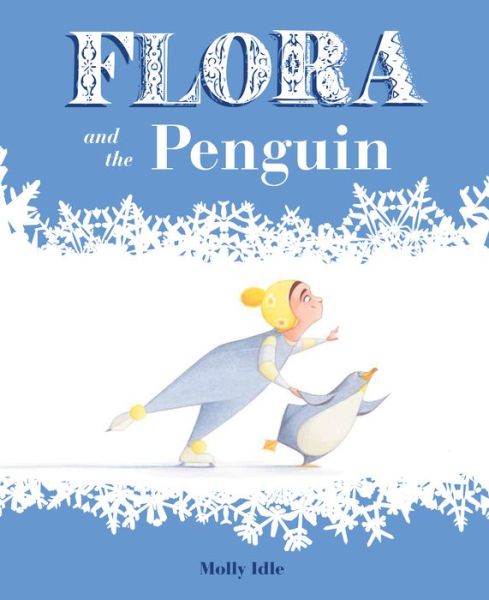
Flora and the Penguin by Molly Idle

Wordless. Playful and interactive with lots of flaps and expressions to study. Go ice dancing with Flora and her charming little friend.

Gift Books 2014 – twenty picture books to give this season There's a Book for That

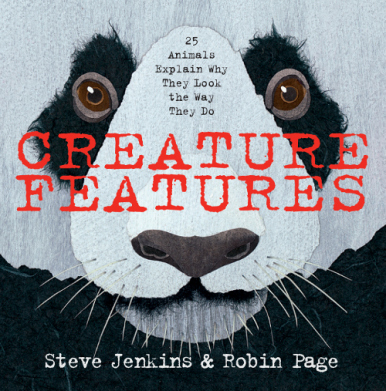
Creature Features: 25 Animals Explain Why They Look the Way They Do by Steve Jenkins and Robin Page

Why do certain creatures have these specific features? They will tell you in this gorgeous nonfiction title.

Gift Books 2014 – twenty picture books to give this season There's a Book for That

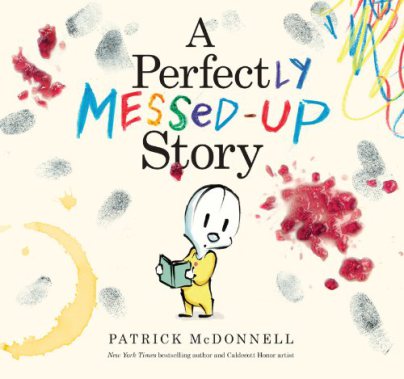
A Perfectly Messed up Story by Patrick McDonnell

Lots of humour. A conversation starter. A book to read together and then to refer to often. Life is full of messes. How are we going to face them?

Gift Books 2014 – twenty picture books to give this season There's a Book for That

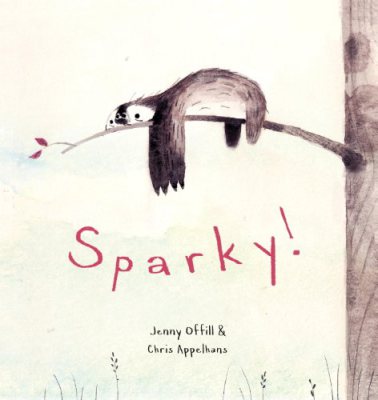
Sparky! written by Jenny Offill and illustrated by Chris Appelhans

This book is so absolutely charming. And wonderfully slow – yes, like a sloth.  It is about our desires and vulnerabilities. The last page will totally get you. This book needs to sit on your family’s bookshelf.

Gift Books 2014 – twenty picture books to give this season There's a Book for That

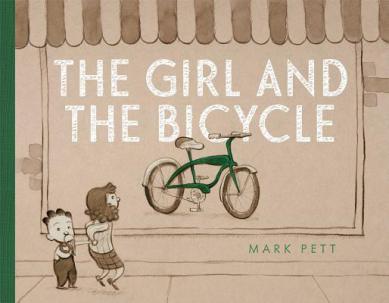
The Girl and the Bicycle by Mark Pett

This book will speak to your heart. Wordless perfection.

Gift Books 2014 – twenty picture books to give this season There's a Book for That

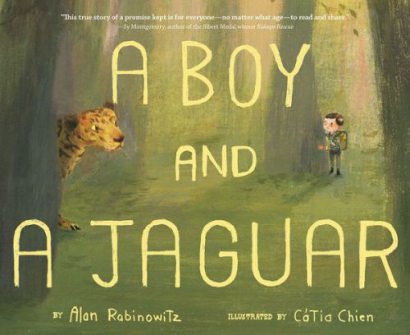
 A Boy and A Jaguar written by Alan Rabinowitz and illustrated by Cátia Chien 

Based on a true story. Gorgeous. Special. It’s a must own and must share. A story of a boy who finds his voice and shares it in the best of ways.

Gift Books 2014 – twenty picture books to give this season There's a Book for That

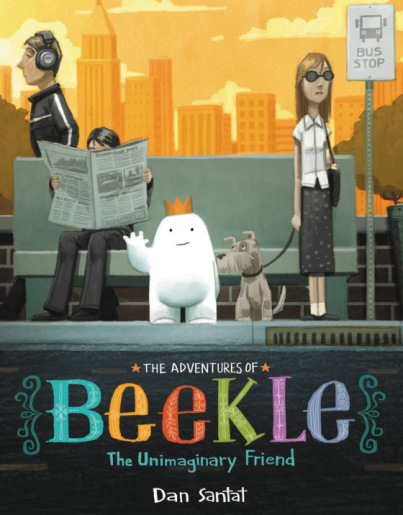
The Adventures of Beekle, The Unimaginary Friend by Dan Santat

A little “imaginary friend” goes in search of his person. What could be better? A book about connection and “meant to be”.

Gift Books 2014 – twenty picture books to give this season There's a Book for That

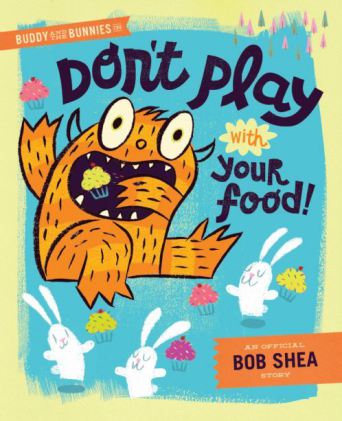
Don’t Play with Your Food by Bob Shea

We need to laugh lots with those we love. Little people will delight in this story. Big people will adore reading it aloud.

Gift Books 2014 – twenty picture books to give this season There's a Book for That

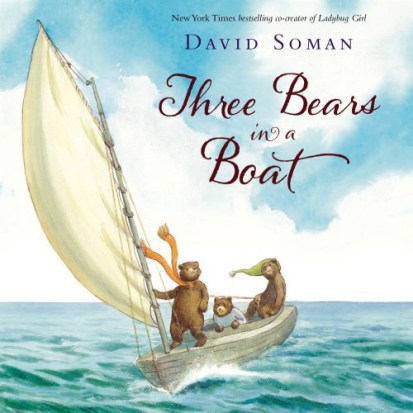
Three Bears in a Boat by David Soman 

A wonderful story about siblings, mistakes, owning up and doing what’s right. I challenge you to find a favourite illustration. Just stunning.

Gift Books 2014 – twenty picture books to give this season There's a Book for That

Feathers Not Just for Flying written by Melissa Stewart and illustrated by Sarah S. Brannen

This book needs an audience! Guessers to be specific. What else could feathers be used for besides flight? Feels like you could pluck some of these feathers right off of the page. Share the book and then come back to it often as you notice birds in your neighbourhood.

Gift Books 2014 – twenty picture books to give this season There's a Book for That

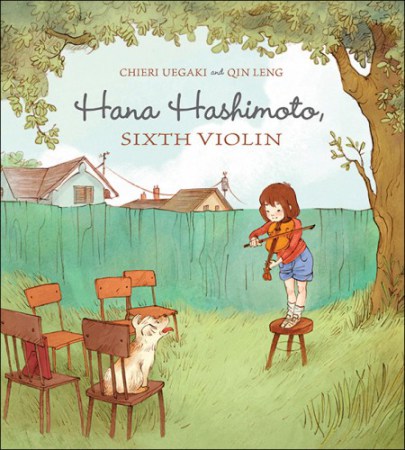
Hana Hashimoto, Sixth Violin written by Chieri Uegaki with illustrations by Qin Leng

A story of determination, perseverance and creativity. Absolutely about courage and dreaming. Connections to family. A treasure.

Gift Books 2014 – twenty picture books to give this season There's a Book for That

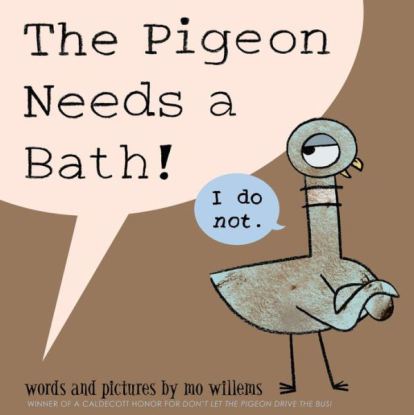
The Pigeon Needs a Bath by Mo Willems

This pigeon is channeling all children who resist, resist, resist the bath and then, absolutely refuse to get out. Have kids? You will relate!

Gift Books 2014 – twenty picture books to give this season There's a Book for That

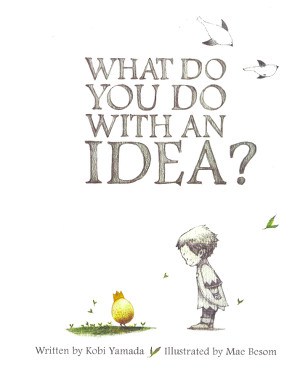
What do you do with an idea? written by Kobi Yamada and illustrated by Mac Besom

I previously described this title as a celebration of imagination and a Must Have/Must Own/Must Share title. I’m still going with that. Tempted?

Gift Books 2014 – twenty picture books to give this season There's a Book for That

Books are gifts to treasure! This season give books!

Nonfiction conversations: Talking nonfiction picture book biographies with kids

When I read aloud nonfiction titles to my class, it takes a long time. Often, we stretch a read aloud over weeks. Lots of reading aloud is happening in our room – a novel, various picture books, selections from titles we are book talking and always, always, one or more nonfiction titles.

No, my students don’t forget what was happening between read aloud sessions. Connections are made in the days between. We pick the title up and we loop back into our previous wonders, observations and learning. We bring more to the next time we read because there has been space for more thinking, more questions. And always, our nonfiction read alouds are titles we use to talk and share our thinking.

Turn and Talk. Share out. Repeat. Repeat. Repeat.

Lots and lots and lots of talk.

We retell. We predict. We infer. We look for evidence. We list questions. We share observations.

The talking is rich so the learning is rich.

It sounds like:

“I noticed that . . . ”

“But we are still wondering why. . . ”

“Last time we learned _______ so .  . . ”

“My partner and I have a question still.”

“Oh! Now I get how . . . ”

“This is connected to what _____ just said: . . .”

So when I finish a nonfiction title, the book has become part of our classroom community. Our shared knowledge. Our shared thinking. Our layers of learning. Often, when I read the last page, the students clap. They jiggle about. We have come out the other side a little more enriched with knowing more about our world. We are celebrating.

Am I reading a variety of nonfiction titles aloud? I think so. I am so very conscious of this thanks to the conversations I have had via twitter and blogs with authors and educators who read, write and share nonfiction titles. I am particularly indebted to author Melissa Stewart and educator Alyson Beecher for stretching my thinking. When I think back to titles we have read deeply and meaningfully, I find narrative non fiction like biographies and nature themed books feature big. But I also read a lot of expository titles. And I often share snippets from what Melissa Stewart calls Fast Facts titles. See her Pinterest pages for specific examples.

So if I am exposing my students to a variety of styles, what do they think? Are they enjoying the genres we are reading? Starting with picture book biographies, I asked 🙂

 The Tree Lady  Nonfiction conversations: Talking nonfiction picture book biographies with kids

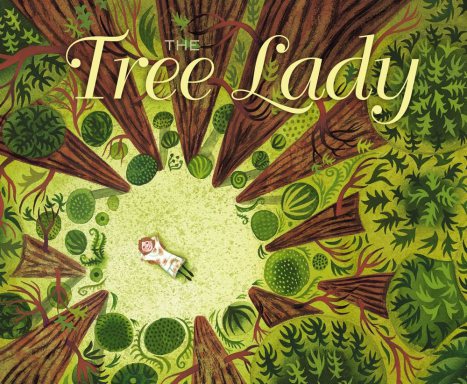
Yesterday, we finished The Tree Lady by H. Joseph Hopkins and illustrated by Jill McElmurry. When I closed the book, there was the reaction I love. The big smiles. The big breath in. The sitting up straighter. The perfect time to grab their thinking while the reactions were fresh. I asked questions and wrote down all of these thoughtful responses. Sharing here:

Me: “So what words describe how we are feeling right now?”

Class: “Hopeful.” “Energized.” “Joy” “Like standing up and connecting to the Earth.” “Smarter.” “I like Kate so much. It happened a long time ago but her soul probably still speaks for trees.” “She was one person who did so much.”

Me: “This is one of many picture book biographies we have shared together. Last year we read Me . . . Jane (by Patrick McDonnell), Who Says Women Can’t Be Doctors?: The Story of Elizabeth Blackwell (written by Tanya Lee Stone and illustrated by Marjorie Priceman), The Boy Who Loved Math: The Improbable Life of Paul Erdos (written by Deborah Heiligman and illustrated by LeUyen Pham), and many others. Why biographies? Why do you think I share these with you? Why do you like these titles? What are you thinking?”

Class: “I like to know about what other people did.” “I like those books that tell the story of someone who can’t but then they did.” “Kids can learn a lot.” “It inspires us.” “I respect people who helped us in the past.” “I feel grateful.”

Me: “Why do you think authors keep writing biographies?”

Class: “We are really interested. They know we will be.” “People can know about the past.” “It’s so we can know that one person can change things.” “So we will know history.” “Kids should know how things have transformed.”

Me: “How do these books make you feel?”

Class: “They show me not to be scared.” “They make me feel happy and inspired.” “Yeah, lots of inspired.” “People can do big things.” “I am learning history. About people who changed a city, or a country or the world!” “I like learning so much.” “This book also teaches us about community and dreams. We should think about that.” “Yeah. Cuz we will grow up and be adults. So we need to learn lots now.”

Me: “Okay. But here’s the thing, I usually read these titles to you. Then, a lot of you read them again. Or take them out from the library. But . . . would you choose to read these books on your own?”

Class: “Yes! Because I get to know facts and share them with other people.” “I don’t know where to find them in all libraries.” “Yes, because now I know there is lots of science in them.” “The librarians should make a big sign and an arrow – learn about interesting people in these books!” “It’s books that inspire you. We like that.” “It’s all new stuff. It’s nonfiction. I love nonfiction!”

Me: “But what if I had never read any picture book biographies to you? Would you choose to read them on your own?”

Class: A pause happened.

Then everyone started talking at once and I couldn’t write down specific comments. But I can summarize. Most students said that teachers need to show their students about these books. My language/their sentiment: Lots of exposure to this genre as classroom read alouds (where you get to talk and write and think together) will hook kids on this genre. Many expressed that they like that these books are written like a story that they can just settle in and at the same time, learn facts and be inspired. Some said they wouldn’t like to read a biography organized like other nonfiction titles with fact boxes, etc. because it would distract them from the person’s story. Some pointed out that some of the language would be too hard for some kids to read on their own. So these titles could first be read alouds and then be books they could read on their own when they were older. “Because we won’t forget about them,” one student added.

Me: “Should we read more picture book biographies this year?”

Class: “Yes!” “Six thumbs up!” “Like next week?”

My learning? It is still settling in. But a few things stand out.

  • It is imperative that we expose children to a variety of nonfiction genres
  • We need to name the genre. Talk about its purpose. Discuss how we feel and what we have learned.
  • Stories hook us. Stories that are full of learning and one particular personal story touch us deeply.
  • Conversation with children about what we are reading and talking about is so very rich

I wrote a series of blog posts in the summer about teaching with nonfiction titles. This post: Part 3: Interacting with nonfiction: getting students reading, thinking and talking together highlights some of what I am trying to emphasize here.

I plan to engage in conversations with my students about other nonfiction genres and share their thinking. Please let me know if this is helpful or interesting to you as you think about read aloud choices, nonfiction purchases, instruction around reading and sharing nonfiction titles.

*Note, my class is a Grade 3/4 class that I looped from a Grade 2/3/4 last year.

Nonfiction Picture Book Wednesday: So, I think I might read . . .

So . . . I am back to teaching again! Finally! If you are a regular reader of this blog, you might notice that I have announced this frequently but considering we had job action disruption since May and more than 5 weeks of full scale strike action, I am celebrating in every moment that I am back to doing what I love.

My energy is “leapy” – which I am not sure is a word exactly but I’m translating it as: a feeling of great excitement; can result in jumping up and bouncing about in happiness. Often and without warning.

Sitting to write a blog post will be a little challenging. I decided to use this opportunity to celebrate nonfiction titles to share some books I am thinking of reading aloud to my students in the next few months and why. . .

The Rat by Elise Gravel (published 2014)

Our first read aloud of the year was The Fly by Gravel and it was a huge hit. Students are completely intrigued with this series and I can’t wait to share more titles with them. One child offered this description:

“great because it’s a graphic novel and it fills your head with knowledge and funny facts!”

The Rat Nonfiction Picture Book Wednesday: So, I think I might read . . .

Salmon Creek written by Annette LeBox and illustrated by Karen Reczuch (published 2002)

We are off on our first field trip of the year on Monday, heading up to Grouse Mountain to explore. Salmon Creek will give us an opportunity to read about B.C. wildlife and forest habitats.

Salmon Creek Nonfiction Picture Book Wednesday: So, I think I might read . . .

Can We Save the Tiger? written by Martin Jenkins and illustrated by Vicky White (published in 2011)

I want to study endangered and extinct animals as we learn more about habitats, animal interactions and adaptations. This is one of the best nonfiction titles to introduce some of these concepts.

Can we Save the Tiger? Nonfiction Picture Book Wednesday: So, I think I might read . . .

Parrots Over Puerto Rico by Cindy Trumbore and Susan L. Roth (published in 2013) Winner of the 2014 Sibert Medal

The perfect story about how human actions can begin to help rather than only interfere with an endangered species.

 Parrots over Puerto Rico Nonfiction Picture Book Wednesday: So, I think I might read . . .

The Tree Lady by H. Joseph Hopkins and illustrated by Jill McElmurry (published 2013)

I love sharing picture book biographies and this is a title I didn’t get to read aloud last year. I also have some incredible art projects in mind that I think this book will inspire.

 The Tree Lady Nonfiction Picture Book Wednesday: So, I think I might read . . .

Jasper’s Story: Saving Moon Bears written by Jill Robinson and Marc Bekoff; illustrated by Gijisbert van Frankenhuyzen (published 2013)

Another title that illustrates how a species can become endangered because of human treatment and behaviour. I found this book this summer and knew it would be a book I had to share with my class.

 Jasper's Story Nonfiction Picture Book Wednesday: So, I think I might read . . .

Feathers Not Just for Flying written by Melissa Stewart and illustrated by Sarah S. Brannen (published 2014)

I have a very interesting project in mind that this book will be a part of. There are a few other titles that will also be part of the inspiration. I don’t want to spoil anything but stay tuned . . .

Feathers Not Just for Flying Nonfiction Picture Book Wednesday: So, I think I might read . . .

Eye to Eye: How Animals See The World by Steve Jenkins (published April 2014)

Every year I share bits of a Steve Jenkins book over the course of weeks or even months. A page or so a day. This is the Jenkins title I plan to begin with.

 Eye to Eye Nonfiction Picture Book Wednesday: So, I think I might read . . .

Thanks to Alyson from Kid Lit Frenzy for the inspiration to read and share more nonfiction picture books in 2014. Follow the link to Alyson’s blog to read about more nonfiction books you need to read!

klf_nonfiction2014_medium (1)

My goal is to read 65 nonfiction picture books for 2014. Progress: 107/65 complete!

Teaching with a Passion for Nonfiction Books: Part 3 A

This is the third post in a three four post series highlighting how to use more nonfiction in the primary/early intermediate classroom. The first two posts can be found here:

Part 1: Everywhere you look . . . let there be nonfiction!

Part 2: The importance of the nonfiction read aloud

The intention with each of these posts is to share a practical “how to” list of how to read more, celebrate more and use more nonfiction picture books in our classrooms. For reference, last year I taught a Grade 2/3/4 class.

Teaching with a passion for nonfiction picture books:

Part 3: Interacting with nonfiction: getting students reading, thinking and talking together

3 A: Generating excitement, making choices and having time to read This post will touch on these questions:

  • How to generate excitement about nonfiction texts?
  • What are some ways to get students reading more nonfiction books?

 Teaching with a Passion for Nonfiction books: Interacting with nonfiction: getting students reading, thinking and talking together There's a Book for That

One of the best ways to create a buzz about nonfiction texts is to make authentic connections with the authors, illustrators and photographers that are making the books we love to read! We read a lot of nonfiction titles in my classroom and its is always exciting for the children to be able to communicate with the people behind the books that we have loved and shared together.

I would like to share three of our important connections here.

FirstNic Bishop.

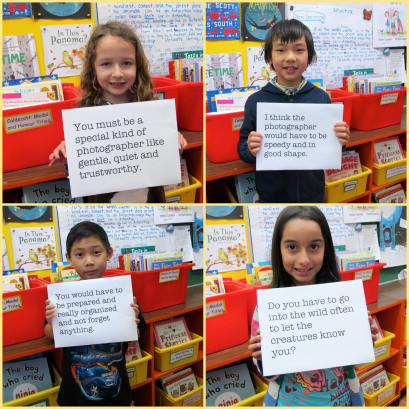
When I had the opportunity (thanks Adam Shaffer) to introduce author and photographer Nic Bishop at this year’s Western Washington’s Children Literature ConferenceI knew that my students had to be part of the presentation. We spent time with Nic Bishop books (titles like Butterflies and Moths, Lizards, Spiders, Frogs, and Snakes). I asked the children to explore the books with these questions in mind:

  • How were these photographs taken?
  • What skills (besides photography) would the photographer need?
  • What would be the rewards in this kind of work?
  • What would be the challenges?

I then made a slide show that showcased some of their answers. The children were thrilled that they had “come with me” to help with the introduction! Here are a few photos that were part of the slide show.

 Teaching with a Passion for Nonfiction books: Interacting with nonfiction: getting students reading, thinking and talking together There's a Book for That

Second, with author Melissa Stewart.

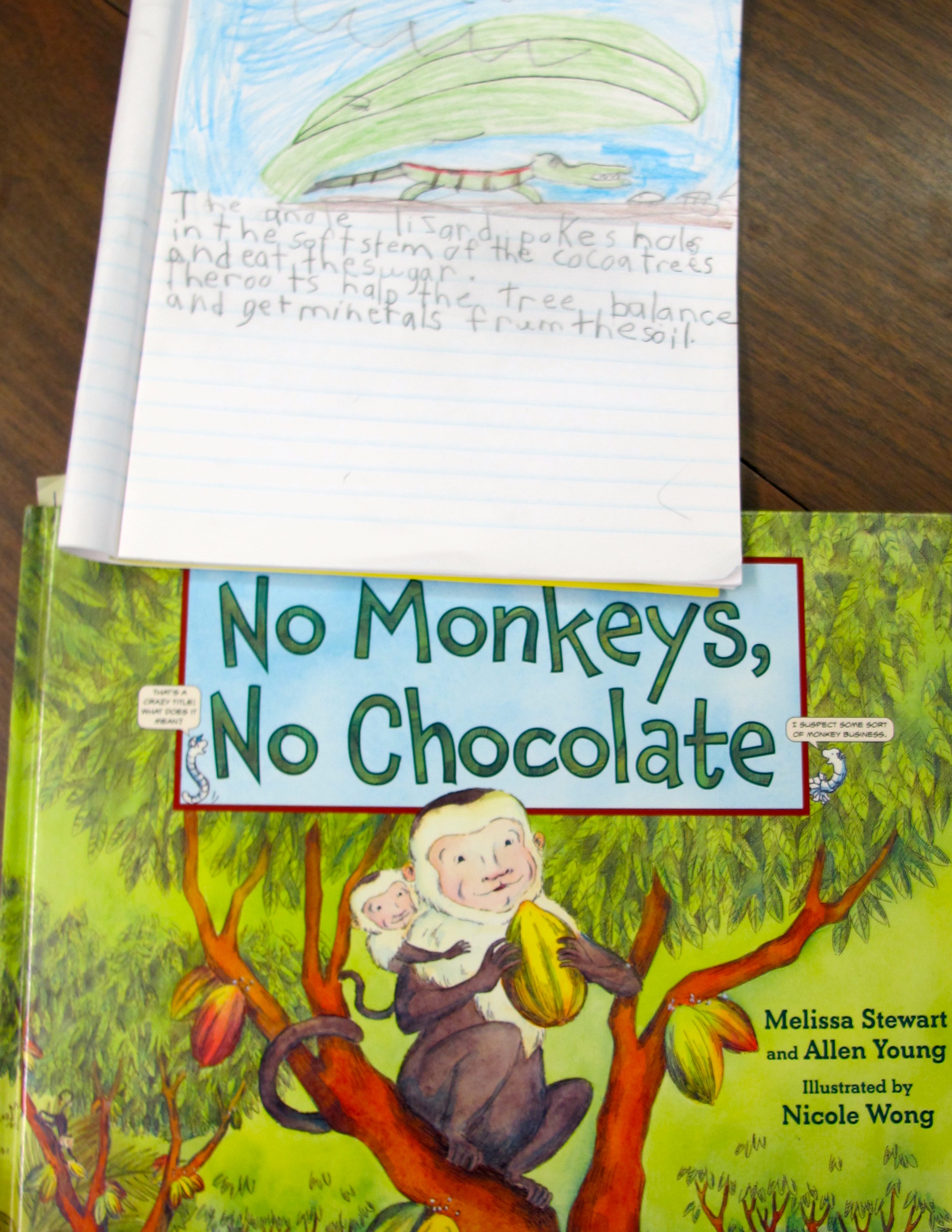
We took forever to read No Monkeys, No Chocolate written by Melissa Stewart and Allen Young (with illustrations by Nicole Wong) We had to stop to talk, to write, to talk some more. So much learning in this book! It was one of our favourite read alouds of the year! A very special thing happened when I tweeted a picture of one child’s picture and writing to Melissa. She shared this on her blog, Celebrate Science. One little boy now has dreams of being an illustrator for nonfiction picture books!

 Teaching with a Passion for Nonfiction books: Interacting with nonfiction: getting students reading, thinking and talking together There's a Book for That Students were so excited to see a classmate’s work on a real author’s blog! It was such a surprise to see his work up on the big screen!

 Teaching with a Passion for Nonfiction books: Interacting with nonfiction: getting students reading, thinking and talking together There's a Book for That

And third, with author Deborah Heiligman.

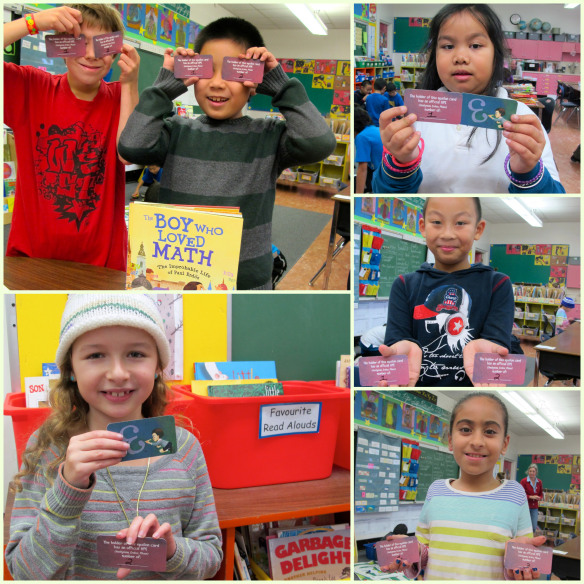
Another one of our very favourite read alouds this year was The Boy Who Loved Math: The Improbable Life of Paul Erdos written by Deborah Heiligman and illustrated by LeUyen Pham. I shared all of our learning and connections with Deborah in this post on my classroom blog Curiosity Racers: For the Love of Math It is worth reading to see how very engaged my students were with this book and to figure out just what those cards they are holding are all about!

 Teaching with a Passion for Nonfiction books: Interacting with nonfiction: getting students reading, thinking and talking together There's a Book for That

Provide time to read nonfiction books

Of course, with many nonfiction books in the room and lots of book talking highlighting nonfiction texts, many students are already reading nonfiction books.  To ensure that all students were having the opportunity to be making nonfiction a choice and having guidance in choosing nonfiction texts, we decided to set aside a specific amount of time once a week (we grew it to 20 minutes and some kids read longer) and called it Nonfiction Reading Day. Of course, many children read nonfiction daily. But after a few weeks of honouring nonfiction reading with a special time, more children began choosing nonfiction more often throughout the week.

On Tuesday (the day we chose) I made sure to book talk nonfiction titles and my Teacher Librarian (who is in the room with me for every Reading Workshop)and I help students select nonfiction books that are a good match for them in terms of reading and interest level.

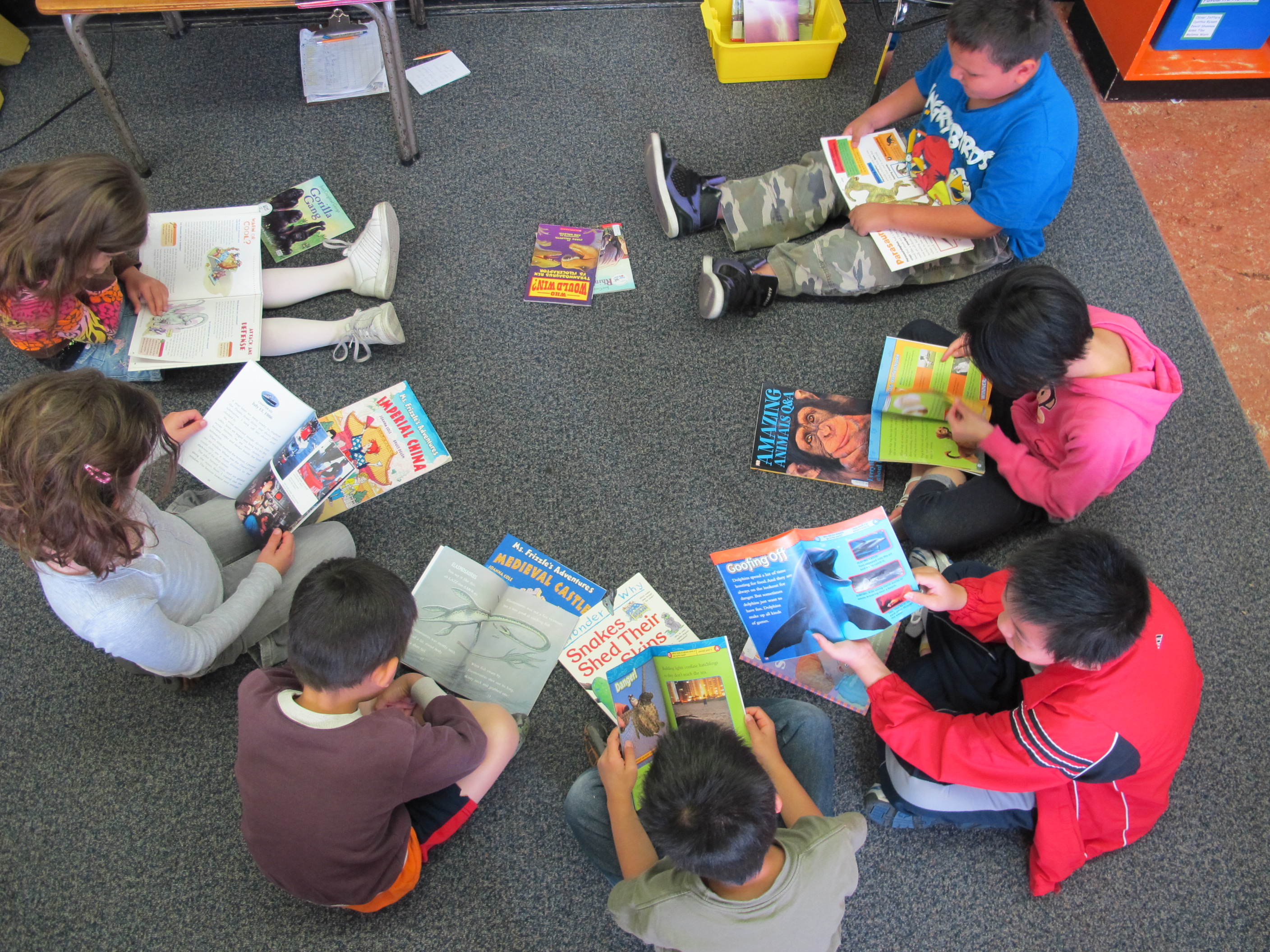
A great way to introduce more titles is also through book sharing circles. I group children into small groups of 6-8 students and have enough for 2-3 books per child. Every few minutes, we pass the books to our left and have a small amount of time to explore the titles just passed to us. At the end, we place all of the books in the center of the circle and students have a chance to share which books would be their first choices to read “next.” These conversations help to further promote the excitement about the books and invariably, many of these books are nabbed as students head off to read.

 Teaching with a Passion for Nonfiction books: Interacting with nonfiction: getting students reading, thinking and talking together There's a Book for That

On Nonfiction Reading Day, we acknowledge that the volume in the room will be noisier than our usual independent reading. It is hard to stay quiet when we read nonfiction because there is just too much that is too tempting to share. Many students also love buddy reading with a nonfiction text. I do specific mini-lessons with some ideas about how to make this go well.

Many days, we gather back to the carpet and sit knee to knee with a partner or a trio and share highlights from our nonfiction reading that day. Students are encouraged to ask questions and share their learning. We have a chart that we have created together in the room with some prompts to help out. A few examples:

  • Share a favourite illustration or photograph and explain what is significant about it
  • Read aloud a particularly interesting part and ask your partner if they have any questions about what you read.
  • Share something new that you learned.
  • Share a fact that was confirmed for you.
  • Talk about something you still don’t understand or have further questions about.
  • Give some reasons why someone might be interested in this title.

Time to read is a huge piece of generating excitement about nonfiction texts. Without this time to self-select titles, explore a variety of texts, talk about what we are reading and actually sustained time to read, our love for nonfiction won’t grow at the rate it does with all of these things in place.

 Teaching with a Passion for Nonfiction books: Interacting with nonfiction: getting students reading, thinking and talking together There's a Book for That

Share the #NFbooklove!

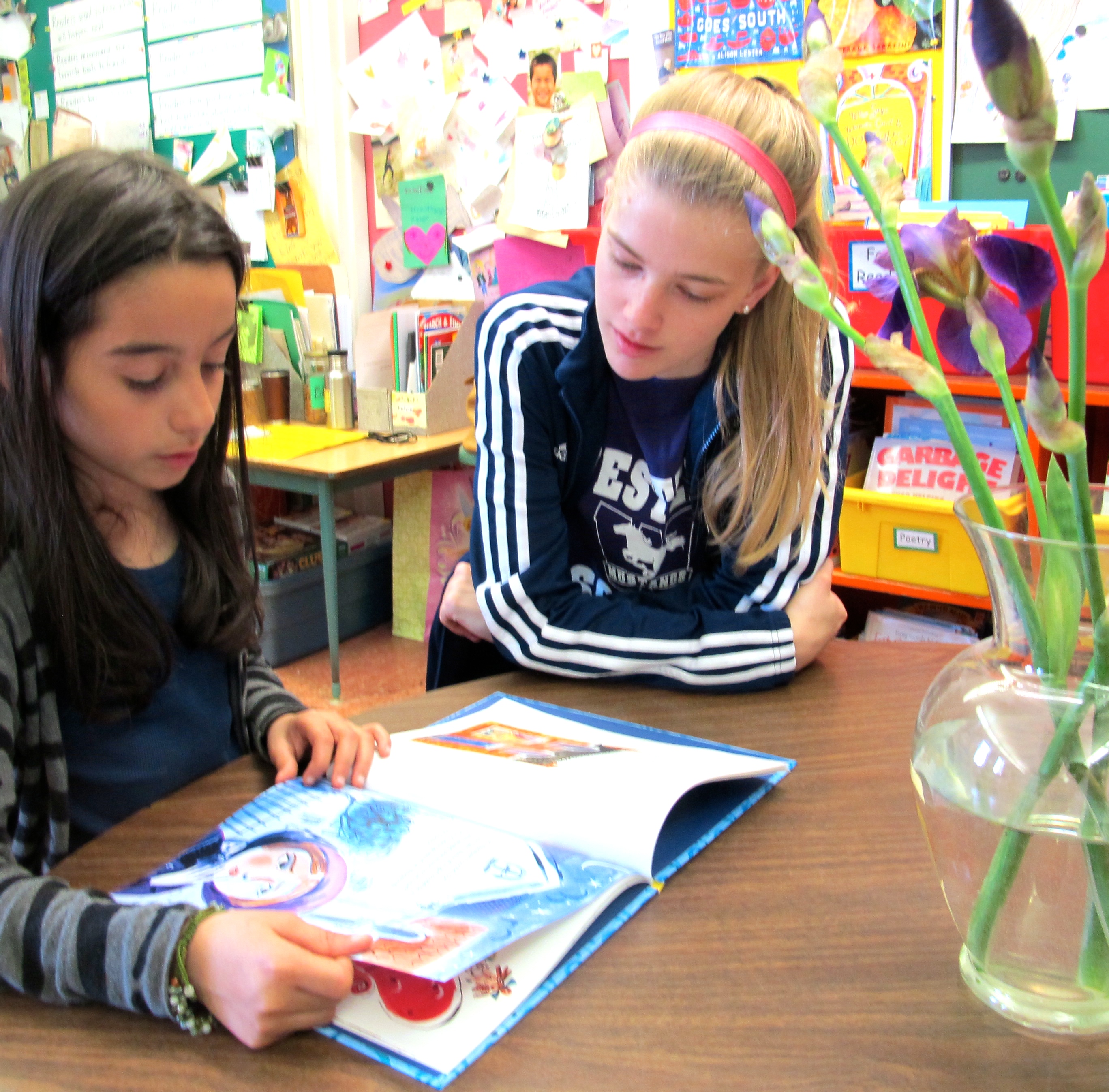
I love to welcome volunteers into my classroom during Reading Workshop. Often, when students get to choose which book to read to a volunteer, they choose a nonfiction text we have shared together!  This picture below is very special. My student, who dreams of becoming a doctor is reading Who Says Women Can’t Be Doctors?: The Story of Elizabeth Blackwell written by Tanya Lee Stone and illustrated by Marjorie Priceman to our volunteer who is currently applying to medical schools. I shared highlights of the conversations about this book in my classroom here.

 Teaching with a Passion for Nonfiction books: Interacting with nonfiction: getting students reading, thinking and talking together There's a Book for That

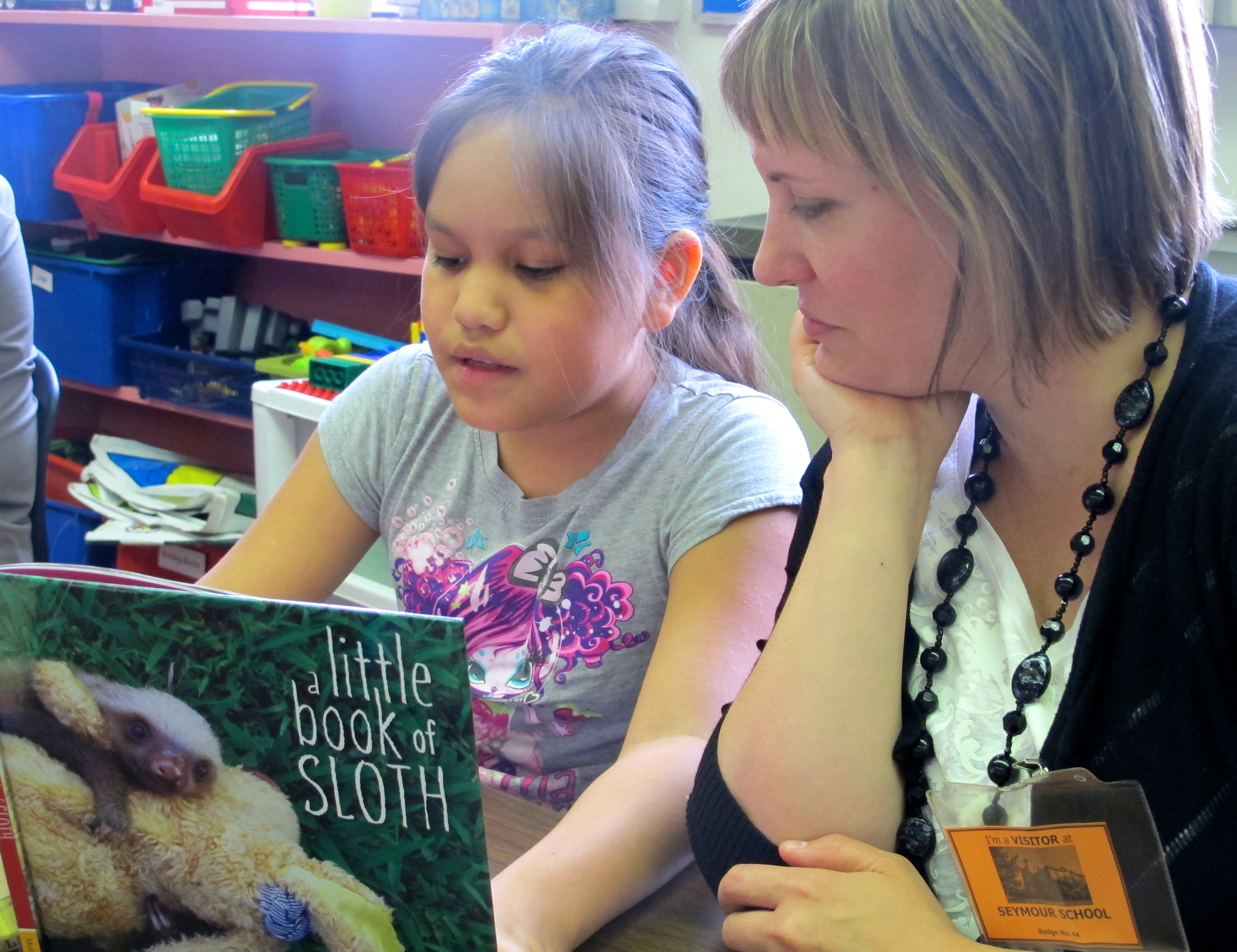
This picture was taken during the last week of school. My student is reading A Little Book of Sloth by Lucy Cooke to a guest visiting our room. She chose this from our Favourite Read Alouds bin. Why so significant? This was the first nonfiction read aloud I shared with my class back in September! Truly a testament to the joy these books bring to us.

 Teaching with a Passion for Nonfiction books: Interacting with nonfiction: getting students reading, thinking and talking together There's a Book for That

Up next? Part 3: Interacting with nonfiction: getting students reading, thinking and talking together – – > 3 B: Reading and working with the texts 

Please continue the nonfiction conversation with me. I welcome any questions or feedback in the comments section 🙂

Teaching with a passion for nonfiction picture books: Part 1

I recently had a conversation with author Melissa Stewart about sharing nonfiction titles in the classroom. We were discussing ways to introduce more nonfiction titles to our young learners.

I started thinking about some of the things I do, looked back through blog posts and classroom photos and realized that I was potentially going to write one of the longest blog posts ever written! For ease of reading (and writing!), I have broken things up into three distinct posts and will share these over the next week:

Part 1: Everywhere you look . . . let there be nonfiction!

Part 2: The importance of the nonfiction read aloud

Part 3: Interacting with nonfiction: getting students reading, thinking and talking together (Updated: this post is now split into 2 parts)

3A: Generating excitement, making choices and having time to read

3 B: Reading and working with the texts 

The intention with each of these posts is to share a practical “how to” list of how to read more, celebrate more and use more nonfiction picture books in the late primary/early intermediate classroom. For reference, last year I taught a Grade 2/3/4 class.

Always, my goal is to increase an interest in and a love of nonfiction reading. I am sure that many of you are already doing many of these things – probably many of them differently and better than me! But it is always informative to read about what is happening in other classrooms to help us think more about what is happening in our own. Please feel free to offer suggestions and ideas in the comments.

Teaching with a passion for nonfiction picture books:

Part 1: Everywhere you look . . . let there be nonfiction!

Know your books.

There are so many fantastic nonfiction titles being published and keeping current is important if we want to nurture a love of nonfiction in our students. One of the biggest issues for teachers wanting to share more nonfiction with their students is where to begin. What books are out there? Are they a good fit for specific grades/readers/interest levels? What books are wonderful read alouds? Which books are ideal for independent reading at different reading and interest levels?

It is hard to know where to start. Best piece of advice – start with the educators, authors and illustrators who have not only started but are immersed in the land of nonfiction books. Let their passion and knowledge inspire and inform your choices.

  • Read blogs (see a list of recommendations at the bottom of this post)
  • Check out the new titles in your favourite bookstore and public library.
  • Pay attention to best of lists (see below) and award winners (again see below).
  • If you are on Pinterest, follow boards that highlight nonfiction titles

Read nonfiction picture books for your own enjoyment.

We are passionate about titles that we have read and enjoyed. Set a goal to read more nonfiction titles and you won’t be able to resist sharing. One of the best things I did was join Alyson Beecher‘s nonfiction picture book challenge last year. Alyson challenged educators to read more nonfiction picture books and share updates by participating in the #nfpb20i4 (this year’s twitter hashtag) meme. Here is a link to Alyson’s challenge for 2014. The best thing about participating in this challenge is being part of a reading community who is excited and passionate to share nonfiction titles with students and educators.

Bring these books into the classroom!

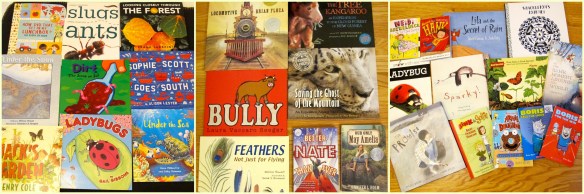
Children need to look up and find nonfiction titles in their learning environment, not just associate nonfiction with one section of the library where you go to learn research skills. I regularly rotate nonfiction from the library into my classroom displays. But I also purchase new nonfiction titles for our classroom collection. When I buy new books, I am conscious of making sure I have both fiction and nonfiction titles. Sometimes I go shopping strictly to add new nonfiction books that represent current student interests. Students will often ask me to find more titles about a particular topic or “a book that is like ________”(some current favourite). In my classroom this year, there was a lot of interest in insects, gardens and life in the ocean. I keep a little notebook full of sticky note requests and take it with me when I go book shopping. Often I take photos of a book shopping spree so these pictures help illustrate the balance in my book purchases.
Teaching with a passion for nonfiction picture books: Part 1 There's a Book for That Book talk nonfiction books.

I keep a basket of books to book talk by my chair at our carpet area. The students know that they aren’t supposed to peek and what is in the basket is always a source of anticipation and excitement. There are always fiction and nonfiction books in this basket so that I ensure I am giving equal “rave about/celebrate” talks to both genres. On certain days I will just book talk some new nonfiction. Other days I book talk a variety of titles. The consistent thing, I am book talking every day. If I have limited time, I set a timer and grab a pile and challenge myself to “sell” those books before the timer goes off. The students think this is hilarious. I think it is highly effective because about 95% of the time all of the books have been nabbed and landed in student book boxes or in reader’s hands by the time I am finished.

What do I highlight when I book talk nonfiction titles? Some of these things (depending on time available and purpose)

  • information about the author and illustrator/photographer: What motivated them to write the book? Have we read their work before?
  • some of the features in the book i.e. maps, timelines, close up photography, etc. I also use this time, when possible to review how to use some of the features in the book. For example, I might be sharing a book about grasshoppers. I will wonder aloud how high they can jump. I then ask students about how I might find that information. They might suggest the index, table of contents or page headings. We would go through the process of actually looking to see if we could find the answer to my question.
  • ways to interact with the book i.e.  skipping to a life cycle chart as an overview of the stages of life before reading sections in more detail
  • ways to buddy read a title (i.e. how to take turns reading sections/what kind of questions that might be asked, turn taking looking up words in the glossary, etc.)
  • suggestions of other books in the room on the same topic/theme or asking students if they can think of any other books in the room on same topic (as they get to know our library better I do this more and more)

I also might

  • read aloud an interesting fact or two
  • share my favourite photo/illustration and ask a few questions about it
  • “quiz” the students and take guesses before sharing information in the book i.e. “Does anyone want to guess how long a mountain gorilla lives in the wild?”
  • read aloud a passage that reinforces something we have just learned so that students know that they can increase their knowledge on a topic we already know something about

Think about your book displays

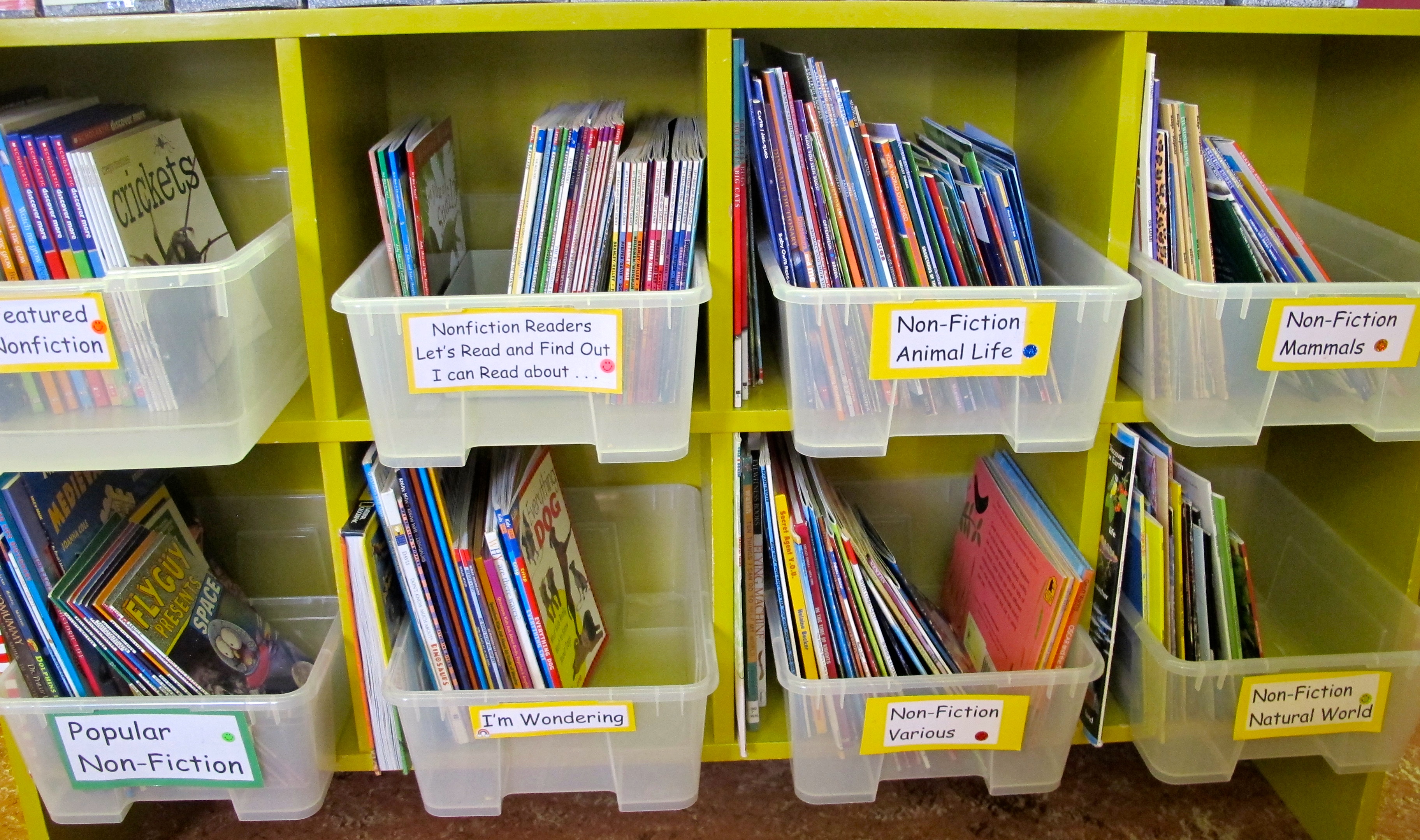
I have a shelf of nonfiction titles right beside our carpet area where we gather for many lessons and read alouds. I believe that proximity leads to curiosity so I was strategic about placing these titles close.
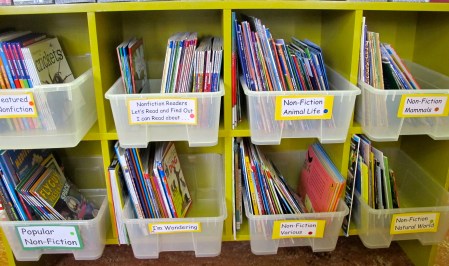
Teaching with a passion for nonfiction picture books: Part 1 There's a Book for That

I also use a tiny bulletin board in another area of the classroom to display the book covers of the nonfiction books we are in the middle of reading or have just finished. Because we do so much reading, writing and talking about these titles, I like highlighting the covers in a place of importance.
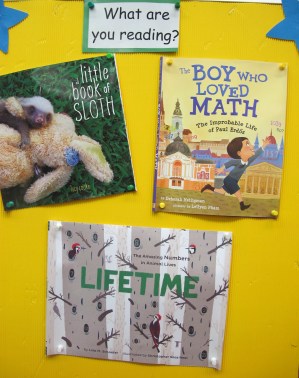
Teaching with a passion for nonfiction picture books: Part 1 There's a Book for That

On top of one set of bookshelves is a display stand of nonfiction titles where I can display books with the covers facing out. It sits beside an identical stand of fiction picture books. This is deliberate – to convey the message to students that we read widely – choosing both fiction and nonfiction titles.
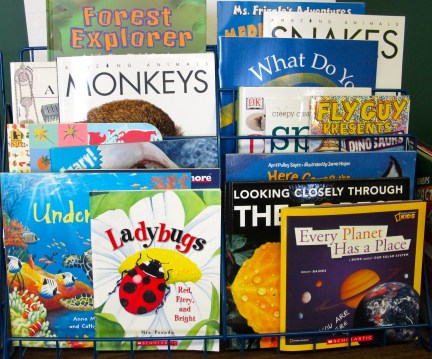
Teaching with a passion for nonfiction picture books: Part 1 There's a Book for That

Also near the carpet area is an every changing book display of books from the classroom and school library that we have recently read or book talked. As you can see in the photo below, both fiction and nonfiction feature prominently. We know from our own reactions when we walk into a library space that our eye is drawn to books that are displayed covers out. Be conscious of what students see when they look around the classroom.
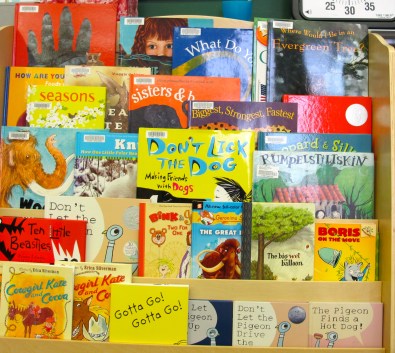
Teaching with a passion for nonfiction picture books: Part 1 There's a Book for That

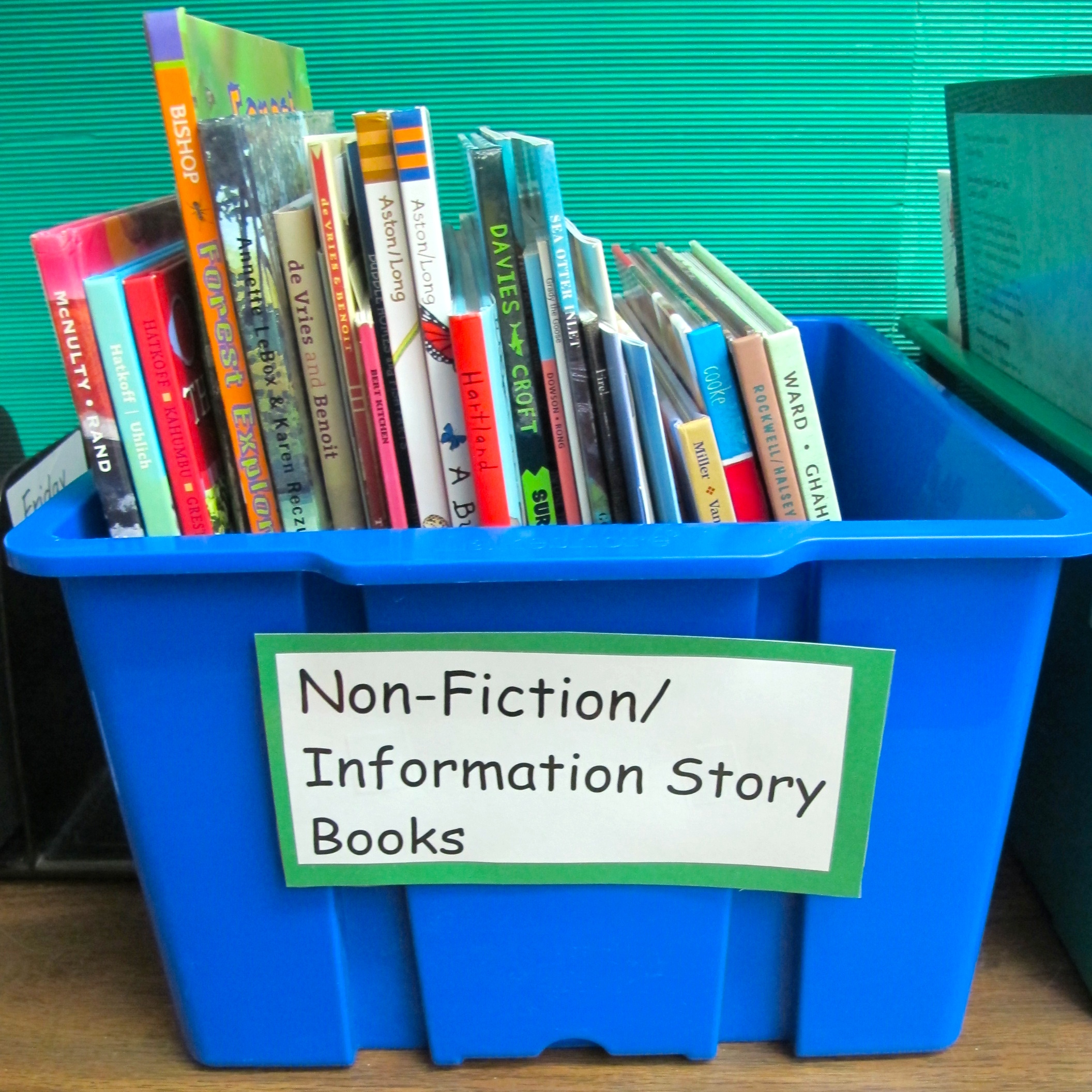
My students also see that I have bins dedicated to nonfiction titles in my own teaching areas. They get excited about peeking into these bins and making read aloud requests.
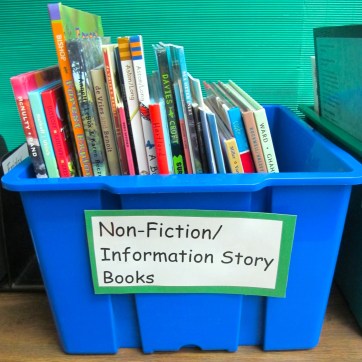
Teaching with a passion for nonfiction picture books: Part 1 There's a Book for That

One of my favourite memories of this school year was after we read Who Says Women Can’t Be Doctors?: The Story of Elizabeth Blackwell written by Tanya Lee Stone and illustrated by Marjorie Priceman Later, I found one of my students snooping through my Picture Book Biography bin. “Do you have any more of those girls can’t or people can’t kind of books?” she asked. Of course, I did. We went on to read Every Day is Malala Day and our discussions and learning continued.
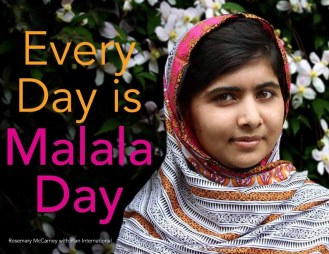
Every Day is Malala Day Teaching with a passion for nonfiction picture books: Part 1 There's a Book for That Teaching with a passion for nonfiction picture books: Part 1 There's a Book for That

Further reading/information:

Blogs that highlight a lot of nonfiction titles:

KidLitFrenzy and all of the blogs that regularly participate in the #nfpb2014 challenge. All of my posts from 2014 are here and from 2013, here.

The Nonfiction Detectives

Celebrate Science

Librarian’s Quest

Delightful Children’s Books

Under the category of picture books Mary Ann Reilly shares fantastic themed lists by subject and grade level ranges on her blog Between the By-Road and the Main Road

Best of Lists:

The Nerdy Book Club: Nonfiction Picture Book Winners:  2013 winners

School Library Journal’s Best Nonfiction of the year: Here is the 2013 list

Waking Brain Cell’s best nonfiction list: Top 20 2013 titles 

Awards:

Robert F. Sibert Informational Book Award

Cook Prize (STEM) Award 

Pinterest boards featuring nonfiction picture books:

My boards: Nonfiction and Wishlist: nonfiction picture books

2014 Best Children’s Nonfiction by Tasha Saecker

Best Non-fiction for Kids by Pragmatic Mom

Great Nonfiction for Kids by Choice Literacy

Melissa Stewart has started a board that highlights blogs that share lots of nonfiction: Blogs Worth Reading

Some posts on my blog which feature a number of favourite nonfiction titles:

Wonder Inducing Nonfiction Read Alouds

Swoon Worthy Nonfiction Picture Books

If you are a blogging teacher or a reader of blogs consider following and participating in the #nfpb2014 hashtag and link up on the blog KidLit Frenzy every Wednesday. There is also a Nonfiction 10 for 10  blogging event that has run for the last two years in February. This is hosted by Cathy Mere from Reflect and RefineMandy Robek of Enjoy and Embrace Learning  and Julie Balen of Write at the Edge. Follow on twitter with the #nf10for10 hashtag. My #nf10for10 post this year was The Wonder of Women. It featured 10 picture book biographies about women in history.

I am passionate about sharing lots of nonfiction titles with my students and increasing their excitement about reading nonfiction books.  I welcome any feedback. In particular, please feel free to suggest favourite blogs, lists and Pinterest boards that others might enjoy.

Happy nonfiction reading!

Next post? Part 2: The importance of the nonfiction read aloud