A beautiful book to inspire hope on Remembrance Day

We read this beautiful book by Michael Foreman on the eve of Remembrance Day.
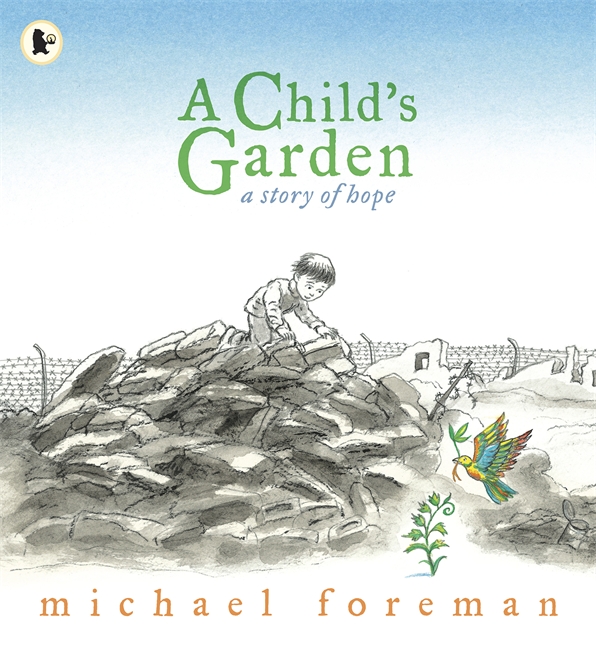
Both the text and illustrations are simple and beautiful.  As a read aloud, it is perfect. Each page brings exclamations, predictions, connections, sighs, expressions of joy and anger! The story? A boy finds a tiny plant in a pile of rubble next to a barbed wire fence – he nurtures it and it grows into a grape vine, spreading to cover the fence and bringing birds and butterflies and children to play.  Then the soldiers tear out the plant and throw it over the fence. “Huh? No! Why?” – the class erupted in outrage!

The boy is sad and troubled and suffers a miserable winter with his family in his war torn home.  Then in the spring he notices the vine is growing on the other side of the fence and soon seeds also sprout again on his side.  With more watering and care the vine soon grows and the green tendrils become entwined as they grow up either side of the fence to meet together at the top.  Again, the children have their beautiful garden.  This time on both sides of the fence. The subtitle of this book is A Story of Hope and it certainly is.  The discussion continued as we went for our afternoon walk outside.  Questions, connections and thoughts still to be shared.  How lucky we were to have a beautiful afternoon walk in the sunshine, talking about hope and peace and community.  Books like this work their magic! How do we talk about war and conflict with children? How do we honour peace?  Sometimes all we need is the perfect book to get us started.
Exploring unique animal relationships

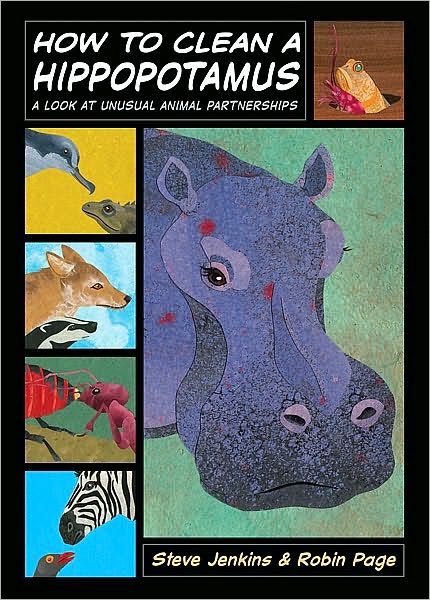
We have been reading this fantastic book by Steve Jenkins and Robin Page called How to Clean a Hippopotamus and are learning all about symbiotic relationships – today we read about the oxpecker, also known as a tickbird and how it hangs out with some pretty large animals doing a very important job.

We drew some pictures of what we learned today and tried to explain how all the animals in a symbiotic relationship benefit.

Gary explains: The giraffe lets the oxpecker on its back because the oxpecker eats the parasite  and the oxpecker warns the giraffe when the giraffe predator is near! The oxpecker likes to go on to the giraffe’s back because it eats the parasites.

Ricky writes: The oxpecker is a really nice bird.  It eats ticks from the giraffe.  Ticks are small small parasites that use your body as a home.  But ticks don’t go only on giraffes! They go on rhinos, buffalos, zebras, giraffes and deers.  So the oxpecker can have lots of food.  These animals can’t get the ticks out of their body because they’re not like us.  So the oxpecker can help by eating. These are African animals.

Scott explains: The oxpecker helps the giraffe by eating the parasites.  Also they scream and flap their wings to warn the giraffe so the giraffe could run away or kick predators with their legs.  Because the oxpecker loves eating parasites, it spends time on large animals.   Scott also provided some definitions: A parasite lives on a host.  They are annoying.  A tick is a parasite.  A predator means that they hunt animals.  They hunt them so they could eat them.

We can’t wait to read about more unique animal relationships in this book!