How do we have those conversations with other teachers where the gist is basically this: There is some work involved.
And yes, you have to do it.
It’s kind of awkward.
We all start from the same place. The same amount of time in a day. Our differences are sometimes vast and sometimes slight in these areas: experience, education, knowledge, time management, access to money, access to help, willingness to stick to or stray from a reasonable work day schedule.
Then there is the stuff some might call political. We get fired up about this and we should. Teachers should not have to spend their own money. A teacher’s workday can be endless. There needs to be some limits. There isn’t enough prep time. New teachers don’t get enough support. We need more time and structures to talk to and learn from each other.
But we can’t just dwell there. We all put time in beyond the teaching day. It’s impossible to do this job without that. And, of course, a full day is beyond those 9-3 hours. So, maybe we could start there. Can you sometimes dip into your planning, marking, communicating time and invest in some thinking and action that will result in changes to your classroom? Positive, healthy, inspiring changes. Changes that maybe, in the end, make things easier and better for everyone?
This isn’t coming from a place of judgement. It’s just what it is. We need to make changes to make our practice meaningful. The children we work with everyday need us to invest in our own learning to make things better for their learning. We need to acknowledge that there is always more to learn.
Yet. . . often when we talk about shifting practice, the response begins with “I can’t . . . ”
I am in the middle of prep for a presentation where part of the message is starting with change in ourselves. Change that will take time and effort. Effort over time. I am anticipating the “I can’t. . .” I am thinking about how to be convincing, about persuasive arguments and hard to dispute evidence.
When we make shifts, it is about turning on our own axis and really looking at something from a different perspective. It’s not about easy: a boxed program, an on-line lesson or a step by step guide without individuality. It’s about a little bit of information, some important evidence, a compelling example or two (or twelve) and a lot of individuality.
It’s in the individuality where the work comes in. We need to be responsive. Let things be organic to a certain degree. Embark on change knowing that watching our students respond might mean we need to tweak this and change that and sometimes begin some things again and again.
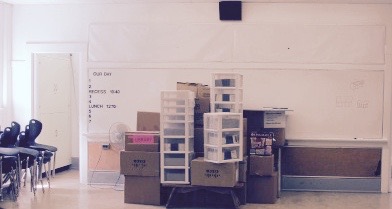
I think back to unpacking in my new classroom last summer. Everything had to be done to create a learning space that would be a fit for my students. I was sourcing furniture, organizing shelves and setting up during most of the break. I had it all figured out about ten times and it still took forever. Kids arrived. It shifted again. I am still moving tables. Clearing counters. Rethinking everything. I have it all together often. For about 10 seconds.
When I learn something new, I celebrate and I sigh because it means, yet again, changes ahead. I love being this old and comfortable with not having it all perfect. I embrace the work.
I hope I can share with others what I am thinking and gently nudge them towards their own work.
It’s always work.
Telling people so shouldn’t be awkward.
So why does half of my planning time seem to be about making the message more gentle?

I am participating in the Slice of Life challenge to write and publish a post every day in March.
Slice of Life is hosted by Two Writing Teachers. I thank them for the community they provide. Read more slices here.








 There's a Book for That