Strength of triangles!

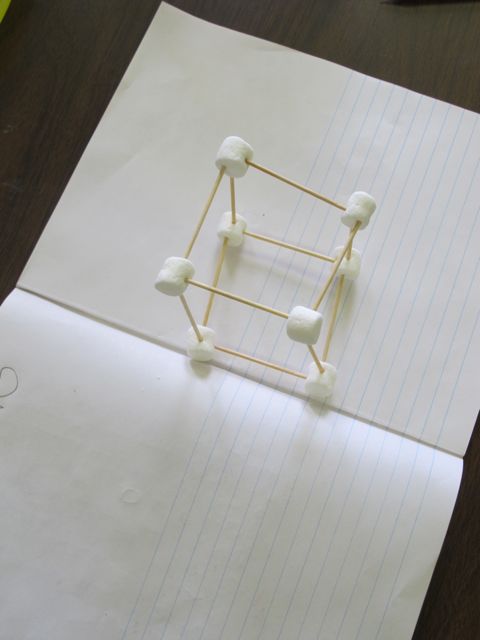
Marshmallows, tooth picks and a challenge! Make a cube. How many blocks can you balance on a single card?

Step one: Make the cube

IMG_1533

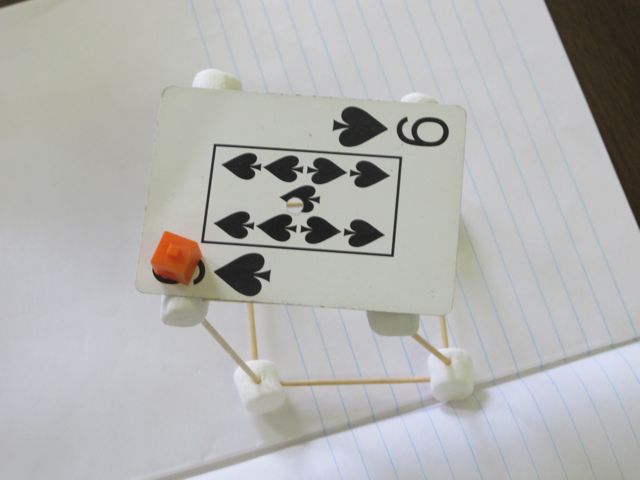
Step two: Start balancing

IMG_1535

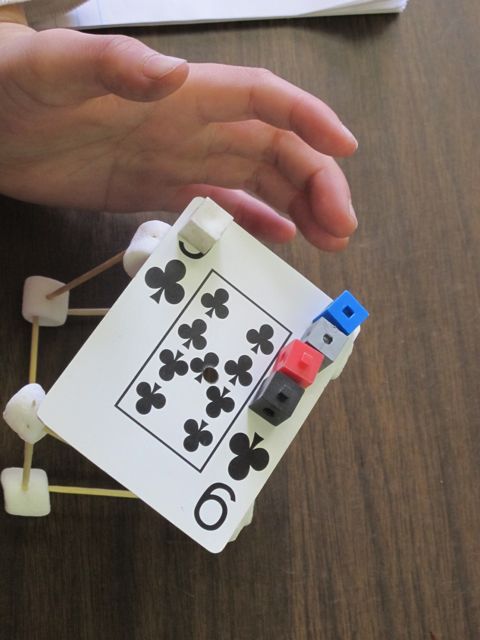
Step three: Detect a problem? Yes, definite leaning!

IMG_1536

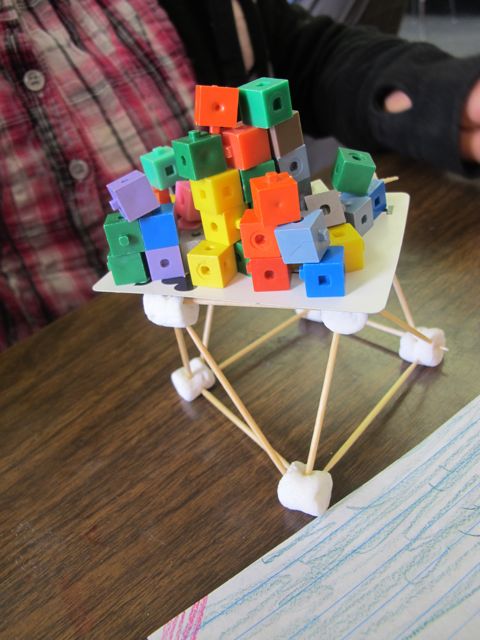
Step four: Get four more toothpicks and . . .

IMG_1549

Step five: Give credit to the triangle! It is the strongest structure!

IMG_1550

This fun activity and more can be found in this book: Build it! Structures, Systems and You written by Adrienne Mason and illustrated by Claudia Davila.

More on Poop

Well, yes, it is true we are addicted to Poop (the book Poop of course!) Every page of this little book is full of fascinating facts on poop. We have been reading and learning in every spare minute and just have to share our new learning. (For Poop Part 1 read here) Nicola Davies and Neal Layton have created a book to keep you busy learning, reading and stopping to say “Really? Wow!” all on the topic of poop.

We learned that many predators use poop as clues to where to find their prey. So many animal parents get rid of their young’s poop to keep their babies safe and hidden. Jenny had a connection. “So it’s just like you can follow footprints, poop can be like a trail to lead them to the prey.”

We learned that golden moles in Africa stay underground all of the time to avoid being eaten. So they make one chamber in their large burrow just for pooping in. This prompted much discussion.

Ricky wondered, “But if that chamber gets full . . . do they just make a new one?”  Jena suggested that the moles could fill that chamber, close it off and then dig a new one. Kevin pointed out “This is just like we make a bathroom place in our houses.” (Unfortunately moles don’t have that flush feature that is so handy for us!) Miami asked, “Do they eat their poop to get rid of it?” This is not a farfetched questions as we had just read about rabbits eating their feces to get more nutrients out of it.

We then read about latrines (animal toilets) of the giant otters in South America. They use their latrines as more than just a toilet. They make a large flat area on the riverbank and poop all over it. This big smelly area is like a sign that says stay away: we made all of this poop, it is our area! The students found this quite amusing. “Like a big sign to say stay away!” “It’s a poop shield. You can’t get to us!”

We continued to read more intersting poop facts and Ricky piped up. “Scientists want to know things and they learn a lot of them from poop. They even studied dinosaur poop – prehistoric poop!” “I want to be a poop scientist,” said Eddy. “A poopologist,” suggested Josiah.

We then read about sloths and how they climb down their tree and poop every four days. Jenny wondered if they poop really slowly too. Good question!

At the end of our reading I asked students to share their new learning. Here is some of what they said.

Miami “Sloths eat lots and lots of leaves.”

Lisa “If sloths poo, they go down the tree to do it in a big pile and then back up every 4 days.”

Kevin “Sloths sniff other sloths poo to see what’s happening.”

Edwin “It’s weird that sloths have poo piles near each other. If they made them together, it would be huge.”

Jena “Some animals sniff other animals poo to know what is going on like who is pregnant.”

Ricky “Male hippos wiggle their tail when they poo to tell other hippos they are fierce and strong. The poo sprays everywhere.”

Have we tempted you yet to go and read this book?

Poop. Everything you ever wanted to know. And then some

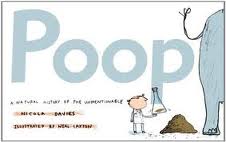
Our current read aloud is a non-fiction title. On a kind of gross but okay, let’s admit it, kind of a lot of fun to talk about topic: Poop – A Natural History of the Unmentionable written by Nicola Davies and illustrated by Neal Layton.
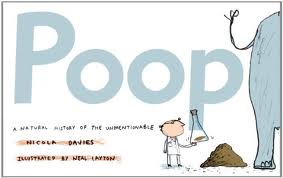
How can you not love this book? The cover shows a huge elephant behind with a pile of dung and a little scientist carefully examining the specimen. Open up the cover and notice that it is all brown and smeary coloured. “Eww! Is that real poo on there?” someone asked. (No, it’s artistic suggestion 🙂 )And then on the first page you get to learn that feces is the proper name of poop and that if we were speaking scientifically, we would know that all animals defecate (meaning to poo). So it seems that reading this book will make us into scientific experts on poop. Excellent!

Today we decided to use Adrienne Gear‘s Questions and Inferences sheet from Nonfiction Reading Power to record some of our questions and what we were inferring as we listened to the text.

The level of engagement was pretty high. Poop is an interesting topic! Near the end of the lesson, Jena commented, “Who knew poo could be so interesting?” Indeed.

We practiced asking some questions/inferring together when we looked at the first few pages titled – A Tour of Poop

We noticed that tapir poop seemed to have hair in it. Nobody knew what a tapir was so it seemed to be the perfect question to do some inferring.

Question:  Why does some poop have hair in it?

Our inferences:

Jenny: It must mean they are predators. The hair is from their prey.

Eddy: Maybe they have furry bums. When the poo comes out, it gets covered in their own fur.

Miami: I’m thinking that – perhaps, they licked their babies’ fur to clean them and stuff. So that’s how hair got into the poop.

Manny: Maybe it’s not hair. Maybe it is grass and they eat grass. Maybe it just looks like poop. If it is hair, why doesn’t the stomach acid eat the hair?

As we read on, we found out that meat eating animals (carnivores) have poop that contains hair, fur, feathers and bones. But I love all of the thinking we were doing to come up with different possibilities!

Most conversation and discussion was related to the text but as I read and we shared our thinking some students just couldn’t help sharing. A few hilarious statements I overheard: “I feel better when I poop.” “Do you think everyone pees a bit when they poop?” “Do you think we would explode if we never pooped?” “My Dad got diarrhea when he ate spicy pork.” Poop is a great topic of conversation! Maybe not to use at your next dinner party but when hanging out with primary students, it rates pretty high!

During our sharing someone asked this question: “Why do we fart?”

Kevin happily shared his thinking. “Maybe when your body has no more poop in it, there are still poo smells that need to get out so you need to fart.”

This was a very popular suggestion. One student responded. “Oh! Oh! Kevin may I write that down on my sheet?” “Yeah me too,” someone else said. We love to share our thinking! 🙂

Some other questions/inferences from our sheets:

Hajhare: Does poo have food in it? I think it does because the food all combines together to make it brown.

Edwin: Why is animal poo smaller? Maybe the animals don’t have big tummies like people.

Kevin: What happens if you poop a lot? I think you live longer.

The students can’t wait to learn more about poop! Stay tuned!


Predator Showdown

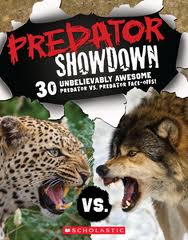
Yes, of course we know that predators have few reasons to fight each other. They are too busy hunting for prey to ensure their survival. But if they did battle each other . . . Well, wouldn’t we all just love to know what would happen? Lucky for us, Scholastic has published this very cool book about exactly that: Predator Showdown (30 Unbelievably Awesome Predator vs. Predator Face-offs!)

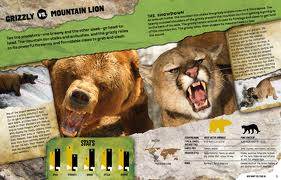
We are currently exploring this book with our Reading Group. It allows us to interact with non-fiction text features such as bar graphs to compare stats about speed, strength, defence, brains, etc or charts that tell us about predator style, range and sample prey. Students are asked to decide between two predators – First Instinct: Who would win? Justify. Some students are very familiar with the predators and find this easy, others are guessing just by looking at the pictures. Either way, it’s okay. There will be an opportunity to read more and make a more informed decision.

Today Catriona was thinking about a battle between a lion and a spotted hyena. Her first instinct? Who would win? She wrote:  “A hyena because male lions are lazy. Female lions do all of the work. And this is a picture of a male lion.”  She shared this thinking with me and then went on to explain, “I happen to know this. I’m taking my background knowledge and putting it into the paper.” (How much do I love when students are able to articulate exactly what they are thinking like this?)

We have been looking at three Predator Showdowns in more detail.

  • The Lion vs. Spotted Hyena
  • The Raccoon vs. North American River Otter
  • Tasmanian Devil vs. Dingo

After students have a chance to read the information page, they answer specific questions. Some questions have answers easily found on the page like: Look at the Stats section. Where is the raccoon superior? Other questions ask the students to include their own thinking. Can you think of a real life situation where these two animals might actually battle each other? Explain why you think this might happen?

We are also asking students to read a section and identify what was important to them about what they just read. For example, What is something you found particularly interesting about otters? Student answers varied. Some were intrigued that otters can stay underwater for up to 8 minutes. Others thought it was interesting that otters could dive up to 60 feet in search of prey.

After reading, students are asked to again think about who would win in a showdown. Many students changed their initial answers and provided lots of evidence from the text to support their thinking.

An inside page from Predator Showdown

Such a great book to engage children in learning and discussions. Answering questions allowed the students to build their confidence about forming an opinion based on evidence. Everyone wants to read this book when I put it out on the new non-fiction shelf! It will be a battle – a Student vs Student Showdown. Who will win and get to read it first?

Rocket Art (Finished Pieces)

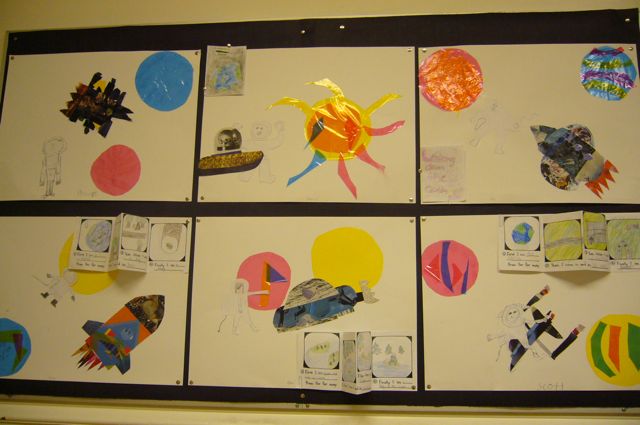
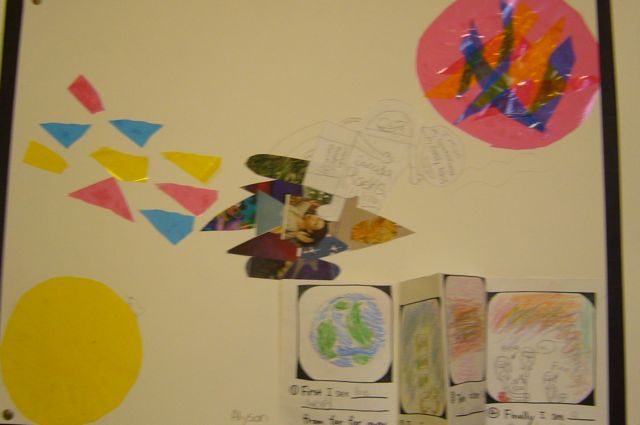
Ms. Chen has posted our finished Rocket Art pieces in the classroom and on the bulletin boards which surround our classroom. Displayed all together, they look amazing! If you haven’t seen our work in process, read more about how these pieces were created here.

P1020879

This week students were able to complete fold out panels about looking back to Earth. Ms. Chen used Steve Jenkins’ book Looking Down to illustrate zooming in to a specific object – from looking at Earth and then zooming in possibly to a specific street, then maybe a particular house and then finally to a single window within the house.

This is such a fantastic book to illustrate zooming in on a particular object – first from far away and then getting closer and closer.

A very interesting journey in looking at the world from a different perspective.

Closer and closer and close

Read about how this book was conceived on Steve Jenkins’ site.

What is amazing about this book is that it is “told” strictly through visual images – as a wordless picture book.

P1020882This is Jena‘s art. Now in addition to her rocket ship, planets and drifting astronaut, she has attached her mini fold out book which depicts looking back to the Earth.

First she drew a portion of the Earth – oceans and land covered by forest. In the subsequent drawings she zooms closer and closer into the forest scene.

P1020883Here is Alyson’s completed work. We loved how she used the cellophane to represent the emissions coming from her rocket as it zoomed through space.

Her mini booklet zooms in to a single room in her building.

Such a colourful piece!

P1020886Hailey isn’t quite finished her mini zoom in booklet but her art so far, is wonderful.

Her astronaut’s suit is extremely detailed and she was able to create a very efective planet by layering her cellophane pieces.

Beautiful.

Such a fun and successful project. Thank-you Ms. Chen!

National Geographic Kids

We’ve been able to pick up some fantastic non-fiction titles through Scholastic Books this year. Published through the National Geographic Society, these books include all the non-fiction features necessary to make navigating through the pages a wonderful experience. Hundreds of full colour photos, maps, labelled diagrams, comparisons, an interactive glossary and more! Recently, we used Everything Big Cats to practice asking questions before we read and to answer questions about the text by interacting successfully with the features.

This past week our Reading group learned about the differences between the big cats, what the big cats eat and how they hunt and how the bodies of big cats are built to survive.

Some of our pre-reading questions:

  • Do big cats hunt together in a pack? (Jena)
  • Do they have super smell for food? (Jenifer)
  • Why do cheetahs have dots? (Hajhare)
  • Do they eat human beings? (Truman)
  • Why do tigers need whiskers? (Sergio)
  • Do they eat in groups? (Lisa)
  • Does their fur keep them warm? (Eddy)
  • How big is their brain? (Jeremiah)
  • How strong is the force of a big cat’s bite? (Ricky)

Students answered questions about what the big cats eat using a chart called What’s For Lunch? Some surprising discoveries? Jaguars eat small crocodiles (large crocodiles would be too dangerous). Leopards hunt (very carefully) porcupines! We also discovered that tigers can eat the equivalent of 80 pounds (36 kg) of meat in one sitting. Wow!

P1020694

Students also found it interesting to compare the bodies and fur patterns of the four big cats by reading Who’s Who? The largest of the big cats? The tiger who can weigh up to 660 pounds (300 kg)! We also learned that the stripes on a tiger are like fingerprints. No two stripe patterns are the same. And what about black panthers? They are actually either jaguars or leopards with dark fur. Who knew?


Crocodile Safari Take 2

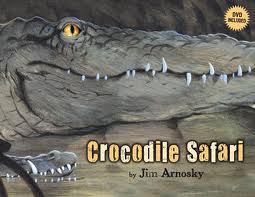
We finished reading Jim Arnosky’s Crocodile Safari today.

Some interesting things we learned?

crocodile safari

  • Crocodiles are not the only dangerous things in the mangrove swamp. Also beware of diamondback rattle snakes and poisonwood trees
  • Those large jaws are full of teeth! Humans have 28-32 teeth but crocs have 80 to 120 teeth!
  • Toothless crocodiles exist but still beware! These crocodiles still have powerful jaws that can crush bones!
  • Crocodiles can be huge! In the U.S.A. they might be up to 15 feet (almost 5 m) long but in Madagascar there are crocodiles up to 30 feet (over 9 m) long! These are the largest living reptiles in the world. Wow!

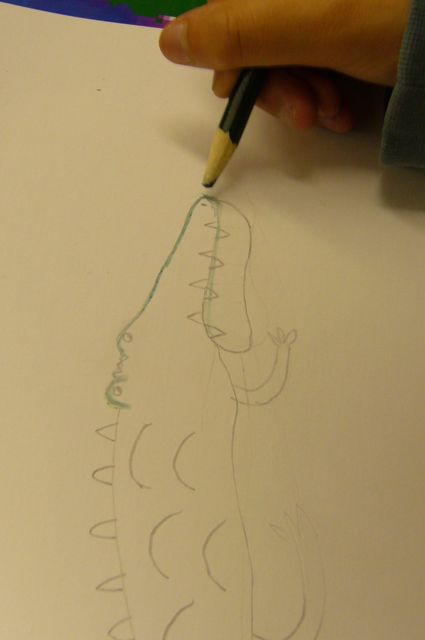
P1020645Crocodile Safari comes with a DVD that features Jim Arnosky discussing the differences between alligators and crocodiles and how important these differences are to a wildlife illustrator. At the end of the DVD, Mr. Arnosky gives us a drawing lesson. We watched this part twice! All of us brought paper, pencils, crayons and pencil crayons to the carpet to work on our crocodile drawings! Notice the scaly skin and lumps and bumps.

P1020680Arnosky showed us how to draw the mangrove roots at the side of the water where the crocs like to lurk unnoticed amongst the roots and branches. He mentioned that he likes drawing the mangrove trees because they seem like upside down trees. We learned that water birds sense when the crocs are not hungry and then it is safe to perch near them.

P1020676Jenifer has done a fantastic job of showing how large the teeth can be in a croc’s jaws. Inside the book there is a page with pictures of lifesize crocodile teeth. Some teeth were longer than our little fingers! Yikes! Suddenly those teeth seemed all the more real!


P1020669Crocodiles have long narrow snouts. We can see all of their teeth even when their jaws are closed. Alyson has done a lovely job of showing the shape of the croc’s head and all of its large sharp teeth. Many students brought their drawings home to share with family.

What fascinating creatures!

Students are already requesting more books by Jim Arnosky!

Crocodile Safari

We have begun to explore the fact – question – inference continuum using non-fiction books and information storybooks. This process is inspired by Adrienne Gear’s Non-Fiction Reading Power book. When we learn a new fact, what question does it prompt and using our background knowledge (schema), what can we infer? We practiced this today using Jim Arnosky’s Crocodile Safari. This is a detailed account of American crocodiles. Crocodiles were photographed and sketched while Jim Arnosky and his wife Deanna were on their crocodile safari through the Florida Everglades. This book is illustrated with the detailed paintings inspired by the images collected on safari. Stunning!

Today we read about a third of the book learning about the crocodile population in the U.S.A., the differences between crocodiles and alligators (finally, a book that makes this totally clear through text and drawings!), crocodile habits and hunting strategies (a page called Ambushed from Below was quite thrilling!).

Fact/Question/Infer: (some examples)

1. We read that in the late twentieth century there were just 300 crocodiles left in the U.S.A. Now there are approximately 2,000. This led us to question: How were they counted? As we tried to answer this question, more questions arose. What if the same crocodile was counted more than once? Maybe they tagged them. But if they tagged them, how would they get close enough to tag them? We were all fairly worried about those sharp teeth! Perhaps they shot tranquilizer darts at them to put them out long enough to attach a tag. Obviously, some of our background knowledge was helping us think this through. We read on and found out that they were counted when someone flew over their habitat in a helicopter.

2. One page in the book is titled One Famous Croc and it talks about a crocodile famous for migrating hundreds of miles from the Everglades to Sanibel Island. When it was captured and returned to the Everglades, it migrated for a second time to Sanibel Island, where it now lives. Our question was an obvious one: What made it return to Sanibel Island? As we talked this question through, students shared different ideas based on their thinking and background knowledge. Someone knew that birds migrate to warmer places. Why else do birds migrate? Someone shared it was so they could find food more easily. Did this crocodile migrate because of food? Someone pointed out that there was a picture of this crocodile hunting a bird so this seemed logical. Our consensus was that the crocodile migrated to Sanibel Island because it was a great source of water birds (great hunting grounds). A very sensible inference we thought and since we can’t ask this particular crocodile, it’s the answer we are going with! 🙂

Students shared new learning, unanswered questions and some of their own inferences in their writing.

Jenny: I learned today that the difference of a crocodile and an alligator is that the crocodile has teeth sticking out of its mouth when it’s closed and an alligator doesn’t. A crocodile’s mouth is longer and an alligator’s mouth is wider.

Eddy: At night crocodiles hunt. In the day, they like to suntan. They mostly eat fish but they also eat birds and snakes.

Lisa: I have a question about how they communicate with other crocodiles. Maybe they move their tail back and forth in the water.

Jena: Crocodiles eat anything they find. They ambush their prey. They go underwater at night (mostly) to hunt. They rise up to the prey and pull it down and eat it. For example, if you saw a duck and then it just disappears. That’s what just happened to it!

Gary: There are questions I still have. How heavy are crocodiles? How big are alligators? Are alligators stronger than crocodiles?

Questions and new learning about the Moon

We continue to study the moon and have been keen to learn new information. However we realize that the more we learn, the more questions we seem to generate. Our wondering seems endless  – kind of like space!

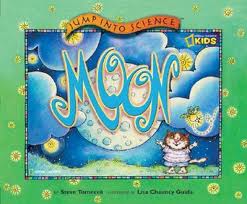
This week we read Moon by Steve Tomecek and illustrated by Liisa Chancy Guida. This is a Jump into Science National Geographic book.

First, we filled out an anticipation guide Ms. Gelson had written based on the book. Did we think a list of statements were true or false. For example: 1. Earth is about four times bigger than the moon. 2. The air surrounding Earth helps protect us from falling meteors because it makes them burn up 3. The sun and the moon are about the same size.

Then we listened to the story to verify which statements were in fact true and which were false. (In case you aren’t sure – with the previous statements 1 and 2 are true and 3 is false 🙂 )

After this, we returned to our desks to work on sheets that summarized some of our learning. What new things were learned from this book? What questions still exist?

P1020522Jena talked about Galileo and his telescope. Students were fascinated that this was the first time people had a sense of what the moon actually looked like. She also noted that the moon is not a star like the sun is. Many people didn’t know the sun is a star.

Her questions centred on space travel. What were the names of the twelve astronauts that visited the moon? Did any animals go to the moon? And a very interesting thing to find out: Were any of the astronauts there when meteors came?

P1020523


Jenny thought it was very interesting that the only way a crater can be filled up on the moon is when dust from a new crater forming (from a falling meteor) fills it up. Many students thought that this was pretty cool.

Jenny had questions about space generally

  • Why is the sun so warm?
  • Why can’t there be air in space?


She also wondered about how the footprints from visiting astronauts could remain on the moon forever. It is pretty hard to fathom a place with no wind and no rain.


P1020525Eddy had some great questions about the moon’s shape and how it formed in the first place.

Many students wondered if the Earth and the moon formed at the same time or different times and why we are so connected. Many thought it was strange to talk about ages of planets, moons and stars and wondered if they had birthdays!

Some other interesting questions students had:

  • If there is no gravity, wouldn’t the planets float away? (Annie)
  • When did the moon appear in space? (Kevin)
  • Is rock the only thing on the moon? (Ricky)
  • Why is the sun so hot when it looks so small? (Edwin)
  • What would happen if you started to dig on the moon? (Gary)
  • Will the moon have volcanoes again? (Manny)
  • Why is the moon grey? (Jenifer)

On a quick visit to the library this evening, I found this book: Really, Really BIG Questions about Space and Time by Mark Brake. Illustrated by Nishant Choski.

I plan to read it carefully this weekend to become a space expert! I will also bring it in for students to explore during independent reading. It addresses questions like:

  • When did the universe start?
  • Do stars live forever?
  • Why is the night sky so dark?
  • What’s the difference between me, a planet and a star?
  • Do black holes turn you into spaghetti?

Why do you think you should never smile at a monkey?

Wow, did we enjoy interacting with Never Smile at a Monkey (*and 17 other Important Things to Remember) by Steve Jenkins.

never smile at a monkey

We used this book to practice questioning, predicting and inferring – when you encounter some of these creatures, what should you not do? And why exactly?

Jenkins explains that certain large creatures are “well known threats” – of course we aren’t going to get too close to tigers or crocodiles. Sharp teeth. No thanks! We also know to avoid “rattle snakes, black widow spiders, and piranhas” Their danger is well known. But what about the creatures we don’t know so much about. Creatures with “teeth, claws, spines and venom that can be deadly” That’s what this book is all about. A very clever idea brought to us with a combination of Jenkins’ gorgeous torn paper collage animals and just enough text to teach us new information related to this theme.

Jenkins organizes this book with a picture of a creature on each page or 2 page spread, Accompanying this is a Never . . . . warning in larger text and then an explanation of why. At the back of the book, more information is provided about each creature as well as a list of books for further reading. In the example here, we are warned to never collect a cone shell. Why not? Yikes. Well, a cone shell has poisoned barbs that it uses when hunting. They can be launched like harpoons. Potentially deadly if they stab you. Makes one think twice about collecting shells!

How did we use this book in the classroom?

Students brought notepads and pencils to the carpet to listen to the story. I would show them a picture and read the Never . . . warning without showing them the rest of the text. Students then wrote their prediction/inference about why we should never . . . We shared a few out loud and then I read the explanation provided in the book.

Some very funny conversation happened. Amazing predictions. Lots of arguing! “Not everything has venom you know!” “How could it bite you, it doesn’t even have teeth?” “What are you talking about? Be more specific!” My favourite line: “Ms Gelson I’m using my schema!”

So  . . . want to learn something new?

Why should you never smile at a monkey?

Our predictions:

  • it might scratch you when it gets excited
  • it will get really mad
  • it will yell at you and bite you with its sharp teeth
  • it will get loud, jump up and bite you

And the real reason. . .

“If you smile at a rhesus monkey it may interpret your show of teeth as an aggressive gesture and respond violently.”

Why should you never jostle a jellyfish?

Our predictions:

  • it can release venom that can kill you
  • it might shock you
  • it might pop
  • it will start to vibrate and kill you

And the real reason. . .

A box jelly fish is in a class by itself . . . even the smallest contact with its stinging tentacles causes intense pain . . . you can die very quickly.”

Later, students chose one creature, wrote their prediction and the real explanation and included a picture. Sometimes our thinking was very close – other times, not a bit. Which was great – real learning happened! We also liked celebrating when we did have background knowledge about a particular creature and could make an inference that made a lot of sense. At one point, as I was reading a little voice piped up. “This is so fun!

Love, love, love Steve Jenkins’ books! His website includes an interesting explanation of how he makes his books.