Pink Day in our classroom!

We have been sharing this lovely book recommended by Ms. Hong at Strathcona Library – You and Me Together – Moms, Dads, and Kids Around the World by Barbara Kerley – a few pages here and there all week. It is a wonderful collection of photos of parents interacting with their children – doing the most natural of things – making a mess, telling a tale, taking a nap or catching a bus. Images from all over the world – make the diversity we can celebrate a truly beautiful and yet everyday thing. Joy within families, in the daily routines of life – just lovely. My students have loved guessing where in the world the photos were taken. Sometimes we are exactly right and sometimes not even close! The text accompanying the photos in the back gives us a little story behind each picture.

I have been waiting for Pink Day to share this amazing book with my students. Spaghetti on a Hot Dog Bun is written by Maria Dismondy and vibrantly illustrated by Kimberly Shaw-Peterson. The picture of Lucy, eyes welling up with tears after she has been bullied is so so powerful! The message of this book is all about courage – courage to stand up for yourself but also courage to forgive and reach out to others. Lucy has been bullied by Ralph in some truly nasty ways. When he gets stuck on the monkey bars, she has the opportunity to get back at him. Instead she realizes, looking at him so full of fear, that just like her Papa Gino told her, Ralph has a heart with feelings. Lucy offers her help, demonstrating courage to do the right thing – treat others the way she wants to be treated.

We used this book as a springboard for our Pink Day writing and discussions.

Hajhare: I learned that words can be strong but you can stand up if you are bullied.

Ricky: If someone bullies you, never bully them back. Paybacks aren’t nice. Bullying and fighting change your body. If someone bullies you, you will need all the courage you have to stand up.

Miami: Why do bullies bully? Do they learn it from someone? Do they do it for a reason? That question I can’t figure out.

Our school paraded around the grounds on a freezing February day holding pink balloons. Our message floated above our heads and rang true in our hearts as we marched to take a stand against bullying together.

Grumpy Bears, Clever Mice and a good night’s sleep

Our BLG reader this week was Sam. He brought in an engrossing story by Bonny Becker and illustrated by Kady MacDonald Denton. A Bedtime for Bear is all about a very particular Bear who needs everything to be just so in order to get to sleep. His friend Mouse, who comes to spend the night is not very capable of being calm, quiet and quick to settle down. This aggravates Bear just a little (well actually a LOT).

A little bit of irony – this book was all about being quiet and my normally very noisy (in a charming sort of way 🙂 ) class sat silent and focussed during Sam’s reading except to giggle at how disruptive and annoying Mouse was to Bear.  Strangely quiet! But I wasn’t about to complain!

As the evening progresses in the story, we begin to realize that Bear wants Mouse up and about because he is a little nervous about a sound he heard.

Miami was on to him, “He doesn’t want the mouse to go to bed because he is scared!” she shouted.

When Bear told Mouse a story about Brave Strong Bear and the Very Frightened Little Mouse, Jeremiah quietly remarked, “That’s the opposite.”

Not much gets past us!

Our student reviewers report:

Lisa: My favourite part is when the bear asks the mouse to check his closet. I think he did that because he was actually scared there was someone that lived in the closet.

Kevin: My favourite part of the story is when they both fell asleep under the full moon.

Ricky: That was a great book you read Sam! It had good pictures and good characters.

Stories that came our way today

Our classroom read aloud mid morning was an information story book to practice asking questions and inferring from our background knowledge.

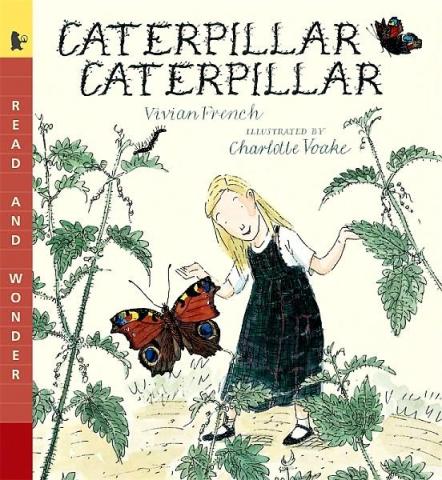
Caterpillar Caterpillar

Written by Vivian French (author of many favourite information story books) and illustrated by Charlotte Voake, Caterpillar Caterpillar is all about a little girl learning about the caterpillar’s development through the help of her patient and knowledgeable grandfather. We realized our background knowledge related to insects has really grown because of all of our research about walking sticks (our classroom pets). We had lots of questions about the caterpillars shedding their skin and wondered if like stick bugs, they ate their skin? Do they have suction cups on their legs to be able to travel on the underside of leaves? Are the butterfly eggs sticky to stay stuck to the leaves? They must be because they don’t fall off in the rain. But then somebody else pointed out that maybe the eggs are only laid on the underside of leaves to protect them. Can caterpillars spray a substance to keep enemies away like some stick bugs can? Great questions and discussion today!

In the afternoon, we walked to Strathcona Library to visit Ms. Hong and have a story time at our public library! What a great way to fit our daily 30 minutes of physical activity into the school day! And . . . what a wonderful story!

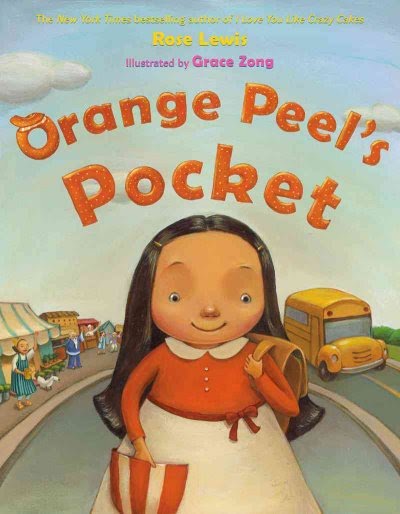
orange

Ms. Hong read us Orange Peel’s Pocket written by Rose Lewis and cheerfully illustrated by Grace Zong. Chang Ming goes in search of answers to the question – What is China like? by wandering into shops and businesses where she can learn more about her cultural heritage. Everyone slips something mysterious into her pocket (how fun to guess what each item might be when Ms. Hong read aloud!) – a poem, a peony, a recipe for noodle soup, etc. Now Orange Peel (Chang Ming) can share her heritage with her classmates.

A lovely end to our day. . . When we returned to class, Edwin shared a drum given to him by his grandfather and showed us a rattle carved from a special tree where eagles nested and gifted to him by his uncle. Sharing of his stories and culture – thank you Edwin!

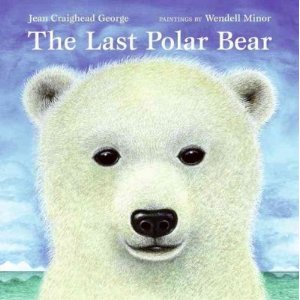
The Last Polar Bear

the last polar bear

Tigluk looks out his window and sees a polar bear in the distance. It is Nanuk. She looks straight at him and seems to speak to him “Follow me.” Tigluk and his grandmother paddle out in the ocean searching the ice floes for the bear. They discover, not Nanuk but her cub and Tigluk names him Pilluk (meaning to suvive). “With the melting of the ice, he is the last polar bear,” says Tigluk and cradles the bear in his arms.

This sad story by Jean Craighead George forces us to confront the serious issue of how climate change is affecting the polar bear habitat.

We used this powerful book to practice asking questions as we read and then looked at our questions critically – Did we find an answer in the text? By inferring, can we answer the question? Do we need to do more research? After discussing things, are we left with more questions?

Some of the questions we examined further:

How many bears are in the Arctic? Someone answered this quickly: “It was in the story: Just one left.” Then we talked further and realized we would have to do more research to find out the actual population. Questions were asked about whether polar bears are considered endangered?

If nobody found the polar bear, would he survive? Most people thought that we needed to do more research to answer questions like: How long do they nurse? What exactly do they need to survive? before we could infer because we don’t have enough background knowledge.

Why would the cub be all alone? To answer this question, we needed to use our own thinking and our background knowledge. Some students reminded us about what we had learned about polar bears in the book Winston of Churchill which was that polar bears could drown if the ice floes were too far apart. So we decided that maybe the mother had drowned while hunting for food because the ice was melting and she had too far to swim back to the ice floe where her cub was waiting.

Why did Nanuk choose a boy to look after her cub? For this question, we decided that we should infer. A suggestion was made that maybe Nanuk chose Tigluk because he was young and would have many years to care for the bear and maybe even help change things. Everyone thought that this made a lot of sense

Our questions and thoughts after discussing the book:

If there is only one bear, how will it mate? How will any more polar bears be born?

Is the world really getting too hot?

If the polar bear became used to humans and human food, could it ever go into the wild again?

How will the people in the village survive without polar bears? If other animals in the Arctic are also becoming endangered won’t this be hard on the people in the North who hunt them and use their furs and skins?

So much to wonder and think about from one very special book.


What is a real friend?

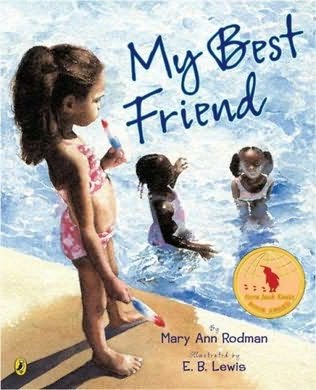
Today we read My Best Friend written by Mary Ann Rodman and illustrated by E. B. Lewis. What a fantastic friendship book!

my best friend

It is summertime and Wednesdays are spent at the pool. Lily has picked out her new best friend and it is Tamika. Tamika, though, already has a best friend and no matter what Lily does, Tamika is not impressed. Lily feels rejected and yet keeps trying to find something that will make Tamika take notice. Taunts by Tamika and her friend Shanice don’t seem to dissuade her from trying to get Tamika to like her best.

This book inspired us to ask: What really makes a friend?  Our discussion throughout the story centered on the choices we make when choosing friends. As soon as we looked at the cover, hands were up – making connections and predictions, sharing stories and asking questions.  The intensity of reactions lasted through each page and then everyone settled down with their Response and Ideas books and did some writing. As a teacher, I appreciated that this book allowed the children to come to their own conclusions. All of them deal with friendship issues daily and need chances to reflect on their choices and struggles. Students connected easily to the characters in this story and did some independent thinking on something that they regularly confront in their school and personal lives.

A sample of reactions:

Gary: Tamika was mean to Lily but not to Shanice.  When Shanice was away, Lily got to play with Tamika, but when Shanice was back, Tamika was mean again. When Lily learned to dive, Tamika wasn’t looking. Keesha was. Now Lily is Keesha’s best friend. A real friend doesn’t be mean or make fun of you.

Annie: A real friend is not insulting another person. Friendship is about giving compliments when someone does something. Don’t wear of do something just to make someone like you. Be friends with someone who is nice to you.

Jenny: A real friend would share with you, play with you and stand up for you. I think the message of the book is you can’t just pick a friend to be your friend without knowing them because they might be mean to you.

Jena: A real friend is somebody who likes you for who you are not somebody who uses you when they don’t have a friend. A real friend plays with you all of the time, not just sometimes. A real friend doesn’t stick their tongue out at you, they don’t ignore you and they don’t tell secrets behind your back. I think the message of this book is that friends are nice to you all the time and they like you for who you are.

Spooky suspense on Saturday afternoon

We did our weekly trip to the library and came back home with piles of books as usual.  Everyone is sick and wanting to be entertained so we pulled the blinds, turned on a little reading light and settled in with some scary books. All we needed was a tiny light in a dark room, a whisper voice used here and there, some well written suspense and dramatic illustrations and things got scary fast!

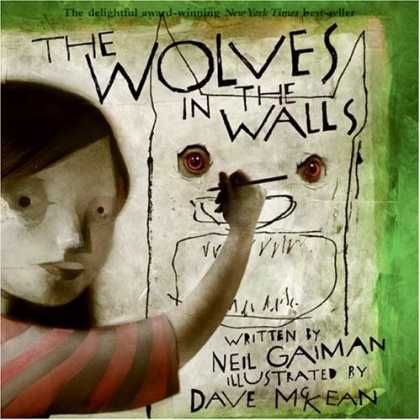
Wolves in the Walls

Neil Gaiman and illustrator Dave McKean teamed up again (they also brought us Coraline) to create this dramatic, quirky and quite scary tale.  Lucy heard noises . . . coming from inside the walls . . . and is sure there are wolves.

By the end of the book – some things change – Who lives where? Who scares who? Who is living in the walls now? It is quite the adventure to find out.

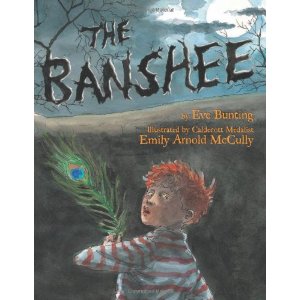
the banshee

Eve Bunting takes us on a “catch your breath, feel your heart beat faster” journey through the pages of The Banshee (spookily illustrated by Caldecott Medalist Emily Arnold McCully). What makes the “Scree  Scree” sound that wakes Terry in the middle of the night? Does he really have to go out into the garden to find out?

“I open the back door. The kitchen heat rushes out, and the night rushes in. I can’t go into that dark yard. Where she is. I can’t. I go.”

These two books allow us to explore some big questions in the minds of young readers:

What is it to be brave?

What is superstition? legend? folklore?

Do we believe what people tell us?

How do we confront our fears?

And the scariest one . . . “Is there really a . . . ?”

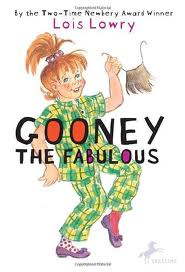
Gooney Bird Greene has plopped herself right smack in the middle of our read alouds!

We are currently reading Gooney Bird Greene by Newberry award winning author Lois Lowry. The class finds Gooney Bird hilarious with her story telling abilities and her penchant for being right smack in the middle of everything, she has become our newest favourite character!  This book is all about story telling – well the telling of absolutely true stories (as Gooney Bird so often clarifies). And we spend a lot of time laughing at the detail and drama in Gooney Bird’s stories as well as the funny reactions of her Grade 2 classmates at Watertower Elementary school.

Pick up this book to discover how Gooney Bird travelled on a flying carpet, how her cat was consumed by a cow, how she received her very unique name, etc.  I have the feeling we will be reading more Gooney Bird stories in the very near future!

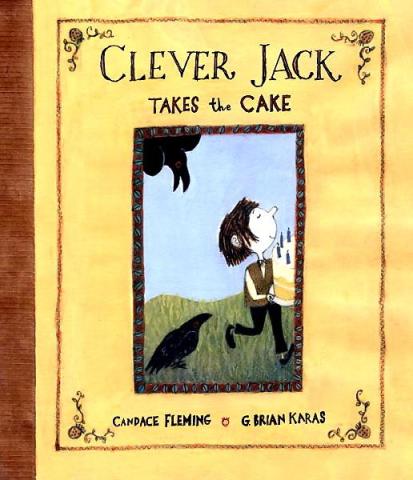
Clever Jack Takes the Cake

Clever Jack Takes the Cake

I introduced Clever Jack Takes the Cake by Candace Fleming by telling the class that I chose the book at the library because it is illustrated by G. Brian Karas, one of my favourite illustrators.  Eddy piped up, “Ms Gelson – lots of times you pick a book because you like the illustrator. Why do you always do that?” I explained that picture books to me are very much a partnership of great illustrations and a really good story – when each are great, the other is even stronger.  Sometimes, if I don’t really like the illustrations they interfere with my enjoyment of a great story.  Not in this case!  This book tells an excellent, highly engaging story with illustrations that add to the drama and fun.

Jack decides to bake a cake to take to the princess on her tenth birthday when he realizes he has nothing to give her and no money to buy a present. On the way to the castle he needs to contend with a flock of blackbirds, a troll, a dark spooky forest and an unfortunate food allergy.  He arrives at the feet of the princess with nothing to give her except the telling of his amazing adventure of trying to bring his cake to the castle.  The princess is delighted with this meaningful gift and we celebrated Jack’s positive outlook and clever strategies all along the way.

Because kids say it best:

“When you have nothing else, you still have your story.” (Kevin)

“You don’t always need a present. Just coming to a party is already a gift.” (Alyson)

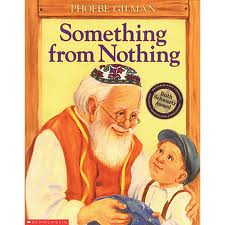
We had some great text to text connections to this story.  The gift of a story reminded us of Something from Nothing by Phoebe Gilman where in the end there is nothing left for Joseph’s Grandfather to stitch up into something new.  But there is enough material to make . . . a wonderful story!

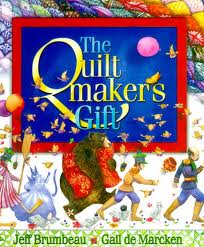
When the princess was bored and unimpressed by the lavish gifts of jewels and treasures from all of the party guests, we were reminded of The Quiltmaker’s Gift by Jeff Brumbeau. The King demands present after present but none have any meaning to him until he discovers the beautiful gift of giving.


Brownie Groundhog and the February Fox

How lucky are we to have a reader from BLG law firm come in every week and read to us! The volunteer readers in our room are a big part of every Wednesday morning. This is the first book review of a new BLG book. Check back weekly for the newest titles introduced to Division 5!

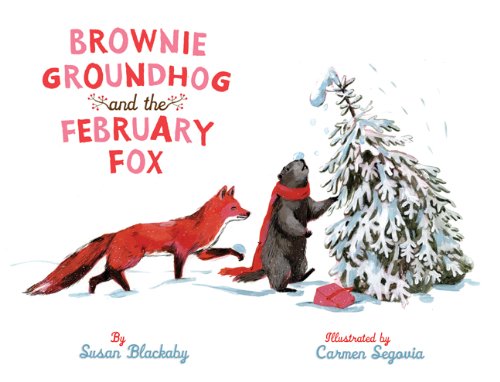
Our book this past week was read by Deborah.  Brownie Groundhog and the February Fox by Susan Blackaby is a lovely book about the impatient wait for spring. Beautifully illustrated by Carmen Segovia, an artist from Barcelona who had exhibited the sketches of our little groundhog at the Bologna Children’s Book Fair Illustrators Exhibition.The paintings in this book actually inspired the story which was written in order to bring these characters to life!

Brownie groundhog

There is a charming interaction between the fox and the groundhog in this story. Brownie needs to keep the fox busy and distracted enough to forget about trying to eat her.

“You can’t eat yet,” she said. “You haven’t worked up an appetite.”

“I feel appetitey,” said the fox.

“Well, you aren’t,” said Brownie. “Why don’t you clear the snow off the pond? That might do the trick.”

Our student reviewers report:

Ricky: I liked when the fox was trying to eat the groundhog but the groundhog kept tricking the fox.  At first, I thought the groundhog didn’t know that the fox wanted to eat him but she actually did. I thought she was just playing.

Jena: I liked how Brownie the Groundhog distracted the fox so he wouldn’t eat him – like taking him skating on the pond.

A visit to the public library uncovers. . .

I went to the library and what did I find?  Some “new to me books”! Exactly why public libraries are such lovely places.  You can walk in empty handed and walk out with a bag bursting full of undiscovered treasures.  For free!  At least that’s what happens to me.

Some books I found today that I have to share – first here and then this week, in the classroom! Excited at the possibilities . . . These will need to be more than book talks – all are simple and quick to read – but like a lovely sweet treat – something to savour for some time afterwards . . .

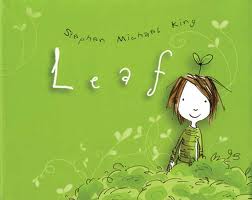
In Leaf by Stephen Michael King, a little boy escapes his Mom’s intentions to give his hair a trim.  While hiding out with his his adorable little dog, a bird drops a seed on his head. A shoot pops up and grows a leaf. Now he needs to carefully tend to this living thing on top of his head. Simple, sweet, endearing. The best thing about this book? It is nearly wordless – the only text  – sound effects – Whooosh, Boing, Sploosh, Glurg glurg . . .

Kathryn Otoshi has created a wonderful book called Zero all about finding value in yourself. I can see this book fitting in wonderfully with extension lessons with the Mindup curriculum where we explore looking at things from a different perspective. Is Zero empty inside?  Or is she open and full of possibilities?

This book is pretty funny,” announces my son. And it is but also a little bit more . . . Penguin by Polly Dunbar lets us look at a child’s frustration when he can’t communicate in the way he wants to with a new friend. And my, my, the things we tend to do as we get frustrated!

Happy Reading!