If you Decide to Go to the Moon

We have been reading If you Decide to Go to the Moon, written by Faith McNulty and illustrated by Steven Kellogg. It begins: If you decide to go to the moon in your own rocket ship, read this book before you start.

if-you-decide-to-go-to-the-moon

We are taken on a journey (on a rocket ship 🙂 ) to the moon and back and learn all kinds of cool things about travelling in space and important facts about the moon along the way.

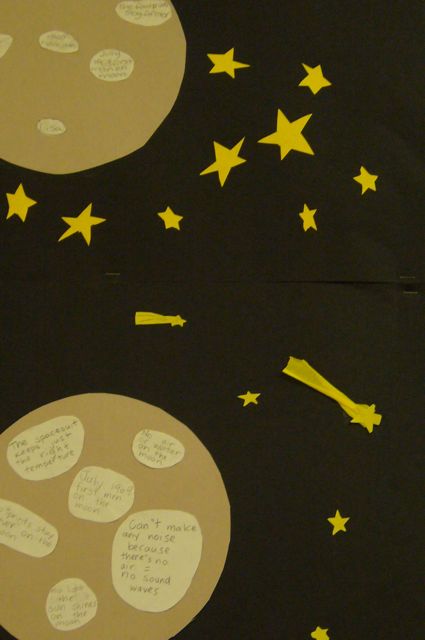
We represented our learning with large space pictures including stars, rockets and the sun.

art1

Facts and questions about the moon were included as fact craters or question craters and glued onto our pictures (inside the moons).

Some key facts we learned today?

  • there is no water on the moon
  • there is no sound on the moon because there is no air to carry sound waves
  • the moon is scorching from the sun’s heat or freezing when out of the sun’s heat
  • the moon has no light
  • the moon is covered in dust
  • craters on the moon are holes made by meteors that have landed on the moon throughout time
art 2

We also learned some pretty neat things about what it is like for astronauts to travel to the moon. Did you know it takes two and a half days to get there (by rocket)? Many people think it would be fun to try and walk on the moon where there is such little gravity. We found it fascinating that astronauts’ footprints stay on the moon forever because there is no wind or rain to wear them away. Most of all though, everyone wanted to look back to Earth from the moon and see what it would look like. Maybe some of us are future astronauts and will get that opportunity . . . .?

A fantastic book as an introduction to the moon and space travel.

What’s it like to be sister number three?

We seemed to be all about girl power this weekend at the library – maybe because it was just my daughter and I, but our big stack of books seemed to include a lot of books about very cool girls – some books new to us and some old favourites.

Two books to talk about featured the youngest sister in a family of three girls. Not fairy tale stories where everything comes in threes including sisters – but books from the here and now that explored themes of identity, self-esteem, and acceptance.

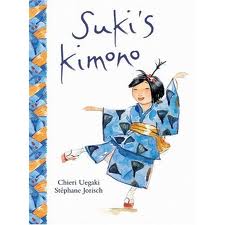
Award winning, Suki’s Kimono is a family favourite at our house. We love how Suki possesses a joyful inner spirit and how she lives in the moment not worrying about what the world might think.  Suki adores her blue cotton kimono – for the memories that it holds and the way it makes her feel. She vows to wear it on her first day of school despite the disapproval of her older sisters and manages to maintain the magical happy feeling of wearing this special kimono throughout her day even when questioned and taunted by classmates.  Written by Chieri Uegaki and illustrated by Stephane Jorisch.

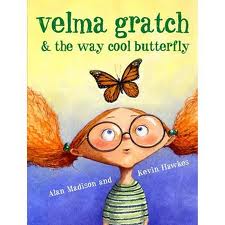
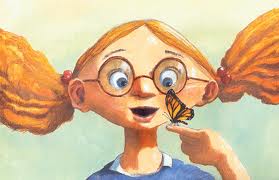
Look at that cover. Aren’t you just rooting for Velma before you even know her issues or struggles? Kevin Hawkes, illustrator, helps create a wonderfully unique character in Alan Madison’s Velma Gratch & the way cool butterfly. Velma arrives in first grade in the shadow of her two older sisters known for their seemingly perfect qualities – athletic abilities, spectacular spelling and marvelous math. Velma wanted to be noticed but for what? She chooses some quite foolish ways to stand out: running the slowest, singing the loudest, muddling her math . . . None bring quite the effect she is hoping for. Slowly, Velma learns to recognize a passion – science. When her class begins to learn about butterflies she twists wonderfully new words around in her mouth – metamorphosis, conservatory, migration. Not only does Velma come into her own as a butterfly expert, but on the class field trip to the conservatory, Velma is noticed by a monarch who lands on her finger and doesn’t leave for days.

Velma releases her monarch with the others from the conservatory a few days later, waving goodbye as they begin their journey south. Velma has gained a little power of flight herself as she floats home between her sisters, happy and confident.

Isn’t it wonderful when the youngest members of a family can teach everyone a thing or two?

Two goldfish? Or . . . your Dad?

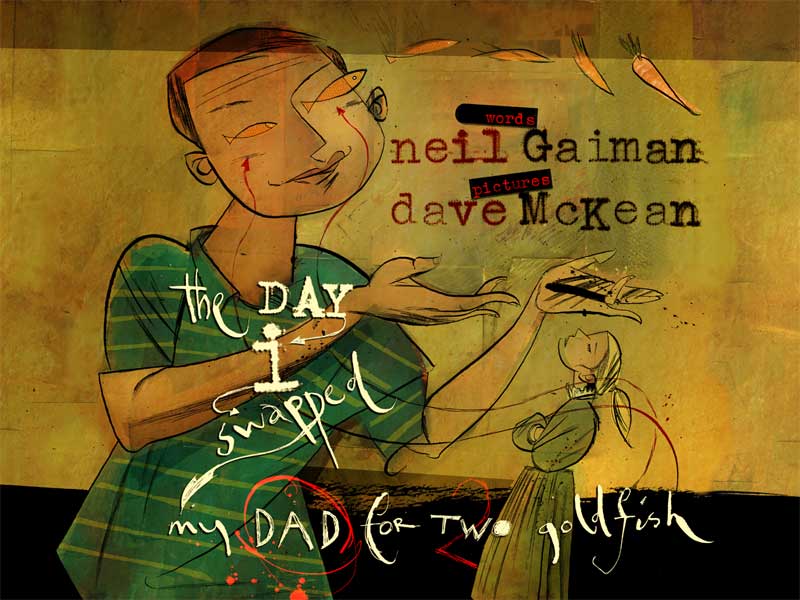
Author and illustrator Neil Gaiman and Dave McKean are a brilliant team. Their book, The Day I Swapped my Dad for Two Goldfish had that amazing silencing power over my classroom – so engrossing that at times there was not a word! And then at other times, volume turned high in discussion and debate – on task talking! Yippee!

Day I Swapped

This book in and of itself is pretty darn amusing. The conversation and comments it inspired in the classroom – hilarious!

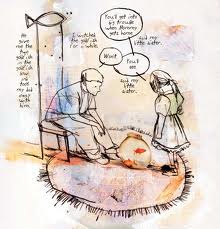
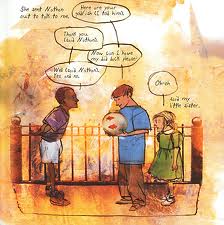
Nathan comes over with two goldfish in a bowl. They were pretty neat – reddy-gold and beautiful swimmers. A swap is proposed. The problem – Nathan isn’t interested in anything offered, not the transformer robots, the annoying penny whistle or the punching bag. So some deep thinking happens: “I’ll swap you my Dad.”

Whoa!! This caused quite the commotion in our room. Nathan, back in the book, was sceptical. One Dad for two goldfish doesn’t seem quite right until it is pointed out that a Dad is as big as a hundred goldfish. And he can swim (“Can’t” protests the little sister) So Nathan leaves with a newsparer reading Dad and the two goldfish remain.

So I ask: What do you all think? Is it a fair trade? I love how they take this question absolutely seriously!

Kevin: “No! A Dad is more useful than goldfish.”

Hajhare: “A Dad is more valuable, he grew up with you.”

Jeremiah: “But he still has his Mom.”

Hajhare: “Nope a Dad is not available.”

Alyson: “Without the father, you can’t have another baby.”

Lisa: “The Mom will be pretty surprised when she gets home.”

And of course Mommy says, “You can take these goldfish over to Nathan this minute, and don’t you come back without your father.”

But this is a little bit more difficult than first seems because Nathan has done some more swapping.

Alyson: “My Dad is more expensive.”

My important clarifying question: “How much is a Dad worth?”

Hajhare: “Love!!”

Ricky: “Dads have mastercards.”

Kevin: “Why don’t you ask a Dad to buy you goldfish?” Indeed!

We began to think this swapping might not end. There was much more searching following the trail and a gorilla mask, Galveston the rabbit and the Queen of Melanesia enter the story. Finally the Dad is recovered still reading the paper and sitting in a rabbit hutch.

Hajhare: “I think the message is Moms are all about love and Dads are about newspapers.”

Manny: “No that’s not the message. It’s – don’t let kids trade people.”

Whatever the message, this book is an adventure worth reading. (Preferably out loud to some opinionated children 🙂 )


Moms are Supergirls!

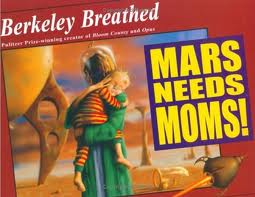
The movie trailer is out – Berkeley Breathed’s Mars Needs Moms! is now a movie. I felt a little bit of pressure to get this book read before my students had no idea that the movie was based on a book. Because it really is such a great book! Almost always, in my opinion, books trump the movies even without the special effects! There is an intimacy that happens when we share a book that a movie just can’t touch. And you are allowed to interrupt with comments and questions and nobody says SHHHH! At least not in our class!

So I asked for some predictions before we started reading. Look at the cover – What do you think this book is about? (predictions especially appreciated from those people who hadn’t seen the trailer!)

A boy needs a Mom to go to space with him!?” “No, it is the Martians that need Moms to take care of them.” “Yeah because Moms are superheroes!” “No – they are Supergirls!” Absolutely!

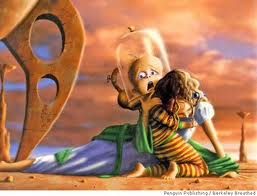
Really what happens is that Martians have been keeping an eye on Earth and have realized that since they have grown up motherless, they will need to send Martian Raiders (with a big net) to capture some Moms. Milo, who has been doing some pretty serious Mom bashing (using terms like bellowing broccoli bully and carrot-cuddling cuckoo to describe his loving mother) watches his Mom be grabbed and rushed into a waiting spaceship. (“Do aliens eat Moms?” Scott wondered.) Milo follows, stowing away on the ship. Exiting the spaceship on Mars, he trips and falls and his helmet smashes to bits. Breathing Martian air – Milo is doomed! Until . . . a figure appears and gives up her helmet so Milo can survive.

Milo’s Mom places her helmet on his head and tells him, “I’ll love you to the ends of the universe.” And then she passes out. “She is sacrificing herself,” Jena explains knowingly. “What does that mean?” “It is when you give up something you really need.” “Oh,” says one of the boys nodding, “that’s what Moms do.

Yep, Supergirls!

Read the book before you see the movie! It’s worth it!

Books I wish I owned

Our local public library has finally reopened after being closed for months due to a flood. Hooray! So in celebration, I wandered through the stacks and selected some of my favourite books to read again – with my own children and likely they will find their way into the classroom this week. If I had a million dollars and a billion bookshelves these books would hold a special place! I might just have to justify purchasing them anyways because I keep taking them out of the library again and again! They must be meant to be mine!

Clara and Asha written and illustrated by Caldecott Medalist Eric Rohmann is a gorgeous journey into the fantasy world of Clara and her friend Asha, a gigantic fish. Asha may be a child’s imaginary friend, yet Asha feels very real!

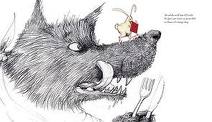
Wolves by Emily Gravett is a delightfully eerie book. You know how a book becomes more real as you read it?

And then you start to feel so connected to a book that you literally feel as though you have fallen into it? Hmm . . . seems to have happened to our little friend rabbit. This book has two endings – one specially designed for those with more sensitive inclinations.

Have you ever been told you are too small to do something? In our house, “small is powerful” is our mantra. In this book, Up, by Jim LaMarche, Daniel (aka Mouse) is a small boy who seems to develop some pretty extraordinary powers. Or at least the power to believe . . . A magical story with absolutely stunning illustrations.

The Great Apes

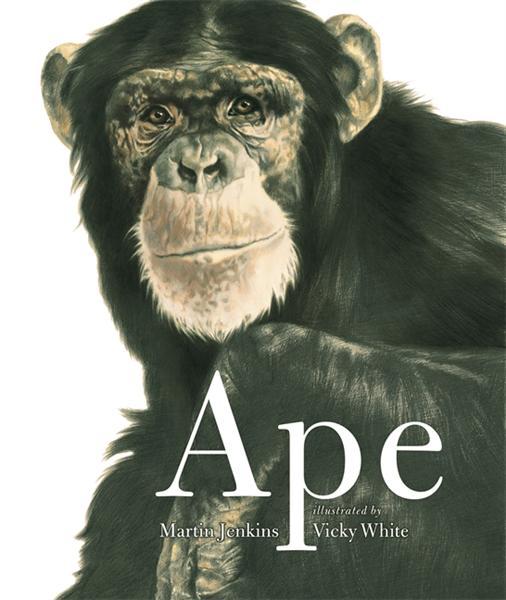
Apes. Orangutan, Chimp, Bonobo, Gorilla – these great apes are fascinating. They are so like us!  At this time in the world we need to protect them to ensure they have places free from being hunted and free to live in peace. What did we learn about these great apes today? What are we still wondering? What do we want to research?

ape

Ape is a visually stunning book! A book to pore over again and again marvelling at the details – both visual and written. Vicky White’s close up portraits and lifelike illustrations fascinated us while Martin Jenkins’ text provided so much new information it was difficult to turn a page without endless questions being tossed around the room.

This was the perfect text to practice questioning with non-fiction text in small groups. First we listened to the story and listed key questions on our individual notepads. Some very fascinating facts that sparked a lot of discussion:

  • Chimpanzees poke a hole into a termite mound with a long blade of grass and then lick off the termites! Some people thought they were using the grass kind of like a straw. Other people wondered if they shared. Many people thought it would be pretty gross to have bugs crawling around in your mouth!
  • Orangutans love to eat the smelly durian fruit!
  • Chimps travel in gangs and hunt down monkeys. “Gangs!?” This seemed very dramatic. “Do they just chase the monkeys or do they actually eat them?” one little horrified voice asked.

We then took our questions to share in a group of four. Each student took turns sharing a question and the group helped decide where to include it on our questioning sheet. Was it a question we found the answer to? Was it a question where we thought we could infer using the schema we already have about animals and the world? Or was it a question where we felt that more research was needed?

Which questions made the lists? A sample below . . .

Questions we had but then found out the answer as we read on:

  • How long do gorillas live? At least 40 or 50 years.
  • Where do the apes sleep? In nests on the ground or in trees
  • What do apes eat? Some eat fruit, some eat termites.
  • Are any of these apes extinct? No!
  • How many species of apes are there? Five species in the world – including us!

Questions that we didn’t find the answers to but we can try to infer:

  • What are the predators of apes? We think humans who hunt them and big cats because they run fast and can catch them.
  • When the chimps fight with other chimps, do they die? We think they might if they get really hurt. Maybe they could get an infection from a bite or bad scratch.
  • What kinds of parasites do they have? Maybe fleas because they have fur.

Questions which need more research:

  • Which of the apes is most aggressive?
  • How are Apes related to people?
  • Can a chimp sense its predators?
  • Can apes swim?
  • What are the differences between males and females?

It was fantastic to see students so engaged with their questions and talking together to make inferences and discuss new learning.

Thank you to BLG who sent in this book to another primary class a few weeks ago. This book will be a very popular book in our library!

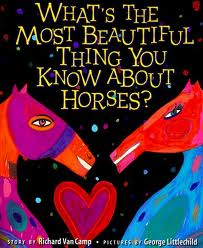
What’s the Most Beautiful Thing you Know about Horses?

We have been reading Aboriginal Literature with our reading group each week. This beautiful book by Richard VanCamp and illustrated by George Littlechild allowed us to learn more about horses while also learning about VanCamp’s Dogrib Nation.

Author Richard VanCamp’s hometown is Fort Smith in the Northwest Territories of Canada. On a cold (forty below!) winter day he decides to ask people he knows What’s the Most Beautiful Thing you Know about Horses? He, himself, doesn’t know much he explains because he is a stranger to horses; his people are not horse people. The people of the Dogrib nation have a great respect for dogs. In this northern land, dogs helped with hunting, protected the food stashes and helped with hauling camp from place to place. But yet in Dogrib the word for horse is big dog. When did dogs grow into horses? When did horses shrink into dogs? he asks.

Oh, the things he learns when he asks: “Horses always find their way home,” his Dad tells him. George Littlechild, who did the amazing illustrations for this book shares, “They stare at you as they breathe. Their soul comes right out.”

We shared some things we know too:

  • They go in running races
  • They are sometimes used in war
  • They are useful
  • They are calm and swish their tails
  • We can see them at the P.N.E.
  • They are in the Chinese Zodiac. Horse people care about their families.

What’s the Most Beautiful thing you Know about Horses?


Simple Books, Little Treasures

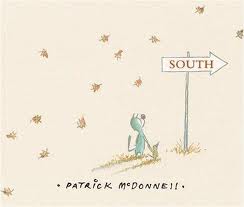
It’s report card writing time: words, words and more words. At the library today I was drawn to books that didn’t contain many (words) at all! These fabulous little finds are all about simplicity – wordless or sparse text. Pages full of ideal illustrations, questions posed and left unanswered and inferences begging to be made. 🙂 South by Patrick McDonnell.

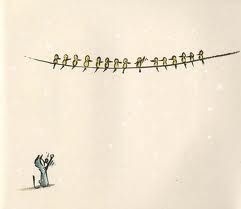
A last fall leaf lands on a lone little bird, asleep. His friends have all left for warmer places. Despair. Mooch, the cat, accompanies him on his journey south through falling snow, falling tears and developing adoration until they happen upon the beautiful sound of birdsong.

Old friends found but reluctant goodbyes to new friends made. South by Patrick McDonnell is a lovely wordless story about being lost and found and having someone sweet enough to help you on your journey to where you need to go.

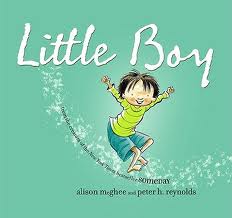
Aren’t we lucky to have children in our lives (like the little boy in this book in his star ship pyjamas and his important cardboard box) to remind us to appreciate the here and now? Kind of why it is great to be a parent and a teacher. My favourite line from Alison McGhee is the last line of the story: Little boy, you remind me how so much depends on days made of now. This book was inspired by the poem The Red Wheelbarrow by William Carlos Williams (a poem that also plays a starring role in Love that Dog by Sharon Creech) Little Boy is illustrated by Peter H. Reynolds.

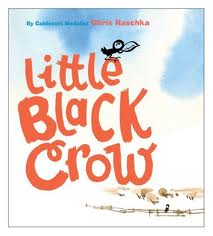
I love books featuring birds, books that ask questions (and inspire more) and books by Caldecott Medalist Chris Raschka. This book was made for me!

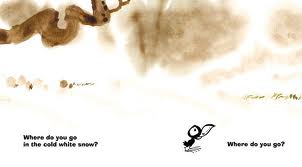
Little Black Crow where do you go?begins the questioning . . . 27 questions make up this book about a little boy wondering about the little black crow he sees in the sky.

Haven’t you also wondered about those birds flying by? Hey! Birds! Are you never afraid? Do you wonder about the stars you see? Might you ever wonder about someone . . . like me?

Happy Reading!

Grumpy Bears, Clever Mice and a good night’s sleep

Our BLG reader this week was Sam. He brought in an engrossing story by Bonny Becker and illustrated by Kady MacDonald Denton. A Bedtime for Bear is all about a very particular Bear who needs everything to be just so in order to get to sleep. His friend Mouse, who comes to spend the night is not very capable of being calm, quiet and quick to settle down. This aggravates Bear just a little (well actually a LOT).

A little bit of irony – this book was all about being quiet and my normally very noisy (in a charming sort of way 🙂 ) class sat silent and focussed during Sam’s reading except to giggle at how disruptive and annoying Mouse was to Bear.  Strangely quiet! But I wasn’t about to complain!

As the evening progresses in the story, we begin to realize that Bear wants Mouse up and about because he is a little nervous about a sound he heard.

Miami was on to him, “He doesn’t want the mouse to go to bed because he is scared!” she shouted.

When Bear told Mouse a story about Brave Strong Bear and the Very Frightened Little Mouse, Jeremiah quietly remarked, “That’s the opposite.”

Not much gets past us!

Our student reviewers report:

Lisa: My favourite part is when the bear asks the mouse to check his closet. I think he did that because he was actually scared there was someone that lived in the closet.

Kevin: My favourite part of the story is when they both fell asleep under the full moon.

Ricky: That was a great book you read Sam! It had good pictures and good characters.

Courage to Fly

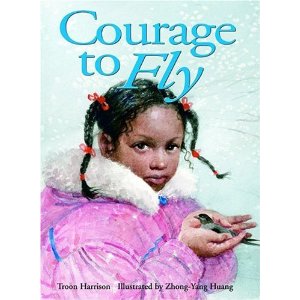
This week I read Troon Harrison’s picture book Courage to Fly to our Reading group. We continue to practice actively using the comprehension strategies we have been taught in Reading Power lessons: making connections, visualizing, asking questions and inferring while we listen to stories. Students loved this beautifully illustrated book (Zhong-Yang Huang is the illustrator) about Meg, an anxious and lonely little girl in a big city in a brand new country.

courage

Meg finds a tiny swallow that was brought down in a snowstorm. She nurses it back to health and then begins to wonder if she should set it free. She is reluctant to do so – but is encouraged to give the bird its chance to fly. Who really finds the courage to fly?  By the end of the book, we were convinced that Meg had been transformed by her experience and that after taking a risk to let the bird go free, could find the courage to open up her heart to new friendships.

Some thoughts from the students:

I think New York is not a great place for Meg (Ricky)

Why is Meg so shy? Is she lonely? Is she scared of the snow? (Truman)

I think the old man is also trying to tell Meg to find courage. (Jena)

I think the message of the book is to let things be free (Jenny)

Meg gets the courage to be free! (Josiah)

Birds and children must have been on my mind this week when I took my children to the public library – I found two more books involving a child and a hurt bird that needed to be cared for. So much learning happens from these experiences. Lovely stories that touch on the themes of hope, courage, relationships, perseverance, transformation, freedom . . .

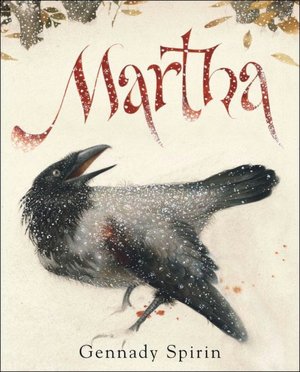
martha

Martha is Gennady Spirin’s story about his own son Ilya who discovered a crow with a broken wing. The veterinarian insisted the bird should be put to sleep as it would never fly. Ilya convinced his parents otherwise and the crow they named Martha made her home with the family. Eventually Martha surprised them all and flew again. Is she the bird that returns the next year and nests in their tree?

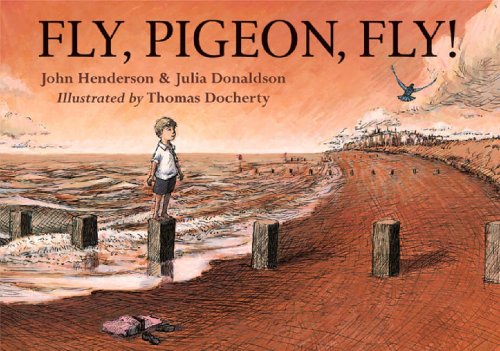
fly pigeon fly

Fly, Pigeon, Fly! is coauthored by John Henderson and Julia Donaldson and illustrated by Thomas Docherty. Set in Glasgow, this is the story of a young boy who discovers a half-starved pigeon in a run down warehouse and takes him home to care for him. The pigeon recovers but the boy cannot bear to set him free. The relationships between the boy and the bird and the boy and his Da are gently explored. In a lovely way, as the boy is able to let the pigeon go, his connection to his Da becomes stronger.