
What a powerful book to read to children! I first read Emily’s Art written and illustrated by Peter Catalanotto with my daughter and she burst into tears part way through. We talked for a long time about the story events and how different characters acted and felt. I knew this was an important book to share in the classroom and the resulting discussion confirmed this and then some.
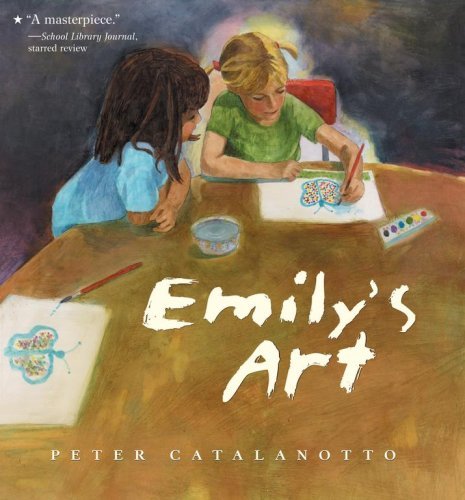
This book begins with a sneak peak into Emily’s classroom. Ms. Fair is explaining to the students about an upcoming art contest where a judge will decide the winner. Catalanotto does a fantastic job of portraying the open, honest and sometimes impulsive comments made by students in a class discussion. Students ask questions about the judge, winning and losing and how exactly things are decided. From Emily: “Does the judge know which is better?”
The story then skips ahead to the days leading up to the contest. Everyday students get painting time. We watch Emily painting and fielding questions about her pictures. Looking at her picture of her family having breakfast (where we see a mother cooking, eating, packing lunches and changing a lightbulb), Stephen asks, “Why do you have four mothers?” Emily explains that there is only one, “She’s just very busy.” Everyday Emily paints a different picture. Her best friend Kelly paints a butterfly day after day.
The night before the contest, Emily cannot settle. She has questions for her mother about which is best and all night she worries about what might be better. Winter or summer? Pink or purple? The sun or the moon? My students were reminded of other stories with characters being unable to sleep because of worries. “That’s like Wemberly Worried!” “Howard B. Wigglebottom!” “Seymour Slug Starts School!” We sure connect to those sleepless worrying nights!
At the contest, the judge is overwhelmed by Emily’s art: “What a gorgeous painting. What a beautiful rabbit!” When Ms. Fair explains that the picture is actually of a dog, everything changes. “A DOG??!!” screeched the Judge.”I was attacked by a dog once! I hate dogs.” She turns and awards the blue ribbon to Kelly’s butterfly.
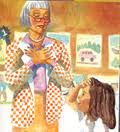
“I love butterflies,” she announced.
Emily’s heart twisted. My class was irate! And deeply impacted.
Jena: “That judge is judging her painting by what she thinks about dogs.”
Alyson: “Maybe she shouldn’t be a judge! What does she know?”
Emily took her painting down and vowed to never paint again. Miami, now in Grade 3 shared a memory from kindergarten: “At my old school, my teacher was mean to me. She said “What is that?” when she looked at my picture. “You can draw better than that. I know you can.” I always felt sad when I was at home.”
Emily ends up going to the nurse’s room, needing to mend her broken heart. She falls asleep and when she wakes, Kelly is on the cot beside her.
I ask the students why Kelly might be there?
Scott: “She is so sad for Emily.”
Alyson: “She feels sad that Emily didn’t win. She would have won if the teacher hadn’t said it was a dog.”
Hajhare: “Kelly’s heart feels sad because she thinks that Emily must hate her.”
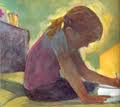
“Wow” Kelly whispered. “You’re a good artist.”
The girls begin talking and Kelly shares that she doesn’t know how to draw anything but butterflies. Because she won, everyone expects more of her. Can Emily show her how to draw a dinosaur? The girls feel better and head back to the classroom where they are having an art party to celebrate all of the wonderful work!
Kevin: “It’s a happy ending. But the middle was the sad part.”
Miami: “I’m connecting. Lots of movies have sad middles but then, happy endings.” The class agreed.
More reactions:
- “She should know her own opinion of her drawing so she won’t be sad. Like positive thinking.” (Lisa)
- “Don’t always agree with other opinions.” (Annie)
- “It is emotional, because if you think of a time like that – like getting rejected, you connect to the sadness of it.” (Alyson)
We talked about how strong words can be.
- “What the judge said was mean.” (Kevin)
- “People should think before they speak” (Alyson)
- “Words can be really strong- something mean said can make you feel like a punch in the stomach.” (Jena)
- “Punches can hurt outside, but words hurt inside.” (Kevin)
- “That’s clever Kevin.” (Hajhare)
For more ideas of how this book might be used in the classroom, check out these questions from Philosophy for Children. I just discovered this website and will certainly be revisiting it!
 There's a Book for That