Dear Guest Teacher

So here are a few confessions and some truths:

  • I have a lot of anxiety about being away
  • Many of my students share this anxiety
  • Often, I choose not to be away even when I should be because it just seems easier all around. I have a few oh my, my, my stories from previous years that contribute to this feeling.
  • While my students are delightful, happy and excited about learning, many of them could also be described as impulsive and as finding change challenging.
  • The reality is that when a lot of the magic of a classroom is based on relationships, and someone new comes in in a leadership role, things can go off course. Normal “substitute” stress that has nothing to do with the capabilities of anyone. It’s just the way it is.

But, this year I have decided that I need to be human. And sometimes I am sick. And sometimes I have to go to the dentist. And sometimes I have an exciting learning or teaching opportunity elsewhere. I need to be away sometimes. My students need to be able to manage.

So I decided to involve my students in the process more. When I was away at the end of September, we planned for a Guest Teacher collectively. Did I think this would ensure that all would go perfectly smoothly? No. I have young students. Impulsivity, anxiety and change is still impulsivity, anxiety and change no matter how prepared one might be. But, did I think our collective ownership of the day would lead to the day having more potential for calm, happiness and learning? Yes!

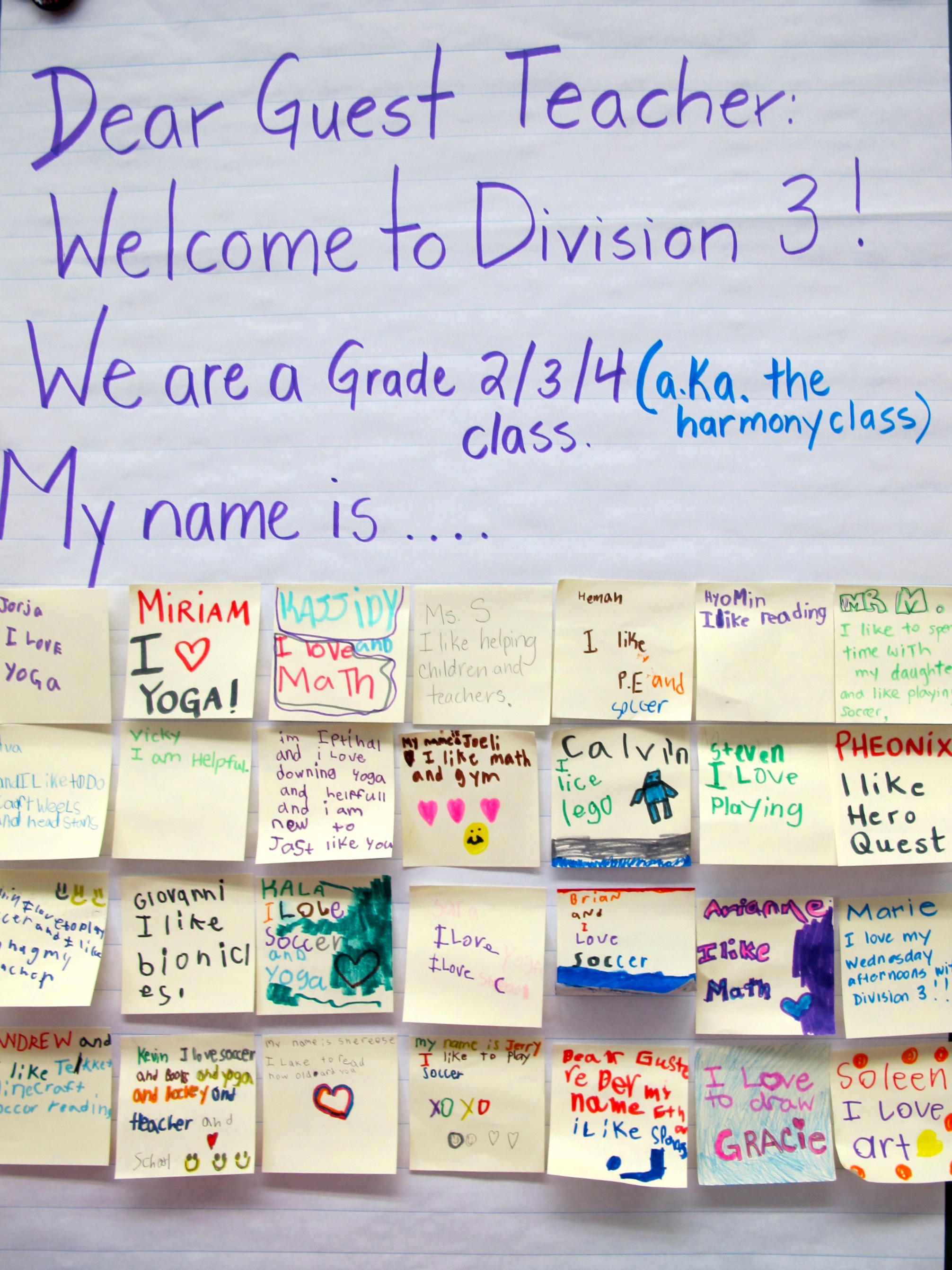
And so over the course of about a week, we spent a little of every day planning for our guest. Everyone, including adults who might be in the room wrote an introduction sticky note. (** We are the self named Harmony Class because when we talked about what it meant to have three grades in one room, one brilliant child observed, “It’s like a harmony.” And the name has stuck! :-))
 Dear Guest Teacher Planning collectively for a substitute There's a Book for That

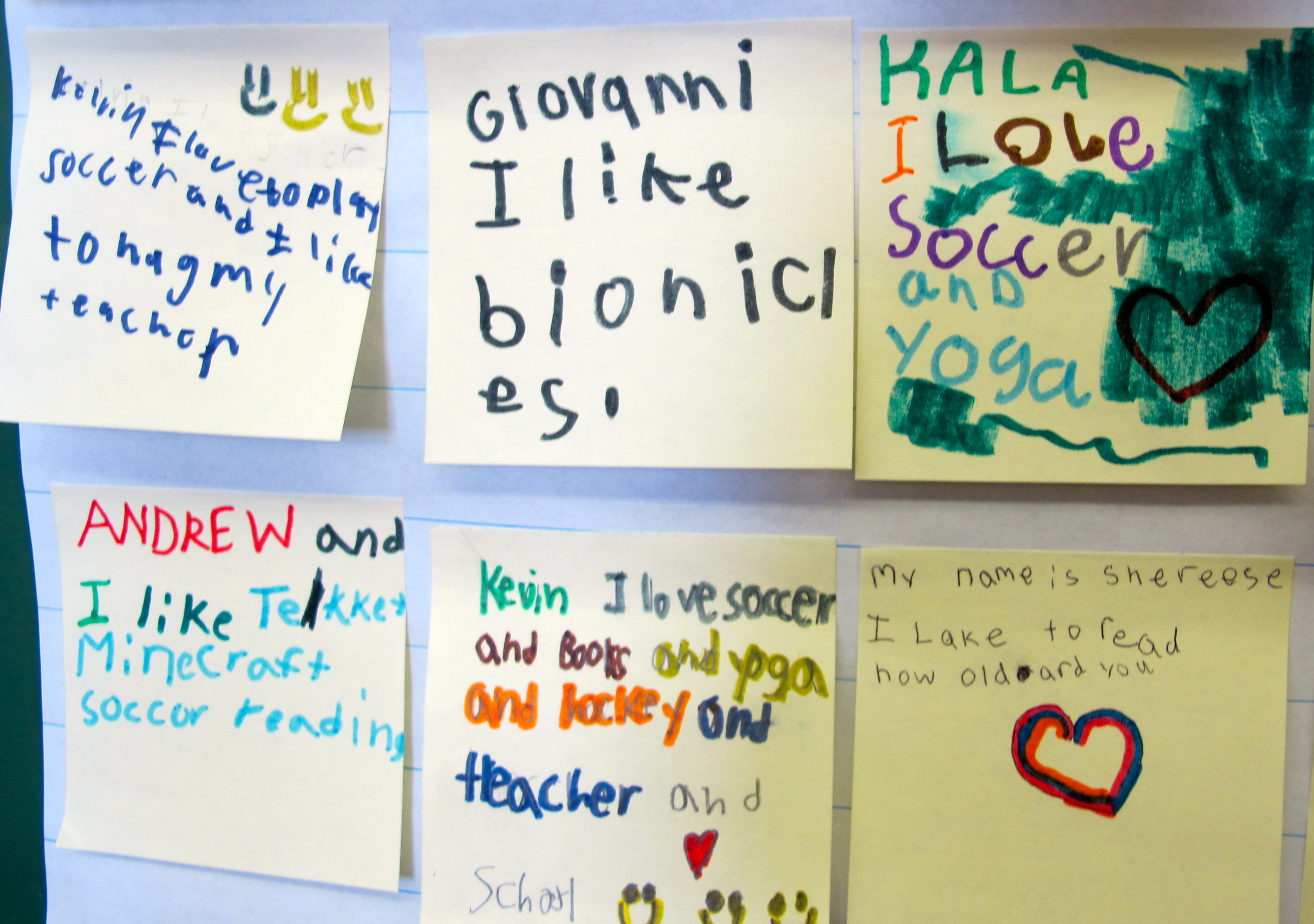
Each child took a moment to share something special about themselves and that helped us to remind each other that not only are all of us special and unique but that the teacher would be too. We had a chance to meet someone new.
 Dear Guest Teacher Planning collectively for a substitute There's a Book for That

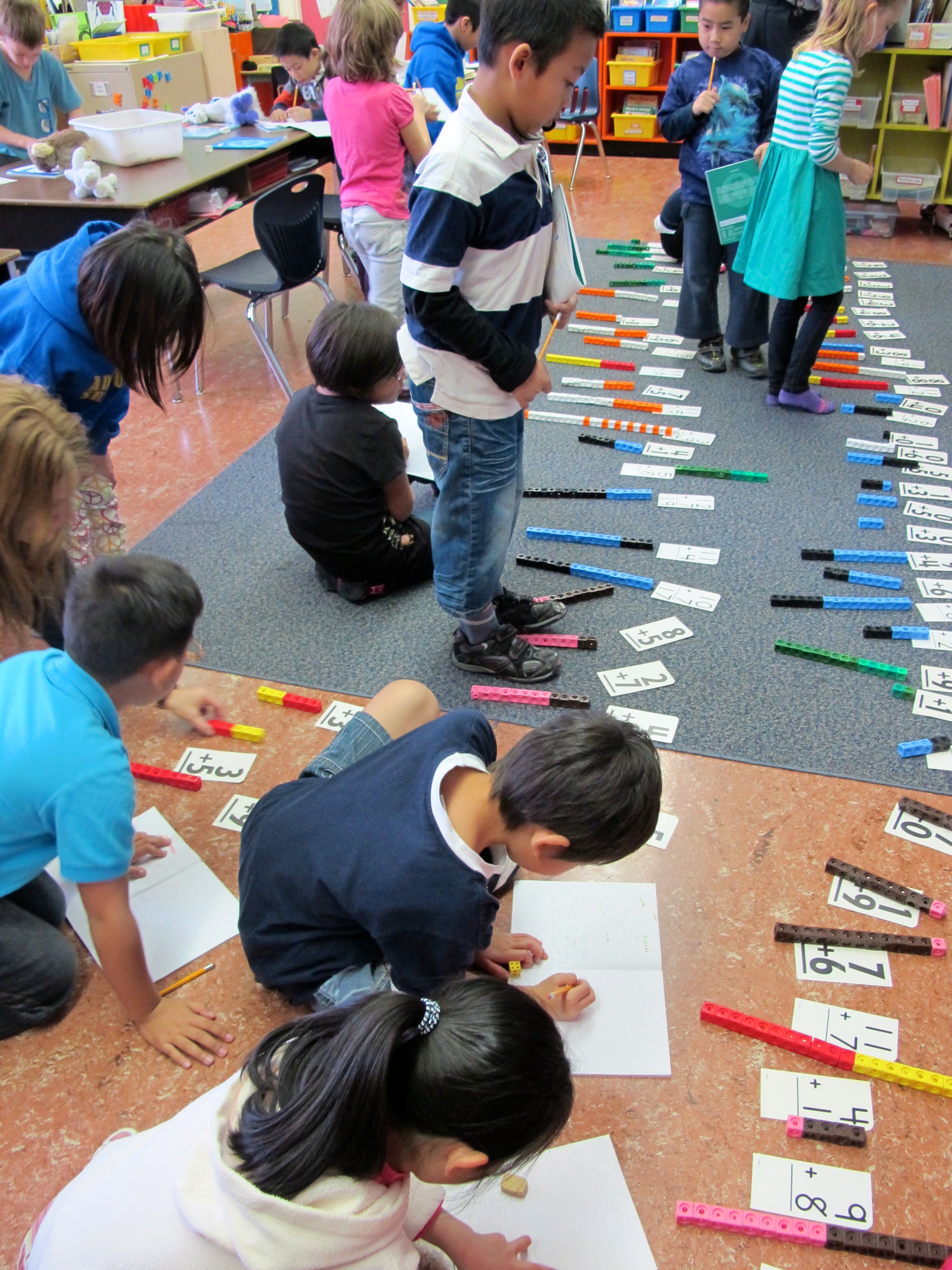
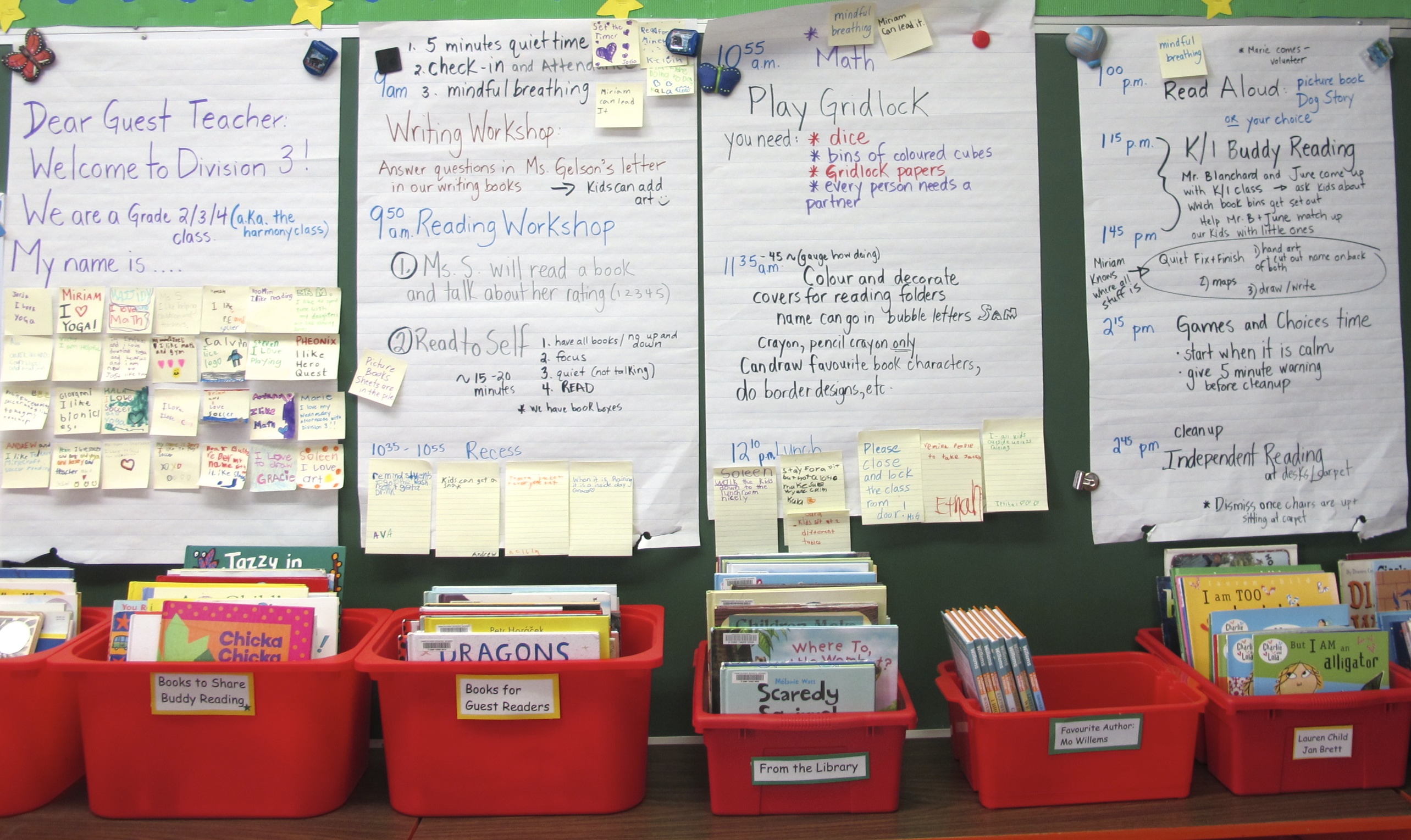
I put up a blank day plan that had times and activities using large chart papers. Everyday we spent a little bit of time filling in details together. For example, what should we do in math that would be successful? The students chose to play Gridlock, a game they had played before to practice coordinate systems. Everyone voted that this would be an activity where we could be engaged and independent.

Eventually, our day plan looked like this. While I filled in the chart, student input was included for each activity. They reminded me of routines, important details and special instructions.
 Dear Guest Teacher Planning collectively for a substitute There's a Book for That

For some procedural details, students added their own sticky notes to elaborate on our directions. I love the lunchtime directions, particularly this one:

“Stay for a bit but not a lot to make sure we are calm.”

 Dear Guest Teacher Planning collectively for a substitute There's a Book for That

So . . . the verdict?

Well, some things went beautifully . . .  I received this tweet from one of the Support Workers who spends time in my room:

The note from my Guest Teacher started like this:

“Thanks for the day plan. You have a very sweet group of kids. Everything went as planned.”

It ended like this:

“I enjoyed my day with them.”

In the middle it referred to an “incident” – I’m okay with that. Truly, even when I am there, we often have an “incident” 🙂 Or two . . . Perfection was not our goal. The beginning of owning the day together was. As was respect, building community and learning how to welcome guests into that community.

The next day in Writing Workshop we had two prompts: Think about your day with the Guest Teacher, write about something you felt proud about and share a “work on for me” thing. Many students shared that they were proud of their hard work, that they were kind and polite to the teacher and that they did many activities as planned.  A general “work on for me” theme was about improving listening, and being more quiet at carpet time. One little guy said he needed to work on being more patient. The noise at times had frustrated him. Students were honest and reflective.

So would I do this again if I am know in advance I am going to be away? Absolutely.

My reflections would be this:

I felt proud of my students for working together to plan a day for a Guest Teacher to share the room with them.  A “work on thing” for me would be truly relaxing and knowing that we did our very best to prepare for a smooth day. I mostly relaxed whereas in the past, I never did. Again, the goal was not a perfect day but rather working towards developing more responsibility and independence. That road is a long one and we need to travel it one step at a time. This collective planning allowed us to sprint ahead here and there!
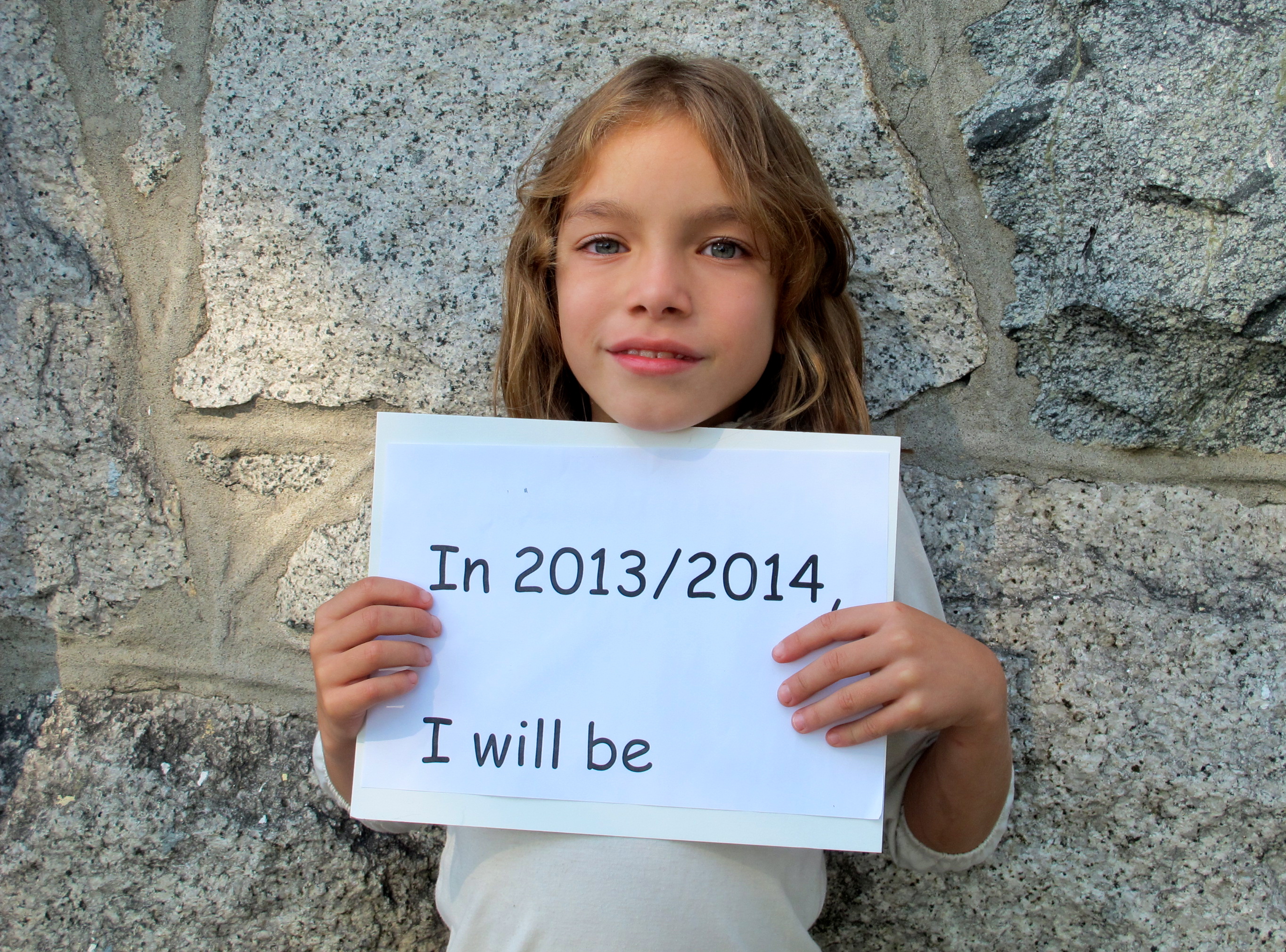
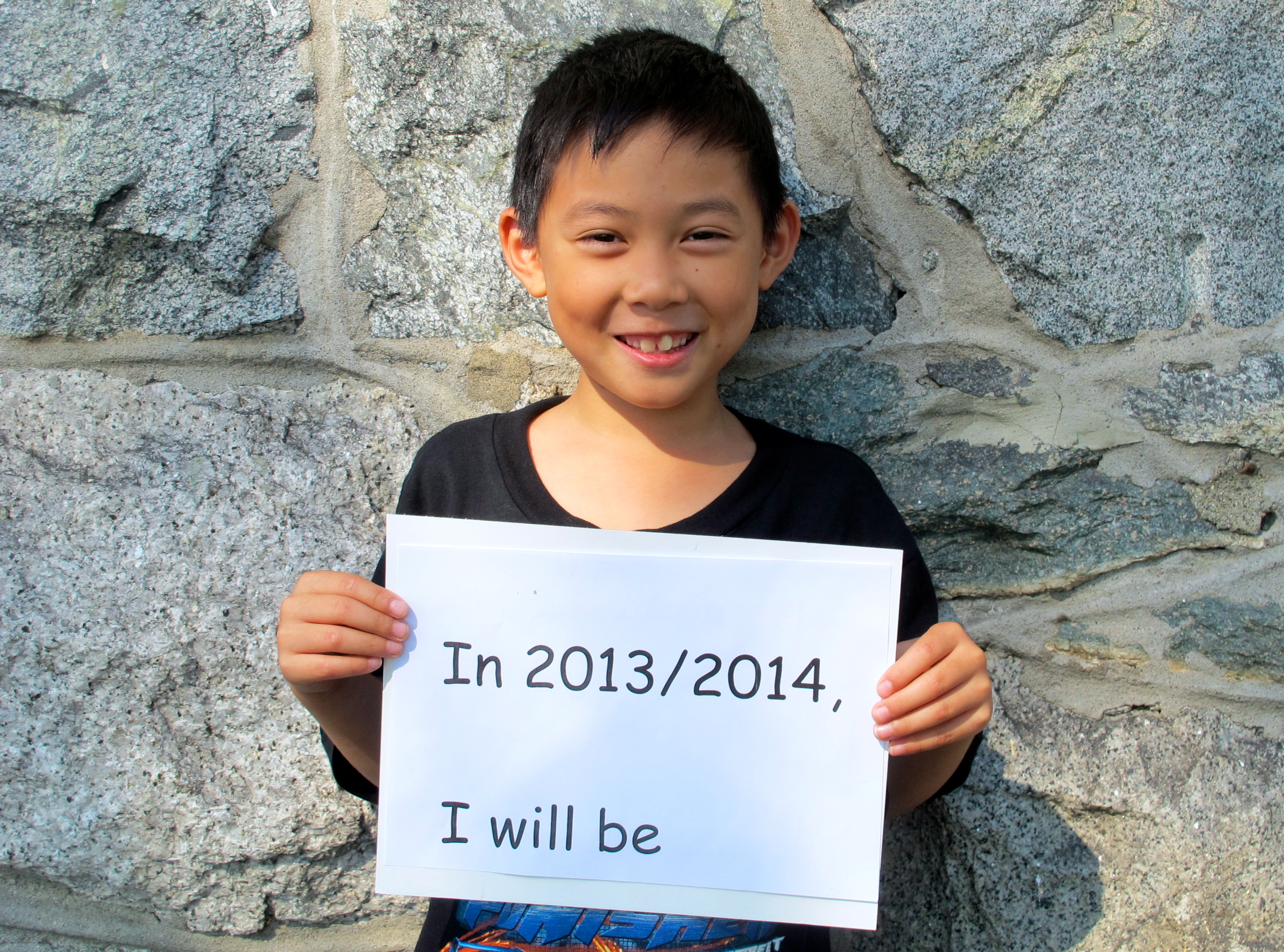
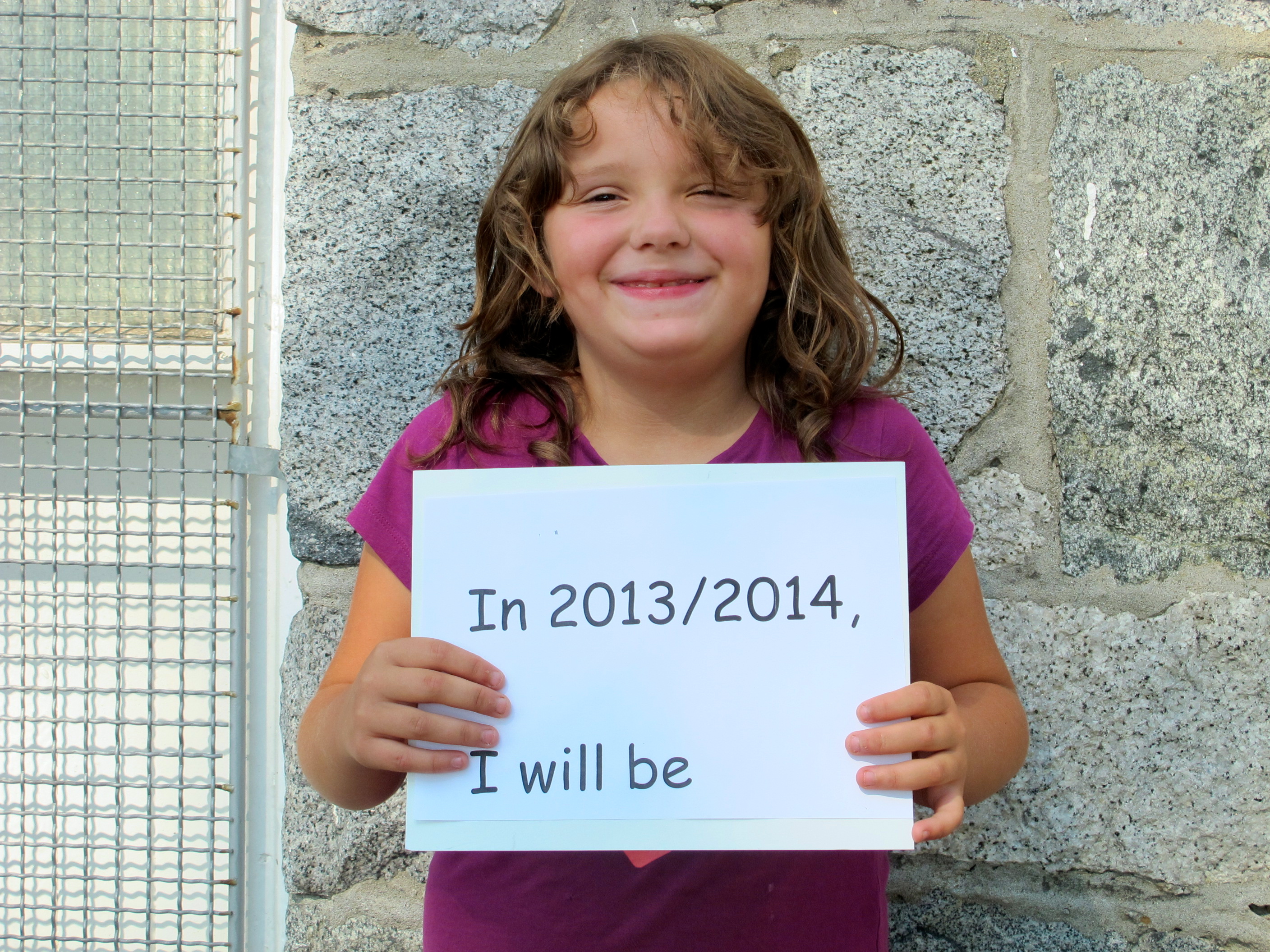
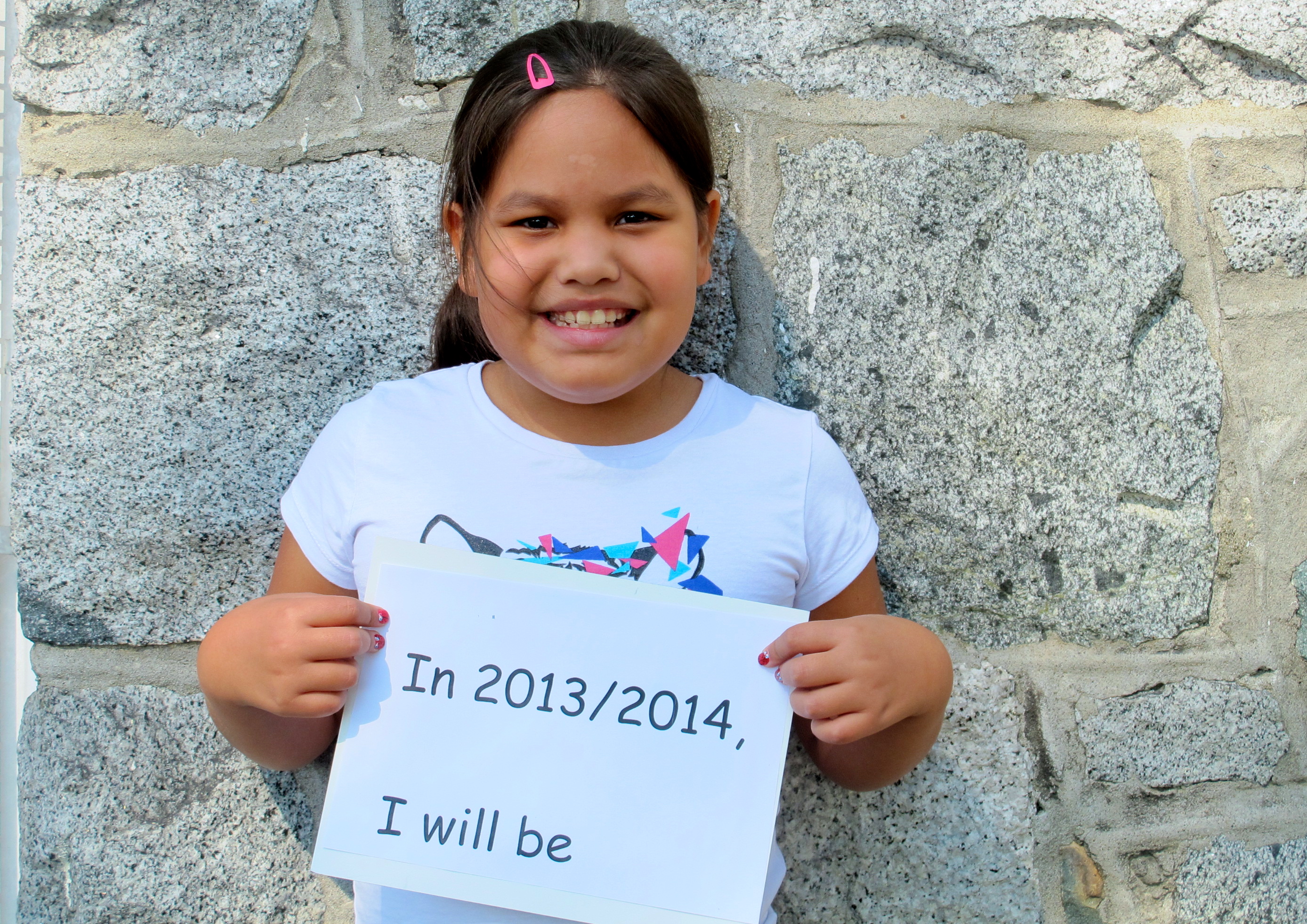
In 2013/2014 I will be . . .

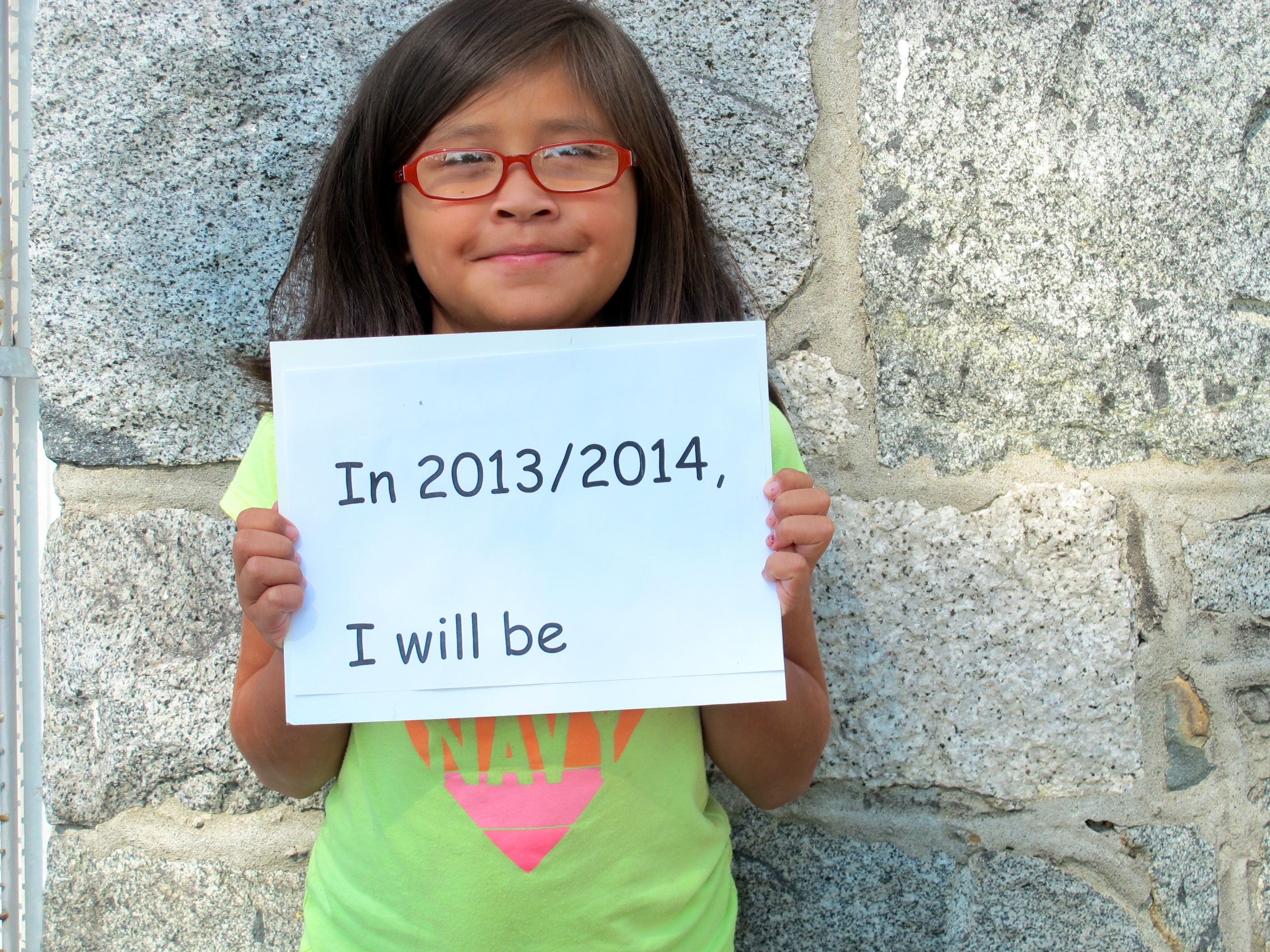
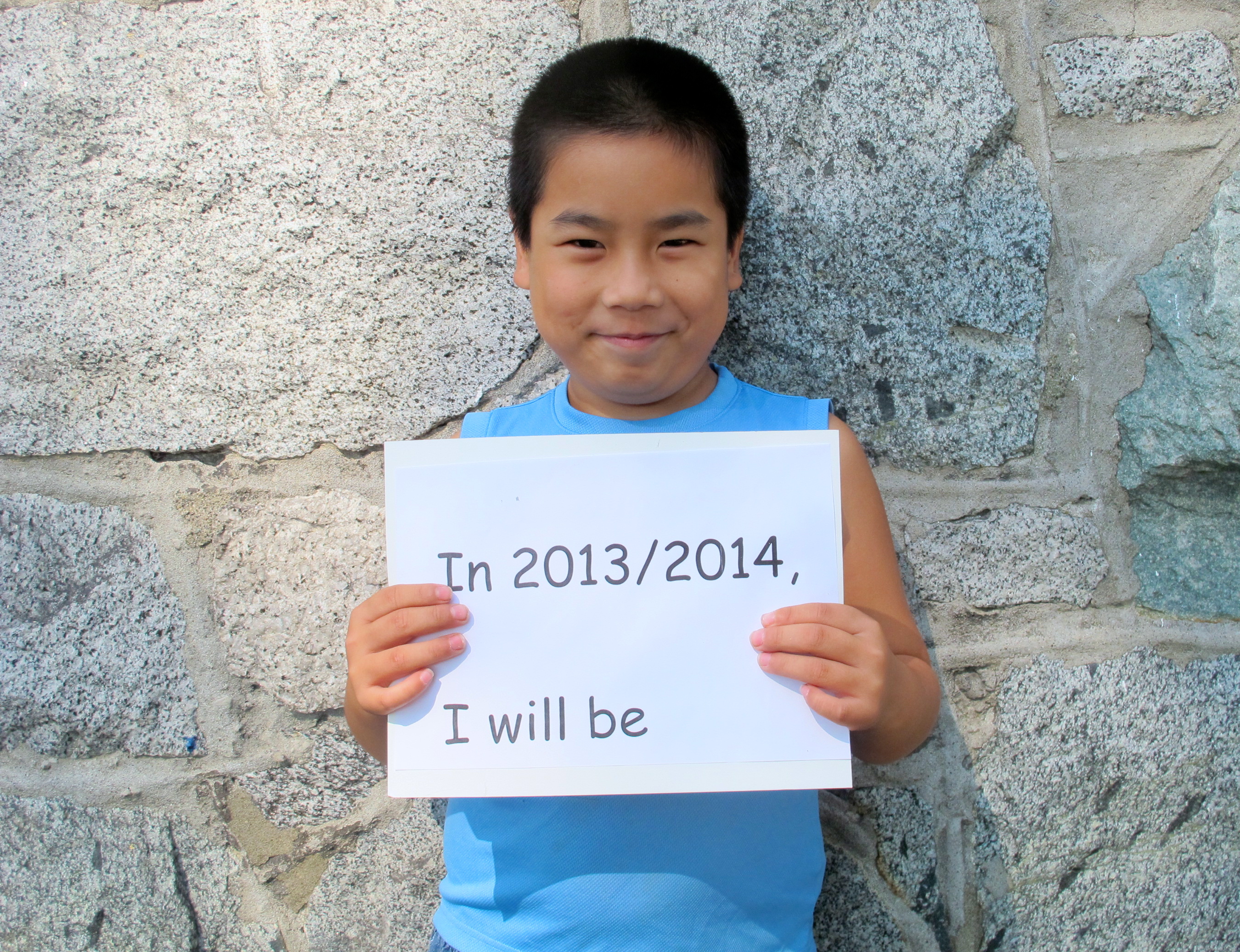
On the last day of school in June all of us in our classroom brainstormed a huge list of words on the board. What did we want to be in 2013/2014? Beyond goals, how did we want to visualize ourselves? How did we want to be described? What descriptors would be a fit for each of us? We each chose five words. We wrote them down and signed the paper. We also asked a witness to sign.

Most of us were returning to spend the year together again for 2013/2014 as our Grade 2/3 class was becoming a Grade 3/4. Over the summer, someone switched schools and some new students moved into the neighbourhood. By the end of week one in September, we had become a Grade 2/3/4 class with 8 new students. We invited our new students to also take part in this exercise sharing our words and coming up with a few more. 

With photographs of us, these words are going to be posted on the walls of our cloakroom. We will see them when we arrive each morning and as we grab our coats and bags at the end of the day. Our words will surround us as we learn and grow. Will these words feel right at the end of the year? Will they be motivational? Will they inspire us? Confuse us? Make us reflect and think? We don’t know yet. We do know that we felt pride and confident choosing our words and happy to share and celebrate them.

If you visit us, please look out for our photos and words in our cloakroom. If you follow our learning journey from afar, here are some lovely examples.

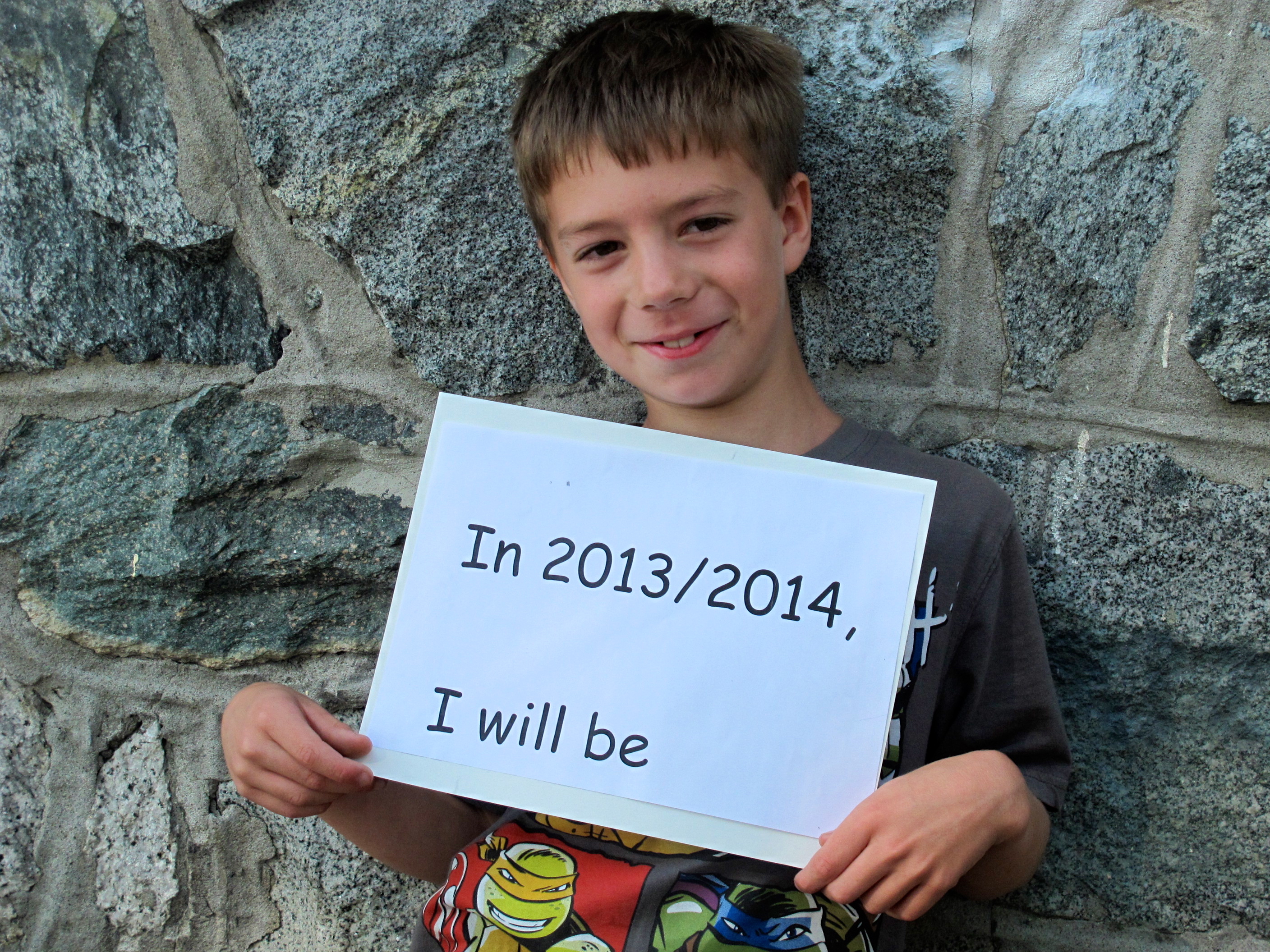
In 2013/2014 I will be . . . . What is your #5word vision? There's a Book for That

*****

Fun

Calm

Focused

A Writer

A Leader

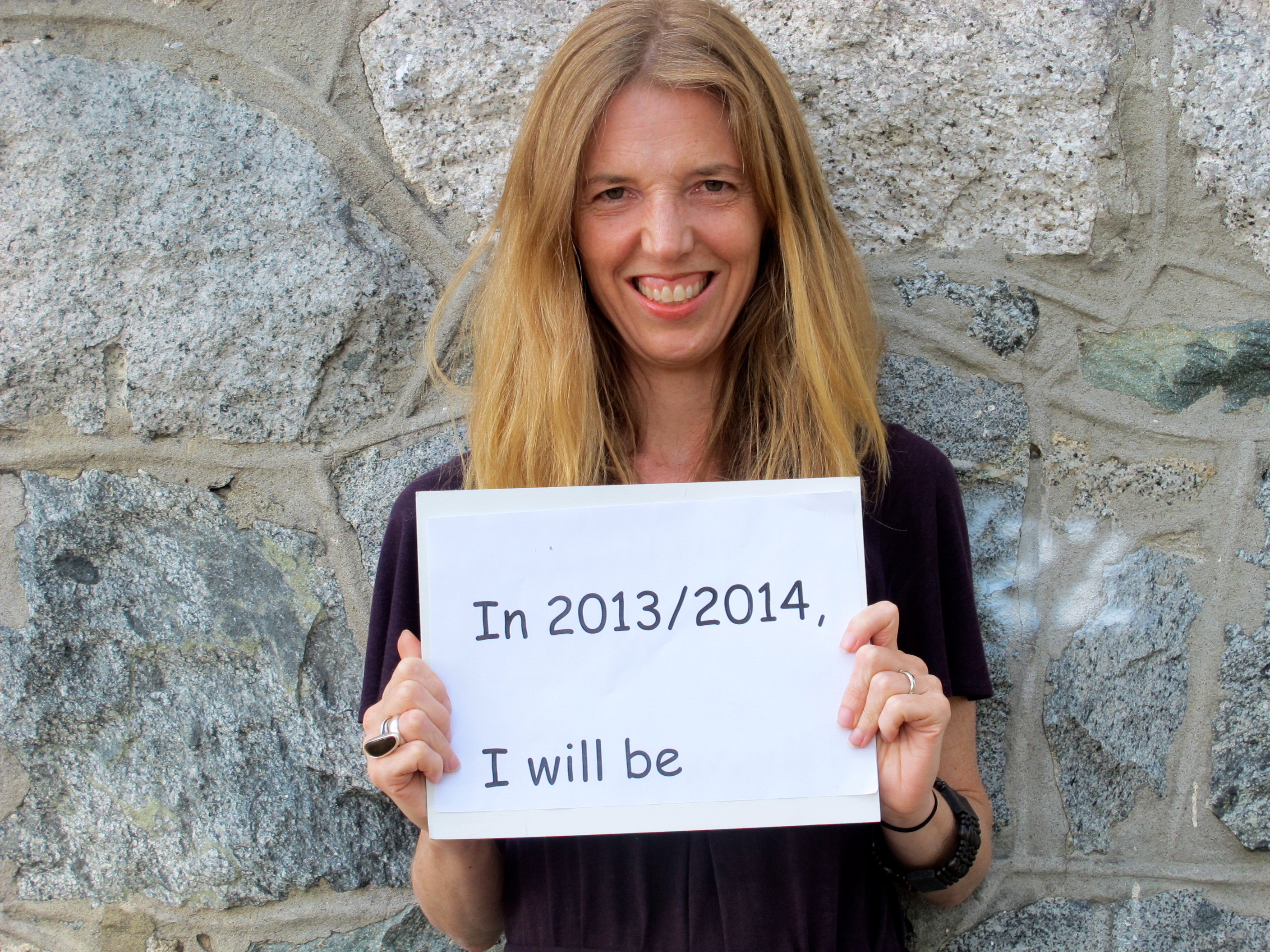
In 2013/2014 I will be . . . . What is your #5word vision? There's a Book for That

*****

A Teacher

Brave

A Reader

A Learner

A Listener

In 2013/2014 I will be . . . . What is your #5word vision? There's a Book for That

*****

Kind

Passionate

Peaceful

Giving

A Thinker
In 2013/2014 I will be . . . . What is your #5word vision? There's a Book for That

*****

A Reader

Creative

Brave

A Leader

Myself

In 2013/2014 I will be . . . . What is your #5word vision? There's a Book for That

*****

Independent

Brave

Compassionate

Helpful

A Reader
In 2013/2014 I will be . . . . What is your #5word vision? There's a Book for That

*****

Creative

Brave

Focused

Patient

Organized

In 2013/2014 I will be . . . . What is your #5word vision? There's a Book for That

*****

Brave

Calm

A Reader

Respectful

Kind

In 2013/2014 I will be . . . . What is your #5word vision? There's a Book for That

*****

Creative

Patient

Helpful

Calm

Fun

As the teacher of all of these young students, I was amazed at how brave many of these word choices were. There was real vulnerability in the writing down of words that have big importance. Some quiet children chose the word Talkative. Children who struggle with impulse control wrote that they would be Calm. Learners just beginning to read wrote the words A Reader as did voracious readers who devour books. Our classroom community values many things and this also came through in the choices: Mindful, A Leader, Creative, Kind . . . 

These words will visit us everyday, I am not going to ask the students to revisit their choices and evaluate later in the year. I don’t want these words to be intimidating. This process is not about living up to a goal. This process is about choice. We all have the ability to choose who we are becoming. The words we have chosen celebrate this power.  My responsibility and my joy will be to support these choices all year long.

Happy 2013/2014 everyone! What will you be?

Would you like to share your 5 words in the comment section? We would love to read them!

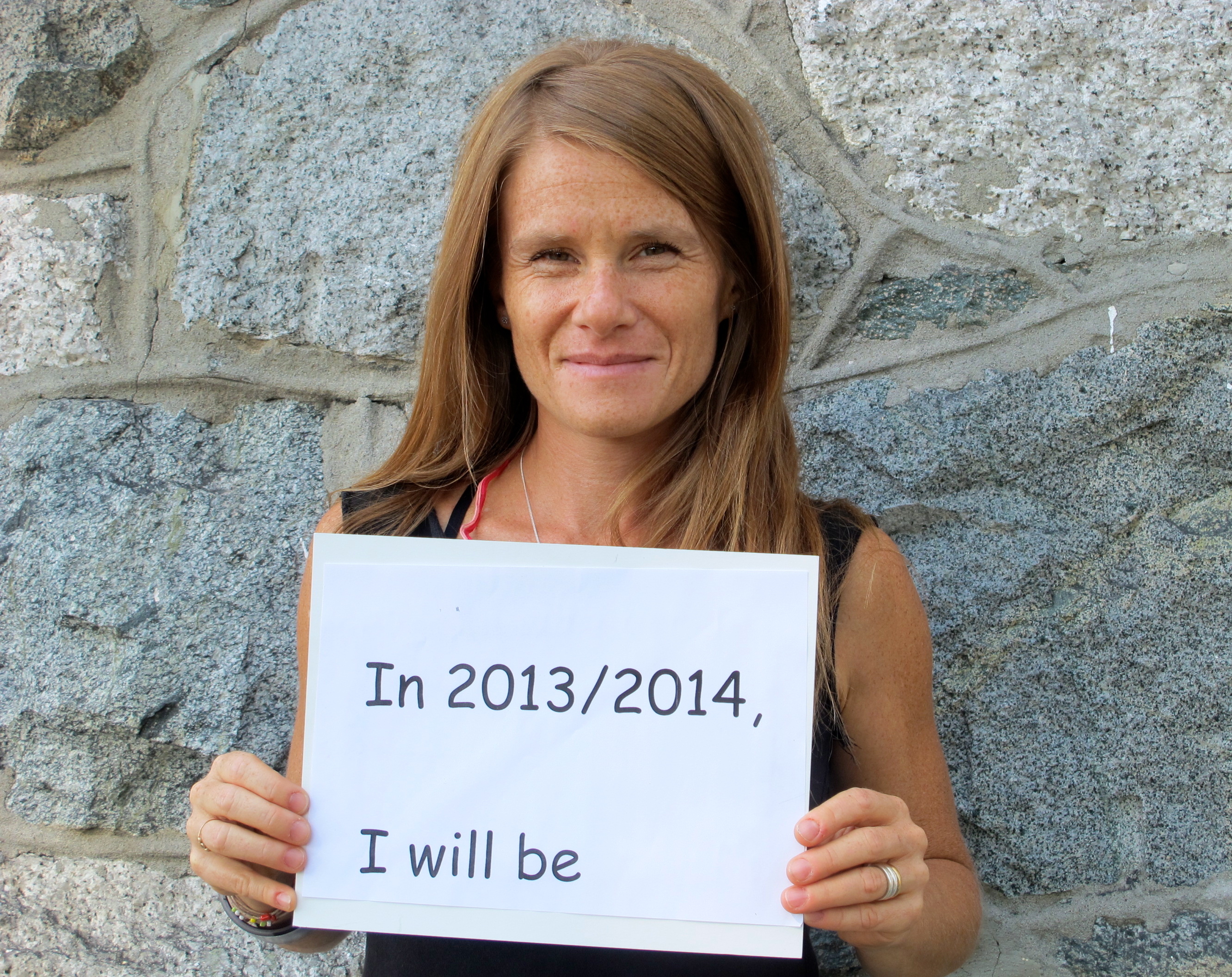
Here are mine and Miriam’s (Miriam is my brilliant Student Support Worker who shares these wonderful children with me):

*****In 2013/2014 I will be . . . . What is your #5word vision? There's a Book for That

Connected

Thoughtful

A Learner

A Reader

Passionate

*****In 2013/2014 I will be . . . . What is your #5word vision? There's a Book for That

Creative

Artistic

Imaginative

Patient

Connected

20 Years, 20 Things

This is my 19th year as a teacher with the Vancouver School Board. If I add up a few months working as a substitute teacher, a temporary contract and two years teaching abroad, I think I can legitimately claim that I have been teaching for 20 years.

 20 Years, 20 Things. What I have learned after 20 years in the classroom. There's a Book for That

After 20 years, what do I know? That there still is and always will be much to learn. I find that exciting and inspiring, not daunting. However, after teaching this long and still loving my job, I can say I have learned a thing or two (20 things in fact – one to honour each year) and in the September of a new school year when pencils are still sharp and excitement is in the air, I made a list. Because that’s what teachers do.

In no particular order because they are all equally important, some wisdom shared:

1. Teach the children in front of you. Not the children you think should be there. Don’t take a curriculum and impose it on a group of learners. Start with who your students are and where they are. Go from there. Take them far!

2. Relationships, relationships, relationships. Without them, good luck. With them, wow!

3. Choose celebration over cynicism. Educators can easily bemoan what is happening in education. Dwell in that place and you will be blind to the wonder and magic that happens everyday with the students in our classrooms. Feel lucky about that and take time to celebrate the daily learning, growth and joy.

4. Laugh a lot. Kids are really funny. Laugh with them and stress dissipates. For everyone.

5. Be one of many teachers in the room. Promote mentorship between your students. Children learn beautifully from each other when we set up learning environments that promote this.

 20 Years, 20 Things. What I have learned after 20 years in the classroom. There's a Book for Tha

6. Make curiousity as valuable, if not more valuable, than the acquisition of specific knowledge. When we spend time collecting facts, we have a finite collection. When we wonder and build on each other’s questions, there are endless possibilities. We don’t need all the answers. We do need lots of questions.

7. Don’t collect “stuff” to facilitate your teaching (files, units, boxes of ____), collect ideas, collect mentors, collect blogs to follow. The environment will thank you. Your students will thank you. You will thank you.

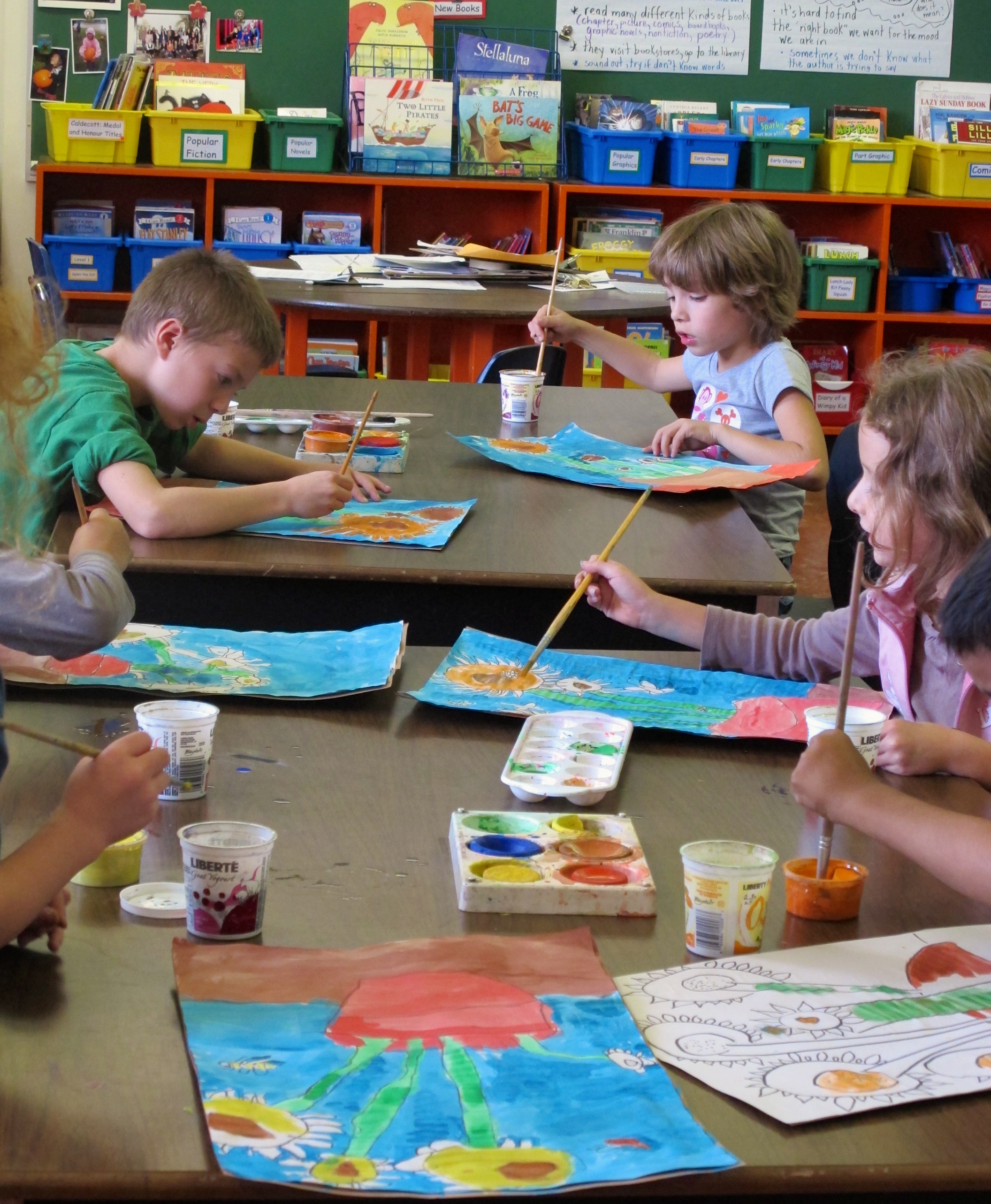
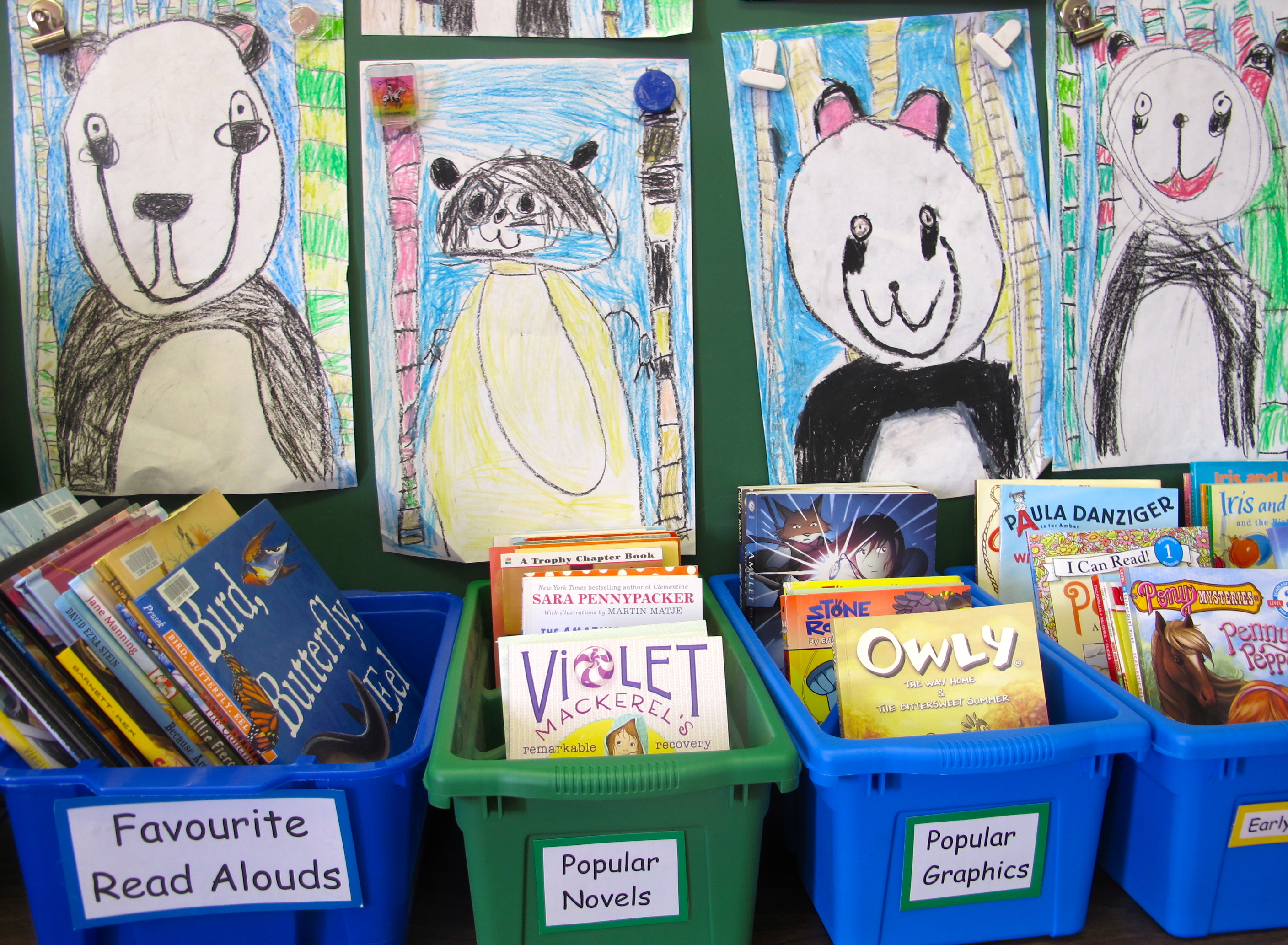
8. Fill your room with student art. Not only does it create a beautiful place and a source of student pride at every turn, but in the regular making of art, so much happens. Creativity. Risk taking. Problem solving.

9. Take nothing personally

10. Can you answer this question: “What one thing do I want my students to really learn this year?” There is no right answer. But it’s a really great question.

 20 Years, 20 Things. What I have learned after 20 years in the classroom. There's a Book for Tha

11. Value community. We are one of many people teaching the children in our classrooms. Students come from varied, interesting and diverse backgrounds. Honour their parents. The extended families. The community that surrounds the school. Make connections to the key players – community centre staff, public library staff, recreation program staff, community health nurses, etc. We are all in this together.

12. Say yes a lot. And when you are tempted to say no, ask a question. The room becomes a happier place.

13.  Be a reader. A voracious one. And then share your reading life with your students.

14. Learn. Children will teach you countless things daily if you open your eyes and your mind. Acknowledge when it happens. Just the other day, a child demonstrated compassion in a situation when I had reacted with frustration. I thanked him publicly for the lesson and then immediately acted on what he had taught me. I am a learner in my room as well as a teacher.

15. Learn from the wisdom of others. So many people are doing so many amazing things in classrooms all over the world. Tap into that. Begin sharing. And borrow the brilliance.

 20 Years, 20 Things. What I have learned after 20 years in the classroom. There's a Book for Tha

16. At the end of everyday, make sure you can think of at least one moment that was magic. Savour it and smile.

17. Adore your students. Interact with them so that they always feel this. You won’t need systems to manage behaviour, you will have relationships. When things don’t go well, when mistakes are made, when conflicts arise, the mutual respect and care will carry you through.

18. Ask yourself this question: “What lifetime habits are being learned in this classroom?”

19. Be a storyteller. Our classrooms are a window into how we as a society look after our children. Speak up.

20. There’s a book for that! The power of books is endless. Read to your students daily multiple times. Sharing books together builds community. Shakes up thinking. Touches hearts. Builds knowledge. Connects us.

 20 Years, 20 Things. What I have learned after 20 years in the classroom. There's a Book for Tha

What would be on your list? What has your teaching journey taught you? Please share, disagree, elaborate, question and wonder in the comment section.

Come on in and read with us!

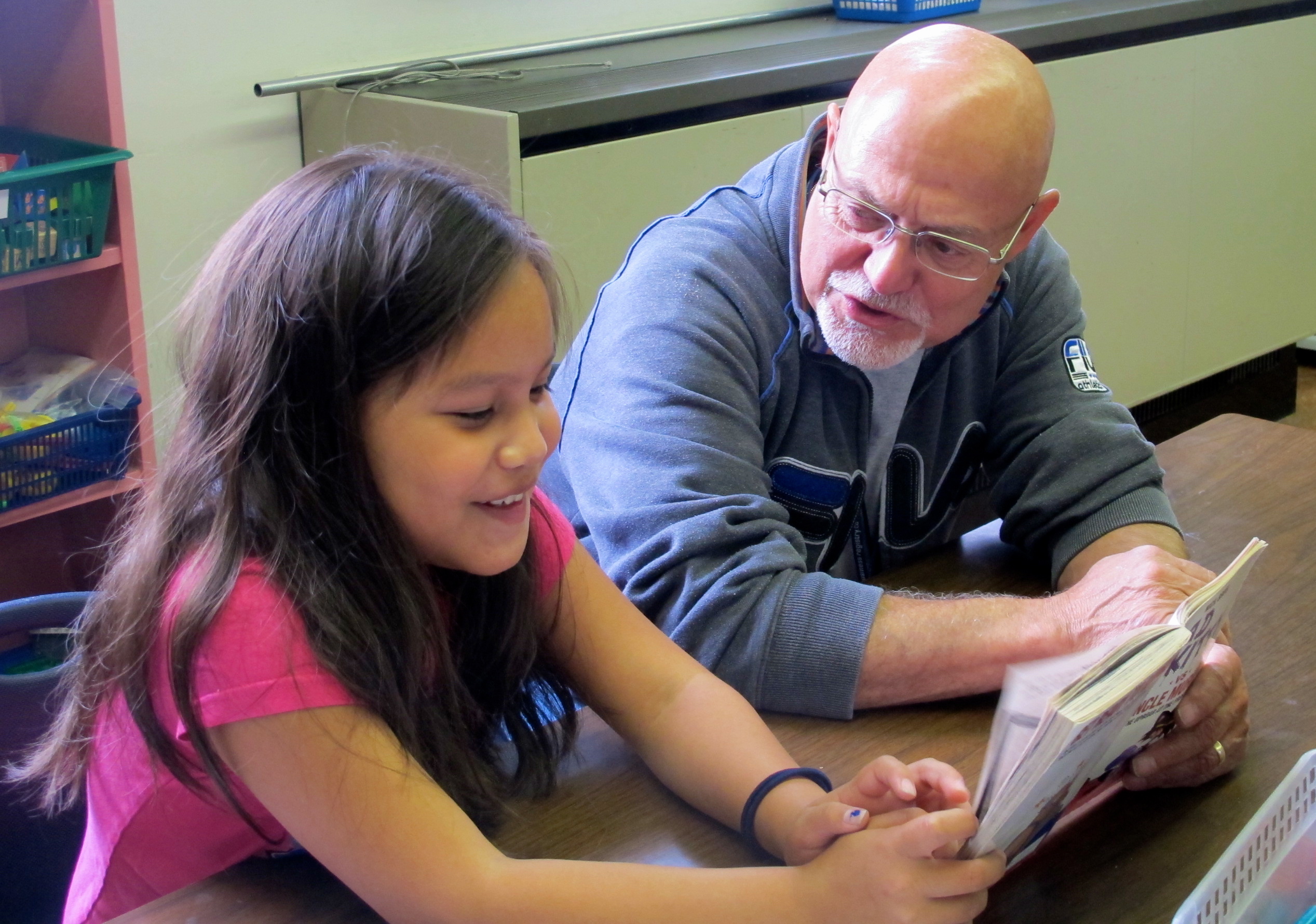
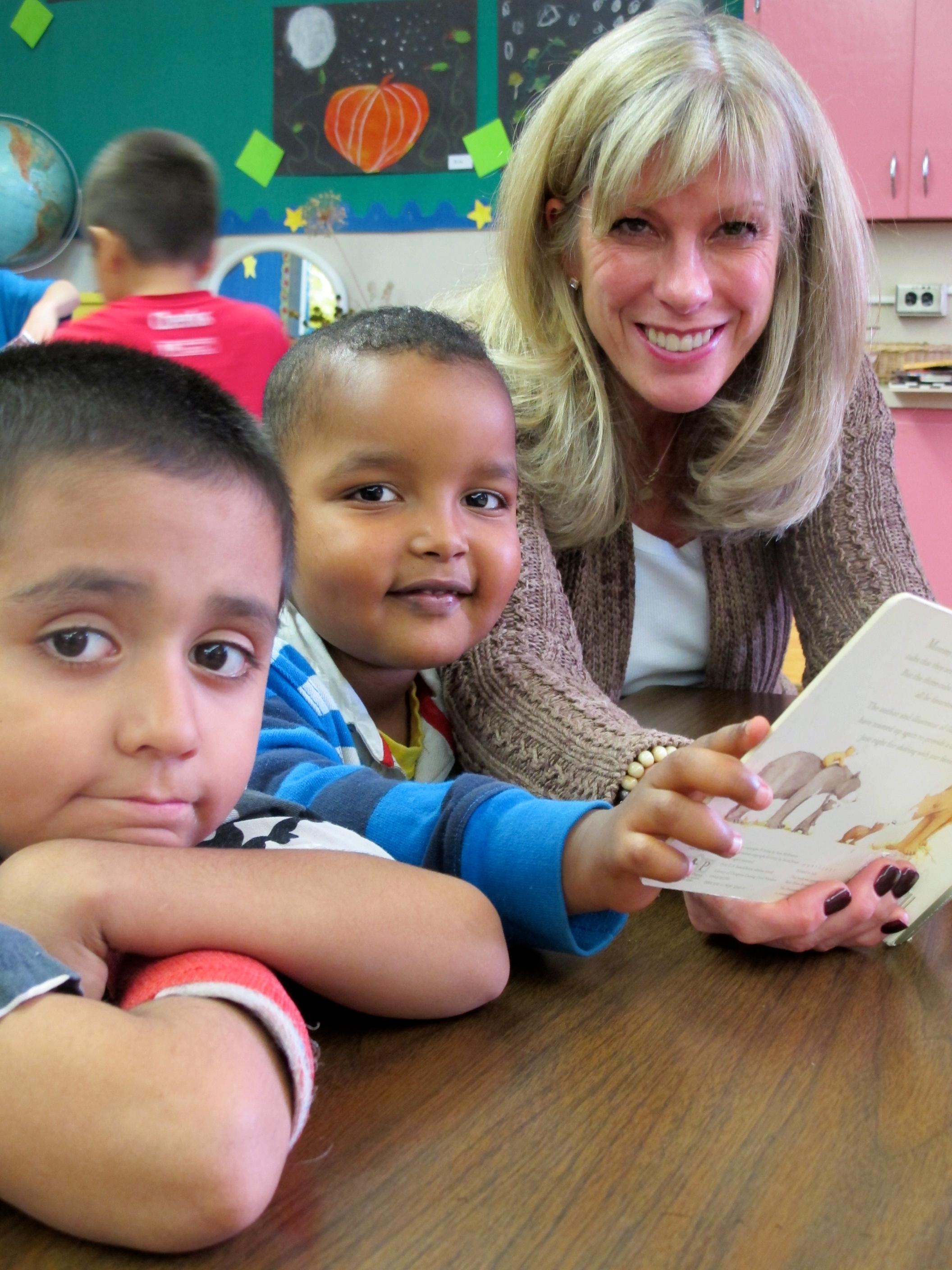
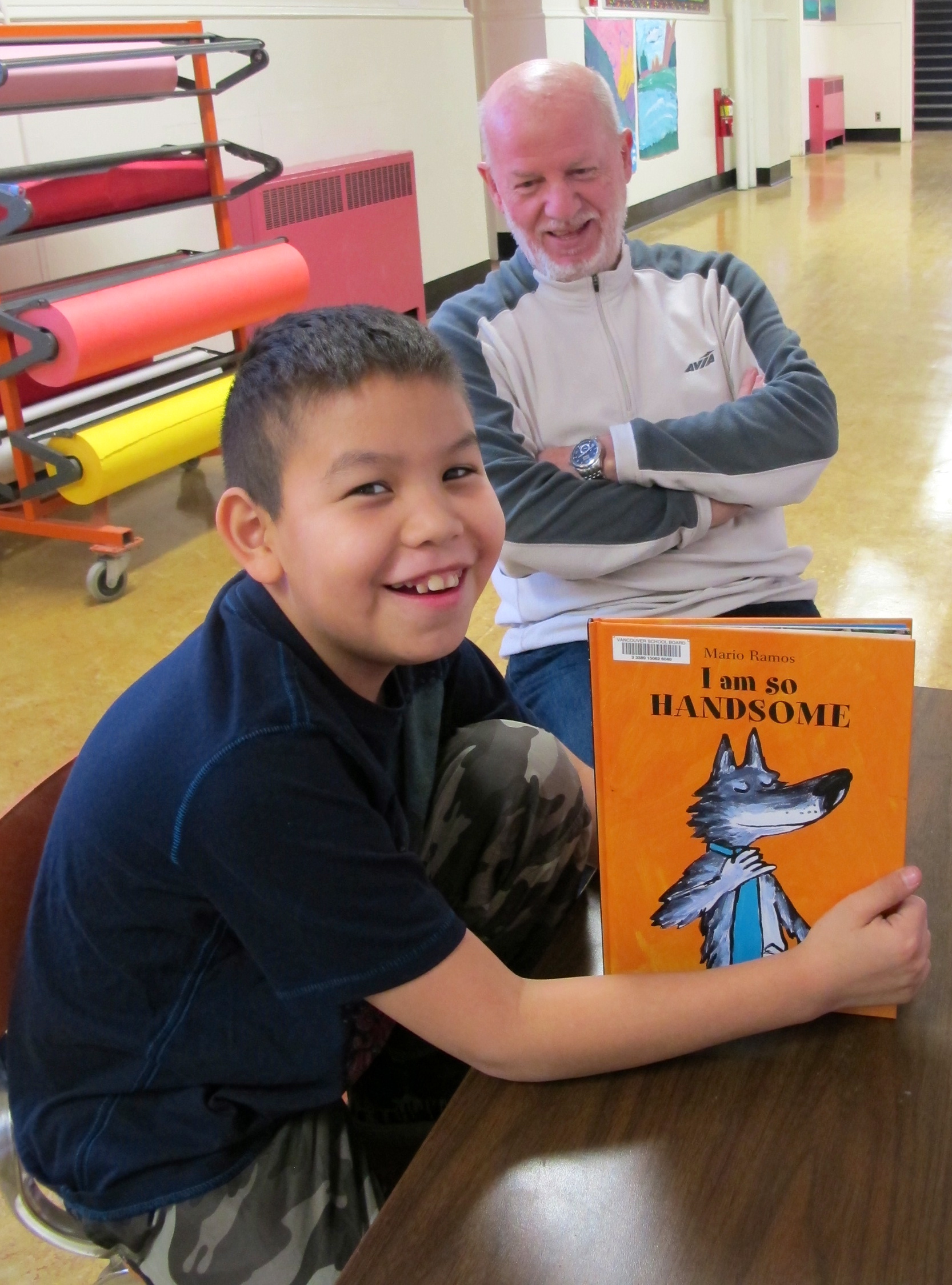
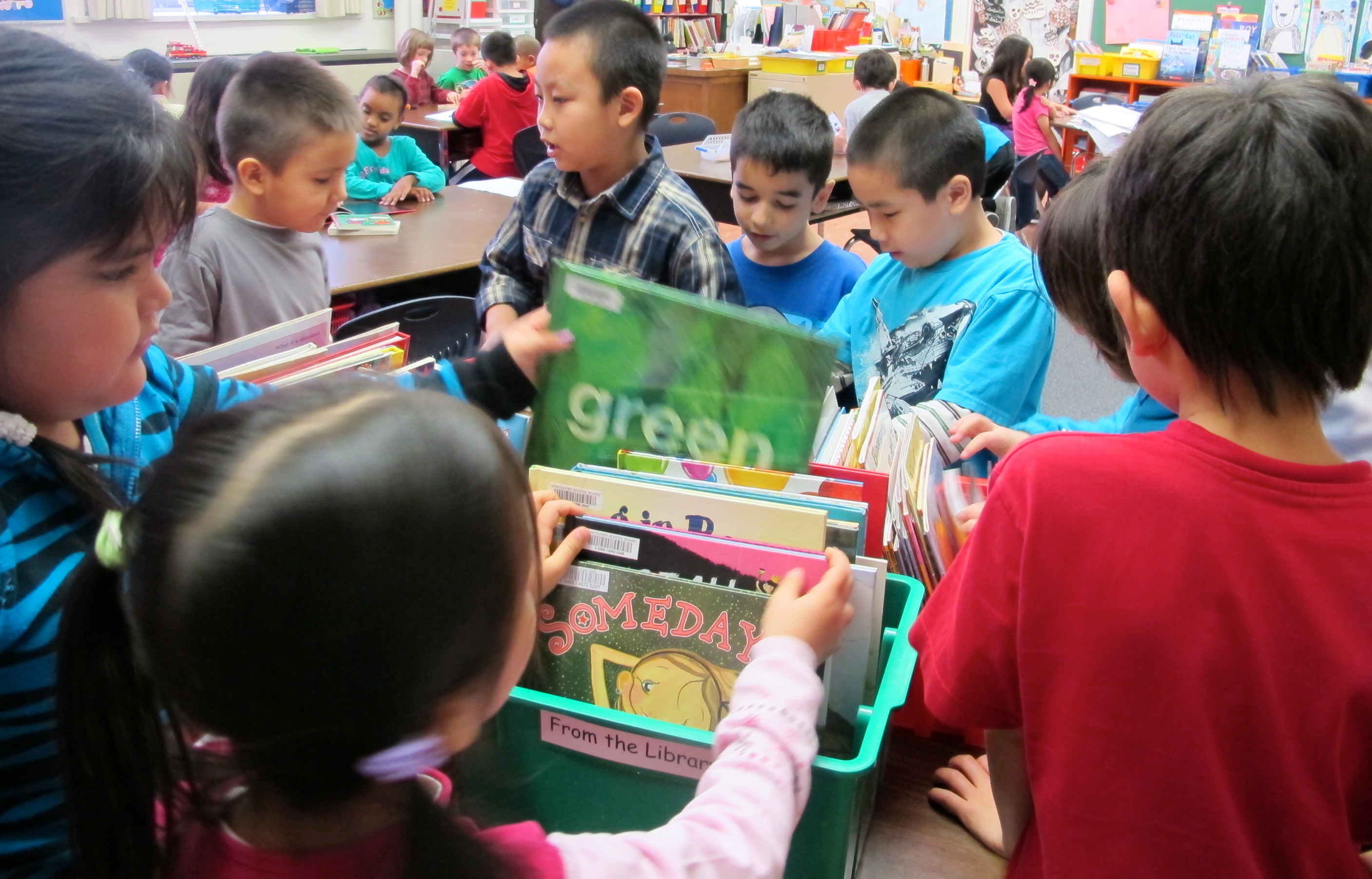
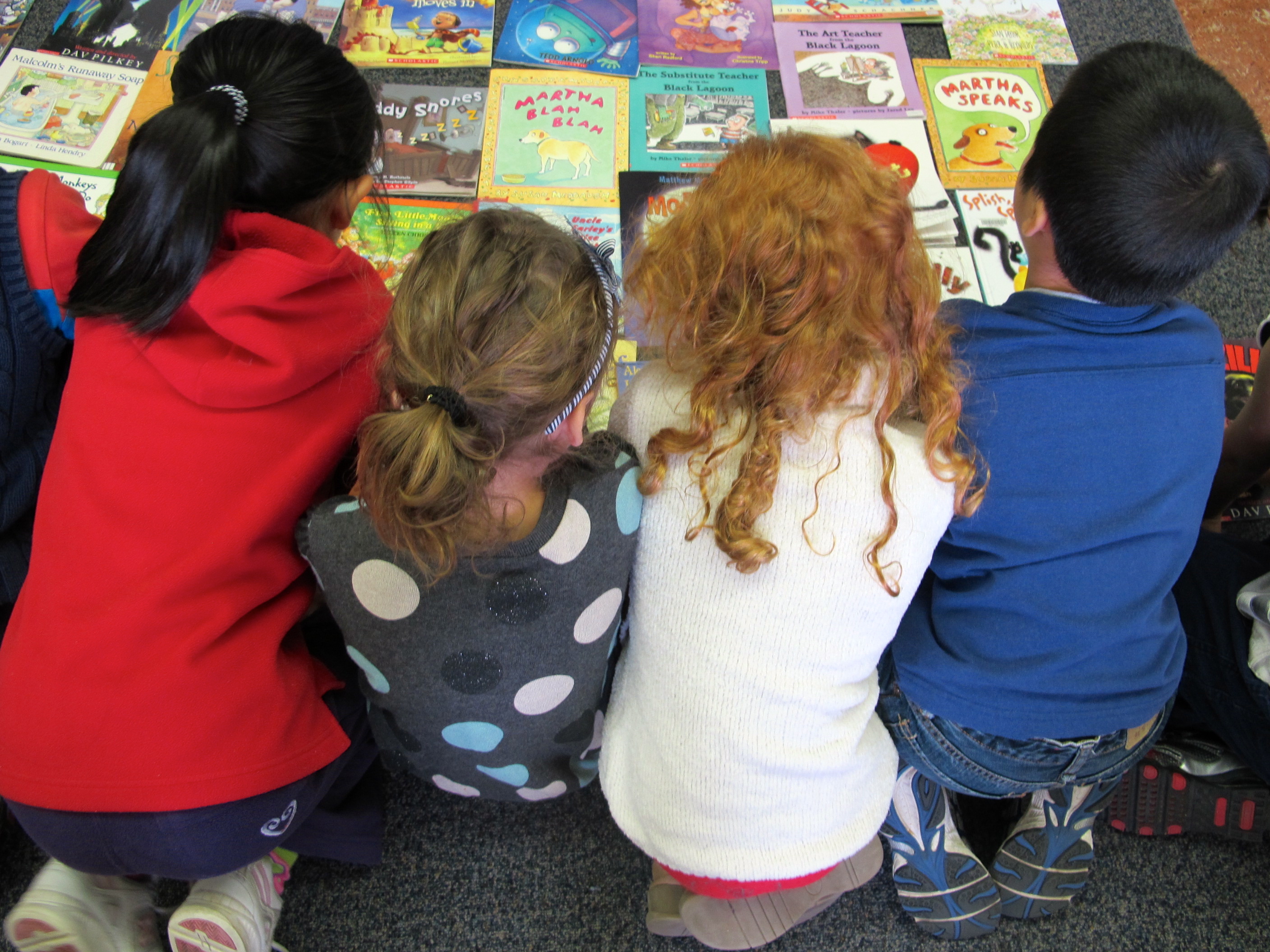
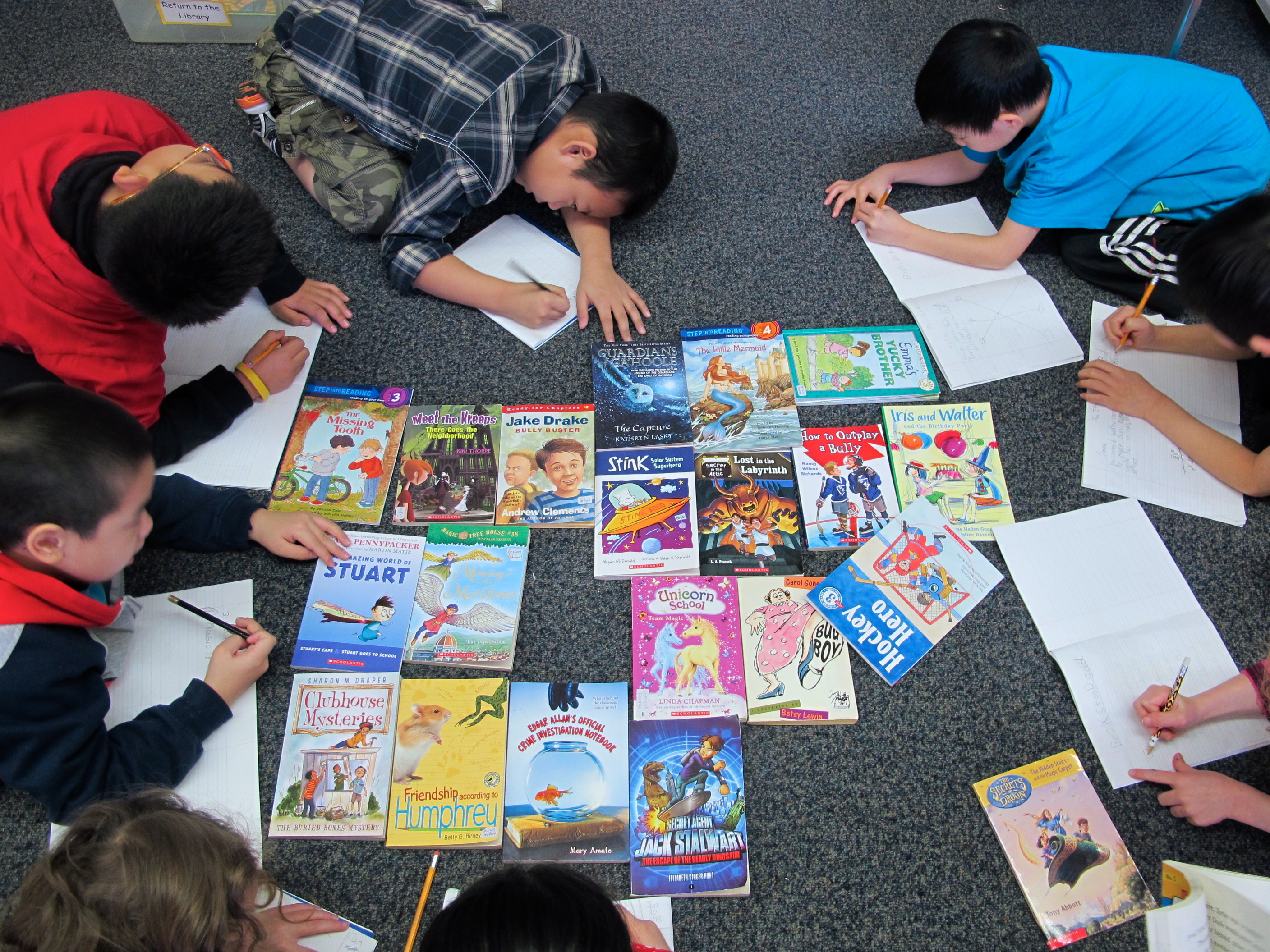
It is no secret that I love books. Books, books, everywhere you look! That is one way to describe our classroom. But the best thing about books is the readers who enjoy them. Sharing the reading experience is an important way to build a community of readers. Time exists everyday for reading and the adults who work in my classroom or visit regularly love to be part of the action.
 
Come on in and read with us! The top ten benefits of shared reading with adults. There's a Book for thatLucky for us, we have numerous volunteers who are a regular part of our week, spending time with us in the classroom. Often, that time involves a shared reading experience  When children and adults read together, everyone benefits – the adults, the children and the teacher (lucky me :-)). Shared reading builds community at the same time as it helps to develop reading skills and a positive attitude about literacy. There are so many benefits – here are my top ten!
1. Fluent models: Opportunity to listen to an adult read. We all know how important this is to help students become more fluent readers. When reading with an adult, there is often turn taking with a story and so the child has the opportunity to sit back and benefit from the modelling of a proficient adult reader who demonstrates the importance of phrasing, expression and enthusiasm as they read.
2. Oral Reading Practice: The students also have time to work on their own oral reading fluency. Reading aloud to an adult is wonderful practice!
Come on in and read with us! The top ten benefits of shared reading with adults. There's a Book for that
3. Enhancing conversation skills: All kinds of talking happens when sharing a book. “How about you read that page and I read this page?” “Can you help me if I get stuck on a  word?” “I’ll be Piggie and you be Gerald!” “What was your favourite part?”
4. Vocabulary Development: As stories are discussed, new words and concepts are introduced. Children are exposed to more new words through reading books than just having a casual conversation. When an adult is working one to one or with a small group, there is the opportunity to talk about unknown words or concepts that are not clear.
Come on in and read with us! The top ten benefits of shared reading with adults. There's a Book for that
5. Time for tangents: It is always wonderful when a story takes you off in a few directions, sharing stories and connections. “That reminds me of . . . ” “Did you know that I . . .?” “Have you ever . . .? ” Time reading with an adult means these important conversations can happen.
6. The gift of time: One to one attention that conveys, “You are important. I like this time we spend together. It matters.” Enough said.
Come on in and read with us! The top ten benefits of shared reading with adults. There's a Book for that
7. Bonding over books: Books are the bridge that help connections form. It is easy to share and talk about books, laugh about stories and learn new things together. As the reading and learning happens, the connections and bonding does too. Magic.
8. Pride: Positive feedback from an interested adult directly impacts the confidence and pride young readers feel about their growing skills.
 Come on in and read with us! There's a book for That
9. Making book love contagious: This happens when we share our love of reading with children. The more people sharing, the more that is shared! I am so thankful for all of the adults who help me ensure that students are catching the love of reading.
10. Reading = Enjoyment: The association of happy experiences and reading is essential if we are going to create life long readers. Not all children have had the experience of being read to by a loved one. Shared reading in the classroom with a caring adult helps students to have positive associations about books. And isn’t that what it’s all about?
Come on in and read with us! The top ten benefits of shared reading with adults. There's a Book for that
 During our busy school year, I don’t always have the time to properly celebrate all of the wonderful adults who share reading time with my students. This post is my tribute to all of them. What you do means so much!
A reading community is very important in my classroom.
Other posts on this topic:

Dear New Student

Hey teachers . . . . What would your students highlight if asked to share about their classroom? I was delighted to see what my students mentioned when I asked.

 Dear New Student - There's a Book for That!

The task? Write a note to a fictitious new student. What would someone new to our room need/want to know?

Dear New Student:

“My friends are so nice to me in this class. I love my teachers and all of our helpers and visitors. I love all of the books! They are special and calm. I play with my friends but not all of the time! We go to the carpet for read alouds. I love math. It is so fun and it makes me happy.”  Kelvin

 Dear New Student - There's a Book for That!

“We are so nice that your heart will break. And we listen. We do art too. You will get smarter in this classroom. You will meet different students in Seymour School. You must have a big brain. We do singing at school.” Kala

 Dear New Student - There's a Book for That!

“This classroom has lots of books like chapters, board books, picture books. So if you don’t know this, this is not the class for you! Get reading!” Ava

 Dear New Student - There's a Book for That!

“We do mindful breathing three times a day. At the class meeting, we say something we are grateful for. Sometimes, I say I am grateful for my friends.” Vicky

 Dear New Student - There's a Book for That!

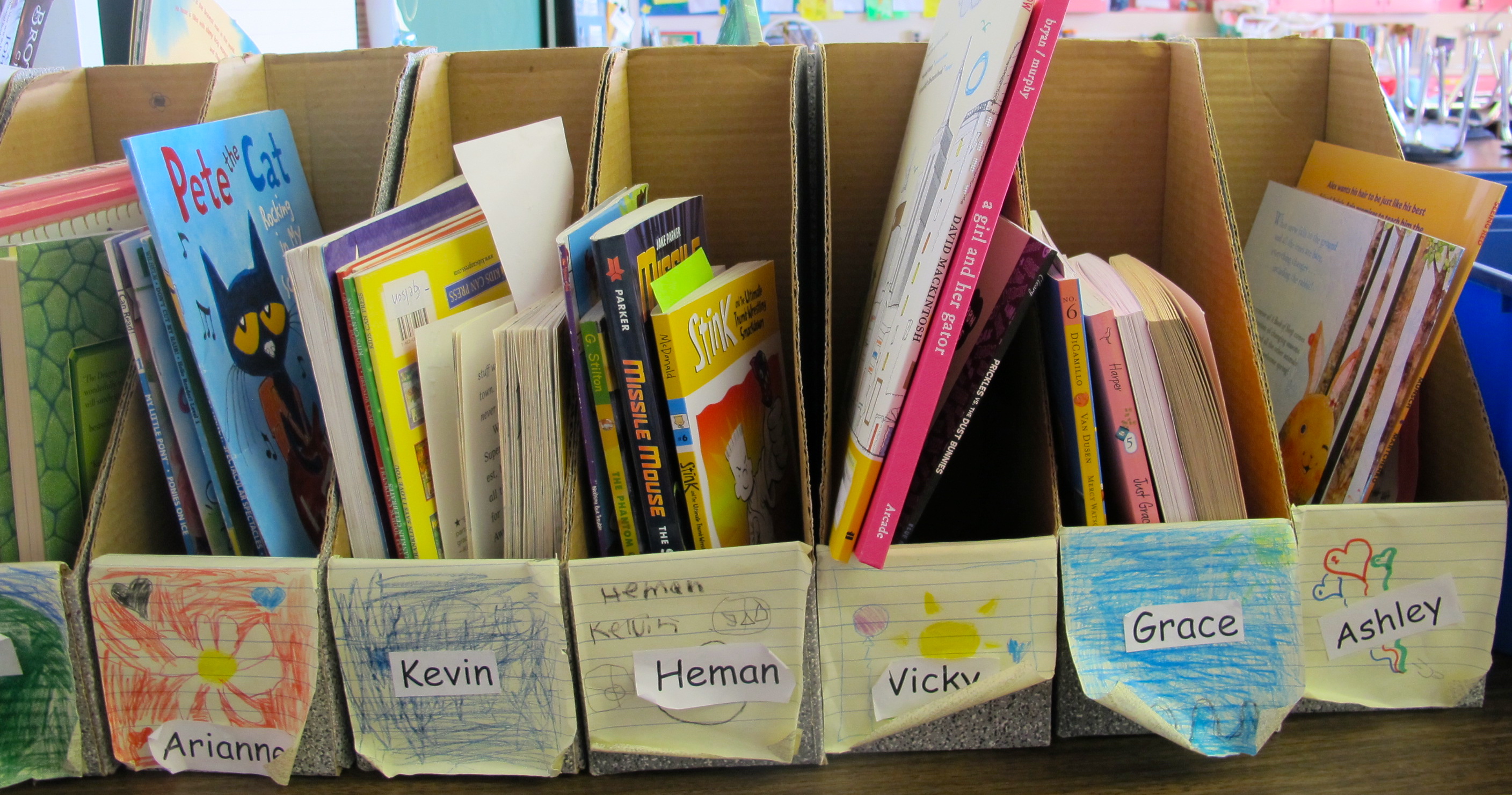
“Be polite at people. Be nice. Do reading groups. Do your job like cleaning up if it is the end of the day. I love math. I love books too! Did you know that we do mindful breathing 3 times a day? You could read a book many times.” Kevin

 Dear New Student - There's a Book for That!

“We always come to the carpet for a story after lunch. We do art every week. We do a gratitude circle. You say something special when you got the gratitude stone. Sometime I say I am grateful for my family. BLG readers come every Wednesday. There are lots of books in our classroom. I like to read Jack Stalwart series, Stink books, Owly and Captain Awesome.” Heman

 Dear New Student - There's a Book for That!

“I’m Gracie. I just wanted to let you know that we do quiet time. And Ms. Gelson has a library in her classroom! She loves loves loves reading. We have an art gallery in our classroom too. On Thursdays we have class meetings. But what you really have to know is that . . . WE LOVE READING!” Gracie

 Dear New Student - There's a Book for That!

So while these letters started off to an imaginary new student, in the end they turned out to be little pieces of writing I treasure.

Yes, the book love is transferring! Students love a room full of books and time to read. Our daily mindful breathing features big. Math is fun! Learning and community are front and centre!

This is a classroom we are proud of and ready to share – so . . . Dear new student, if you arrived, we would welcome you!

The Grandparent Effect

This post was first published on The Nerdy Book Club Blog December 14th, 2012. I am sharing it here on Christmas day as a gift to all of those who share the joy of reading with friends, family and anyone who needs it!

MERRY CHRISTMAS!

Two years ago, I taught a little boy named Emilio in Grade 3.  In his first week of Grade 4, Emilio showed up at my door every day at 3 p.m. He would stand there and give me a big smile, sometimes a hug and tell me quite seriously, “I really miss this class.” When I asked him what he missed, I thought he might say that he missed choices time at the end of the day or the picture books we shared together or maybe even that he missed me. Nope. “I miss Mr. and Mrs. Gelson.” He didn’t even need to think about it. Mr. and Mrs. Gelson are my parents. They come in every Tuesday afternoon to listen to my students read. They sit outside my room at a long table that holds two big baskets of carefully selected picture books. Children take turns having their reading time throughout the afternoon. This reading time with two very special volunteers is what Emilio missed.

When Emilio started Grade 3, he recognized seven letters and knew two sounds. He was not a reader. But he loved books. Every week, Mr. or Mrs. Gelson, read to Emilio. Often, once he was out in the hallway, he wouldn’t come back in. He sat and listened to other children read stories. He asked questions. He got Mr. Gelson telling him about his life and had Mrs. Gelson laughing as he asked for favourite books to be read and reread. They all giggled over silly stories, pretended to scare each other on a spooky page and shared quiet moments when a book touched their hearts. Out in my hallway, on any given Tuesday afternoon, Emilio was gifted by what I have come to call the “Grandparent Effect.

I teach at an inner city school in Vancouver, B.C. characterized by high child and family poverty. Many of my students have not had early literacy experiences. Nobody read to them at bedtime. They never attended library story times. There are few, if any, books in their homes. Families have limited income and limited time. Many parents are working multiple jobs, learning a new language and caring for a family with limited resources. Read aloud time is a luxury many families cannot afford.

Many of my students also do not have grandparents around. Grandparents live in another city or another country and visits are few and far between. I have students in my class being raised by a grandparent so their grandparent is in a parental role.  The lovely experience of story time with Grandma and Grandpa that my own children were raised with has not been experienced by most of my students.

Fortunately, I have two amazing parents who have brought their grandparent love to my classroom. They share it through the magic of books with each of my students every week. As teachers, we know that it is a rare moment when we can just sit with one child and enjoy the experience of having a story read to us by an eager little reader. We are always scanning the room to make sure others are on task, we are taking mental or physical notes about the child’s reading skills and needs, or we are thinking about which book we are going to recommend next to this child. It is hard to turn off our teacher brain. We have a job to do with these little readers. Grandparents, though, have the gift of time. The time to give to each child with their full focus and attention. The time to go off on a tangent and answer a million questions or share connections.  The time to read a story again and again just because it was that great. The time to joke and cuddle and coax and smile.

Last year, when I told Mr. and Mrs. Gelson that Emilio missed them (missed them so much, he showed up every day at my door to tell me so) they started coming in a half an hour earlier to read to Emilio, grabbing him from his new class before they began with my students. This year, in Grade 5, half an hour of reading with Mr. and Mrs. Gelson is still part of Emilio’s Tuesday routine. In these past few years at our school, Emilio has been getting daily direct instruction in decoding skills. Slowly but surely, Emilio has been learning to read. This Tuesday, Emilio read The Enormous Potato (written by Aubrey Davis) two times through. How do I know this? Two excited “grandparents” cannot stop gushing about it. “Emilio read the whole thing!” “Twice!” “He can sound out anything!” “He really perseveres.” “I just can’t believe it. He has come so far.” “Remember where he started?”  “Emilio is a reader!”

enormous potato

I do my best to promote a love of reading in my room: daily read alouds, buddy reading, book talks, library visits, reading instruction, free choice reading . . . . But, one of the best things I do is to stand back and be in awe of how the “grandparent effect” helps associate reading books with love and happy experiences. I believe if we want to create lifelong readers, anything we do to make this association is a gift we give to our students.

I have shared this story of Emilio and my other little readers to remind us all that the magic of reading shared between generations does not just need to happen in our homes. And if it never happened, it isn’t too late.  Find your students some eager seniors to come in and create your own “Grandparent Effect.” Everyone benefits.

**Emilio delivered a special card to my parents for Christmas. He gave me permission to share it here.

IMG_6067


Graffiti Gone!

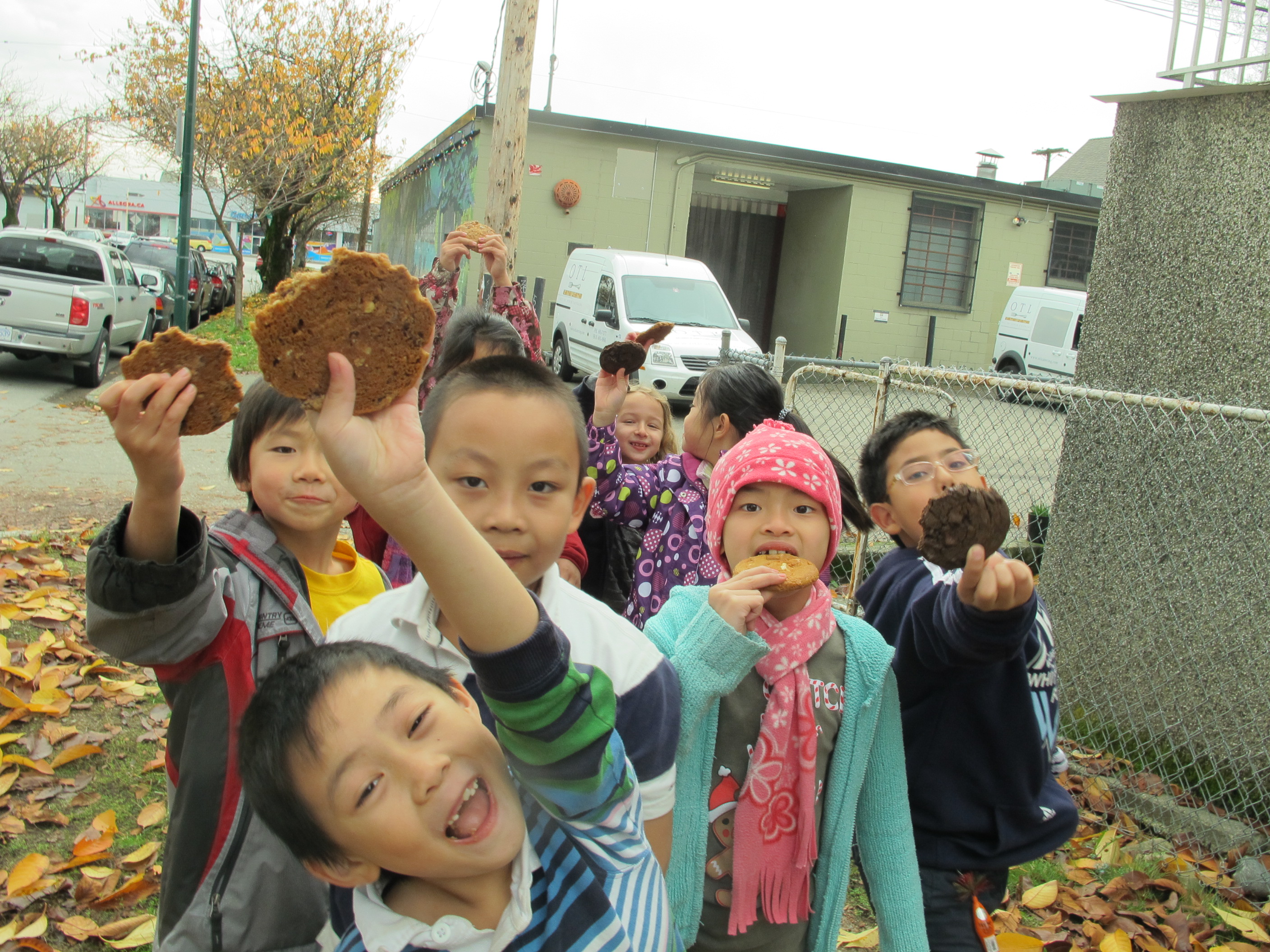
When you are little, it sometimes feels difficult to have a big voice. But when you share your thoughts and feelings about things that happen in your community, and that community shares those words in a bigger way, all of a sudden it seems like little voices do matter and become bigger as they make a difference. Thank you to Out to Lunch Catering for sharing the sentiments of the Grade 2 and 3 students from Seymour Elementary and for helping them learn the lesson that speaking out about something you feel strongly about is important. And has impact. (Thanks also for the delicious cookies shared when we came by to visit!)

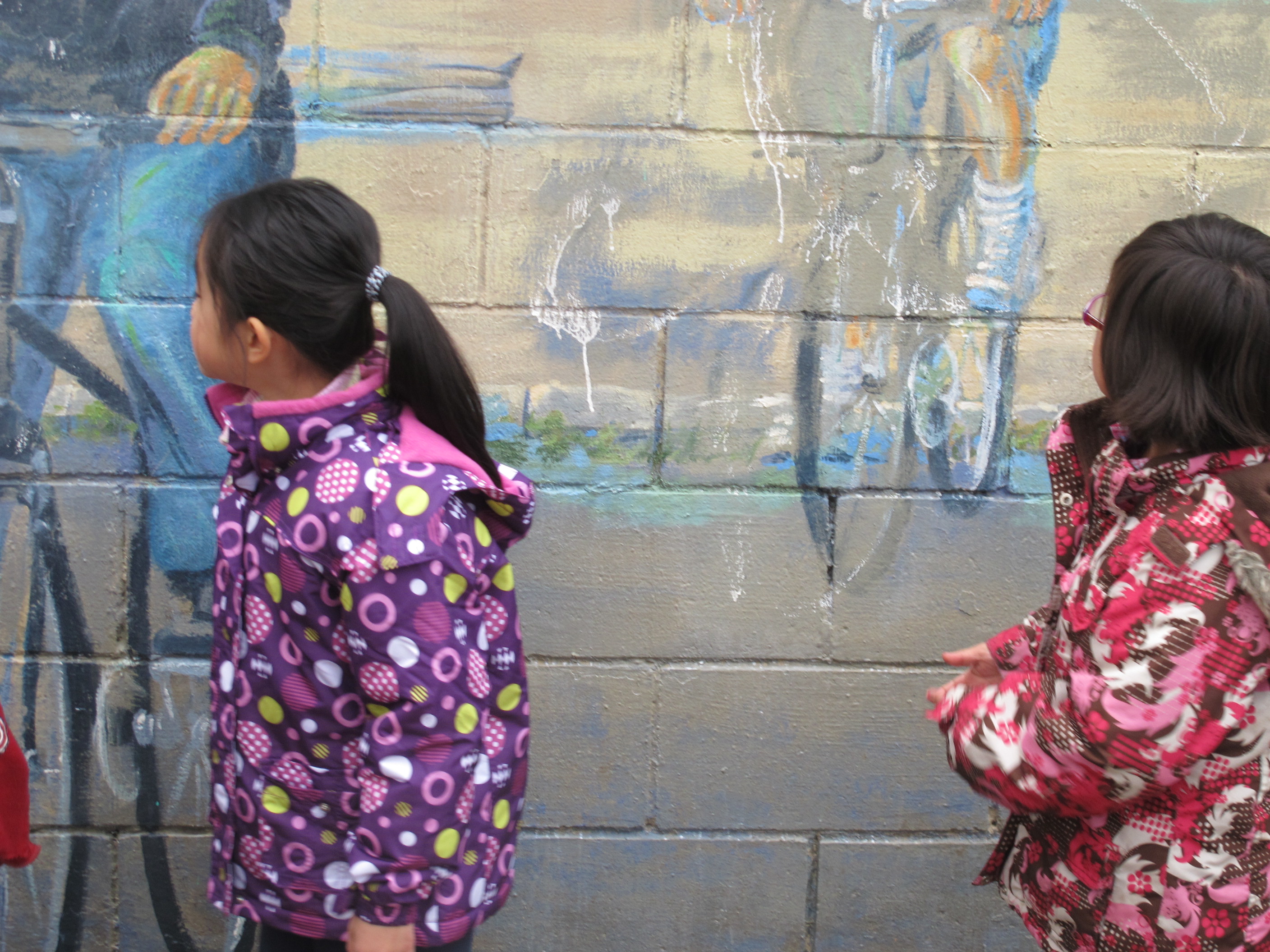
What are we celebrating? Big news in our school community! The graffiti covering the beautiful mural on the wall at Out to Lunch Catering (located just a block and a half from our school) has been washed off! While some traces of the graffiti can still be noticed up close, the mural we love can be seen again. And . . . a little “sign” leans up against one corner of the wall. On this wooden display hang our blog posts (read here and here to catch up on this story) featuring student thoughts and writing about the spray paint that covered this very wall in graffiti just over a month ago. The blog posts covered in plastic to protect them from the rain seem to stand guard in front of this newly clean wall.

Students were thrilled to see their work! Excited voices shared wonder at how great the mural looked again and pride at having our classroom’s voices shared. Students carefully examined the mural and chattered to each other about how fantastic it looked.

After the excitement toned down, we talked about what we noticed, what we felt and why we thought OTL Catering had shared our words. Many students agreed that they felt happy, excited and relieved that the mural could be saved. Some felt proud to have their thoughts displayed. One child commented,”If people see what we wrote, they will know that kids are upset and sad and they might care more to not make any more graffiti. People don’t like to make kids sad.” Many said that we helped the wall be more powerful.

One little guy whispered to me earnestly, “I know who did that graffiti. It was the bad guys.” We were happy to join forces with the “good guys” who cleaned the wall to take a stand against graffiti.

Below are some pretty happy “anti-graffiti” superheroes!

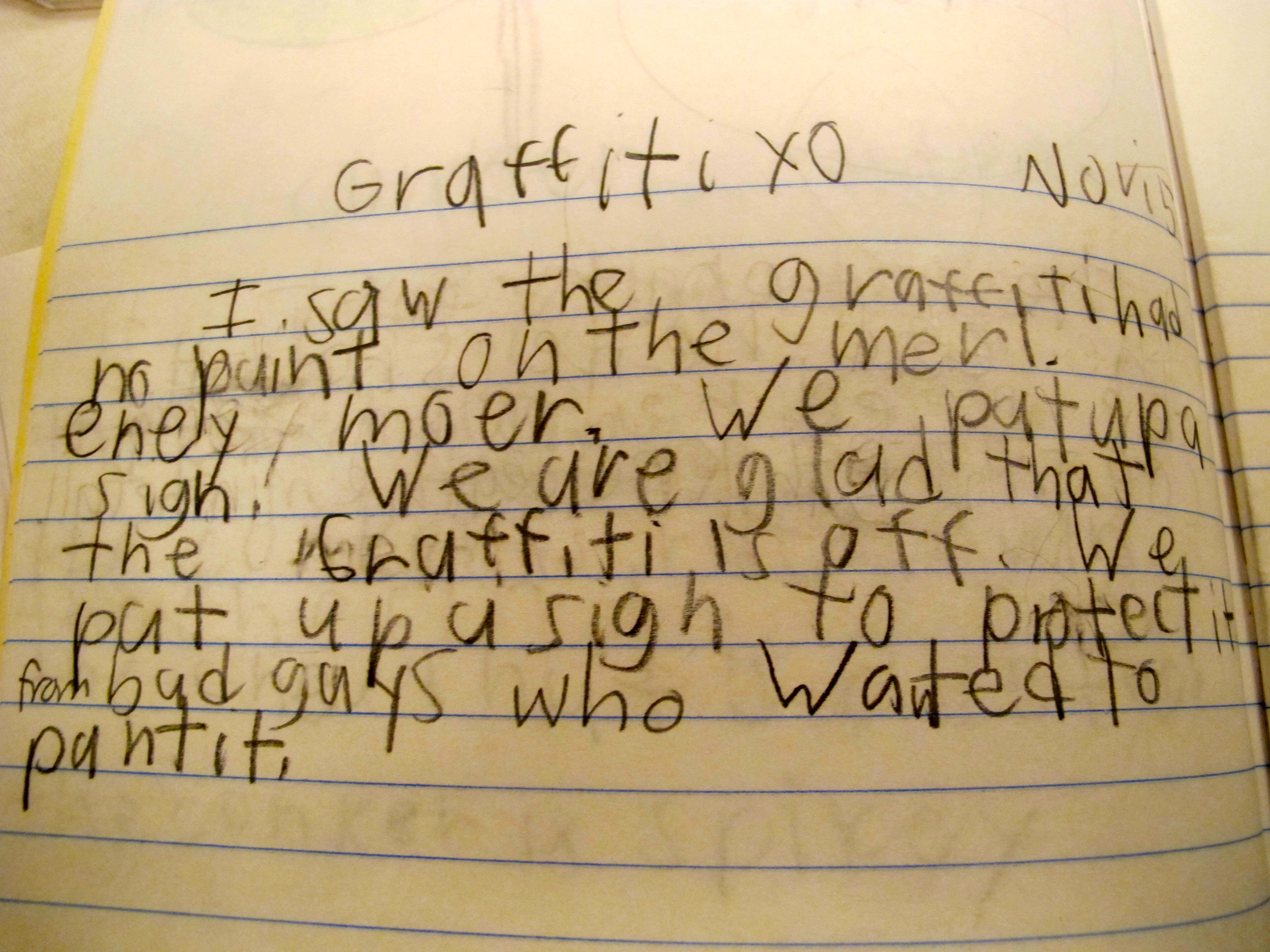
Back in class we decided to write about this subject one more time. We had a big discussion about possible titles for our reaction. “Let’s call it Graffiti x 0 because now there is no graffiti!” “We should call it Graffiti All Gone.” “I’m going to call mine Graffiti Keep Away!

Ava shared, “My title is Graffiti Wipeout because the graffiti has been wiped off and this makes we feel awesome! I hope our writing protects the wall.”

The children had lots to share. What came through loud and clear was how much joy they felt that the mural was back to the way it should be! Kelvin writes “I saw the graffiti had no paint on the mural anymore. We put up a sign. We are glad that the graffiti is off. We put up a sign to protect it from bad guys who wanted to paint it.”

Our words offering protection against future graffiti was a big theme.

Yes, this story got its happy ending in the form of a cleaned up mural. But beyond this, we learned that we can be part of the stories that surround us. That is definitely a lesson worth learning.

Graffiti . . . again?

Our morning began with a surprise and it was not a happy one. I brought the students out to see what I saw when I walked to school this morning. A community mural has been further vandalized.

Seriously? More graffiti? This is beyond not okay. By 9:15 a.m. our class was standing outside on the sidewalk a block from our school looking at MORE graffiti on the beautiful mural at Out to Lunch Catering.

Last week we went to look at the graffiti and wrote about our feelings and sadness. (Read that post here) Imagine how upset we were to see more graffiti on the wall today. The mural is almost unrecognizable. Gracie expresses what many of us felt in her writing today:

Many kids were asking why someone would spray paint over art? Why wouldn’t they spray paint on a blank wall? Even though that would still be disrespectful . . . It was the graffiti on a mural that really hit us hard.

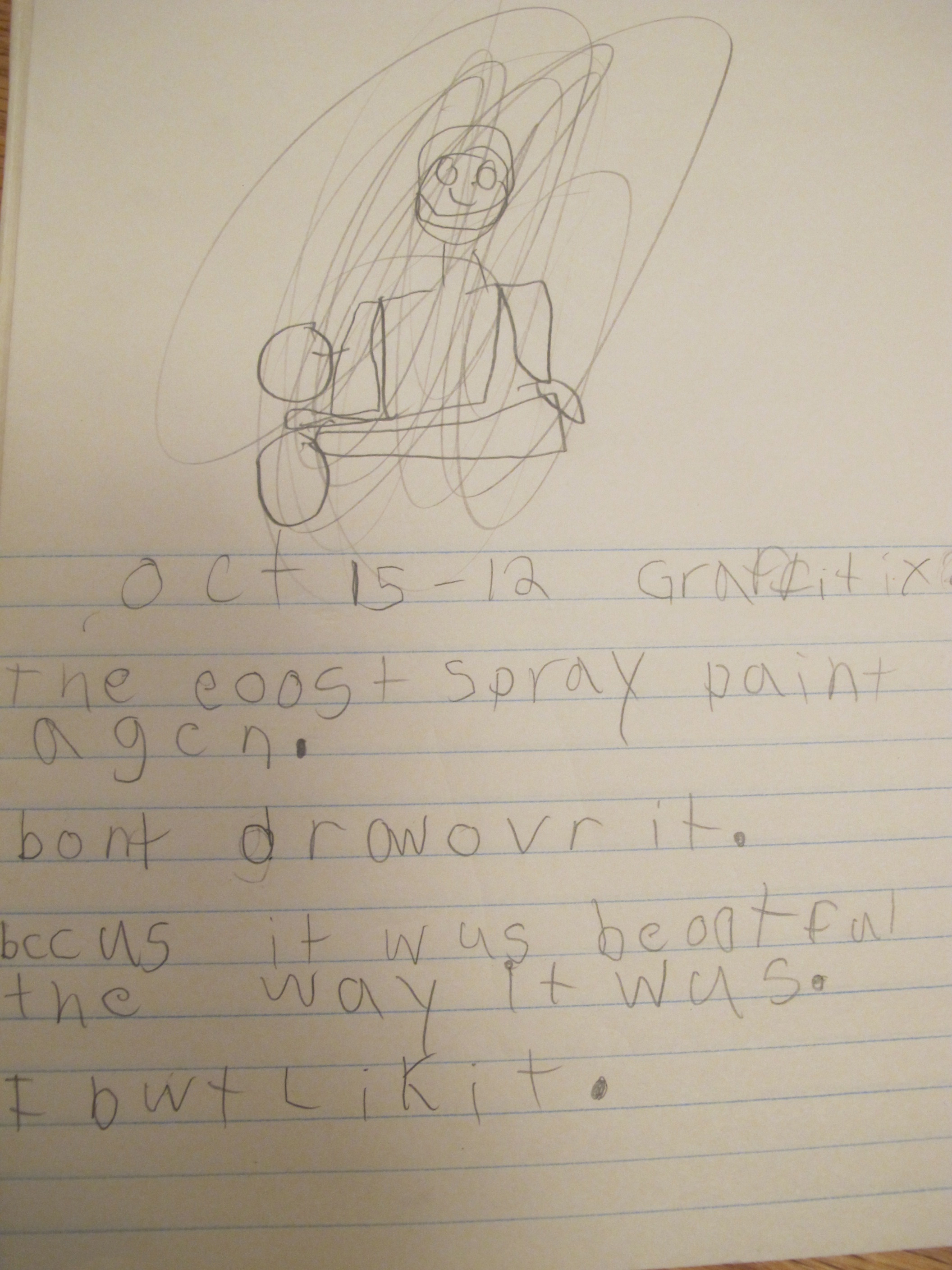
We came back to school and wrote. Kids were keen to express their feelings and outrage. The usual “how do you spell . . . ?”  requests were less. Everyone wanted to get their thoughts down. Violet shared: “They used spray paint again. Don’t draw over it. Because it was beautiful the way it was. I don’t like it.”

Kala was really angry and her writing shows it. She wrote this completely independently: “I don’t like it. That hurt my feelings. Please don’t do it again. How will you think if we did that to you? You are dumb. Why did I say that? Because it was mean.”

I heard from Out to Lunch that beginning today, there will be an attempt to clean up the graffiti. A solvent will be used to strip the spray paint from the mural. But there are no guarantees that the mural won’t be smudged. We are crossing all of our little fingers that it works and that nothing is damaged.

Those same fingers attached to the hands we were wringing today at the disrespectful few who decided it was okay to deface a beautiful community mural. To the graffiti “painters” our message is this (quoting from another student’s writing):  “You are so not cool.

Graffiti

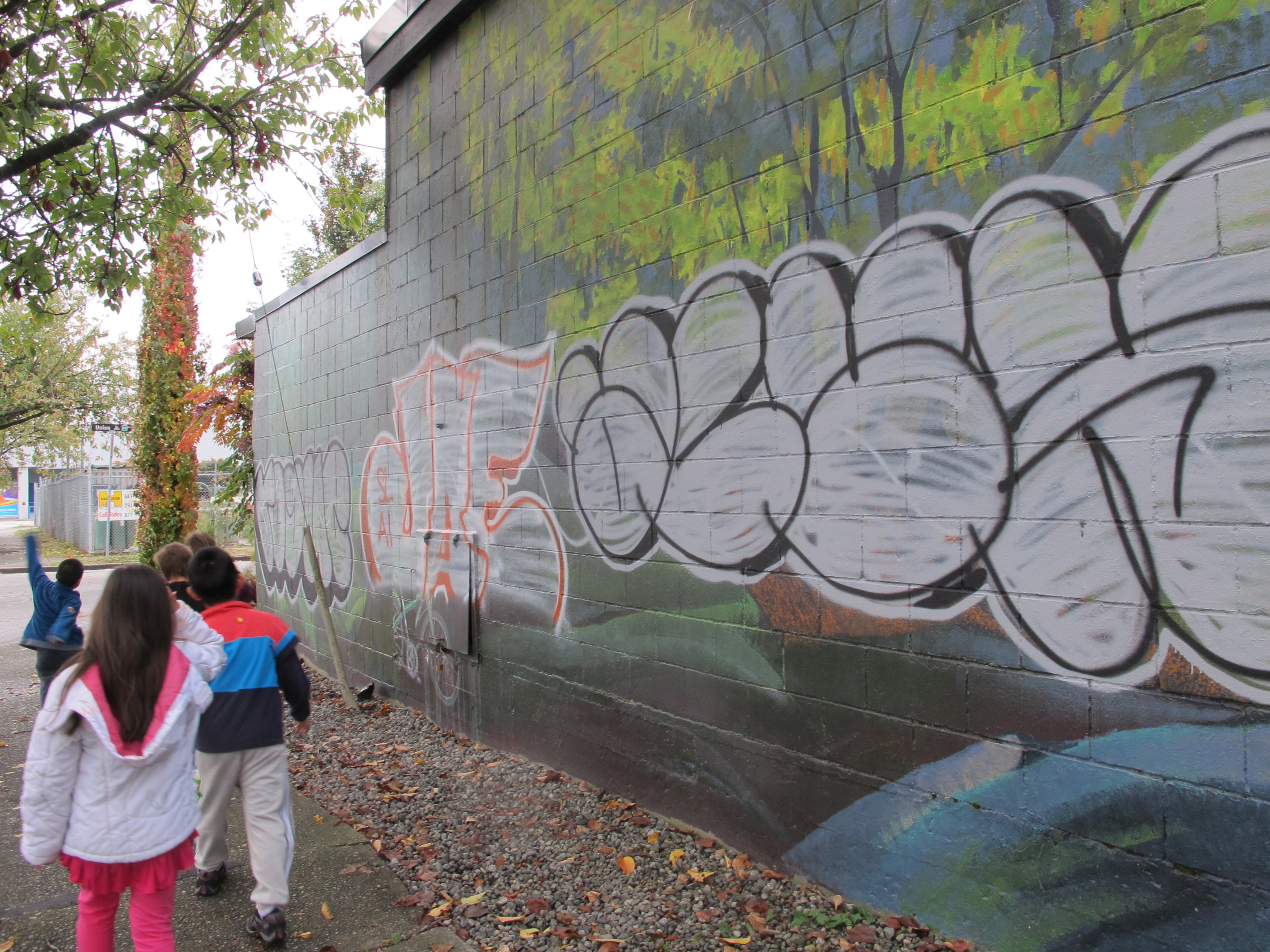
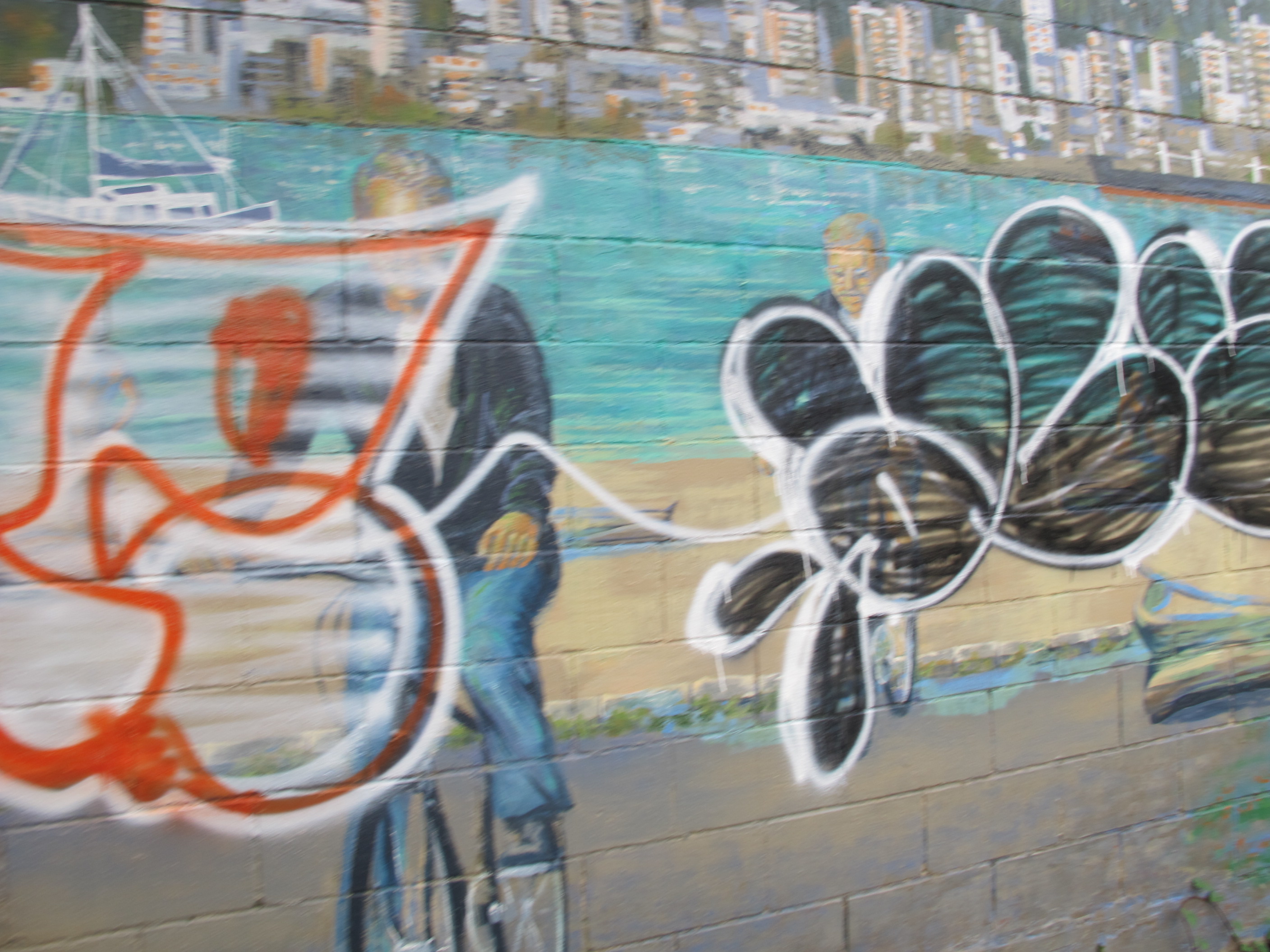
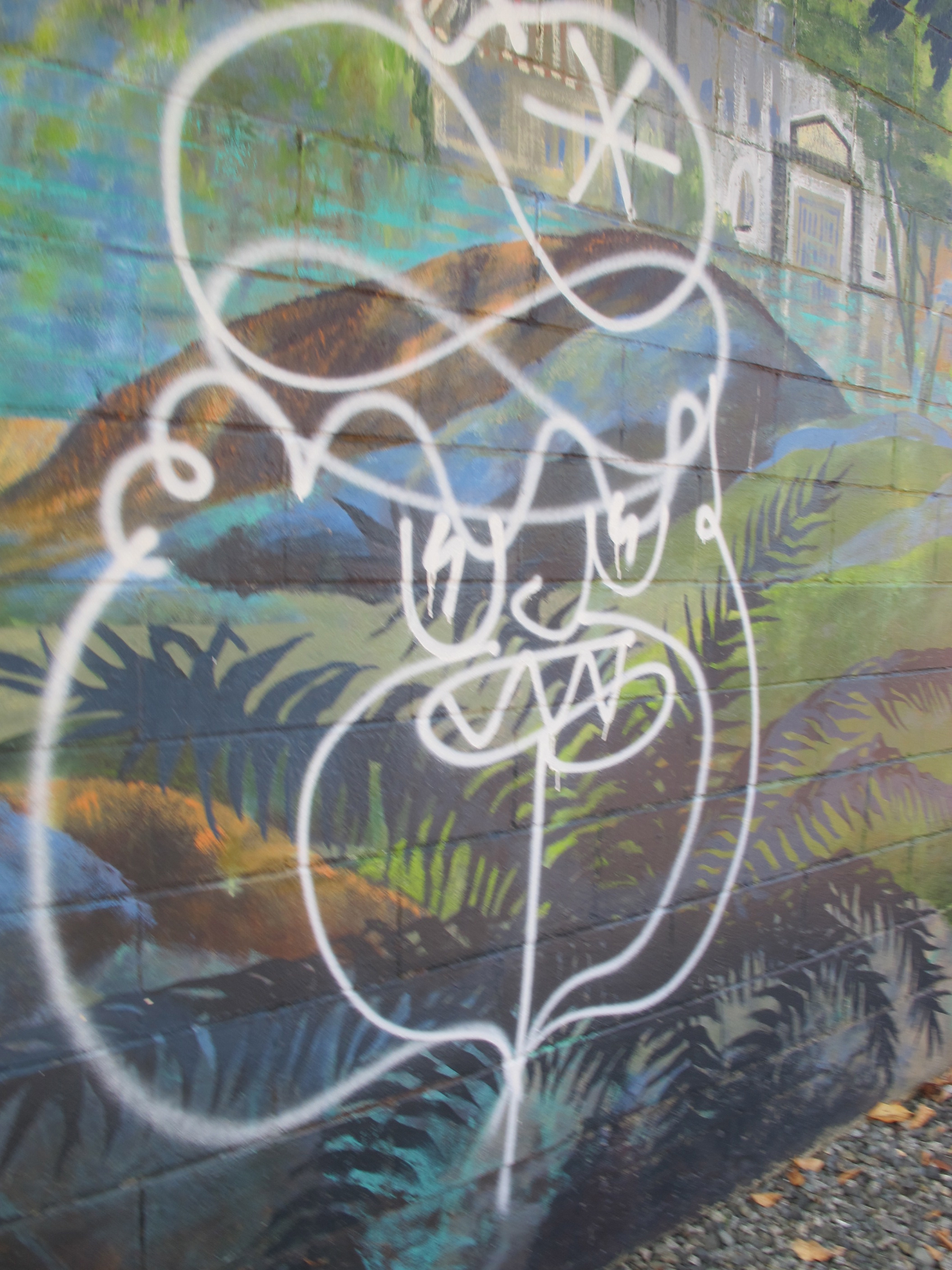
A favourite part of my day is walking to work. A favourite part of that walk is when I am a block away from my school and I walk between two huge murals. Beautiful pieces that celebrate our school, neighbourhood and community. Today I was devastated to see that one mural (on the side of Out to Lunch Catering) was covered in graffiti. Waves of white spray paint and large figures like this (below) covered what is usually a gorgeous, lush Vancouver scene.

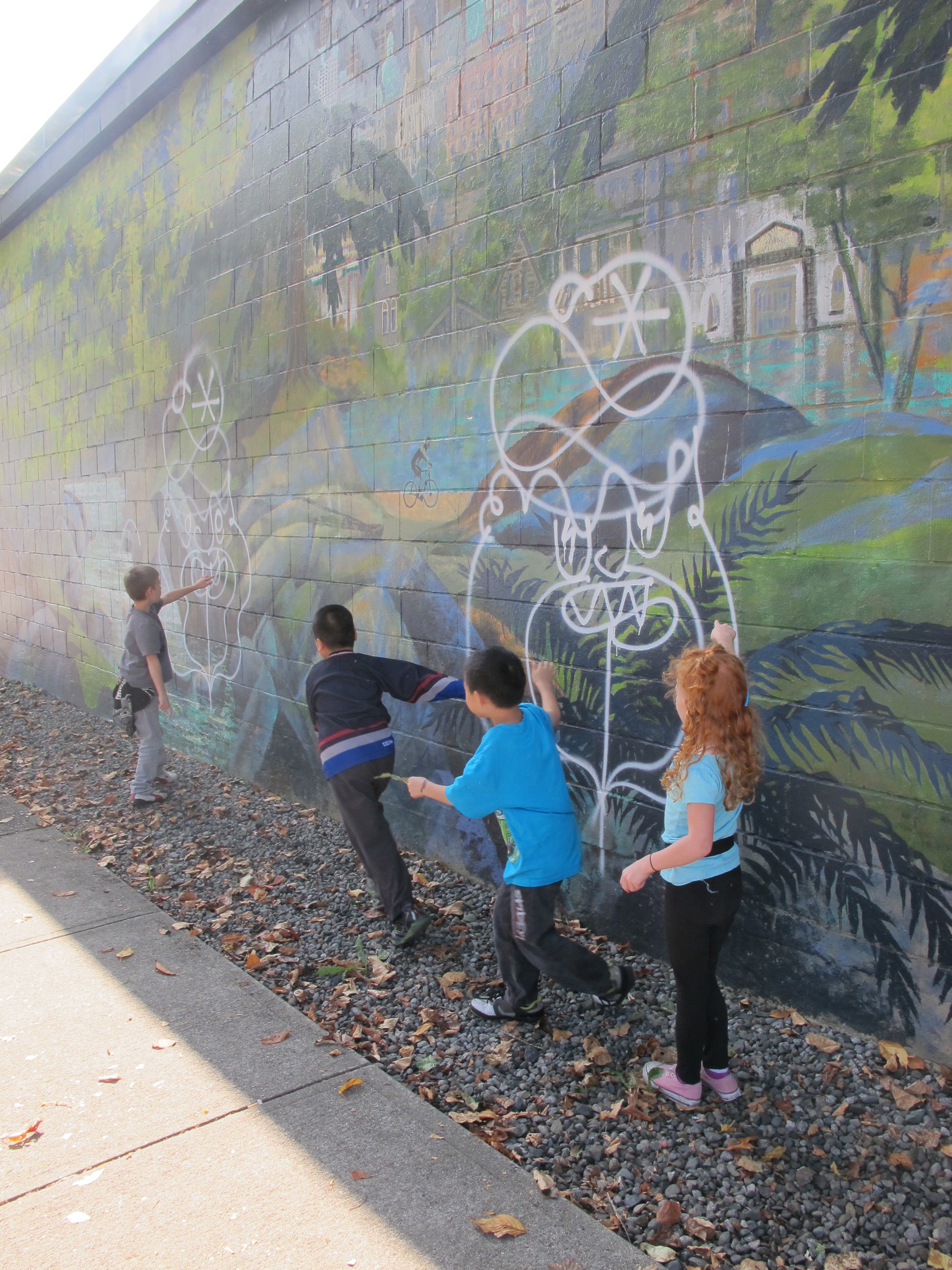
Since this is my “borrowed community” in the sense of where I work, not where I live, I decided to make sure those who lived in this community were aware. I brought my class out to look at it in the afternoon. It is literally a half block from the school. We walk by it on the way to skating. Many children walk by it on their way to and from school. We are a school that just got a mural we are very proud of. This matters to us. So education for us today was in our classroom. For a little part of the day, our classroom was the sidewalk.

There were many questions. That’s what kids do best! Why did they do that? How will it get off? Will the police come? Did the owners of the building cry? Are they mad? Can it be fixed? Why did “those people” want to be mean? Some students were pretty passionate about it and instantly thought about how upset our mural artist would have felt if this happened to the mural at our school. Some kids were equally fascinated by the rocks that lined the building. Which was another great on the spot lesson on being respectful to space, including outdoor space that wasn’t ours and that was meant for all to enjoy. Teachable moments are everywhere! And students provide them if you can’t find any!!
We then had a discussion abut how students felt looking at it. Many shared: frustrated, sad, mad, aggressive (when I asked about this one, the child elaborated that it made him want to yell at the people who had painted on the mural) and disappointed.

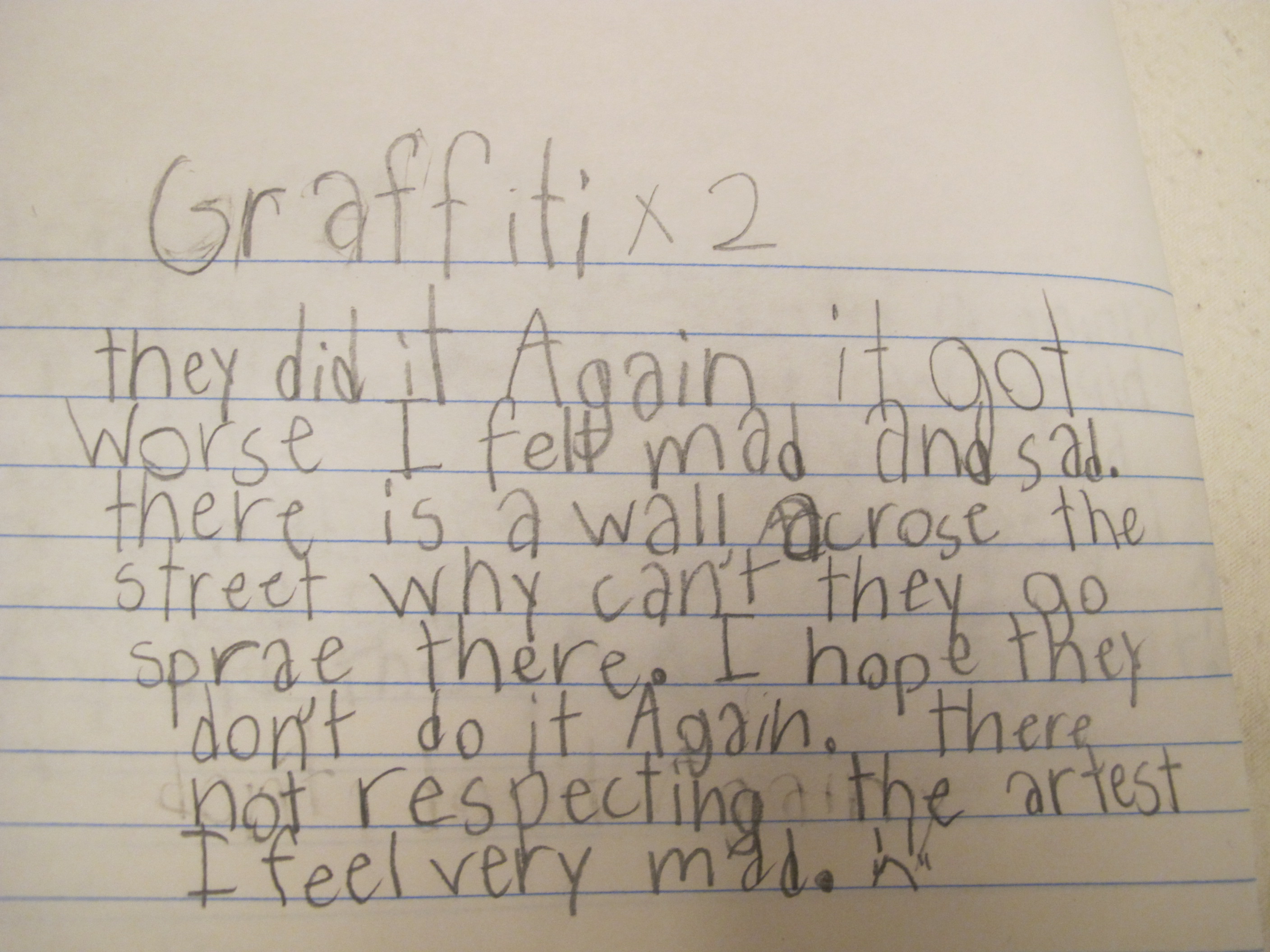
We spent a few more minutes talking about how graffiti typically gets off buildings. More children shared their outrage and confusion and we walked back to school and wrote for ten minutes. Most children chose to include what they saw and how it made them feel. A few simple sentences to convey how they were thinking and feeling and making sense of this. Many drew a picture at the top and then scribbled over it. Like graffiti, scribbles over art.

One little guy wrote that his heart broke into pieces when he saw it. Kind of how I felt. A yucky feeling. Kids just call it – this was not nice, a mean act.

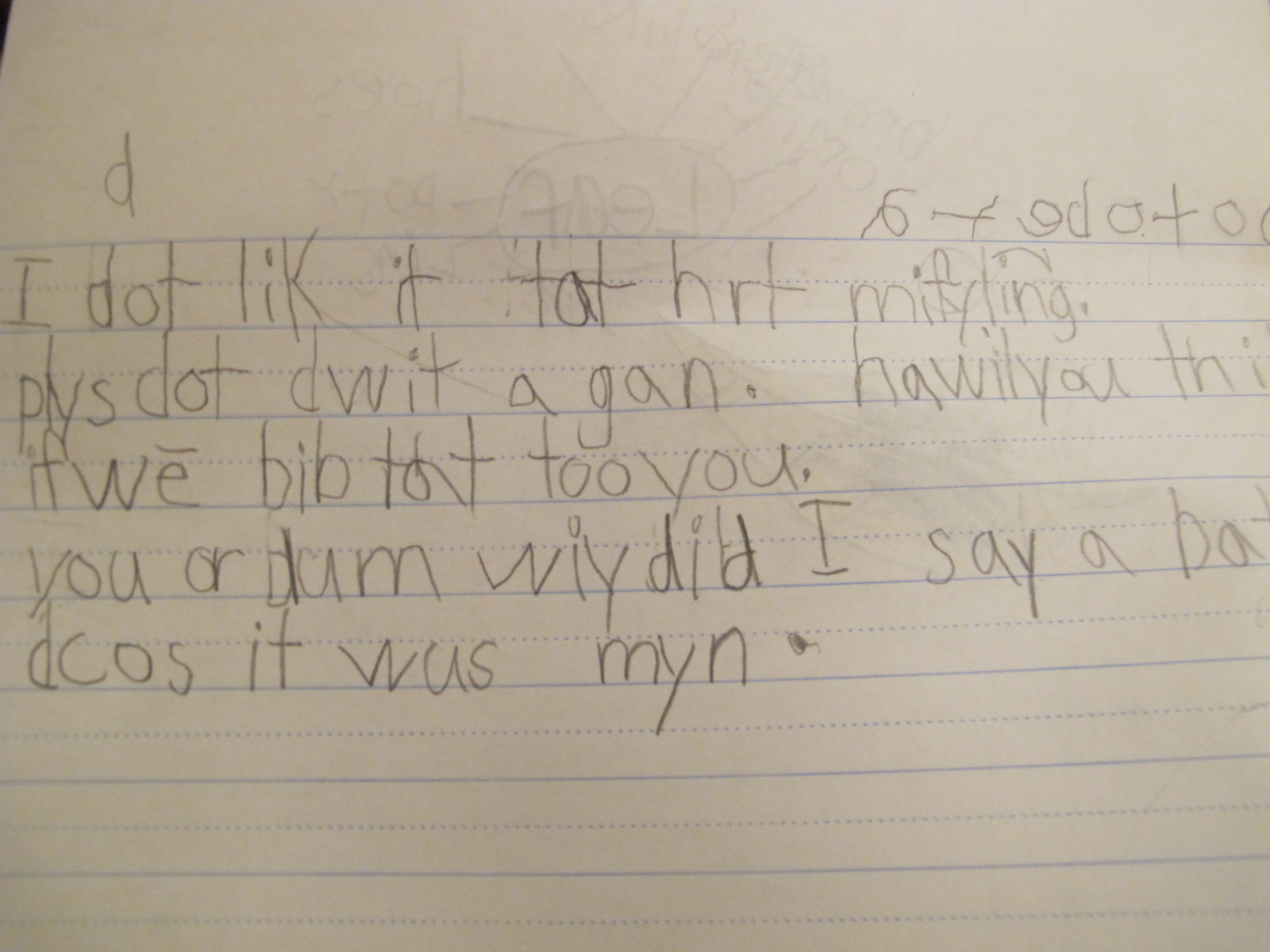
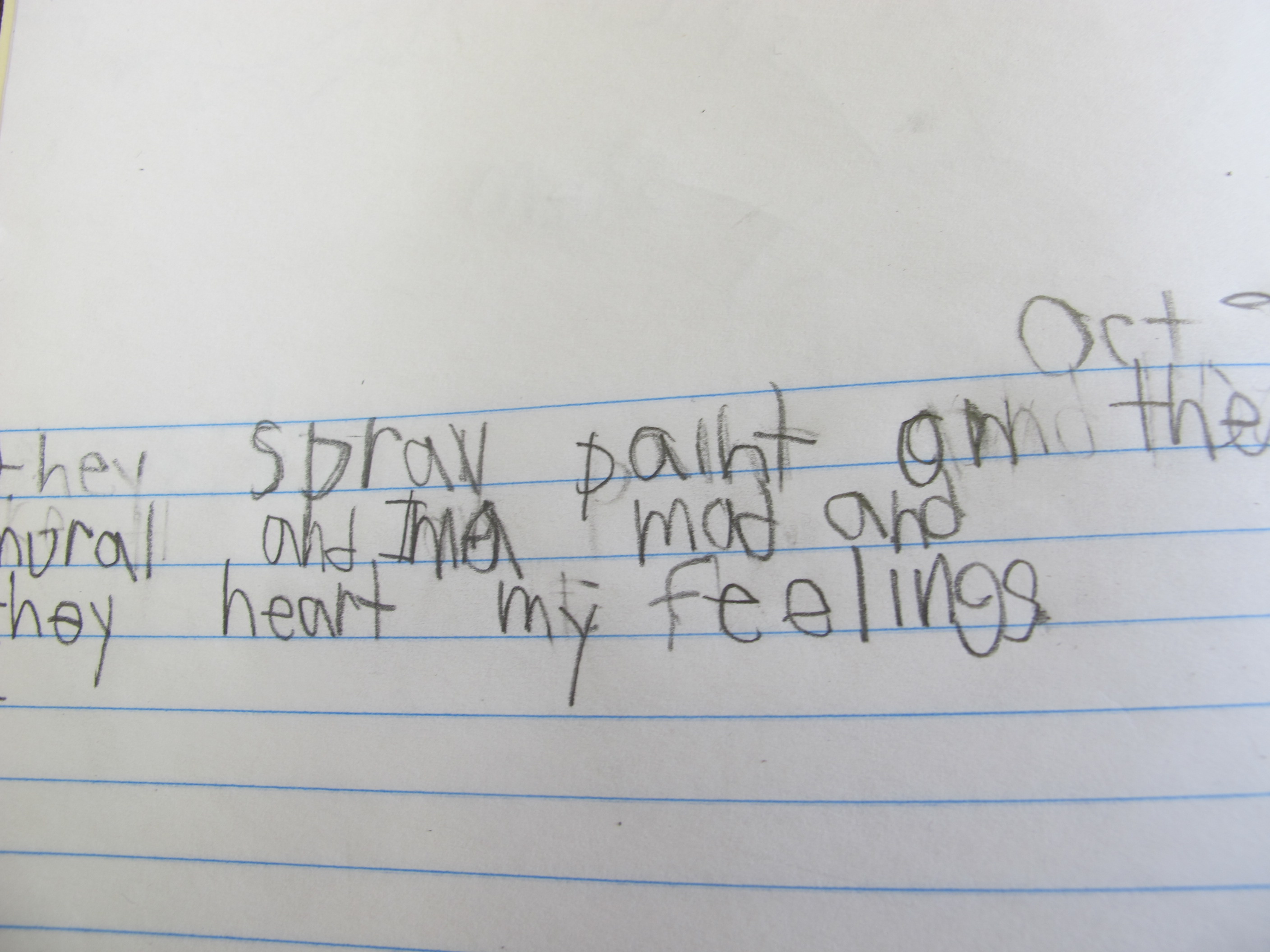
This writing below says: They spray paint on the mural and I am mad and they heart my feelings. Hurt is spelled heart. It is all kind of intertwined.

We are fortunate to go to school in an area surrounded by beautiful murals. Today we talked about how it feels when our art got scribbled on. Not good.

A Bus Called Heaven

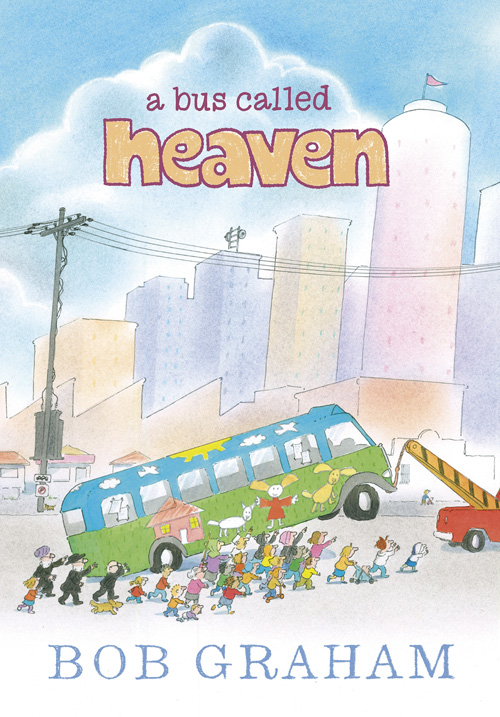
Our latest BLG treasure: A Bus Called Heaven written and illustrated by Bob Graham, read to us by Bill

We were excited as soon as we saw that Bill had a Bob Graham book as we are definite fans of Graham’s work. How to Heal a Broken Wing was a book we used during our kindness unit and April and Esme Tooth Fairies was a BLG book from last spring that often makes it back to our classroom via our library book basket.

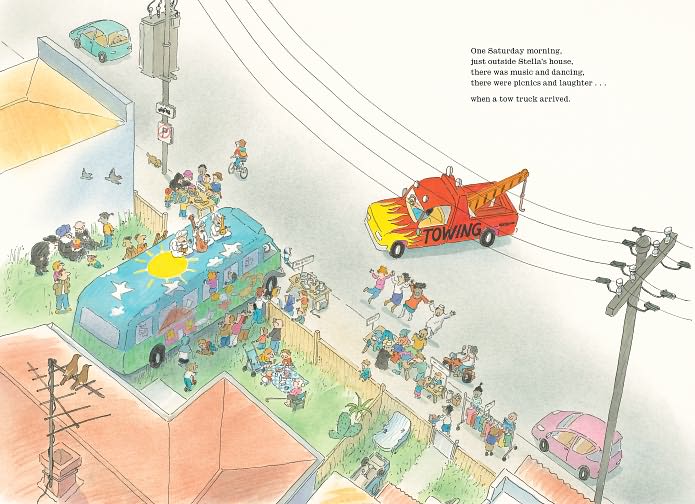
What happens to a community when an abandoned bus gets parked in its midst? Well . . . People start talking. They do some exploring. They begin to take ownership. Soon that bus is pushed into a front yard. It is cleaned and scrubbed. It gets a paint job. And people begin to congregate. They play and interact. They eat and laugh. The old bus has new life. And when a tow truck arrives to tow the old bus away, the community has new purpose.

This story tells the story of a community coming together and of a little girl with a lot of gumption. We read this book and looked around to see everyone smiling. A feel good story perfect for rereading.

Our student reviewers report:

Truman: I liked the part when Stella won with no goalies and bought the bus back with all the kids who were energetic and the adults who were exhausted!

Carmen: The book started with a girl named Stella. She saw a bus and made a bus be like a house. They had a party and music. One night, guys came and sprayed black paint and wrote Street Ratz!