
Times Tables
Multiplication facts
No matter what you call them, knowing them helps as we move up the math concept ladder. I use multiplication facts frequently in the “real world” and knowing my facts helps make my problem solving faster. At the grocery store – 3 kiwis for $1.00 I have $5.00 with me So . . . I want about a dozen. If I buy 12 (3 x 4) then I’m going to have enough money (4 x $1.00) Yes, I need to understand a few things to do this mathematically but knowing 3 x 4 and the rule about multiplying things by multiples of 10 and 100 helped me solve this much more quickly.
In the primary grades we begin to explore the concept of multiplication. I often start the unit with a game of Noodles and Plates (Math to the Max Grade 3 Number Operations) I don’t tell students how to solve the equations. I just explain the rules of the game and let them get started.
 The game is lots of fun. You need dice (I like the soft foam ones to cut down on the noise), pencil and paper. Player 1 rolls one die and draws that many circles for plates (if you roll a 4, draw 4 plates) Player 2 then rolls and draws his/her plates. Then player 1 rolls again and this role determines how many noodles go on each plate (some kids drew tally marks, some drew numbers) Player 2 does the same. Then write a math sentence to represent your turn. (i.e. 2 x 6 = 12) Whoever has the higher total wins a point. Start again. We could have played all day. Everyone was on task, partners were helping each other solve the equations. Lots of math talking! Full on engagement.
To make this more complicated for higher grades, roll both die!
By the time we have played this game for a math period, many kids totally “get” groups of (which is how we read the math statement 4 x 2 is 4 groups of 2) and have started applying repeated addition and skip counting without me telling them to. We then practice more – linking repeated addition (5 x 3 is 5 + 5+ 5) , skip counting (5, 10, 15), working with arrays, understanding that 2 x 3 is the same as 3 x 2, understanding that 4 x 3 is the same as 3 x 3 + 3 etc. Building strategies and understanding through hands on activities, drawing models, looking at pictures, etc.
But how do I help them start committing these facts to memory? Next year’s teachers want them to know their facts. Knowing their facts helps make more complicated problem solving easier (well at least faster). Yes, there are calculators and computers and all but sometimes we won’t be carrying a device with us. What to do? I had been doing drills – many kids loved them! Math drills. Yippee! These are the kids that have “number sticky” brains. They just know math facts – they stick in their brains and don’t leave. I was one of these kids. I still remember correcting my Grade 3 teacher’s math drills on the board (“You already put 5 x 6 for question 3“) She always gave me that Aren’t you a delightfully annoying child? smile and got up from her desk to fix it. (How did she ever have time to sit at a desk?) But not everyone has those sticky brains that facts just stick to . . .
The other kids tolerated them. We would answer 16 questions in 90 seconds – each child working at his/her level (once you had 3 16/16s in a row you would move on) So some kids had worked their way up to the 7s and 8s. Some were still on the 2s and that was okay. There was progress. We did math drill corrections. We trudged along.
But this year a few things changed. We started this process and it didn’t go so smoothly. I still had the celebrators and the tolerators but now I had a few rebellors (is that a word?) Some kids just wouldn’t do it with the timed aspect etc. And you know? I kind of respected them for it. Then I lost my timer (or maybe it walked away?) This was a sign. It just didn’t feel right. So we stopped for a few weeks.
But I got back to thinking about it. Do we need to memorize? Isn’t process as important as product. Don’t I need to allow students to begin developing and shaping their own learning?
The answer? Not sure. Here is what I am trying. We are going to still work on these 16 questions a day at our individual levels. But I’m removing the timed component and therefore the “drill” aspect. Instead, I pass out the sheets early in the day and students try to finish them by day’s end. Some finish in 16 seconds truthfully because they have “math fact sticky brains” Others take all day (working on the questions at various down times). They are noticing patterns, they are applying strategies, they are talking to others and asking for help (yes that’s okay and even encouraged) math peer tutors (self-appointed) are talking them through it (“Remember you can skip count” “You already did 3 x 6 so 6 x 3 is . . . “) Then I ask them to tell me when they are ready for the next level. Because, (really what was I thinking before?) they know better than me. Self directed learning. Student ownership. And what do I do? Guide, mark, respect, give feedback, smile and count up my celebrators 2, 4, 6, . . . 14, 16 🙂
 Working on questions together allows for all of that fantastic “talk” time that is necessary in math. Not talking by me but talking by students. I can confirm “Ms. Gelson, if I want to answer 7 x 2 – that’s like 7 + 7 right?”
“Yep.” and move on. The child is on a roll, I am not needed.
Peer teaching is some of the most powerful teaching in the room!
 So I asked the students what they think of this new system.
They were happy to share.
“When you are rushed, it confuses you. When you take your time, you learn it better.” That timer will not be coming back!
“I don’t feel so much pressure. It’s better.”
“Now we have time to draw out the ones we don’t know.”
Look what happens when you ask!!
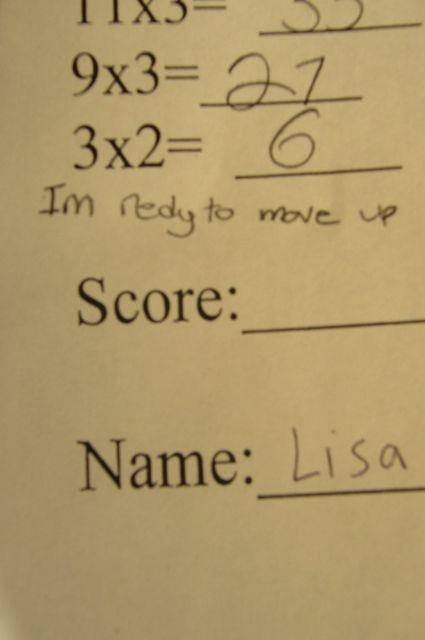
Self-reflection
So now I am getting drill sheets handed in with little notes like the one on the right: “I’m redy to move up.”
“Can I move up?”
“I wanna move up.”
“I can do the next.”
If they are writing me these notes and still making errors, I let them know and we practice a few more times. If they are consistently getting perfect scores and don’t tell me they are ready, I offer encouragement.
The big thing here that I’ve learned – communicate with your students about their learning. Watch for the signs they are giving you. Listen . . . and you will learn.
 There's a Book for That