Teaching with a Passion for Nonfiction Books: Part 2

This post is part of a 3 part series about using more nonfiction titles in our Elementary classrooms. A link to the first post is included here:

Part 1: Everywhere you look . . . let there be nonfiction!

The intention with each of these posts is to share a practical “how to” list of how to read more, celebrate more and use more nonfiction picture books in the late primary/early intermediate classroom. For reference, last year I taught a Grade 2/3/4 class.

Teaching with a passion for nonfiction picture books:

Part 2: The importance of the nonfiction read aloud

The message of this post is simple: read more nonfiction titles aloud more often!

Wanting to do that is the easy part. Finding the time in our busy schedules is another thing! Here is how I have managed to find more time to share more nonfiction in my classroom.
 Teaching with a Passion for Nonfiction Books: Part 2  The importance of the nonfiction read aloud There's a Book for That

Set aside designated time to read nonfiction titles 

Block nonfiction read aloud into your weekly schedule. Don’t trust that you will alternate fiction and nonfiction read alouds. Sharing picture books and poetry and novels needs designated time as well. If you are already doing those things well, you see many benefits to reading fiction aloud and you won’t want to give it up. When you actually schedule time to read aloud nonfiction, it won’t be instead of anything else. Nonfiction can play the starring role. I have two 40 minute blocks of time a week for nonfiction read aloud. This is at minimum – I often fit more time in during other parts of the week.

Of course, that still doesn’t answer this question: What are things you might give up in your schedule to fit in more nonfiction time? I always think we can be strategic to find time for things that we value. Thinking about some of these things might help.

  • Build oral language skills (listening, speaking, retelling, summarizing, asking questions, etc. ) during your read aloud session. The listening and speaking component of Language Arts needs dedicated time in our schedules. Why not build a lot of these skills while sharing nonfiction titles? We often use nonfiction read aloud time to really develop these skills. This is when we do much of our “turn and talk” time with a partner or a small group. Students have the chance to share out to the whole group, listen attentively, build on other comments or questions and practice predicting and inferring. We also work on summarizing, listening for specific information and asking questions. All of this talk time to review makes a huge difference in how much information students recall. I have the students do some of the following things with their “turn and talk” partner or small group as we work through a nonfiction title over multiple read aloud sessions:
  1. Share what you already know about this topic. Sometimes I have the students share facts (questions are okay too) back and forth one fact at a time to really practice turn taking. For example, if we are going to read a book about elephants, the exchange might sound something like “They are huge” “They live in Africa” “They have a trunk” “They use their trunk to drink” “Is their trunk like a nose? Do they even have a nose?” “Their skin is wrinkly and grey” “I think they eat leaves”
  2. Talk about some things you are wondering.
  3. Answer specific questions based on an image on the page i.e. Look at this picture of the hippo in the water, why do you think hippos spend so much time in the water?
  4. List at least 3 (or more) new facts we learned yesterday about __________ (refer to specific section of the book)
  5. What is the most interesting thing you have learned so far?
  6. Explain _________ to your partner. Partners, was any important part missed? For example: Explain the differences we have learned about crocodiles and alligators.
  7. What are you hoping we will still find out?
  8. Listen to the next heading (or chapter title) what do you think we might read about in this section?
  9. Which of our questions never got answered?
  • Use your nonfiction read alouds to support curricular themes in science and social studies. This is huge. I launch every unit/theme with a book, often multiple books! Enhance the rich learning that nonfiction titles help us support through discussion, reflection writing, vocabulary building and opportunities to retell and summarize our new learning in a variety of ways.

Here are some examples of the “work” we do with nonfiction titles in my classroom. We are reading great books and covering curriculum!

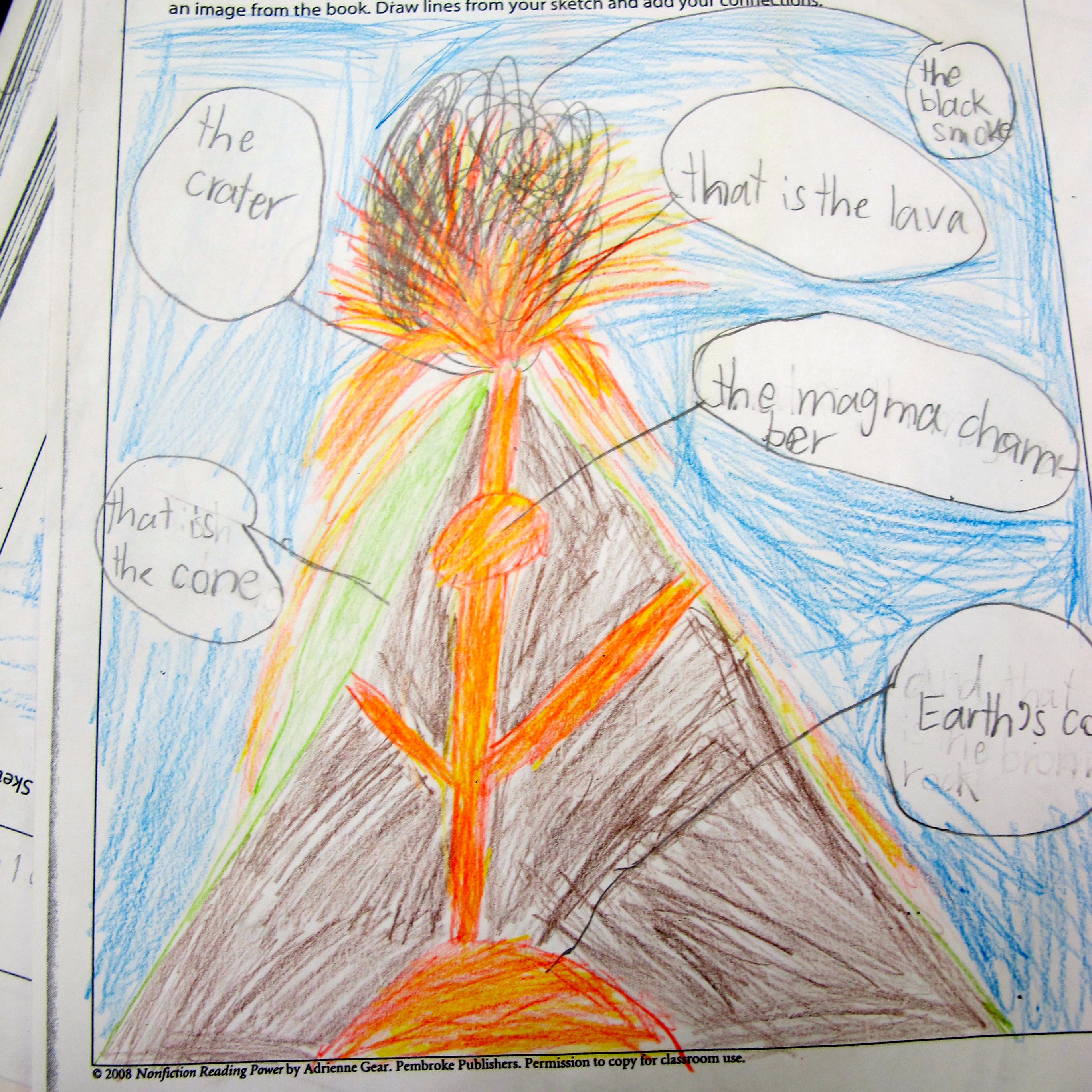
After reading When the Giant Stirred: Legend of a Volcanic Island by Celia Godkin and some sections from a variety of nonfiction books about volcanoes, students completed a labelled diagram of the parts of the volcano.
Teaching with a Passion for nonfiction: Part 2 The importance of the nonfiction read aloud There's a Book for That

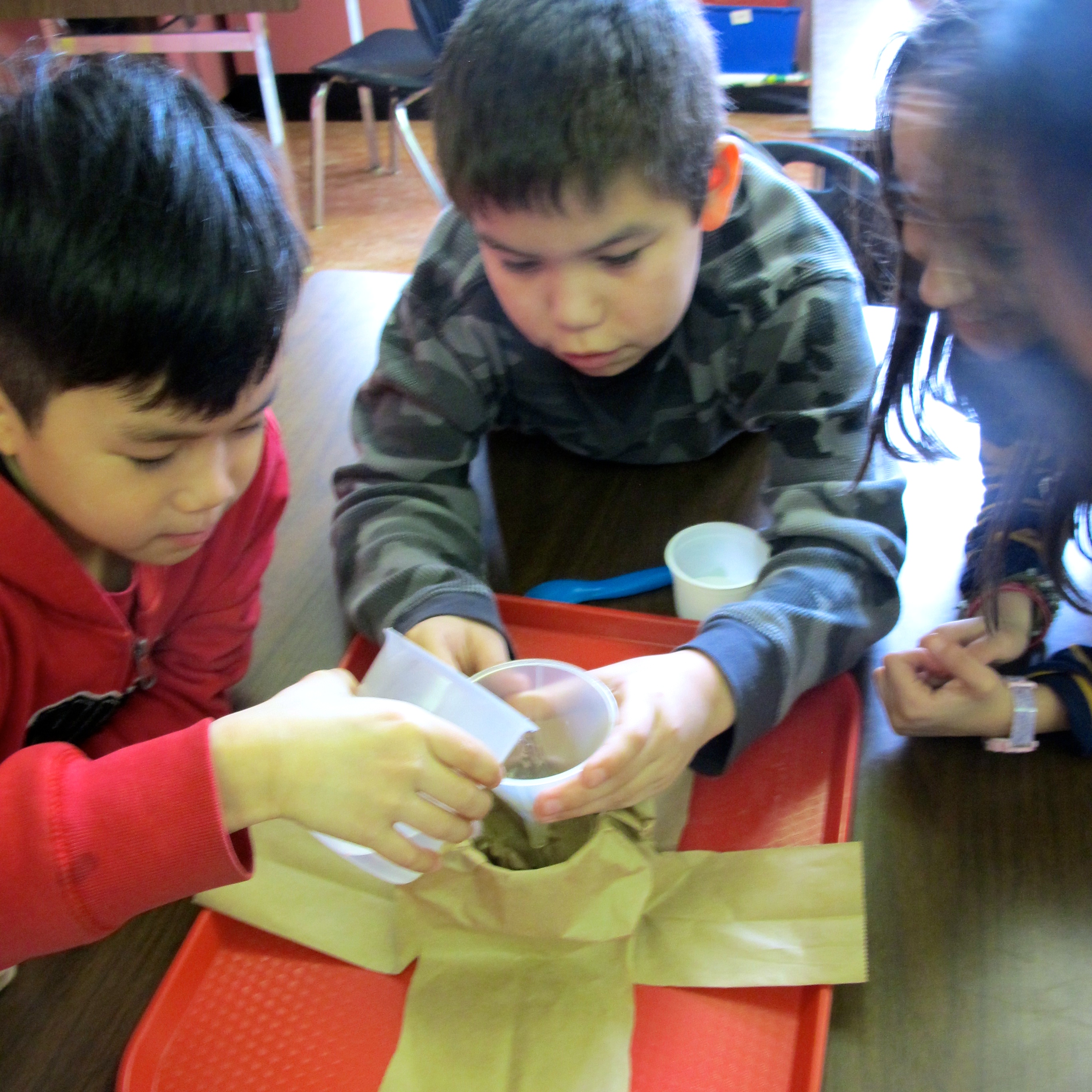
We then completed a paper bag volcano experiment where small groups had to follow a series of oral and posted instructions.
Teaching with a Passion for nonfiction: Part 2 The importance of the nonfiction read aloud There's a Book for That

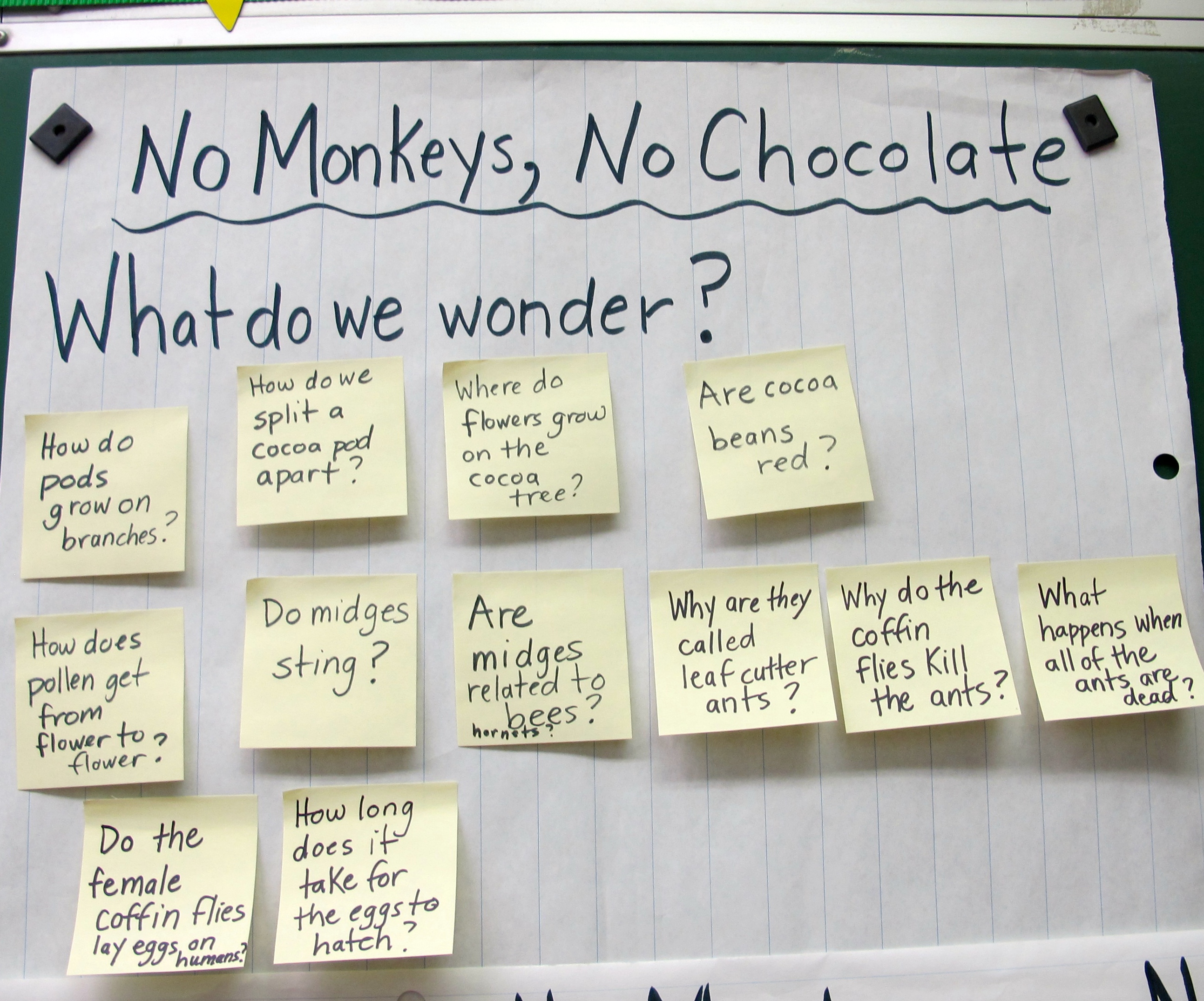
As we read, we keep track of questions we are wondering so we can revisit as we read and when we are finished the story. Students love to notice, “Now we know the answer to that one!” Reading No Monkeys, No Chocolate written by Melissa Stewart and Allen Young (with illustrations by Nicole Wong) took us multiple read aloud sessions. There was so much to learn in this book!
Teaching with a Passion for nonfiction: Part 2 The importance of the nonfiction read aloud There's a Book for That

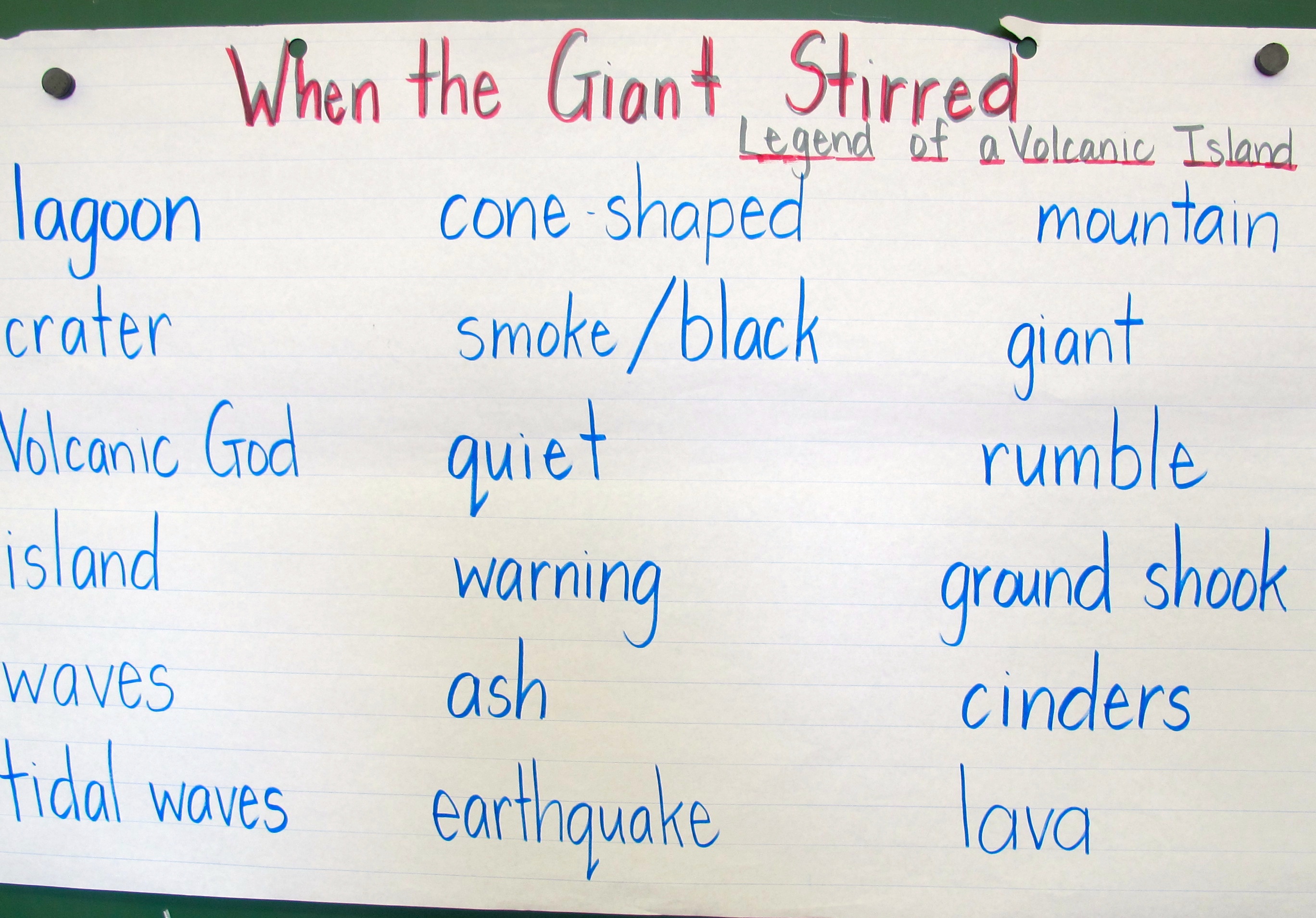
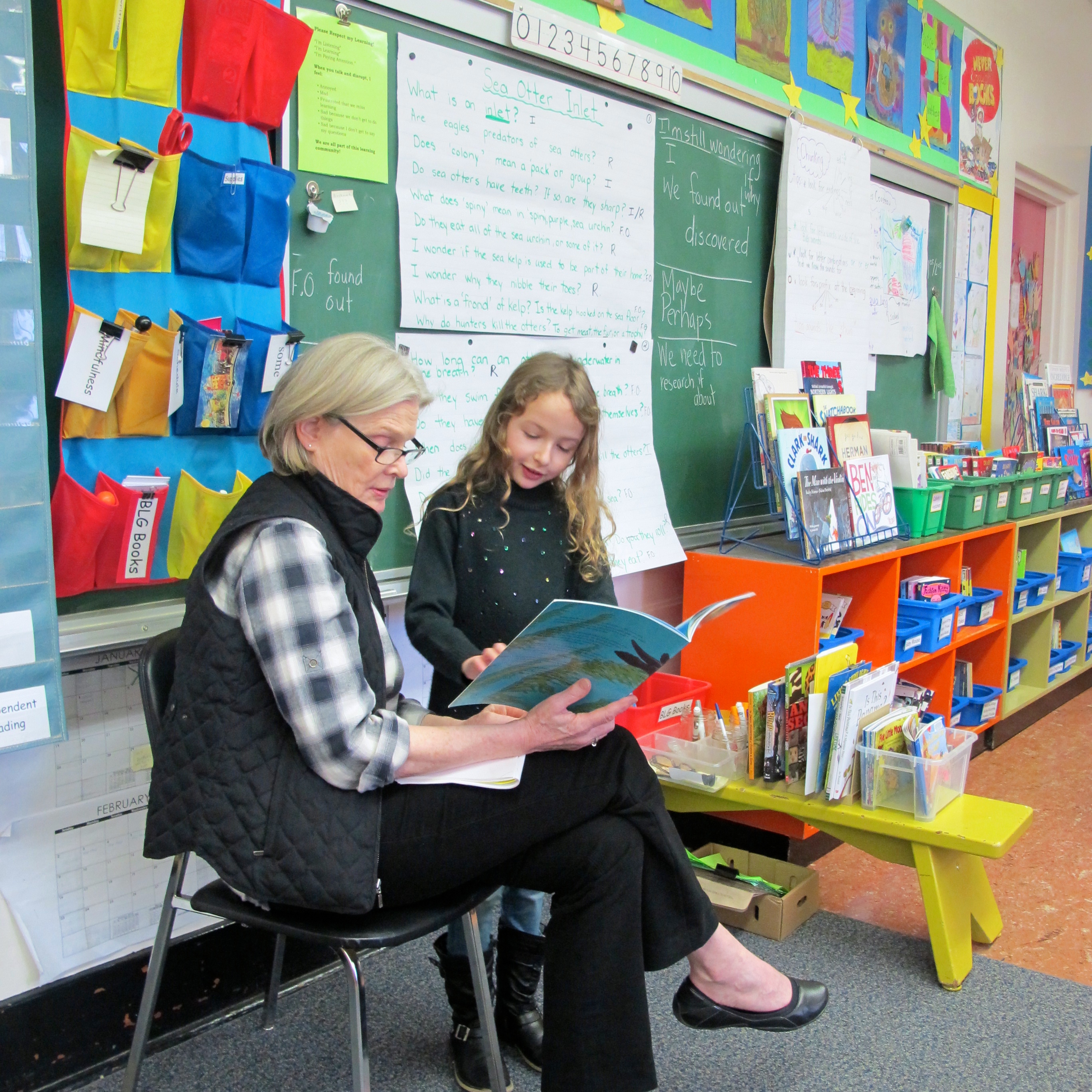
I love when another adult can work collaboratively in the room with me. As we read aloud, we ask the children to provide us with any key words from the text after every few pages and one of us notes them down on chart paper. Both of us can then circulate during “turn and talk time” instead of one person trying to balance all of the pieces of guiding the lesson. These key words help the students when they are doing reflective or summary writing.
Teaching with a Passion for nonfiction: Part 2 The importance of the nonfiction read aloud There's a Book for That

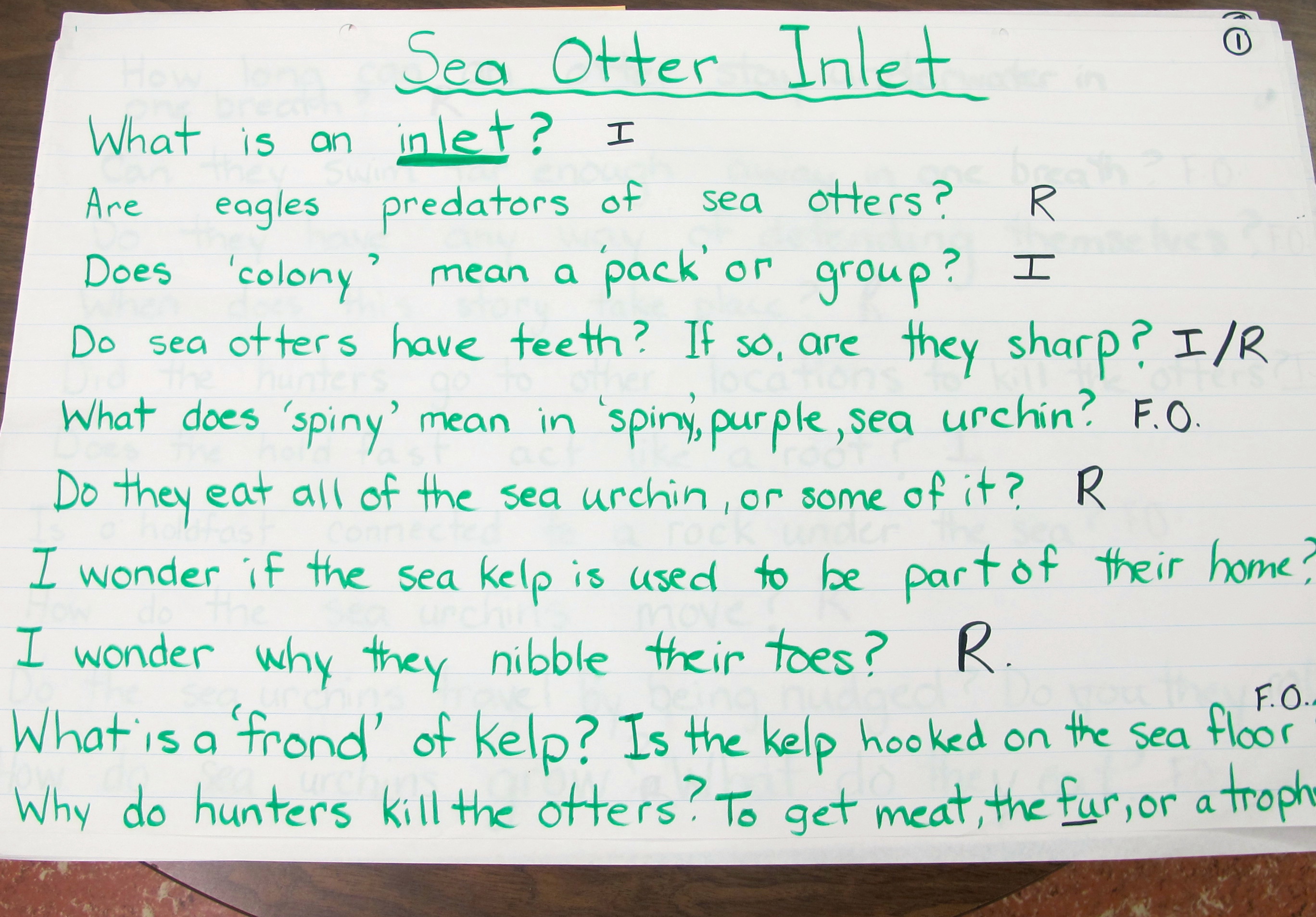
We also often list questions from the students during the read aloud and then code them when we are finished reading. Did our questions get answered? Do we need to do some research? Or can we infer to figure out the answer. R = Research I = Infer FO= Found Out If we want students to do writing, we might provide prompts like those listed below and have them look at our questions on chart paper to help guide their responses.

  • I discovered . . .
  • We found out that . . .
  • Now that I know _________, I think ___________
  • I am still wondering . . .
  • I still have some questions.

Teaching with a Passion for nonfiction: Part 2 The importance of the nonfiction read aloud There's a Book for That

Sometimes, my Resource Teacher (RT) comes into support writing when we have already read a story aloud and done a lot of the thinking work. I have different students take turns summarizing what happened in the book. This allows the RT to be caught up with the information and provides the opportunities for different students to practice summarizing and sharing key points.
Teaching with a Passion for nonfiction: Part 2 The importance of the nonfiction read aloud There's a Book for That

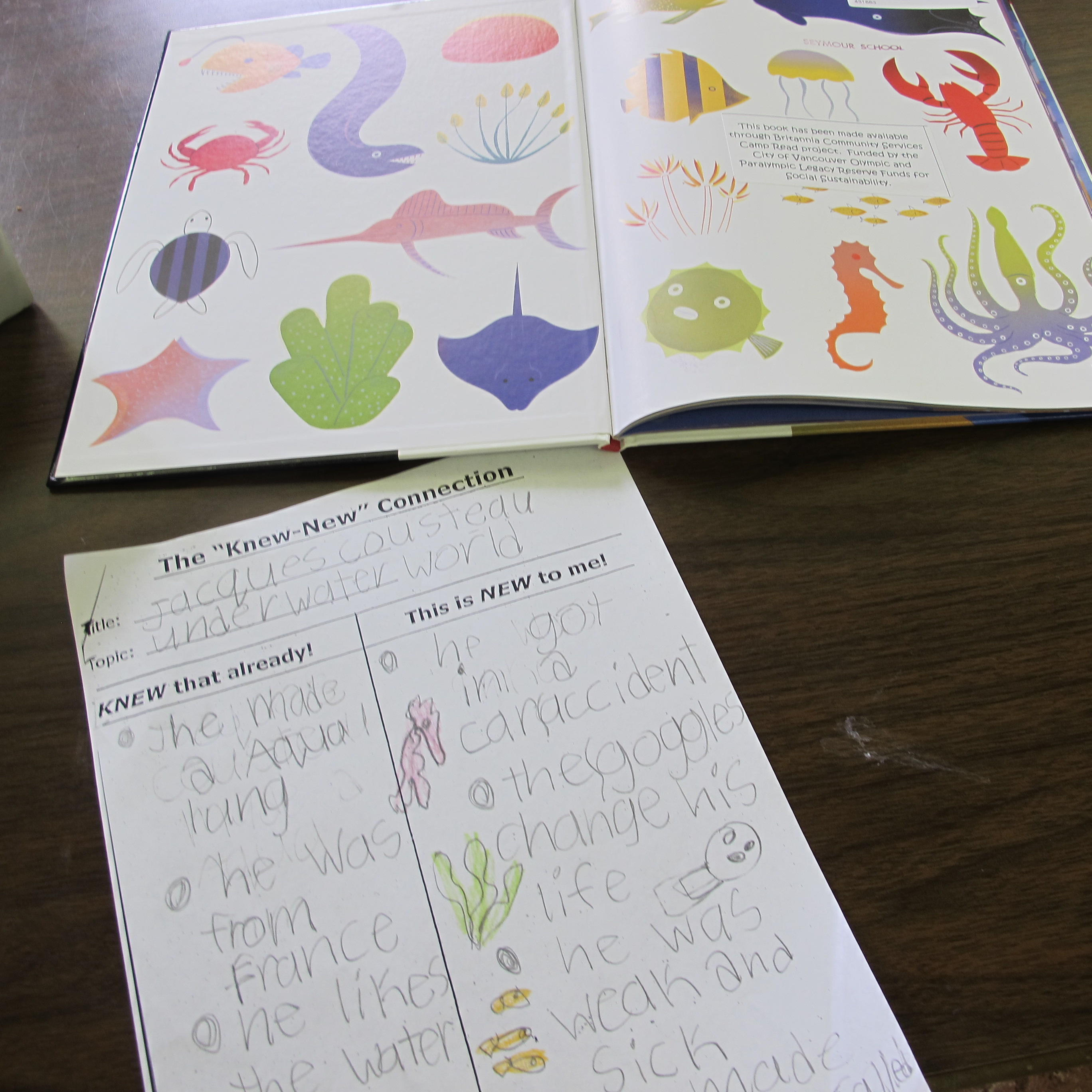
One of our favourite activities to do with nonfiction titles (especially if we are reading more than one text on the topic) is to fill out a Knew/New Chart. This idea is from Adrienne Gear and her Nonfiction Reading Power book (which is amazing if you don’t have it!) We filled out this chart after reading both Manfish: A Story of Jacques Cousteau written by Jennifer Berne and illustrated by Éric Puybaret and The Fantastic Undersea Life of Jaques Cousteau by Dan Yaccarino.
Teaching with a Passion for nonfiction: Part 2 The importance of the nonfiction read aloud There's a Book for That

Read aloud some more!

Get creative about using nonfiction titles throughout your week. It’s easy to find ways to share more nonfiction titles to support things you are already doing.

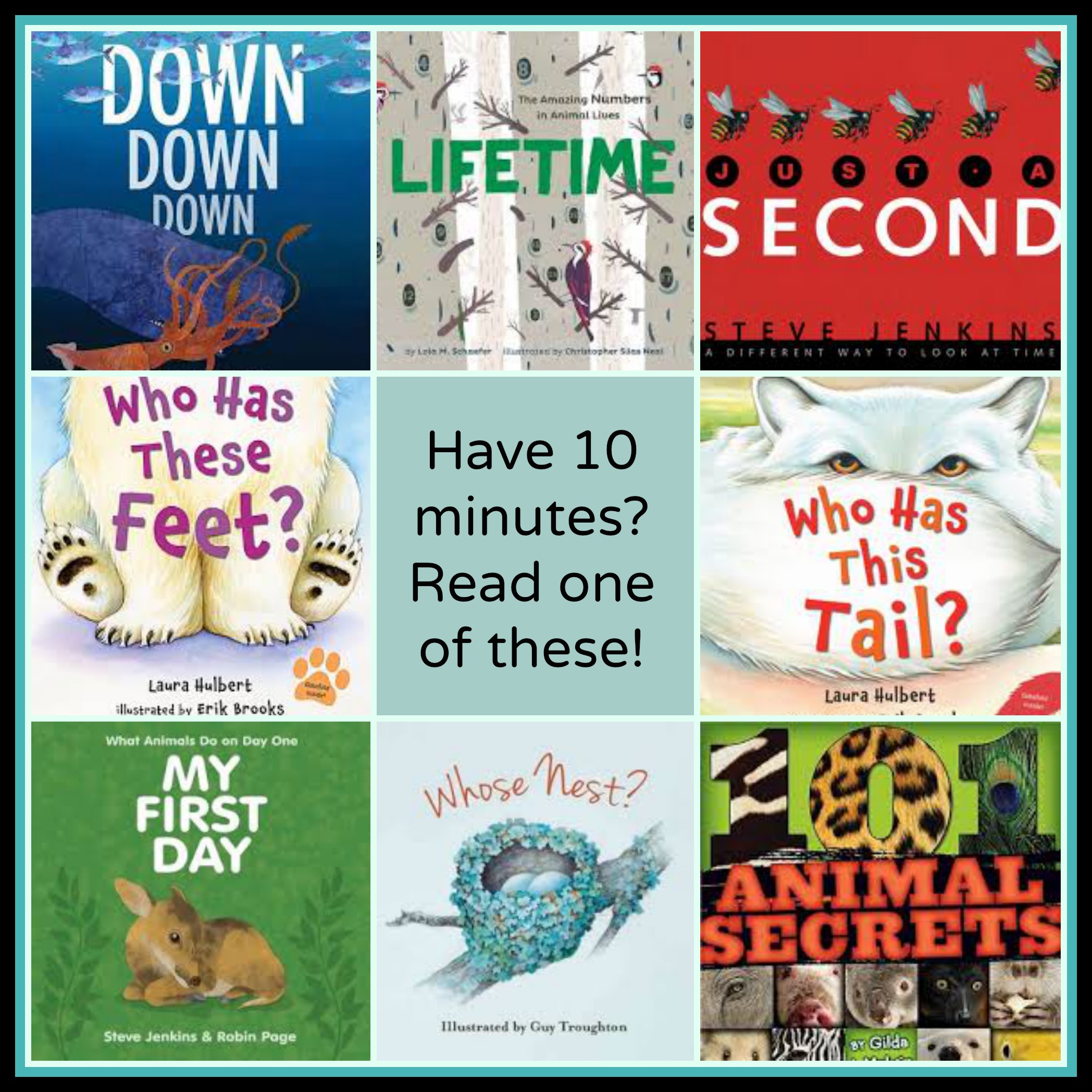
  • Use specific nonfiction titles for those ten to fifteen minute times that happen upon you in the classroom. Kids actually cleaned up and are ready before the bell? The presentation is late in the gym? The play finished early? Use that “found time” to share nonfiction titles. I always have two or three titles in a bin beside our carpet area ready to do just that. Many of these books can be shared a page at a time with lots of success. Some of my favourites for this purpose? Titles by Steve Jenkins feature big here!
Found Time? Read some nonfiction! The importance of the nonfiction read aloud There's a Book for That

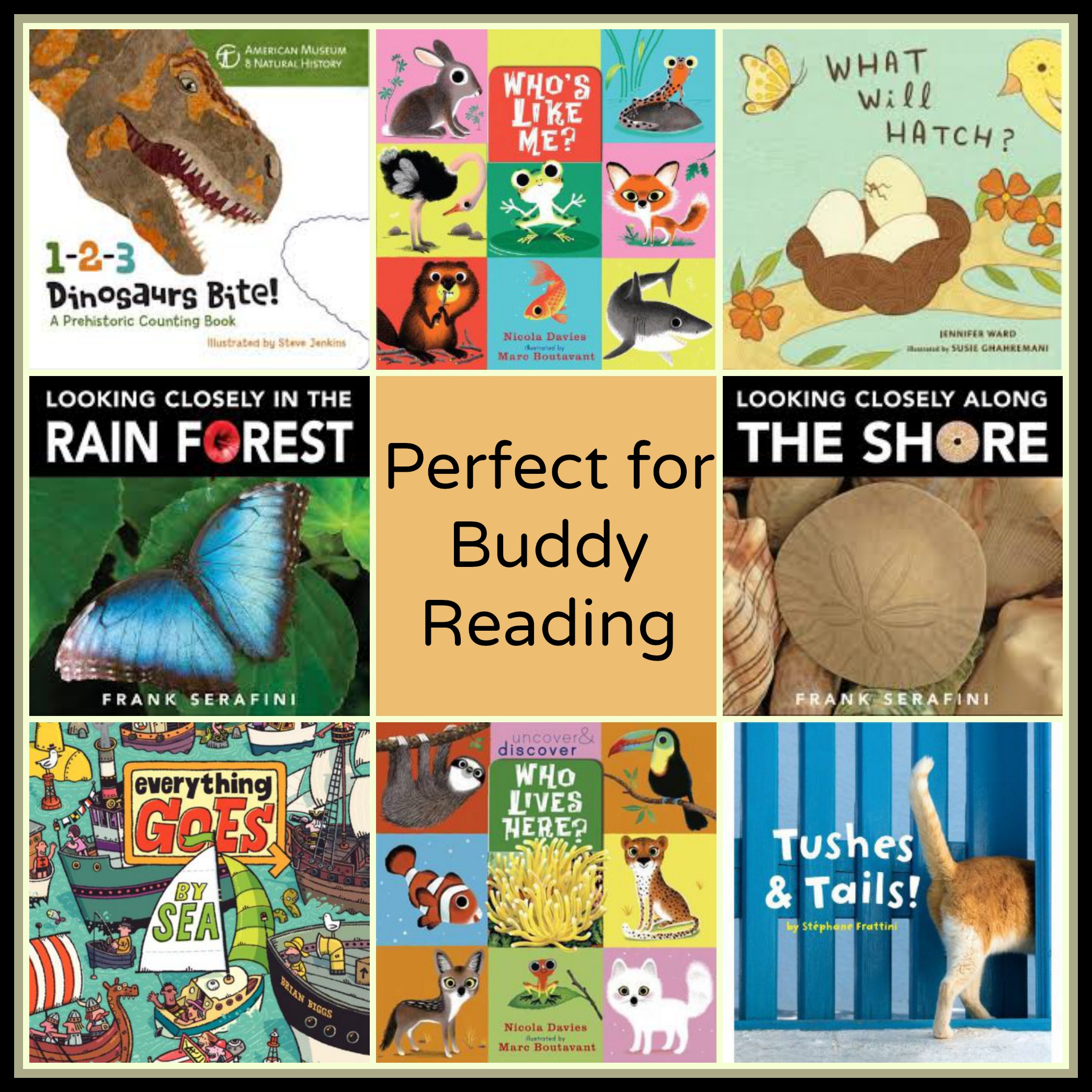
  • Model ways to buddy read with nonfiction titles. Are your kids big buddy readers to a younger class? I like to model how to share various books with my students so their buddy reading time is more successful and fun. I often choose nonfiction titles to do this. First, I get to share these as read alouds and then my students, in turn, share them. My favourites for this purpose?
Nonfiction Titles perfect for buddy reading The importance of the nonfiction read aloud There's a Book for That

  • Inspire an art project! Launch an art project with a nonfiction title. Some of my favourite books to do just that:
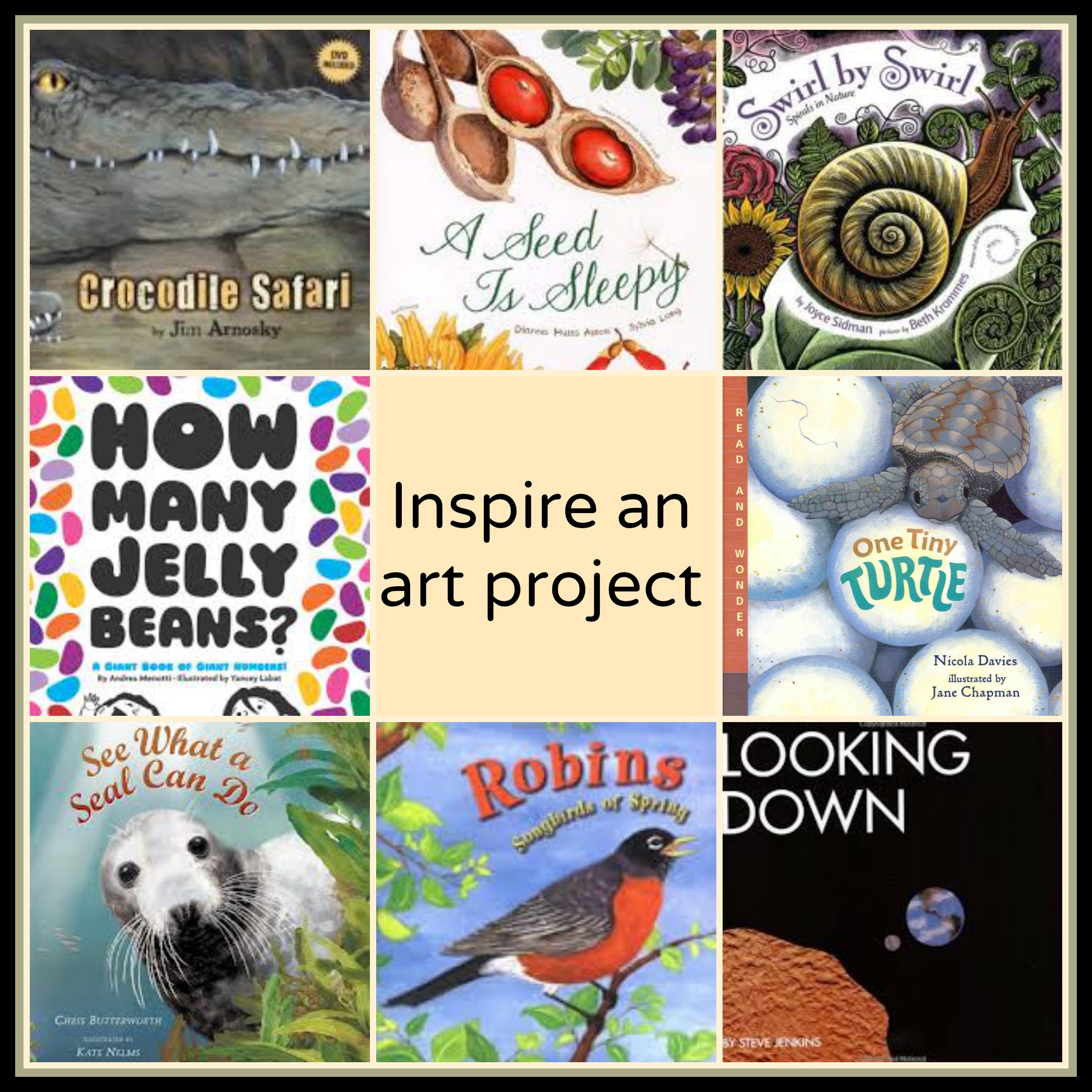
Use nonfiction to inspire an art project The importance of the nonfiction read aloud There's a Book for That

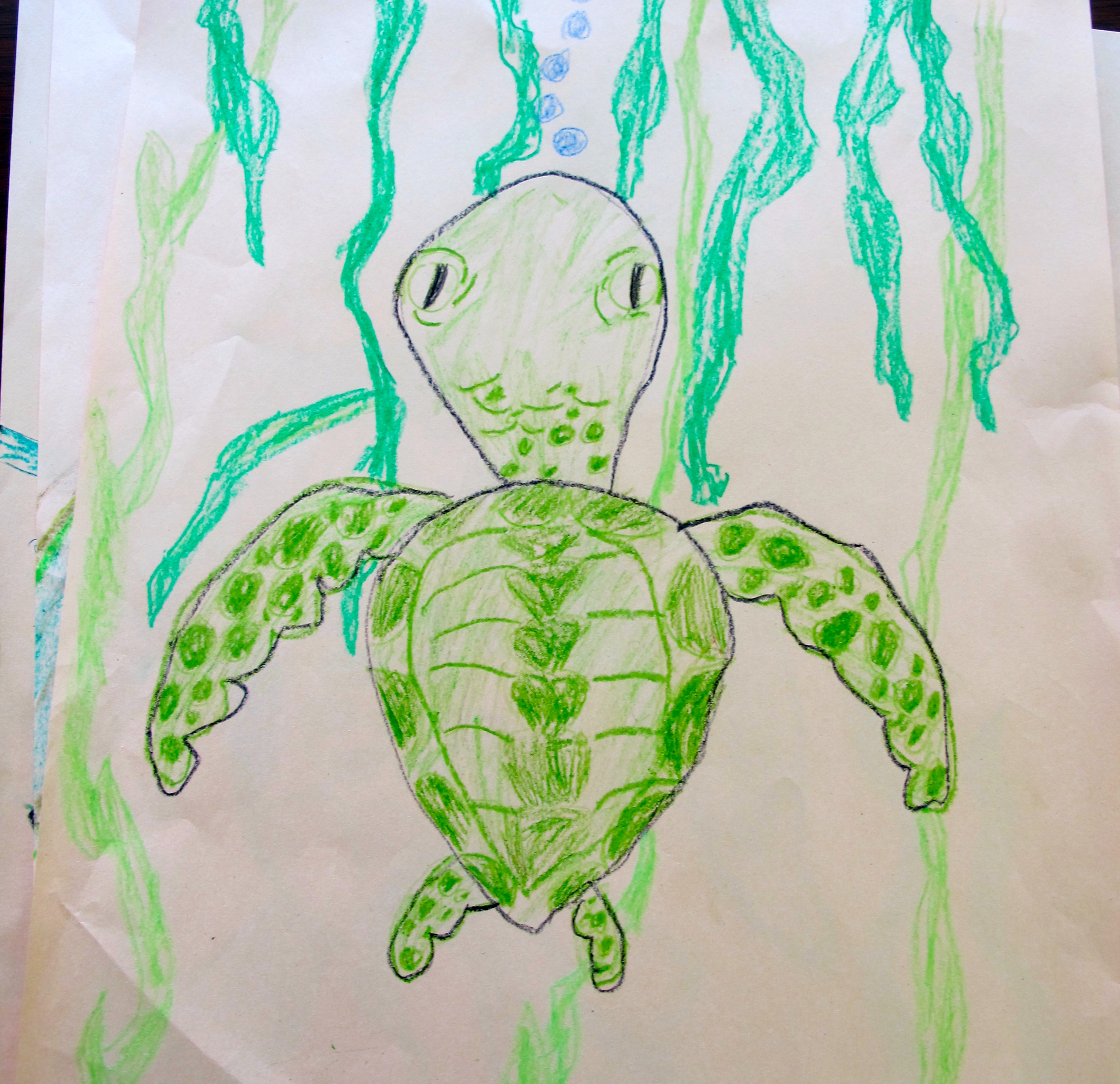
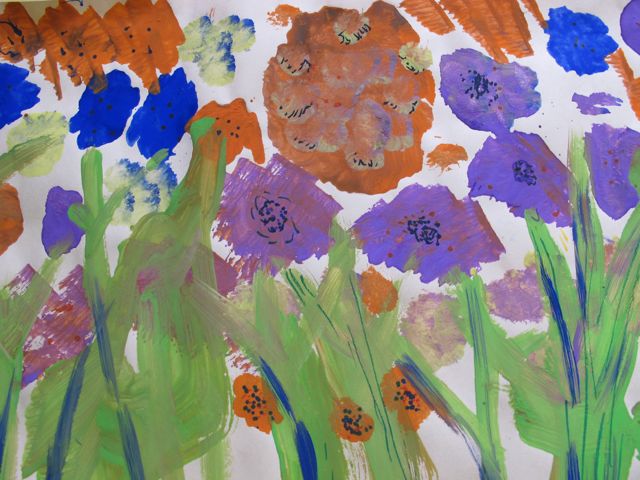
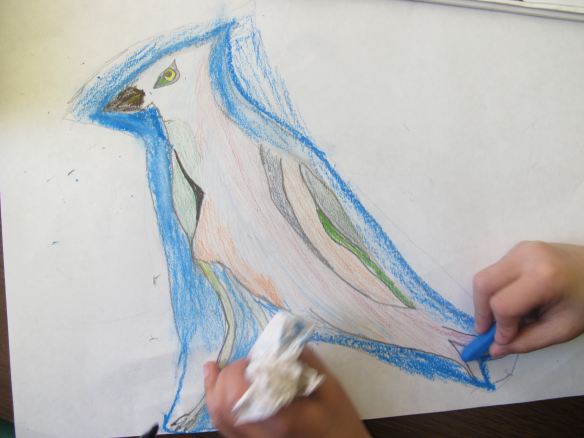
A few recent of art projects inspired by nonfiction books.
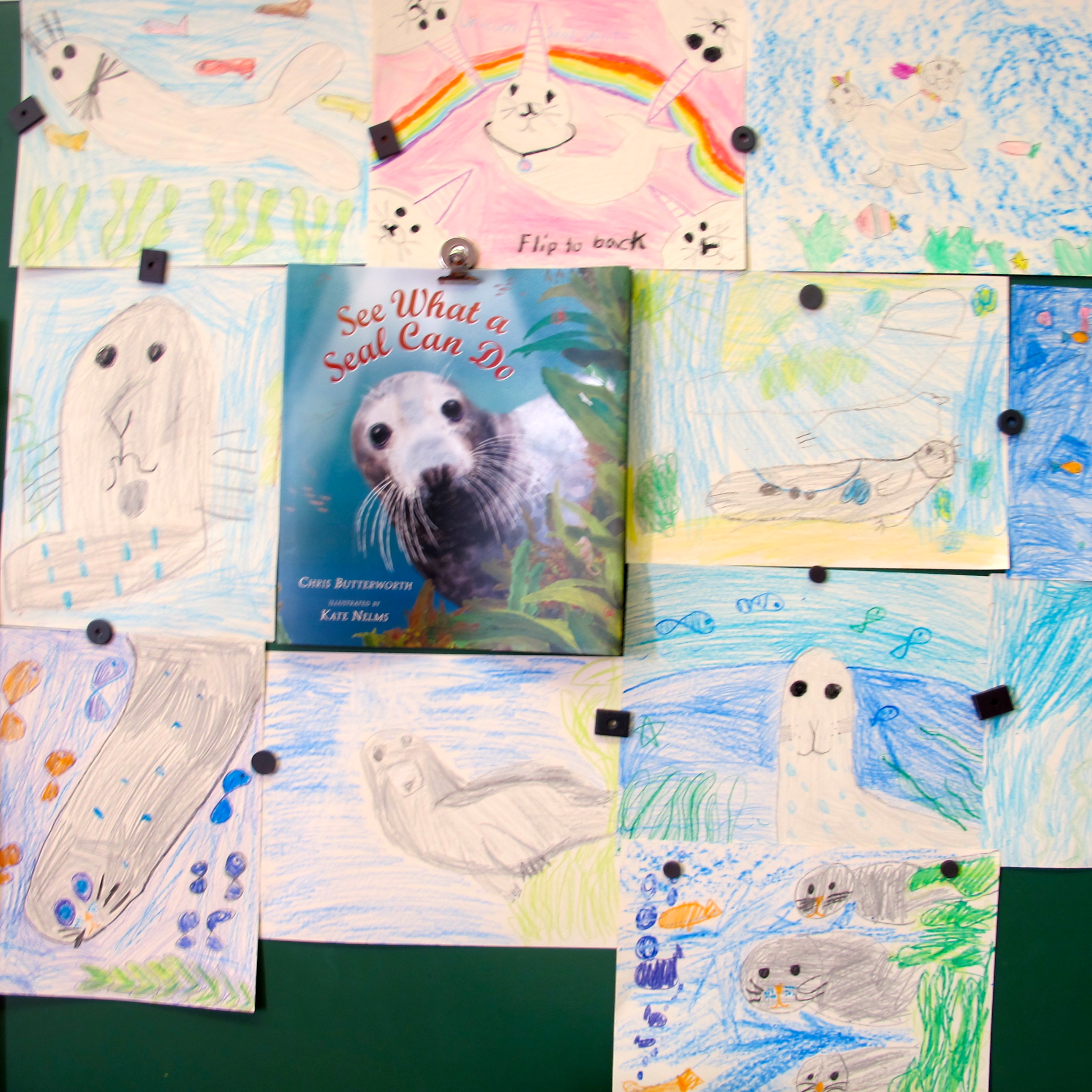
Teaching with a Passion for nonfiction: Part 2 The importance of the nonfiction read aloud There's a Book for That

Teaching with a Passion for nonfiction: Part 2 The importance of the nonfiction read aloud There's a Book for That

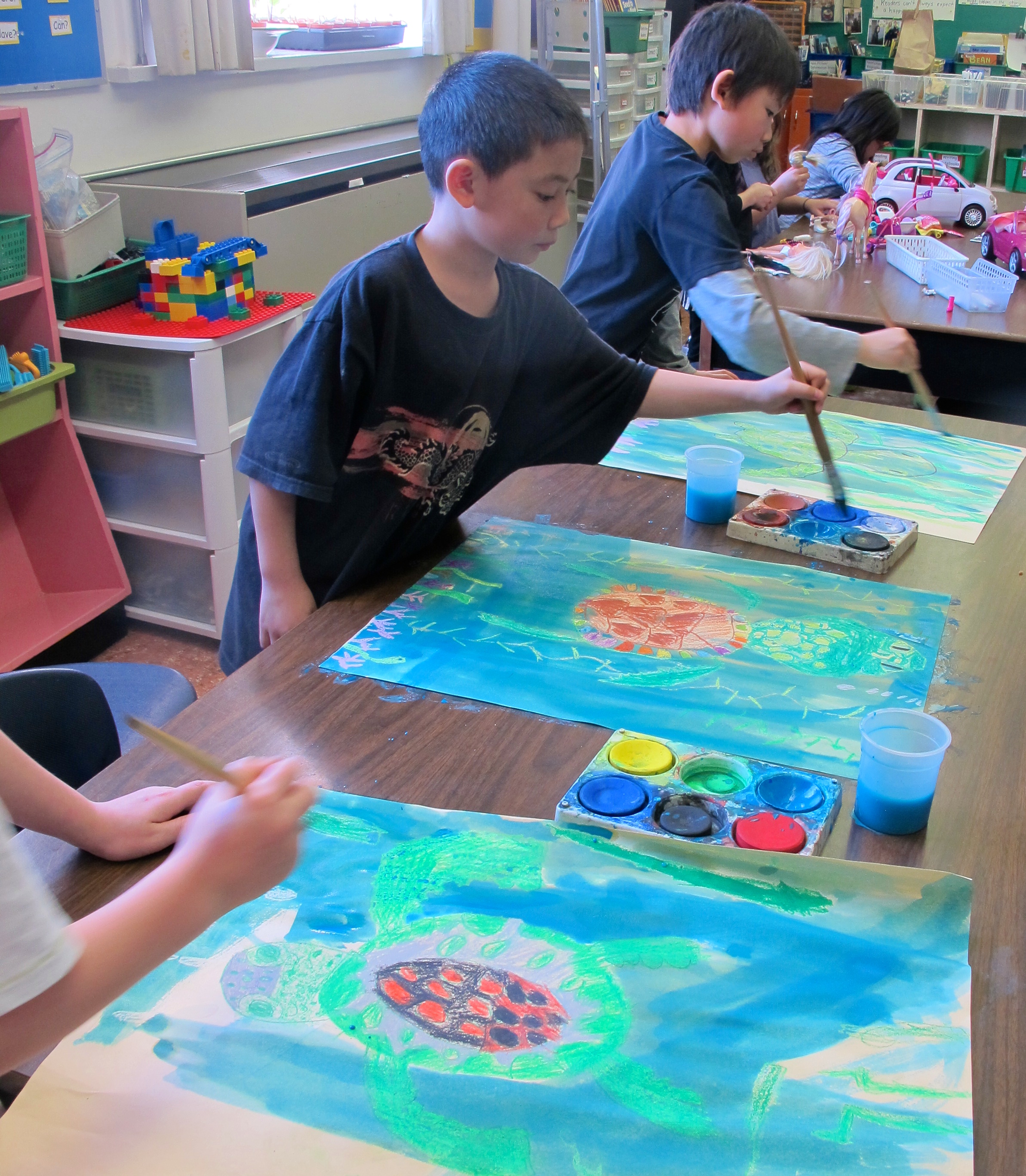
This image (above) was complimented by Nicola Davies author of One Tiny Turtle (that inspired this book) Below some students are painting their turtles.

Teaching with a Passion for nonfiction: Part 2 The importance of the nonfiction read aloud There's a Book for That Teaching with a Passion for nonfiction: Part 2 The importance of the nonfiction read aloud There's a Book for That

Teaching with a Passion for nonfiction: Part 2 The importance of the nonfiction read aloud There's a Book for That

And how can I end this post without sharing some of my very favourite nonfiction to read aloud? Here are some titles that I have used with a lot of success in my primary/early intermediate classroom. Rich, rich learning opportunities!
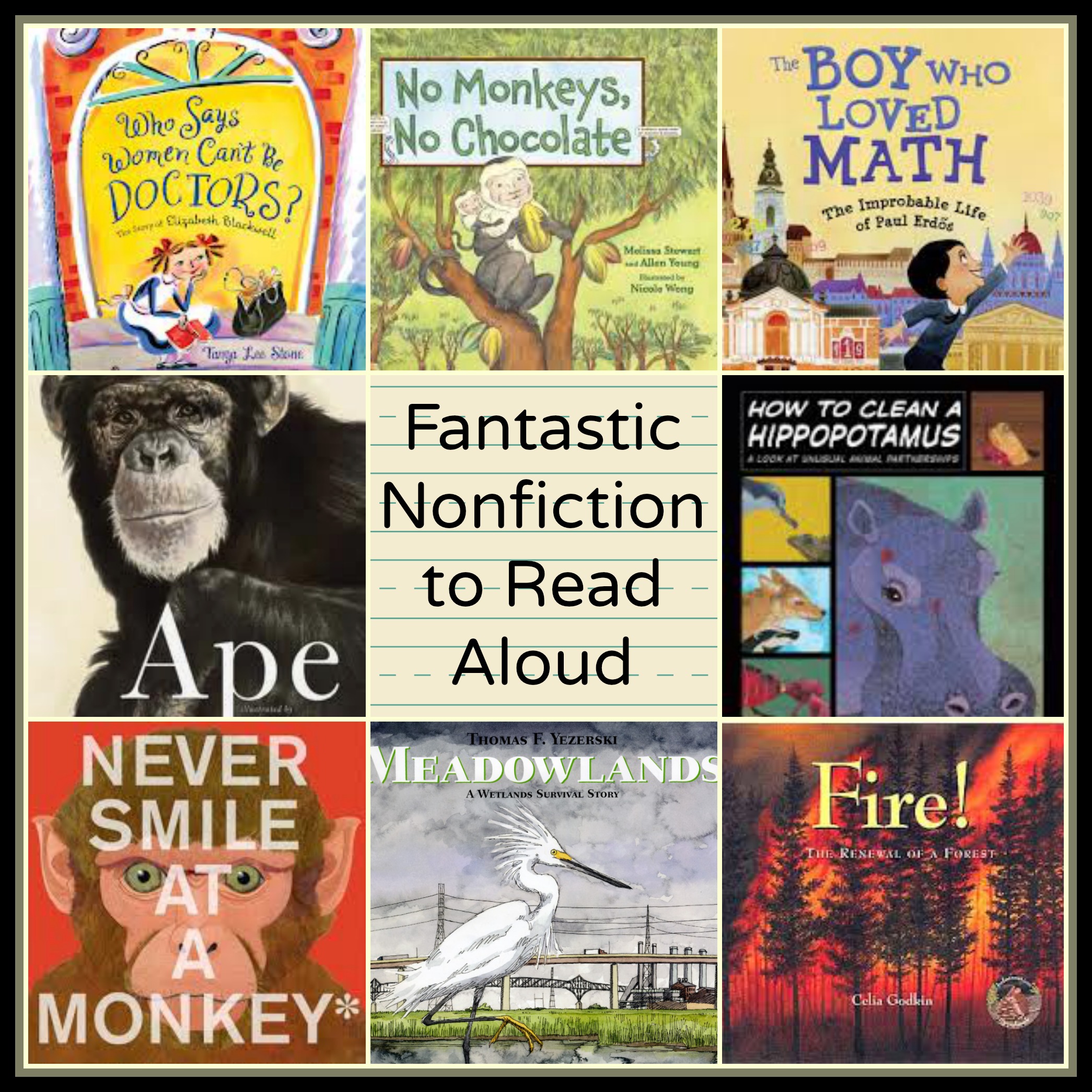
 Fantastic Nonfiction to read aloud Part 2 The importance of the nonfiction read aloud There's a Book for That

I know there are many teachers out there doing amazing things with nonfiction texts in their classroom. This post is hardly a comprehensive list of everything that can be done with the read aloud and is not intended to touch on how to teach specific nonfiction genres. Please share your own ideas and links in the comment section! Let’s continue the nonfiction conversation.

Next post? Part 3: Interacting with nonfiction: getting students reading, thinking and talking together 

3A: Generating excitement, making choices and having time to read
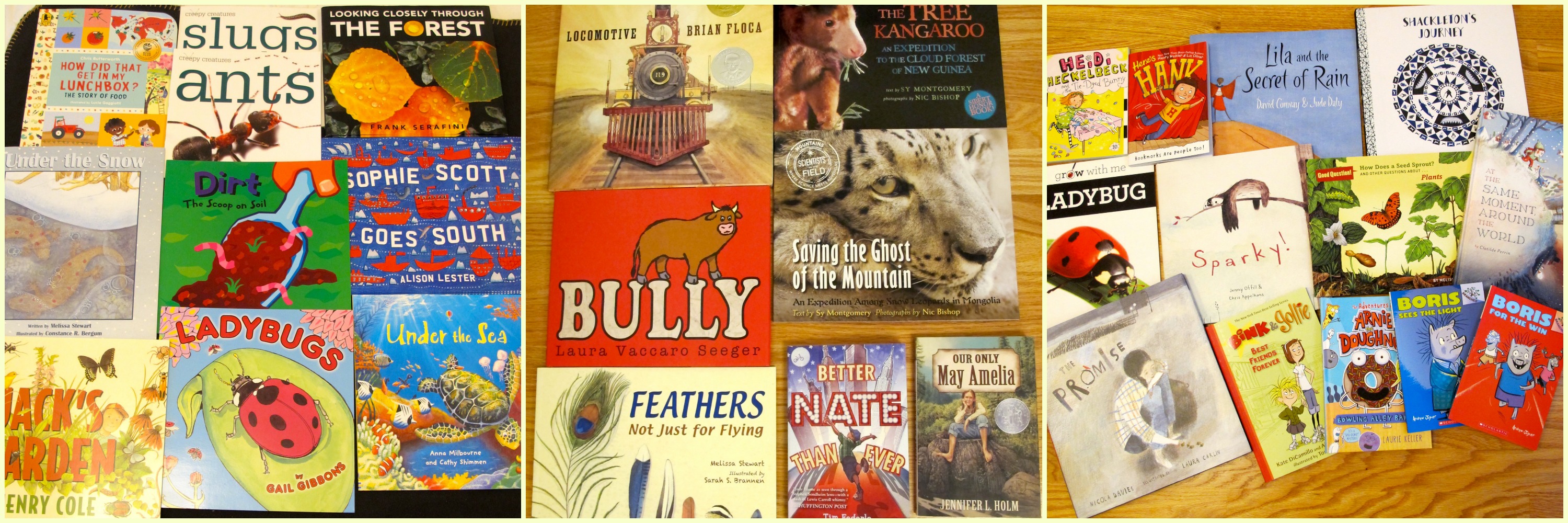
3 B: Reading and working with the texts 


Teaching with a passion for nonfiction picture books: Part 1

I recently had a conversation with author Melissa Stewart about sharing nonfiction titles in the classroom. We were discussing ways to introduce more nonfiction titles to our young learners.

I started thinking about some of the things I do, looked back through blog posts and classroom photos and realized that I was potentially going to write one of the longest blog posts ever written! For ease of reading (and writing!), I have broken things up into three distinct posts and will share these over the next week:

Part 1: Everywhere you look . . . let there be nonfiction!

Part 2: The importance of the nonfiction read aloud

Part 3: Interacting with nonfiction: getting students reading, thinking and talking together (Updated: this post is now split into 2 parts)

3A: Generating excitement, making choices and having time to read
3 B: Reading and working with the texts 

The intention with each of these posts is to share a practical “how to” list of how to read more, celebrate more and use more nonfiction picture books in the late primary/early intermediate classroom. For reference, last year I taught a Grade 2/3/4 class.

Always, my goal is to increase an interest in and a love of nonfiction reading. I am sure that many of you are already doing many of these things – probably many of them differently and better than me! But it is always informative to read about what is happening in other classrooms to help us think more about what is happening in our own. Please feel free to offer suggestions and ideas in the comments.
Teaching with a passion for nonfiction picture books:

Part 1: Everywhere you look . . . let there be nonfiction!

Know your books.

There are so many fantastic nonfiction titles being published and keeping current is important if we want to nurture a love of nonfiction in our students. One of the biggest issues for teachers wanting to share more nonfiction with their students is where to begin. What books are out there? Are they a good fit for specific grades/readers/interest levels? What books are wonderful read alouds? Which books are ideal for independent reading at different reading and interest levels?

It is hard to know where to start. Best piece of advice – start with the educators, authors and illustrators who have not only started but are immersed in the land of nonfiction books. Let their passion and knowledge inspire and inform your choices.

  • Read blogs (see a list of recommendations at the bottom of this post)
  • Check out the new titles in your favourite bookstore and public library.
  • Pay attention to best of lists (see below) and award winners (again see below).
  • If you are on Pinterest, follow boards that highlight nonfiction titles

Read nonfiction picture books for your own enjoyment.

We are passionate about titles that we have read and enjoyed. Set a goal to read more nonfiction titles and you won’t be able to resist sharing. One of the best things I did was join Alyson Beecher‘s nonfiction picture book challenge last year. Alyson challenged educators to read more nonfiction picture books and share updates by participating in the #nfpb20i4 (this year’s twitter hashtag) meme. Here is a link to Alyson’s challenge for 2014. The best thing about participating in this challenge is being part of a reading community who is excited and passionate to share nonfiction titles with students and educators.
Bring these books into the classroom!

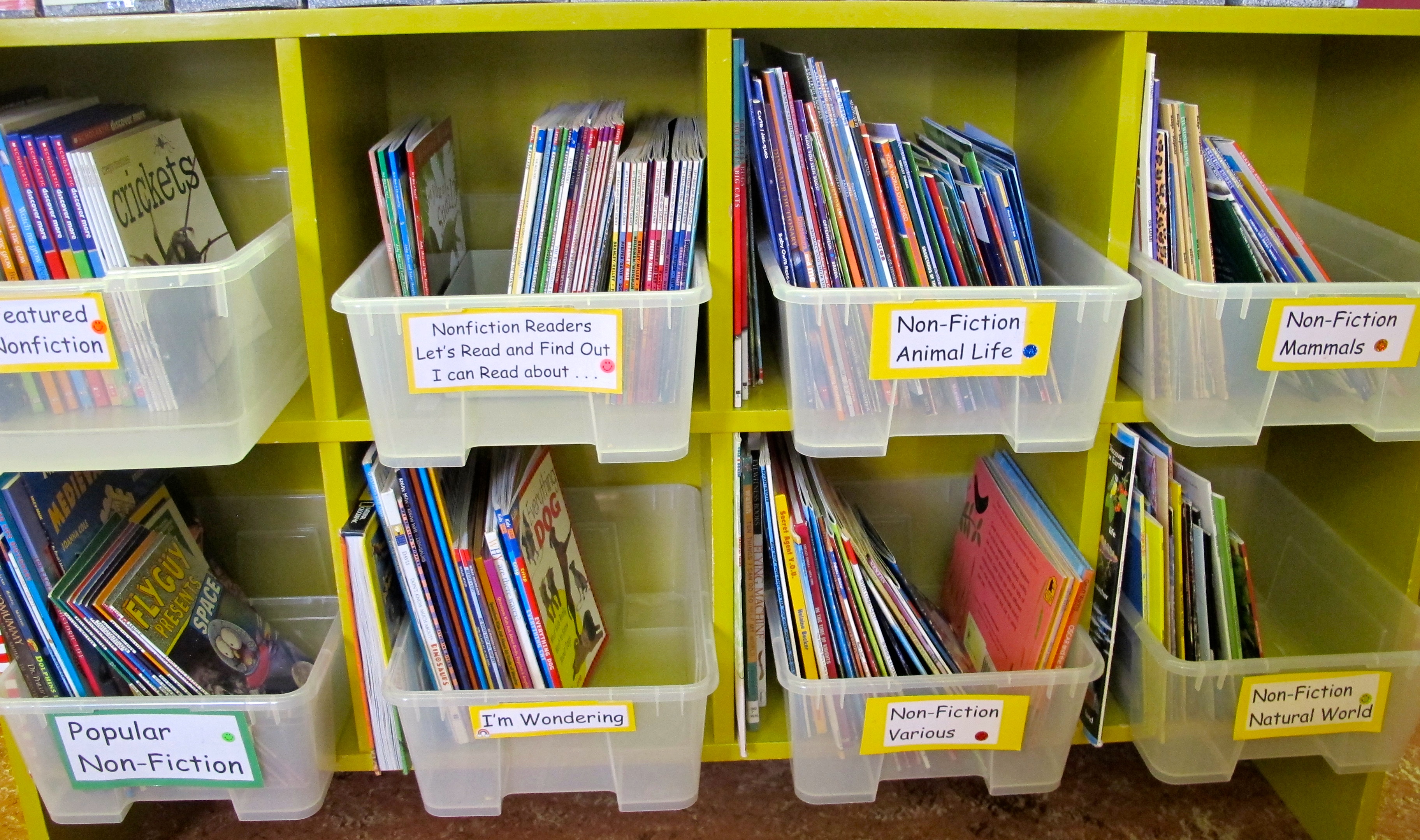
Children need to look up and find nonfiction titles in their learning environment, not just associate nonfiction with one section of the library where you go to learn research skills. I regularly rotate nonfiction from the library into my classroom displays. But I also purchase new nonfiction titles for our classroom collection. When I buy new books, I am conscious of making sure I have both fiction and nonfiction titles. Sometimes I go shopping strictly to add new nonfiction books that represent current student interests. Students will often ask me to find more titles about a particular topic or “a book that is like ________”(some current favourite). In my classroom this year, there was a lot of interest in insects, gardens and life in the ocean. I keep a little notebook full of sticky note requests and take it with me when I go book shopping. Often I take photos of a book shopping spree so these pictures help illustrate the balance in my book purchases.

Teaching with a passion for nonfiction picture books: Part 1 There's a Book for That Book talk nonfiction books.

I keep a basket of books to book talk by my chair at our carpet area. The students know that they aren’t supposed to peek and what is in the basket is always a source of anticipation and excitement. There are always fiction and nonfiction books in this basket so that I ensure I am giving equal “rave about/celebrate” talks to both genres. On certain days I will just book talk some new nonfiction. Other days I book talk a variety of titles. The consistent thing, I am book talking every day. If I have limited time, I set a timer and grab a pile and challenge myself to “sell” those books before the timer goes off. The students think this is hilarious. I think it is highly effective because about 95% of the time all of the books have been nabbed and landed in student book boxes or in reader’s hands by the time I am finished.

What do I highlight when I book talk nonfiction titles? Some of these things (depending on time available and purpose)

  • information about the author and illustrator/photographer: What motivated them to write the book? Have we read their work before?
  • some of the features in the book i.e. maps, timelines, close up photography, etc. I also use this time, when possible to review how to use some of the features in the book. For example, I might be sharing a book about grasshoppers. I will wonder aloud how high they can jump. I then ask students about how I might find that information. They might suggest the index, table of contents or page headings. We would go through the process of actually looking to see if we could find the answer to my question.
  • ways to interact with the book i.e.  skipping to a life cycle chart as an overview of the stages of life before reading sections in more detail
  • ways to buddy read a title (i.e. how to take turns reading sections/what kind of questions that might be asked, turn taking looking up words in the glossary, etc.)
  • suggestions of other books in the room on the same topic/theme or asking students if they can think of any other books in the room on same topic (as they get to know our library better I do this more and more)

I also might

  • read aloud an interesting fact or two
  • share my favourite photo/illustration and ask a few questions about it
  • “quiz” the students and take guesses before sharing information in the book i.e. “Does anyone want to guess how long a mountain gorilla lives in the wild?”
  • read aloud a passage that reinforces something we have just learned so that students know that they can increase their knowledge on a topic we already know something about

Think about your book displays

I have a shelf of nonfiction titles right beside our carpet area where we gather for many lessons and read alouds. I believe that proximity leads to curiosity so I was strategic about placing these titles close.

Teaching with a passion for nonfiction picture books: Part 1 There's a Book for That

I also use a tiny bulletin board in another area of the classroom to display the book covers of the nonfiction books we are in the middle of reading or have just finished. Because we do so much reading, writing and talking about these titles, I like highlighting the covers in a place of importance.

Teaching with a passion for nonfiction picture books: Part 1 There's a Book for That

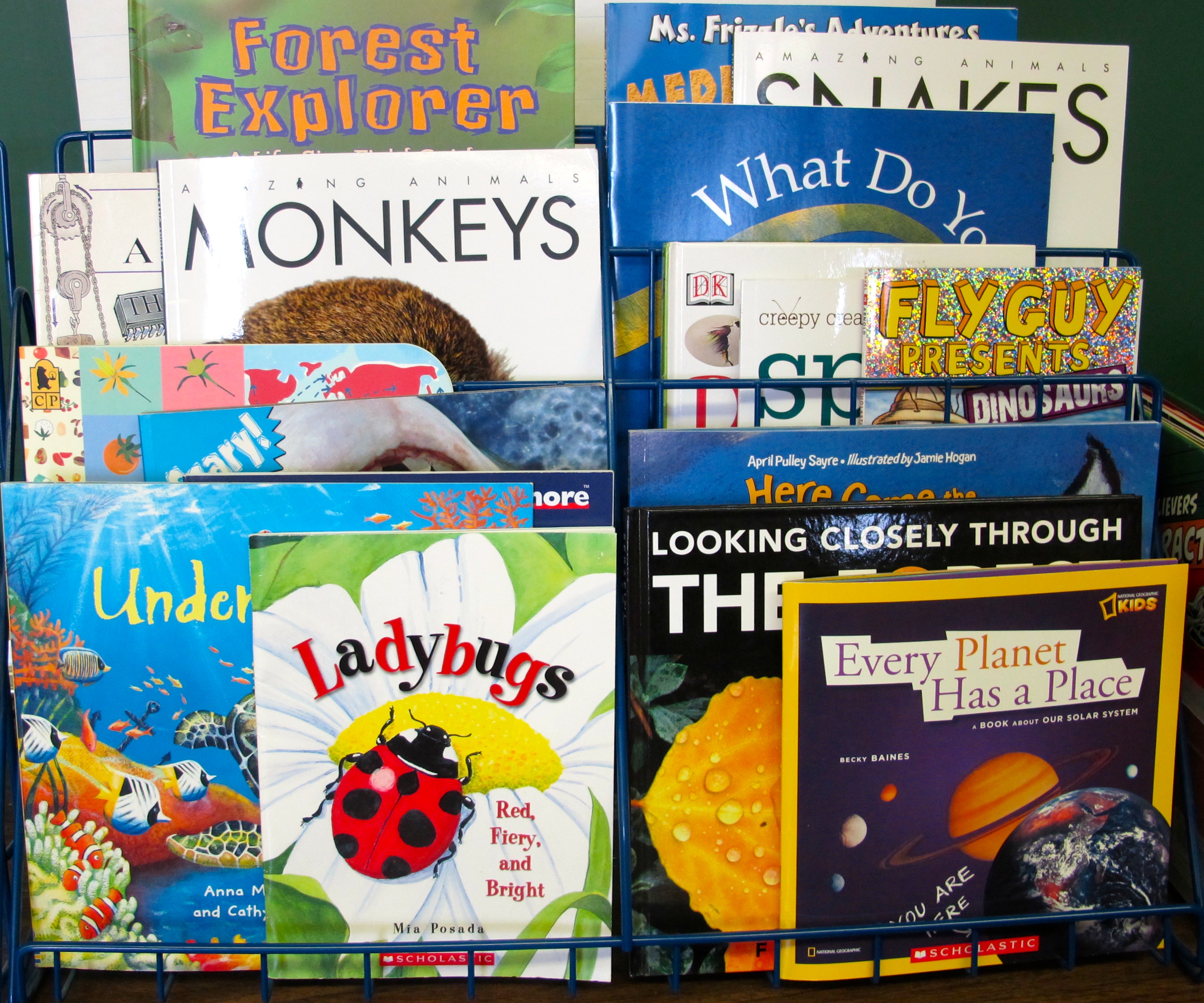
On top of one set of bookshelves is a display stand of nonfiction titles where I can display books with the covers facing out. It sits beside an identical stand of fiction picture books. This is deliberate – to convey the message to students that we read widely – choosing both fiction and nonfiction titles.

Teaching with a passion for nonfiction picture books: Part 1 There's a Book for That

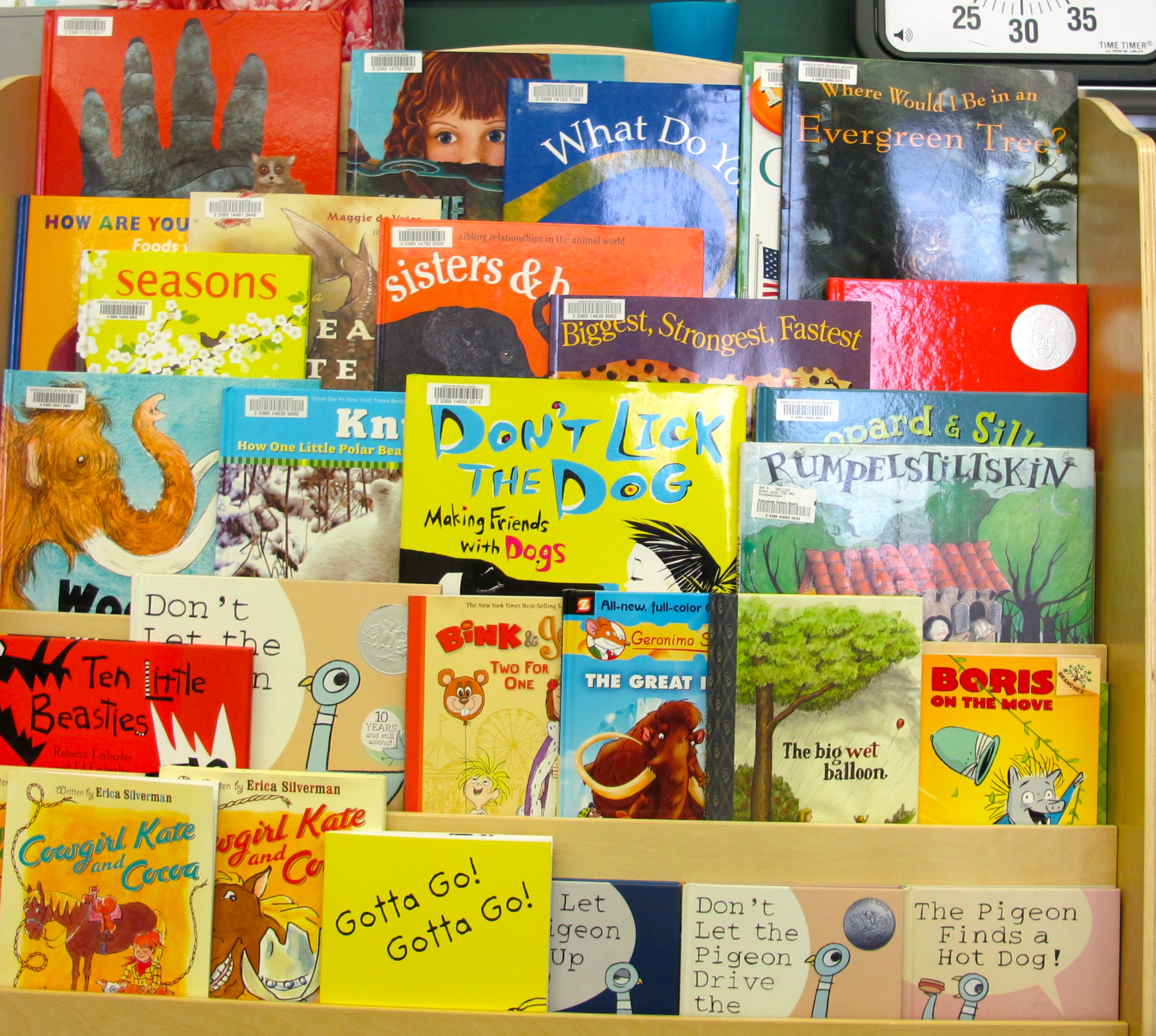
Also near the carpet area is an every changing book display of books from the classroom and school library that we have recently read or book talked. As you can see in the photo below, both fiction and nonfiction feature prominently. We know from our own reactions when we walk into a library space that our eye is drawn to books that are displayed covers out. Be conscious of what students see when they look around the classroom.

Teaching with a passion for nonfiction picture books: Part 1 There's a Book for That

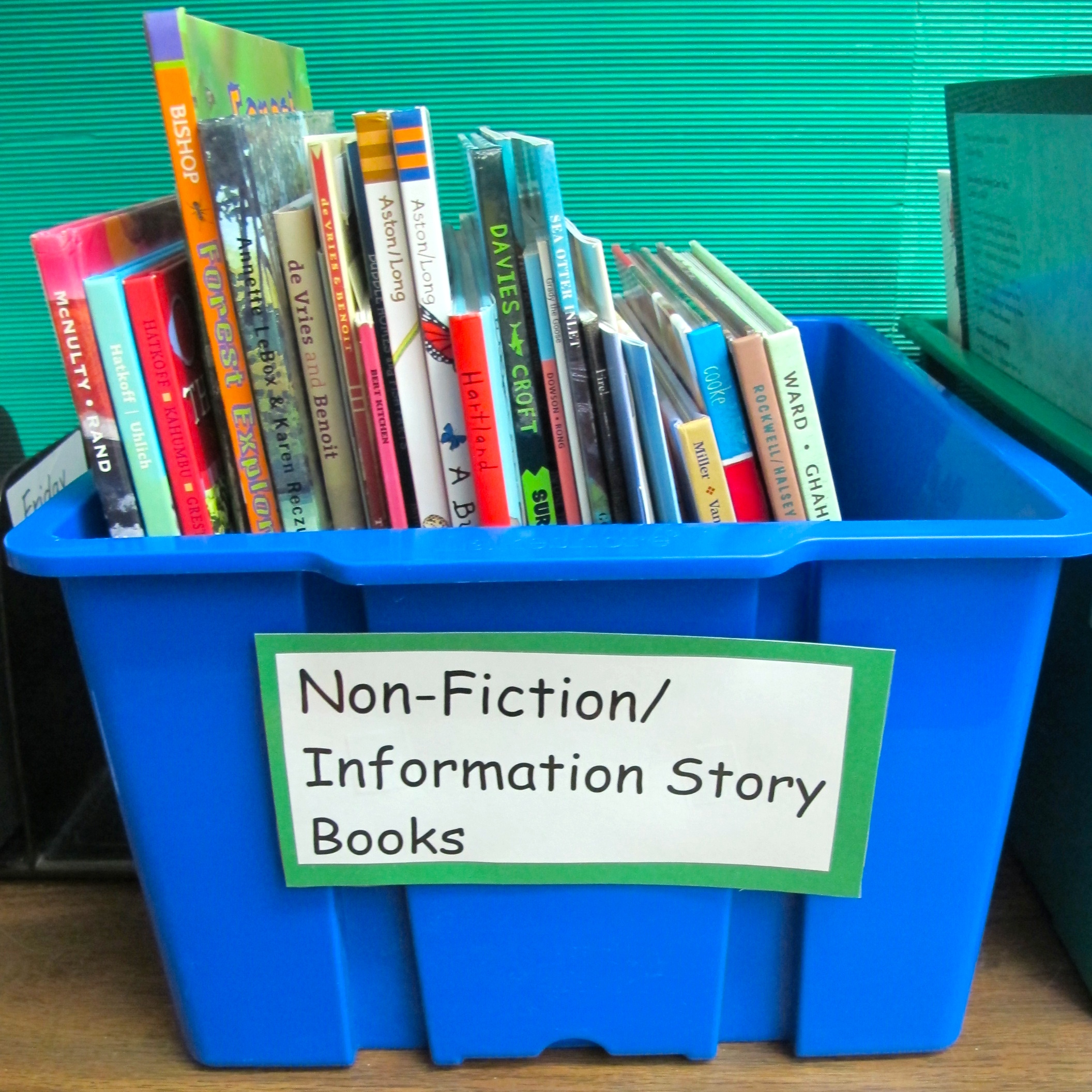
My students also see that I have bins dedicated to nonfiction titles in my own teaching areas. They get excited about peeking into these bins and making read aloud requests.

Teaching with a passion for nonfiction picture books: Part 1 There's a Book for That

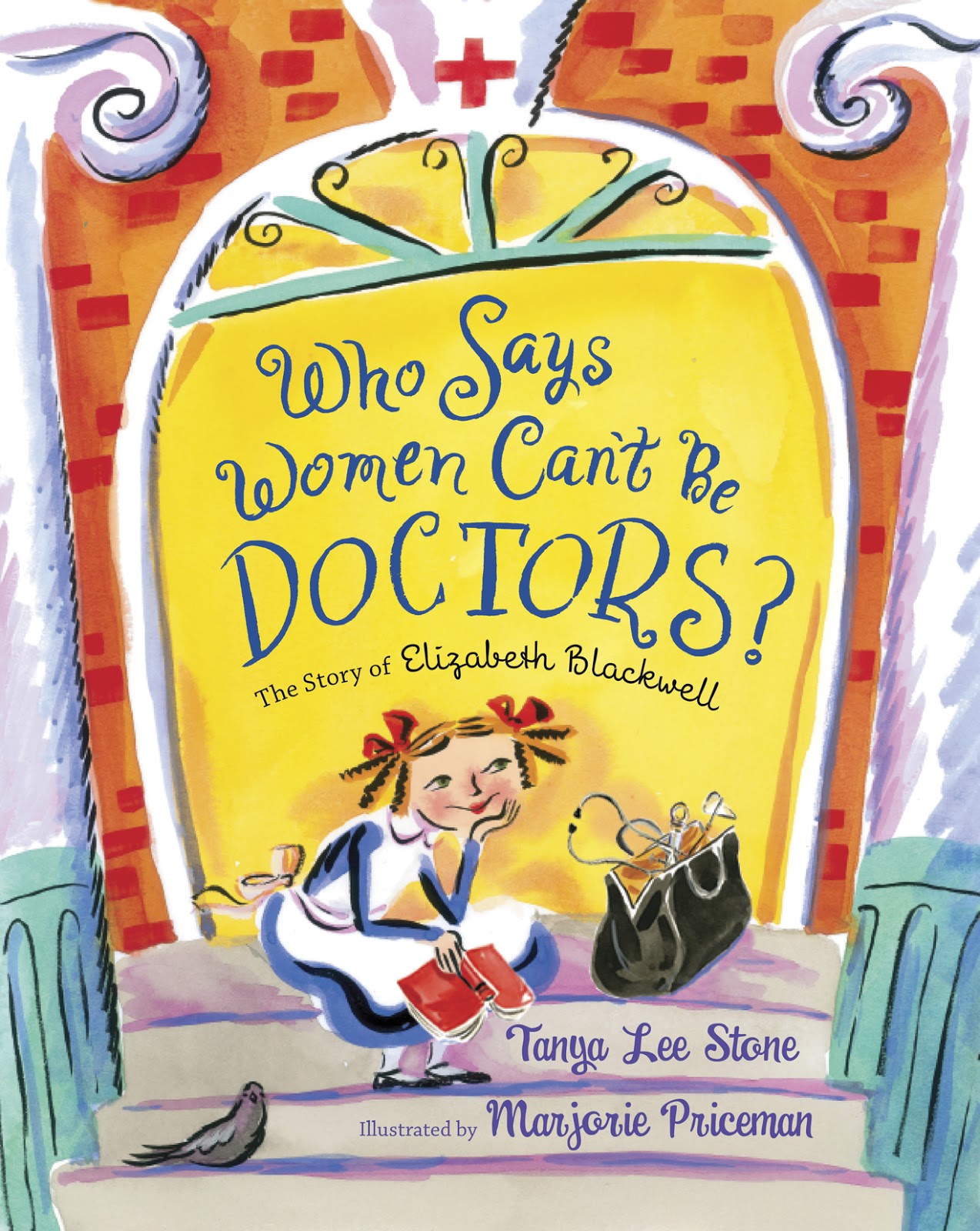
One of my favourite memories of this school year was after we read Who Says Women Can’t Be Doctors?: The Story of Elizabeth Blackwell written by Tanya Lee Stone and illustrated by Marjorie Priceman Later, I found one of my students snooping through my Picture Book Biography bin. “Do you have any more of those girls can’t or people can’t kind of books?” she asked. Of course, I did. We went on to read Every Day is Malala Day and our discussions and learning continued.
Every Day is Malala Day Teaching with a passion for nonfiction picture books: Part 1 There's a Book for That Teaching with a passion for nonfiction picture books: Part 1 There's a Book for That

Further reading/information:

Blogs that highlight a lot of nonfiction titles:

KidLitFrenzy and all of the blogs that regularly participate in the #nfpb2014 challenge. All of my posts from 2014 are here and from 2013, here.

The Nonfiction Detectives

Celebrate Science

Librarian’s Quest

Delightful Children’s Books

Under the category of picture books Mary Ann Reilly shares fantastic themed lists by subject and grade level ranges on her blog Between the By-Road and the Main Road

Best of Lists:

The Nerdy Book Club: Nonfiction Picture Book Winners:  2013 winners

School Library Journal’s Best Nonfiction of the year: Here is the 2013 list

Waking Brain Cell’s best nonfiction list: Top 20 2013 titles 

Awards:

Robert F. Sibert Informational Book Award

Cook Prize (STEM) Award 

Pinterest boards featuring nonfiction picture books:

My boards: Nonfiction and Wishlist: nonfiction picture books

2014 Best Children’s Nonfiction by Tasha Saecker

Best Non-fiction for Kids by Pragmatic Mom

Great Nonfiction for Kids by Choice Literacy

Melissa Stewart has started a board that highlights blogs that share lots of nonfiction: Blogs Worth Reading

Some posts on my blog which feature a number of favourite nonfiction titles:

Wonder Inducing Nonfiction Read Alouds

Swoon Worthy Nonfiction Picture Books

If you are a blogging teacher or a reader of blogs consider following and participating in the #nfpb2014 hashtag and link up on the blog KidLit Frenzy every Wednesday. There is also a Nonfiction 10 for 10  blogging event that has run for the last two years in February. This is hosted by Cathy Mere from Reflect and RefineMandy Robek of Enjoy and Embrace Learning  and Julie Balen of Write at the Edge. Follow on twitter with the #nf10for10 hashtag. My #nf10for10 post this year was The Wonder of Women. It featured 10 picture book biographies about women in history.

I am passionate about sharing lots of nonfiction titles with my students and increasing their excitement about reading nonfiction books.  I welcome any feedback. In particular, please feel free to suggest favourite blogs, lists and Pinterest boards that others might enjoy.

Happy nonfiction reading!

Next post? Part 2: The importance of the nonfiction read aloud
Nonfiction Picture Book Wednesday: Backyard Books

It’s Nonfiction Picture Book Wednesday! 

NFPB 2014I had a post all planned for today featuring some recently published books but then I had the best session with one of my nonfiction groups and decided that highlighting some older but wonderful titles was in order instead!

I always like getting a peek into other classrooms and so I hope you enjoy these photos of my students interacting so enthusiastically with these nonfiction books!

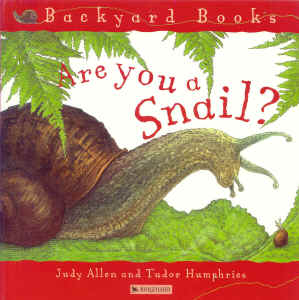
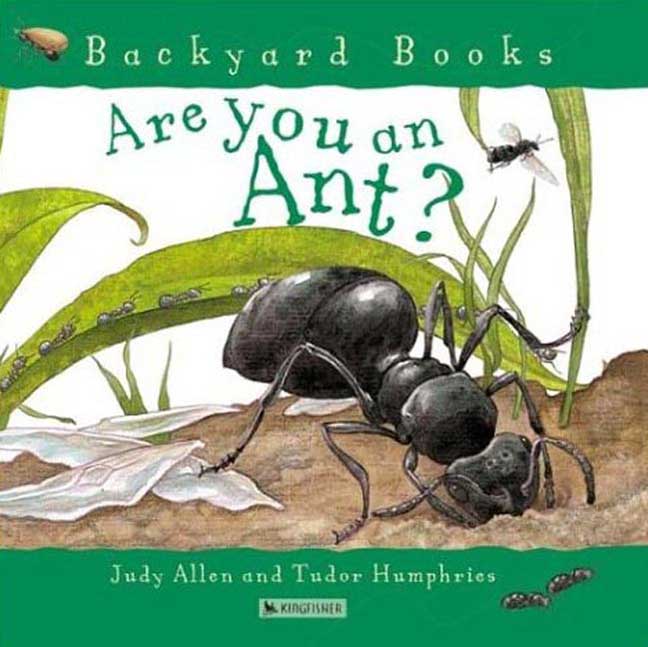
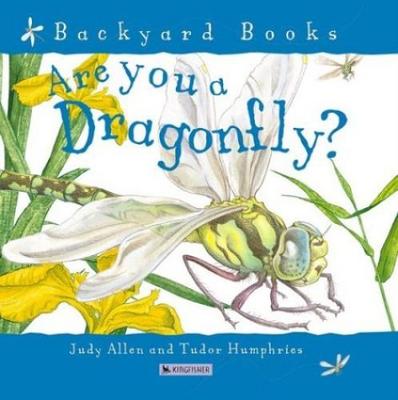
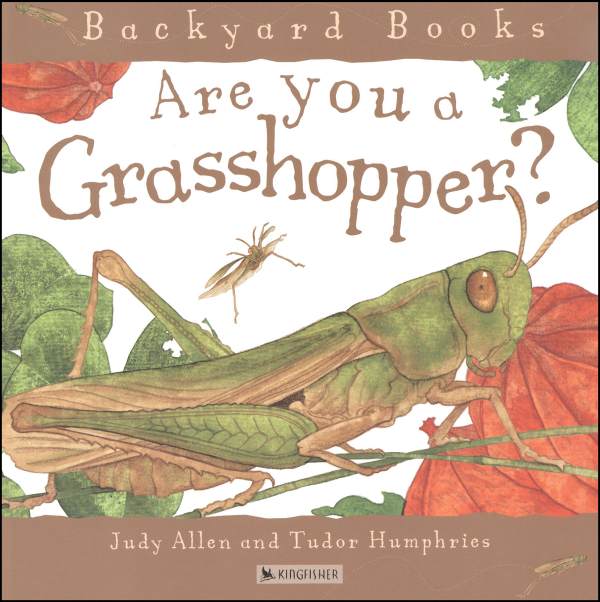
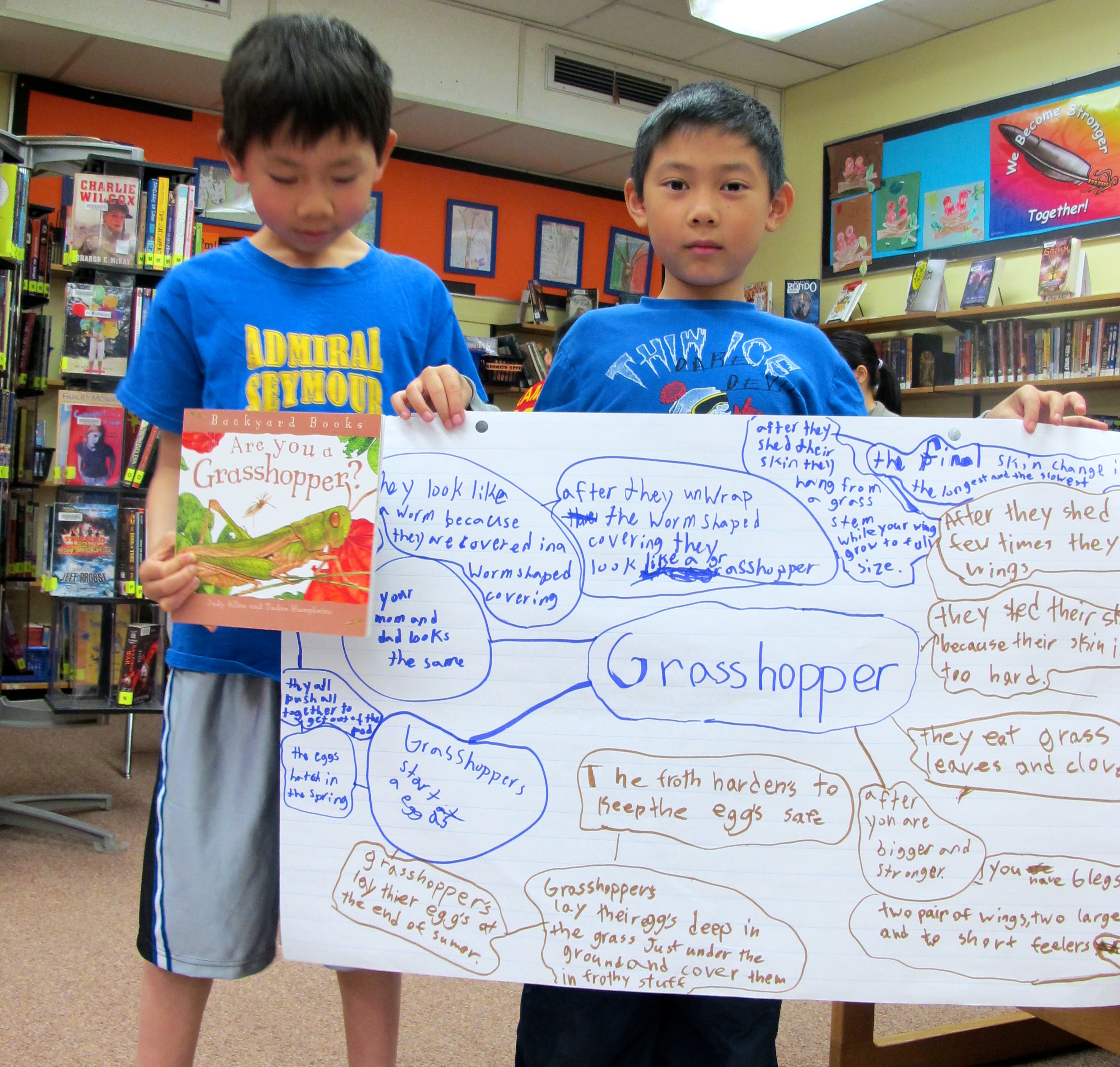
I have most of the Backyard Books (published between 2000 and 2002) by Judy Allen and Tudor Humphries in my classroom. Titles such as these highlighted below are perfect in a primary classroom library.

Each book begins with the question Are you a . . . .? The story continues providing information about a specific insect or backyard creature by explaining details of its life cycle, habits and characteristics. The text is lovely to read aloud “If you are a ____________ then you _____________” While these can be read aloud even to preschool children, they are perfect for young readers who are reading independently. Great books to practice extracting information from narrative nonfiction text.
 Backyard Books #NFPB2014 There's a Book for That  Backyard Books #NFPB2014 There's a Book for That  Backyard Books #NFPB2014 There's a Book for That

 Backyard Books #NFPB2014 There's a Book for That

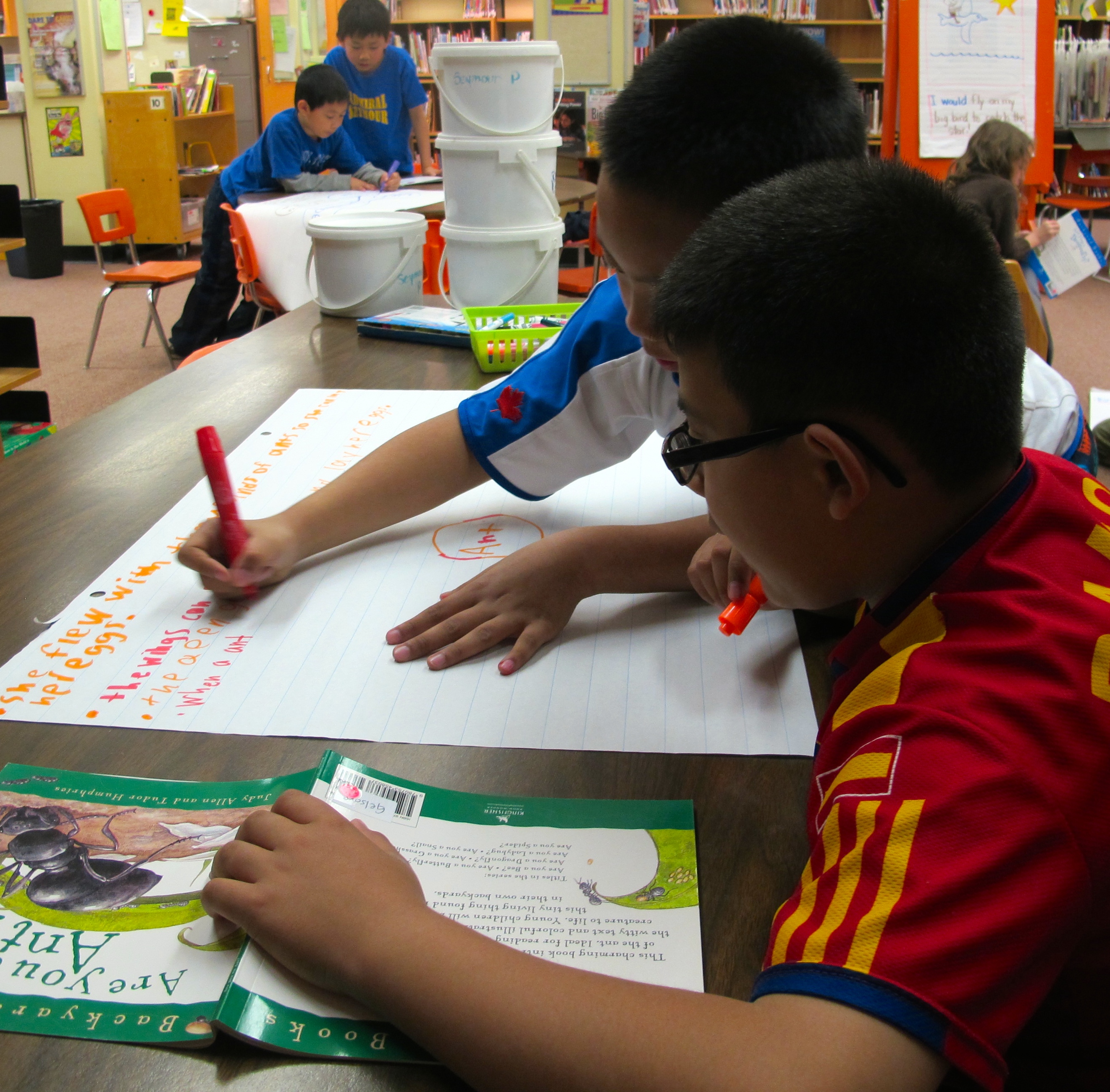
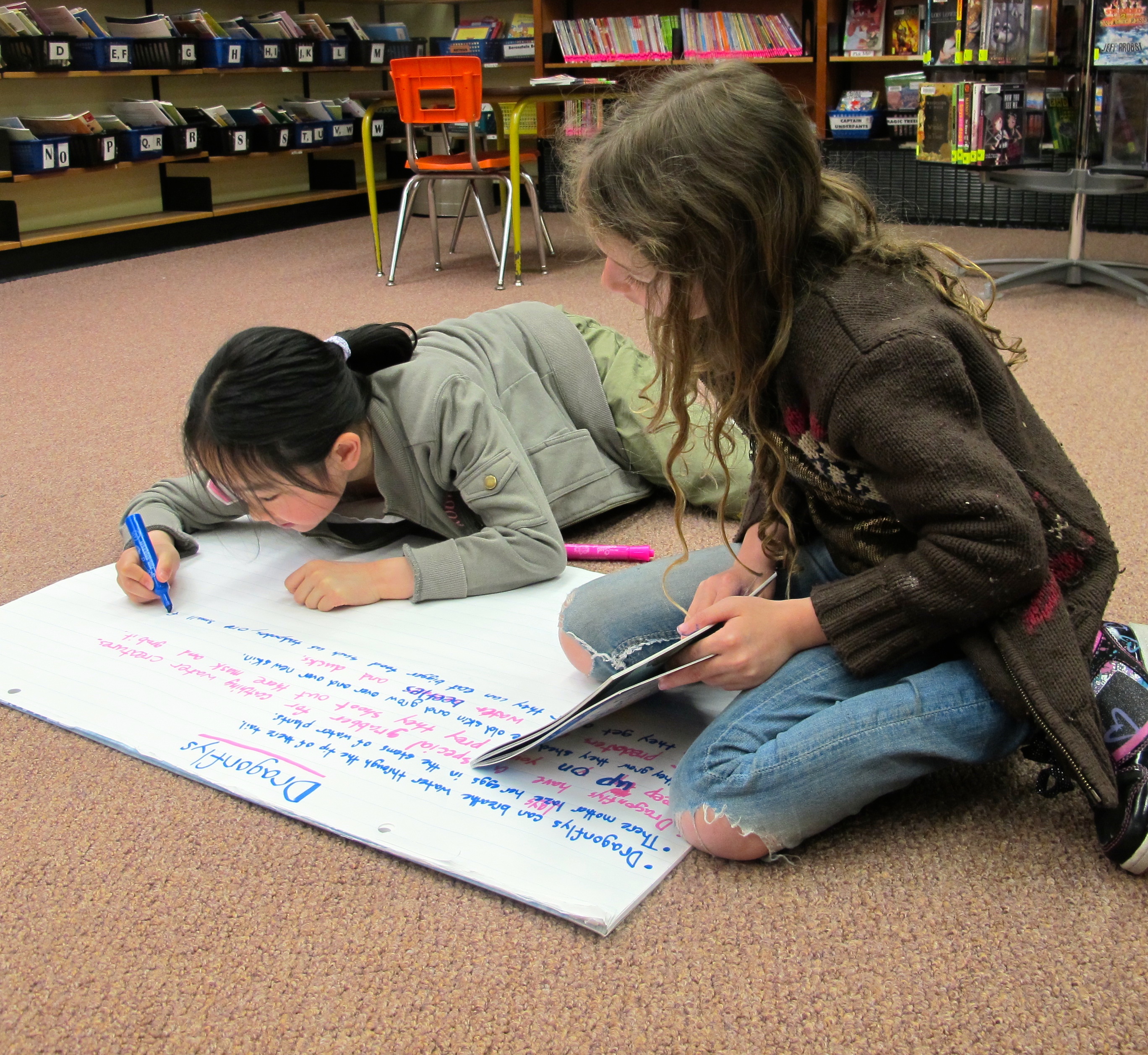
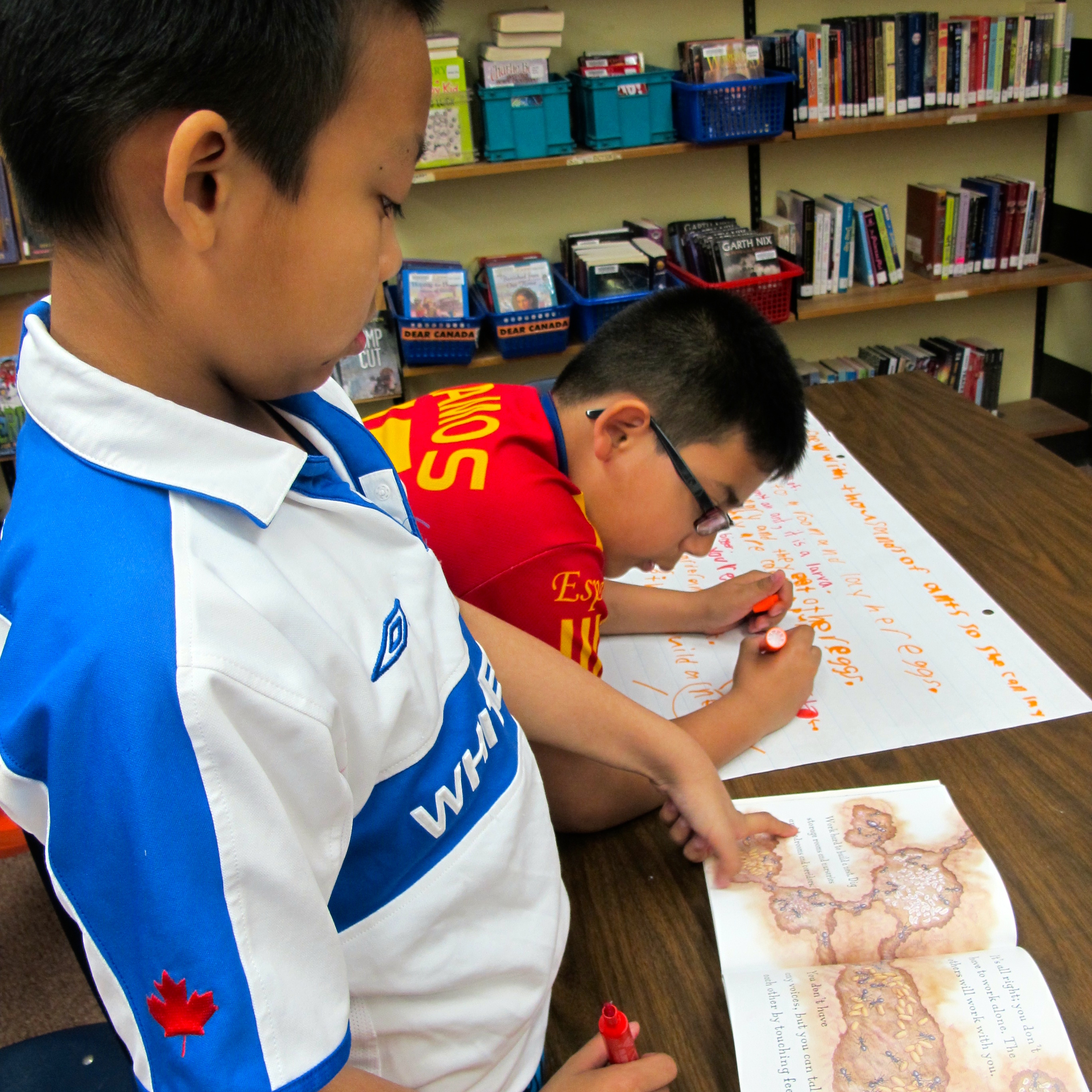
Once a week, I am lucky enough to work with a small group working with nonfiction text. While one of our Resource Teachers and my Teacher Librarian run Reading Workshop with the rest of my class, I take a group down to the library. Today my very keen group of six was working on being “fact detectives” with these Backyard Books titles.

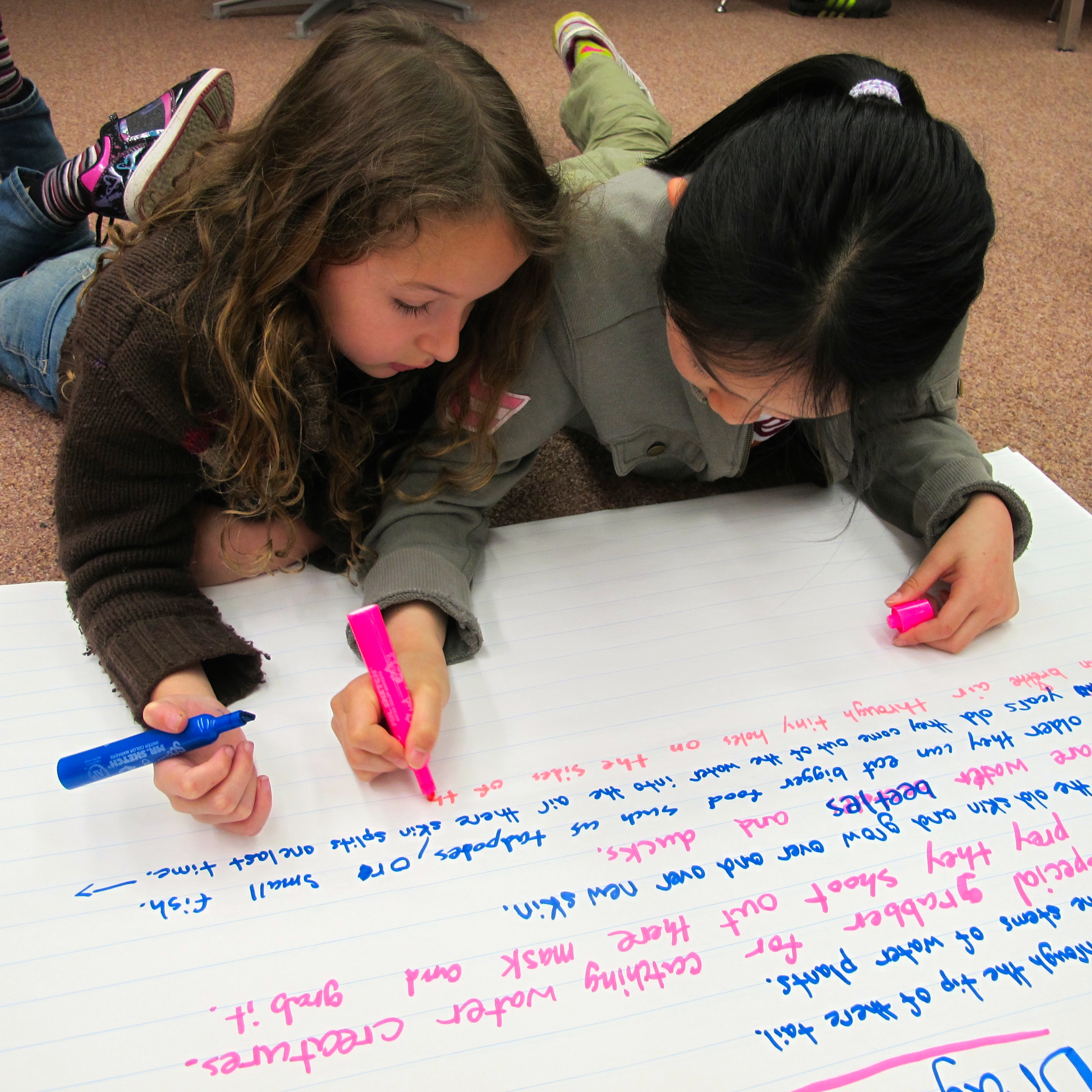
After a few minutes of finding facts together from the Are you a Snail? book, I let each group choose a text and sent them off. The partners took turns reading aloud and noting down information. I circulated to assist and give feedback. Students were trying to find different facts on each page and then record them on chart paper. I overheard:

“Was that a fact do you think?”

“We should write that!”

“How can we write that?”

“Did we find something on this page?”

“Did we already say that?”

Students helped each other with the best way to explain something. Lots of rereading and rephrasing.

 Backyard Books #NFPB2014 There's a Book for That  Backyard Books #NFPB2014 There's a Book for That  Backyard Books #NFPB2014 There's a Book for That  Backyard Books #NFPB2014 There's a Book for That  Backyard Books #NFPB2014 There's a Book for That I Backyard Books #NFPB2014 There's a Book for That

By the end, each group had made it through at least half of the text and had noted many facts down on their charts.
 Backyard Books #NFPB2014 There's a Book for That

I called them back together and asked the children what skills they thought they had been working on. All of them admitted that the task was a little bit more challenging than they thought it would be but they wanted to do it again next time! Here is what they shared:

“We had to reread and think lots.”

“We had to put shorter sentences instead of longer sentences.”

“You have to make sure you have all of the important details.”

“Putting it in different words to make sense is kind of hard.”

For these Grade 3 students, a successful, engaging activity with great nonfiction books!

Thanks to Alyson from Kid Lit Frenzy for the inspiration to read and share more nonfiction picture books in 2014! Follow the link to Alyson’s blog to read about more nonfiction titles.

My goal is to read 65 nonfiction picture books for 2014. Progress: 62/65 complete!

Celebration: Following the questions

celebrate link up

I love ending each week thinking about all that I have to celebrate. Join Ruth Ayres who shares a Celebration Link up on her blog each week. Thank you to Ruth for the inspiration.

This week I am celebrating the power of books to cause a stir. To inspire questions. To promote thinking and lots of discussion.

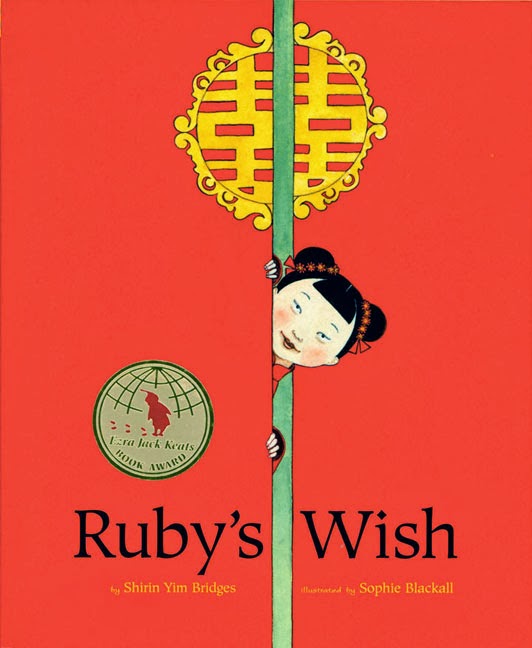
Last weekend I read a title that I just knew I had to share with my class: Ruby’s Wish written by Shirin Yim Bridges and illustrated by Sophie Blackall.

I brought it in early in the week to read aloud. Students were surprised by so much in this book about a little girl in a prosperous Chinese family wants an education like her brothers and male cousins. She doesn’t want to settle with only marriage and motherhood. This story was especially powerful because it is based on the life of the author’s grandmother. A beautiful example of a little girl who speaks up and the grandfather who hears her. The children were shocked that at one time in China’s history, a man could have multiple wives. They were most surprised that boys could go to University when girls could not. When Ruby received an admission letter for University from her Grandfather, there was lots of nodding. And then the questions. The biggest one: “But why could the boys go to school and the girls couldn’t?” I asked the children if they would like to read more books that explored this question. The room erupted, “YES!”

 Celebration: Following the Questions There's a Book for That

And so, the next day I brought in Every Day is Malala Day by Rose McCarney with Plan International and read it to the students. This book is a photographic thank you letter to Malala Yousafzai for her courage and her determination to speak up for the rights of girls to have an education. Both text and photos (of girls all over the world) are powerful.

“People everywhere wondered why it was so hard for girls to have an education. But you and I know the answer. In many countries bullets are not the only way to silence girls.”

This book inspired outrage. Confusion. Upset and indignation. And rich, important discussion. I overheard two little girls talking about this book as they looked at it again together.

“It’s the ladies who should be having the most education because they are mostly watching the kids and kids have lots of questions. The Moms need to know stuff.”

Every Day is Malala Day  Celebration: Following the Questions There's a Book for That

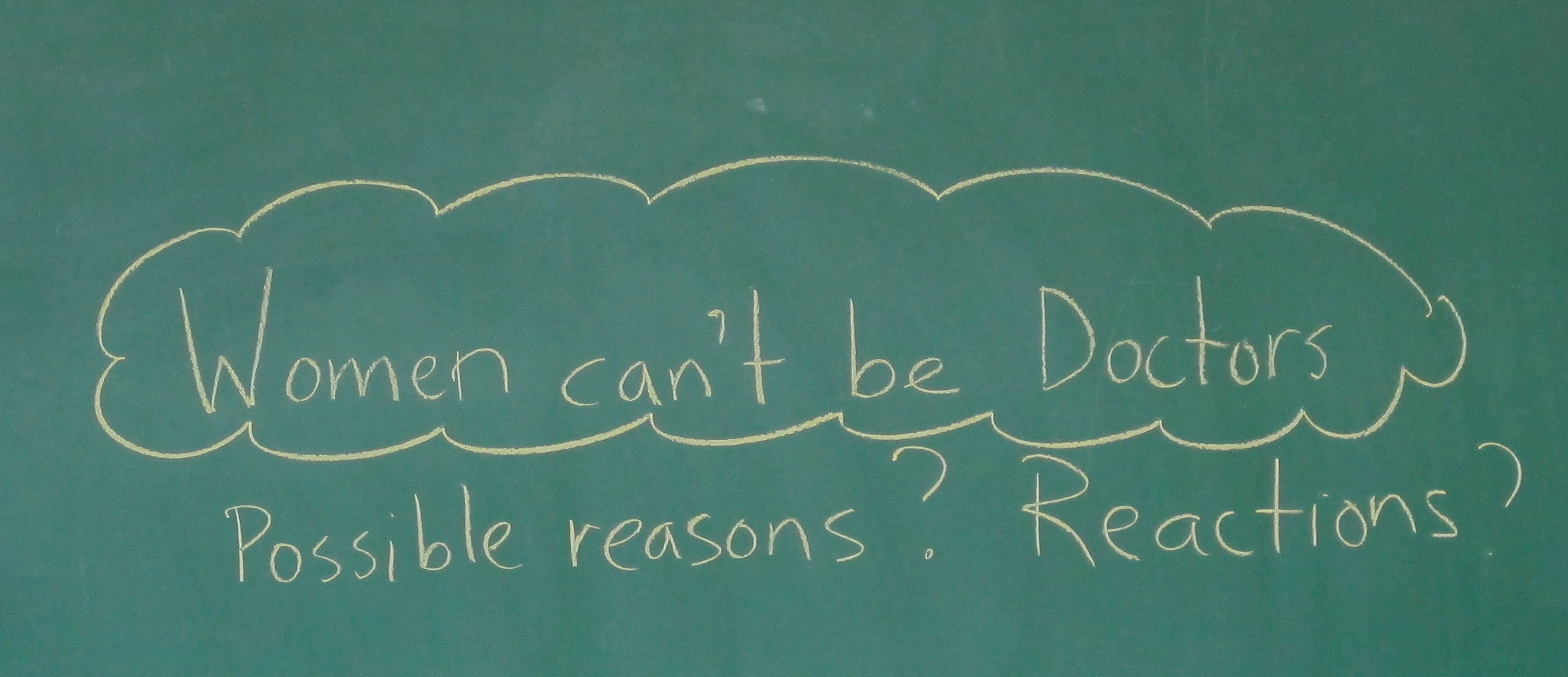
On Friday Morning, with the intention of sharing Who Says Women Can’t Be Doctors?: The Story of Elizabeth Blackwell written by Tanya Lee Stone and illustrated by Marjorie Priceman, I put this statement on the board in the morning:

 Celebration: Following the Questions There's a Book for That

As students noticed it, it became very interesting in the room. There was whispering. Some children raced over to me immediately.

“Ms. Gelson, why did you write that on the board? Womens can be whatever they want!”

More children started to express their upset and confusion.

“I can be a Doctor. I’m a girl. I can be.”

“Really, I can’t be a Doctor?”

“Oh no. The girls are going to be mad about this. I don’t think it’s true.”

“No. It is true. My Mom was told she couldn’t be a Doctor in her country.”

“Are the girls only allowed to be nurses? That’s stupid.”

I had to reassure everyone that I didn’t believe this statement but had put it up as a writing prompt. I asked them to go write for 10 minutes about their thinking. Many leaped up to share their thoughts with each other as they wrote.

 Celebration: Following the Questions There's a Book for That

Excerpts from some student writing are shared below. Note that I am sharing the writing from both boys and girls here:

“Why can’t women be doctors? It is silly. It can be possible for women to be doctors. Women can be whatever they want.”

“Silly! Sad! Because the girls don’t get to be doctors and the boys do. The girls just have to be the stinky old nurses. Why can’t the boys be the nurses and the girls be the doctors?”

“Women can be whatever they want if they put their heart to it! That makes me mad. That’s so silly. That’s not fair. Why would they think that? Wwwwwwhy!!!??”

“Some womens can be doctors if they’re more smarter than the boys. All that matters is about knowledge. It doesn’t matter if you are female or male.”

“Why? It makes me mad because they can. Girls are smart. They should have an education.”

“It seems really unfair if this is true. Because if boys are doctors, girls can be doctors too.”

This little thinker worked out her questions and thinking as she went.

“Why only boys can be doctors, not girls? Can girls and boys be doctors? Can it be girls too? Girls can be doctors too”

This girl who wants to be a doctor, wrote this very powerful statement”

“That is silly. I am a doctor. Why can boys be everything? I am happy because I live in Vancouver. And in Vancouver, I can be everything! And in Vancouver in 2014, I can do everything!”

We came back to the carpet and I pulled out the book to read. But one little girl insisted she had to ask something before we started:

“What is it with all of these books talking about girls who can’t do things and can’t have education and stuff? Girls here can go to school just like boys.”

Then the beauty of classroom conversation took over. I sat back. Some children shared about their mothers in other countries not having the same possibilities. Some children reminded everyone that it is different in history and different in other countries. There was lots of talk and lots of buzz and finally we were able to begin this book.

Who Says Women Can’t Be Doctors?: The Story of Elizabeth Blackwell written by Tanya Lee Stone and illustrated by Marjorie Priceman

 Celebration: Following the Questions There's a Book for That

We only read the first five or six pages and I had to promise that we will finish it next week. The best request?

“Can we talk more like this next week too?

The Other Side of Me

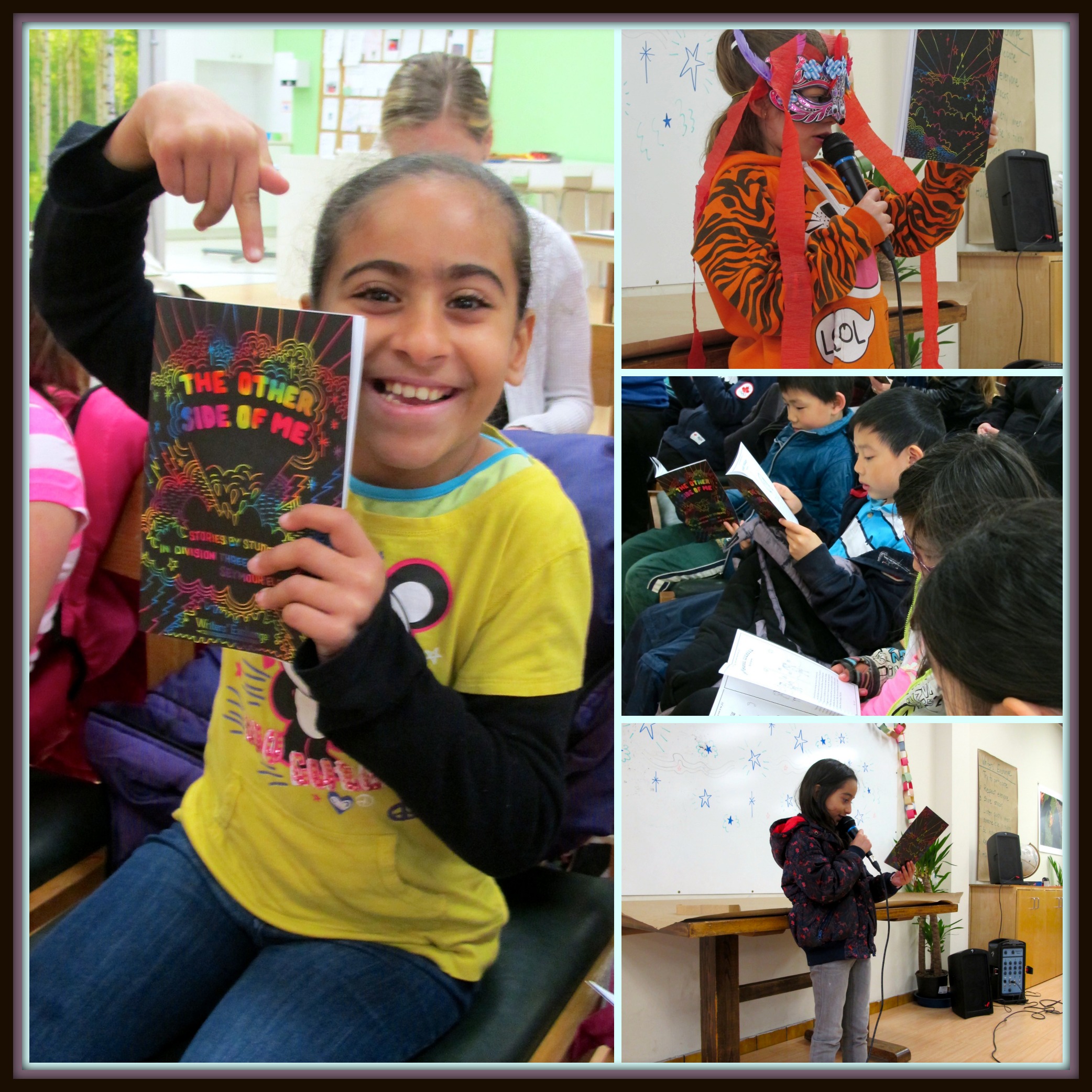
“Lost in a book? It’s the best place to be!”  I often say this in our classroom when the bell rings and everyone is so busy reading or listening to a story that nobody has noticed the time. But how much better is it when the book we are all reading (see below) is a book of stories written by our classmates? Add to this that each of us has our own copy to keep! And . . . that this book is the product of a whole lot of amazing process work: talking about, planning, writing, editing and illustrating a story with the help of staff and volunteer mentors from the Writers’ Exchange.

IMG_4068

This was our journey:

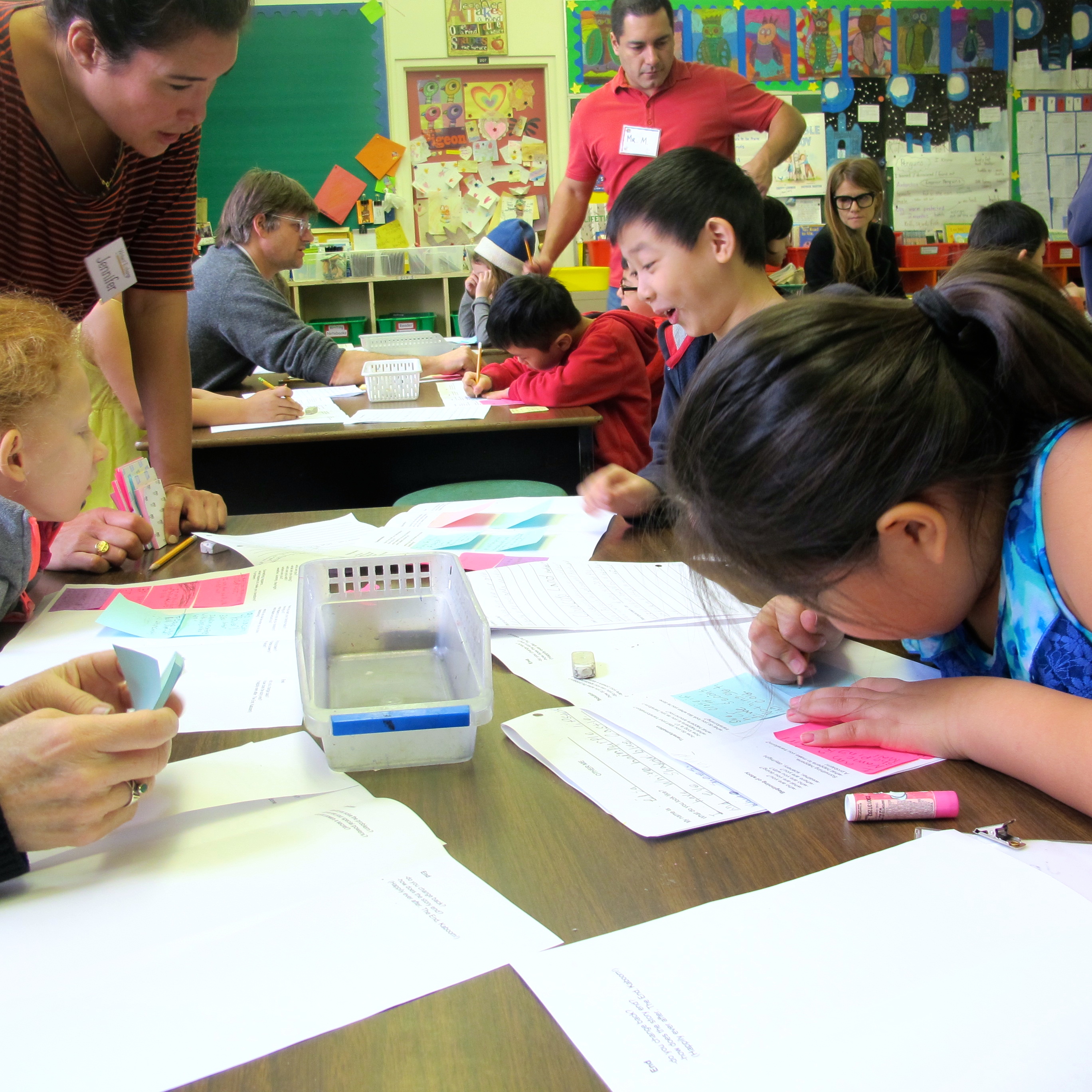
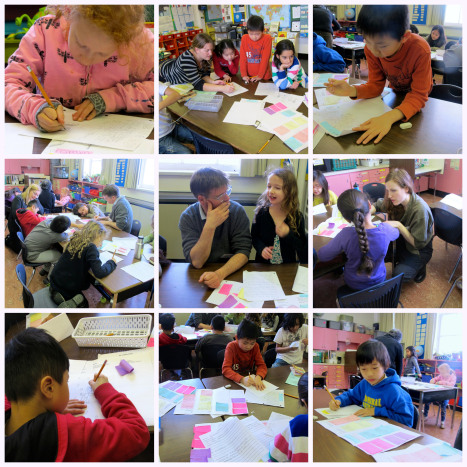
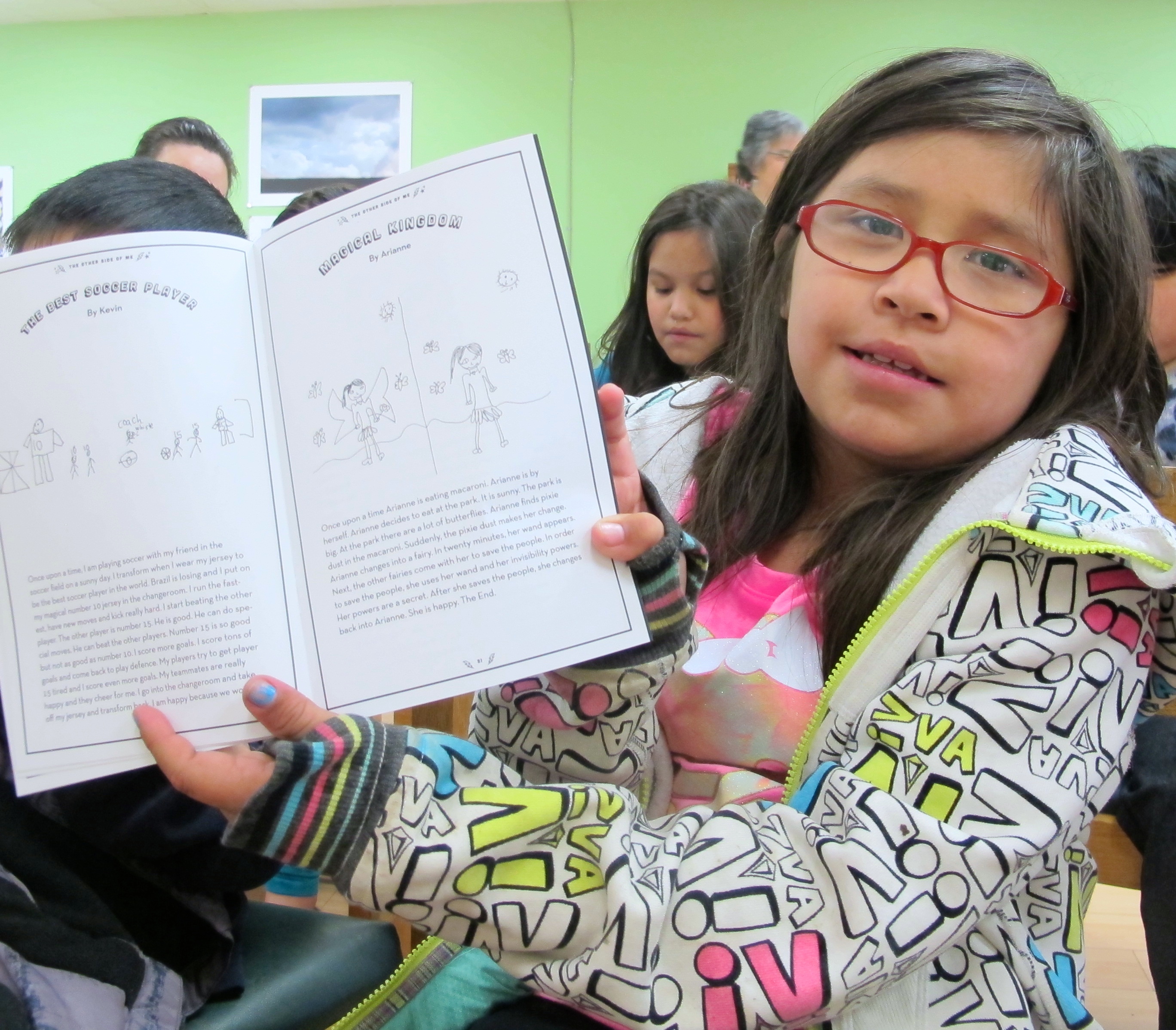
On Day 1, Jennifer from the Writers’ Exchange arrived at our class with four volunteer mentors ready to begin working with students on a creative story. We split into four working groups and Jennifer led us through some engaging get to know you guessing games. Students then filled out a story planning sheet in preparation of writing a transformative story – where they would turn into another “version” of themselves to have a small adventure. With the help of the mentors and school staff, all of the children made a great start on story ideas.

 The Other Side of Me Our Journey with the Writers' Exchange There's a Book for That

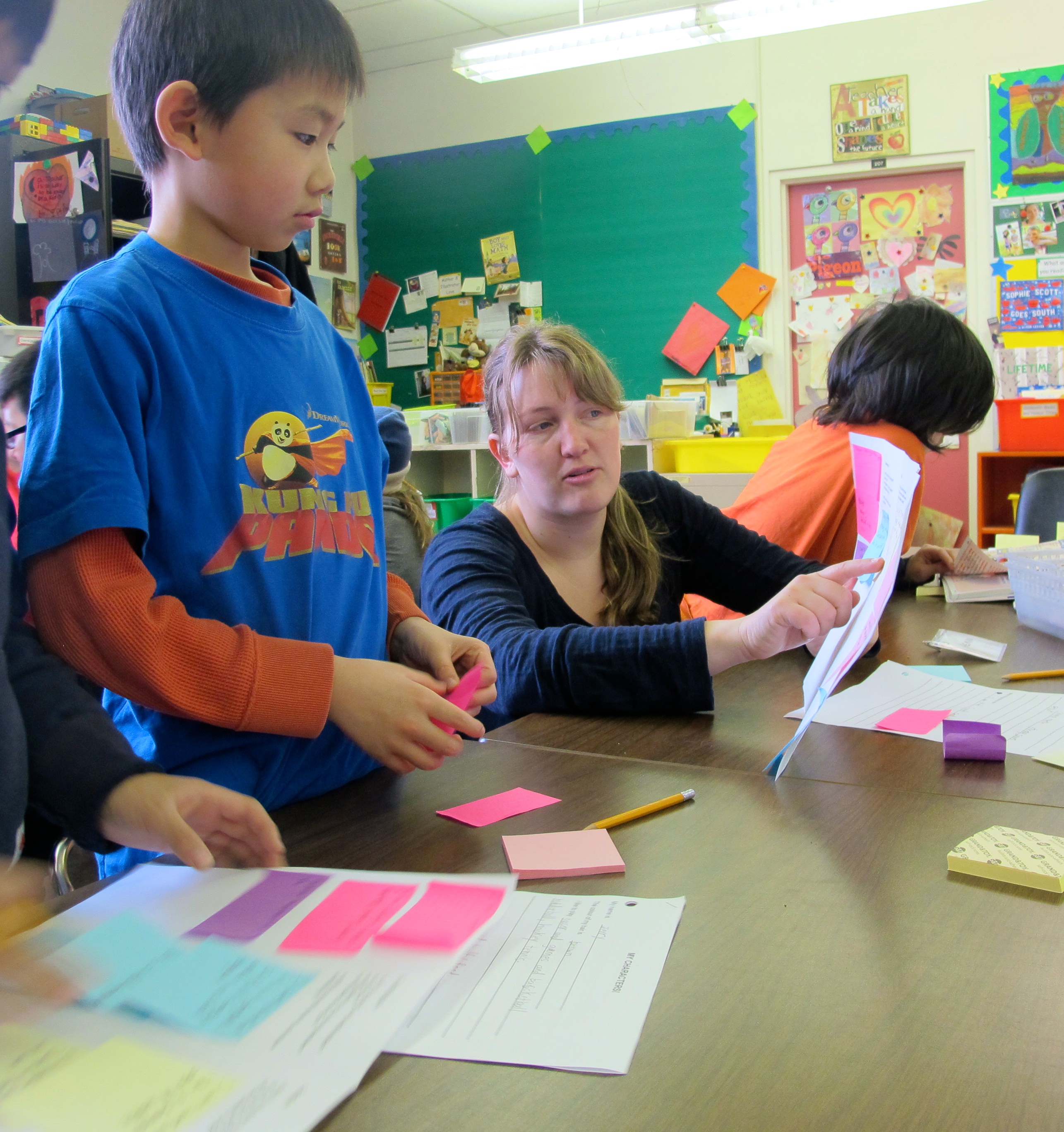
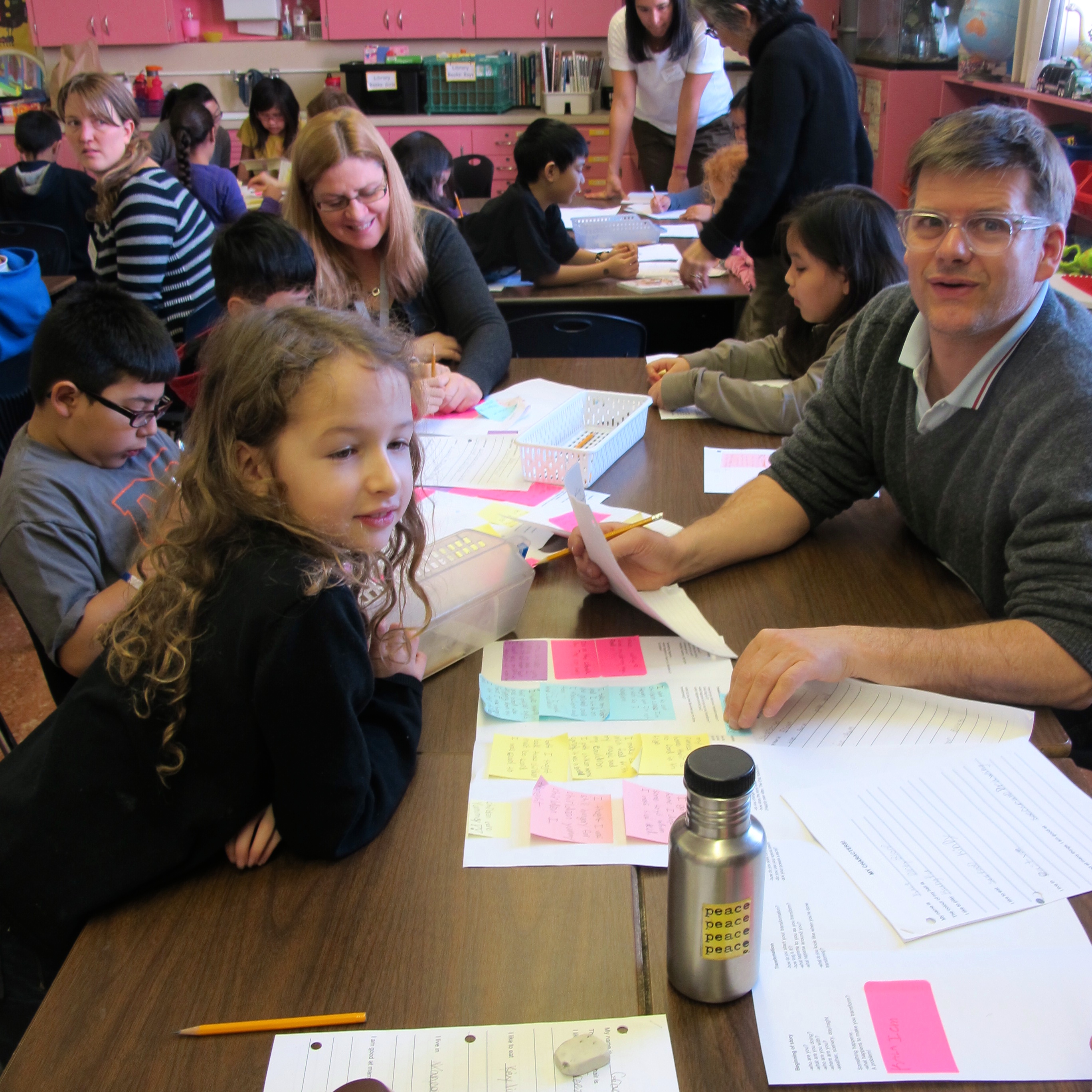
One week later was Day 2. The day we called “Sticky Note” day. Our young writers added various details to Story Maps to flush out their story ideas. Clever mentors seemed to know that these colourful sticky notes were great inspiration for writing a lot of details! And they also make great moustaches. Don’t you think?

 The Other Side of Me Our Journey with the Writers' Exchange There's a Book for That

While I knew we were on route to some really fun stories, I particularly loved all of the talk time with our mentors. Students were so engaged and so excited to discuss their ideas. They were able to listen to feedback and were inspired to stretch their thinking.

 The Other Side of Me Our Journey with the Writers' Exchange There's a Book for That

 The Other Side of Me Our Journey with the Writers' Exchange There's a Book for That

 The Other Side of Me Our Journey with the Writers' Exchange There's a Book for That

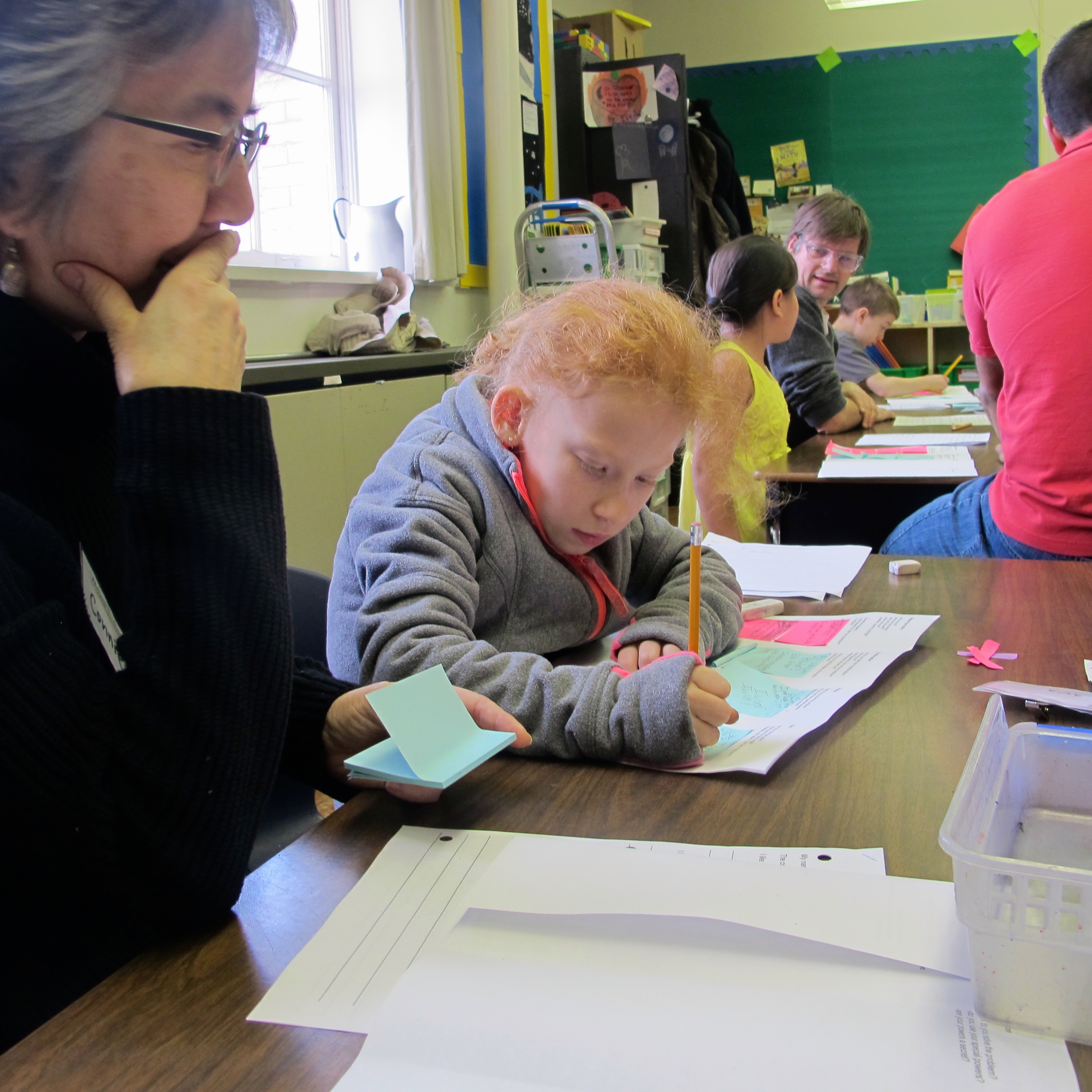
Day(one week later) was our day to write drafts. Jennifer explained that in some places we could just transfer some of our sticky notes and write details/words around these ideas. This certainly took the pressure off students who were worried about rewriting everything again.

 The Other Side of Me Our Journey with the Writers' Exchange There's a Book for That

Look at how many adults were in the room talking and engaging with students! It was a beautiful thing! Many students actually wrote and edited their drafts in this one hour work period.

 The Other Side of Me Our Journey with the Writers' Exchange There's a Book for That

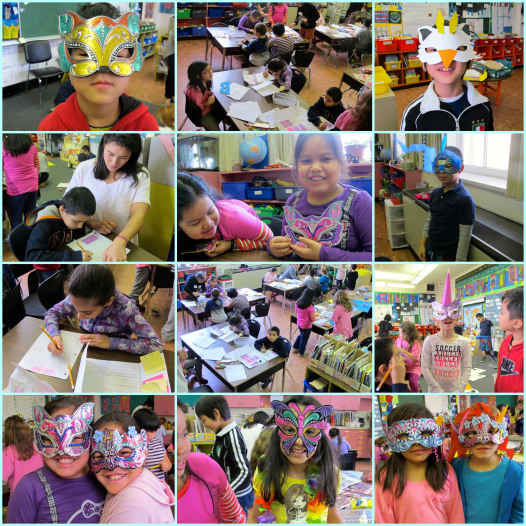
Day 4 was a busy, busy day! Final edits and drafts were completed and then there was time to make masks, complete illustrations and celebrate creativity! The room was full of language, sparkles and the buzz of imagination.

 The Other Side of Me Our Journey with the Writers' Exchange There's a Book for That

And then we had to wait . . . Jennifer and her team brought our stories and illustrations back to the Writers’ Exchange where they would be passed along to those people who worked on the editing, design and layout of our book. In the meantime, we had to decide on a title for our book. We thought The Other Side of Me was a brilliant idea! It captured the essence of our stories of transforming into another “enhanced” version of ourselves.

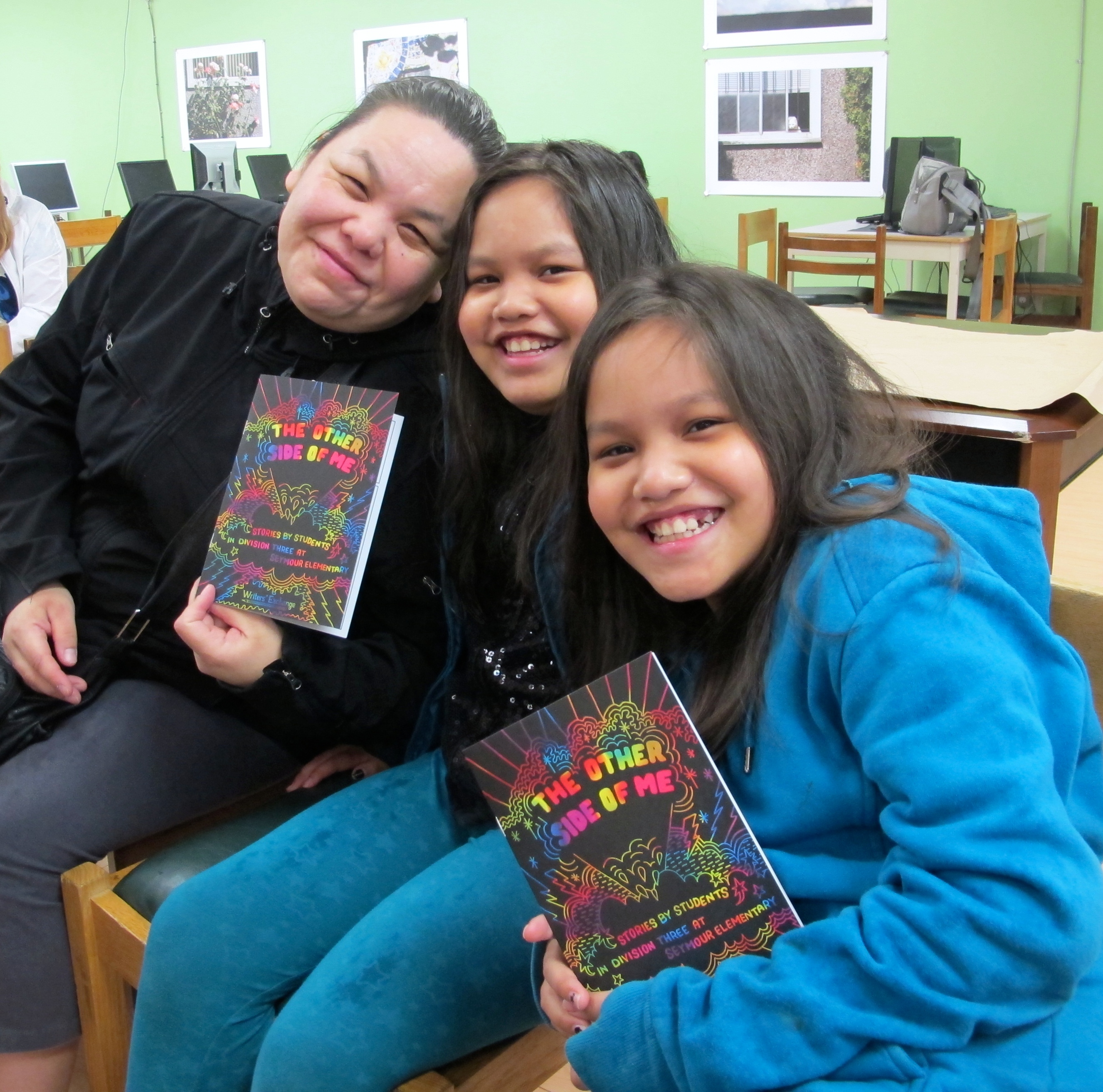
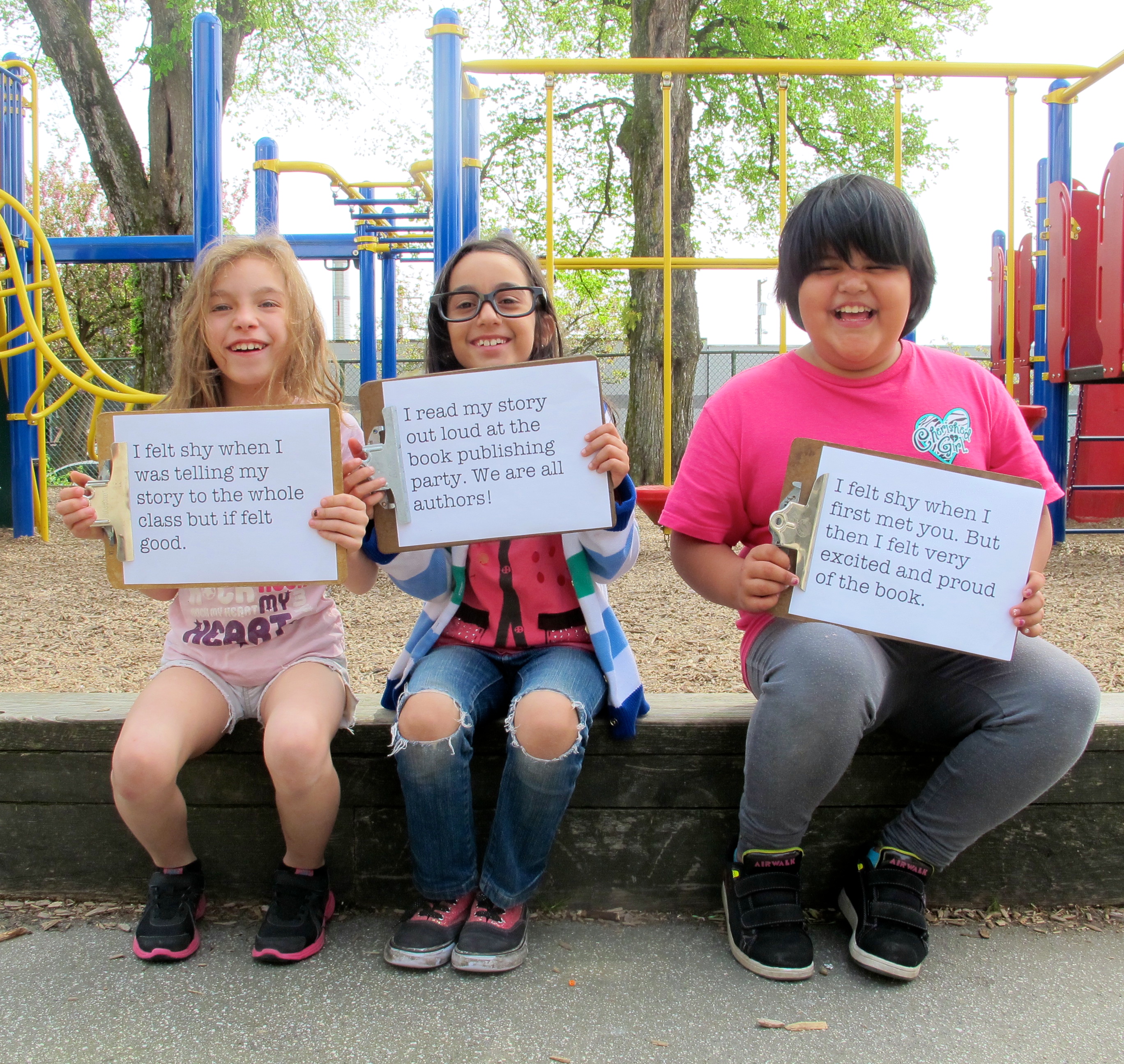
On April 23rd, we had our Book Launch party at the Writers’ Exchange (located just a few blocks away from the school). Yes, there were treats (the brownies were perhaps the biggest hit!) but first we received our books and students were invited to come up and read in front of classmates, Seymour staff and mentors. We even had two Moms come along to celebrate!

As our brave students read their story, everyone else followed along. The respect and focus was incredible. Some of our quietest children volunteered to read. Let’s just say that the adults in the room were in a constant place of “emotional awe”.

 The Other Side of Me Our Journey with the Writers' Exchange There's a Book for That

Proud writer showing us her story.

 The Other Side of Me Our Journey with the Writers' Exchange There's a Book for That

Proud Mama with her two little authors.

 The Other Side of Me Our Journey with the Writers' Exchange There's a Book for That

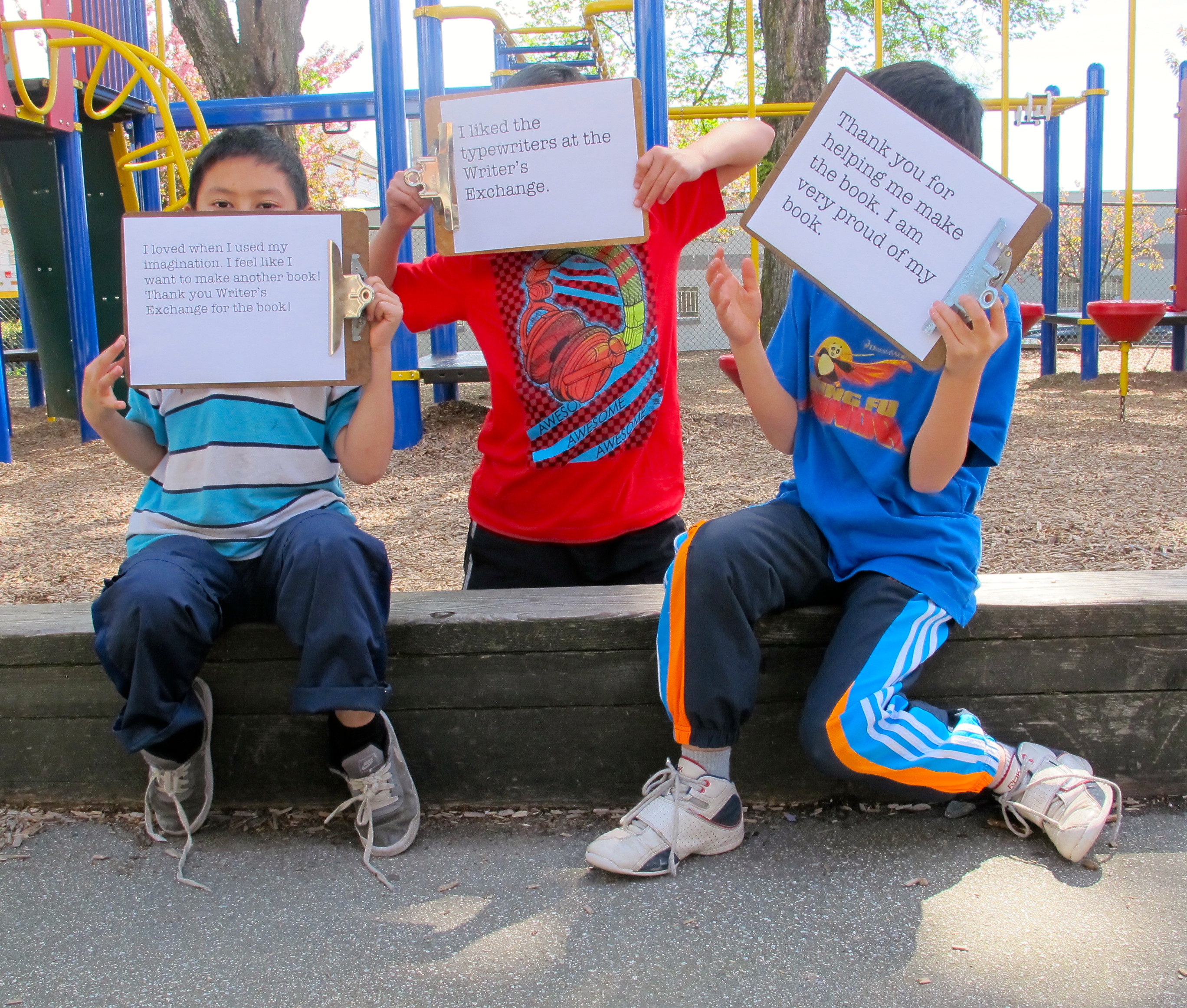
A few days later, students filled out feedback forms about the experience. Here are some answers to the prompt: My favourite thing about working on this project was . . . 

  • writing my story. I like when we made our own books
  • reading, making and drawing my character
  • the nice mentors. I get to use my imagination.
  • making us better at writing
  • that we can put anything we want. We can write mythical!
  • our story! our own ideas! And now we can make our own book at home
  • we made our own stories with our own ideas and they are brilliant ideas
  • everyone feels like a star
  • everyone feels like a real author

Students then did some writing about what this project meant to them and what they were grateful about. I typed out key ideas from each child and these were used as part of a thank you photo series for the staff and mentors who worked with us. This thank you post (The Other Side (and side and side and side) of Me) can be found on our classroom blog. It is well worth taking a peek at! Here are just two photos that are part of the post.

 The Other Side of Me Our Journey with the Writers' Exchange There's a Book for That

 The Other Side of Me Our Journey with the Writers' Exchange There's a Book for That

More information about the Writers’ Exchange can be found on their website. From the inside of our “chapbook”:

The Writers’ Exchange makes literacy exciting and accessible for inner-city kids through free mentoring and creative writing projects like this chapbook.

Our gratitude is huge for everyone who helped make this book possible: staff and volunteer mentors from the Writers’ Exchange, Seymour staff and volunteers and the huge generosity of all those who provide donations for this amazing program!

Our little writers feel all kinds of pride!

Celebration: All is better with a little gold dust

celebrate link up

Celebration honoured. This is the loveliest of reasons to share. Join Ruth Ayres who shares a Celebration Link up on her blog each week.

I had a fantastic week back with my students. I think all of us were thrilled to be together again after a two week break, learning and sharing. I have many things to celebrate this week!

1. I loved all of the #MustReadin2014 spring updates shared by a wonderfully keen reading community. The Must Read phenomenon was born out of an attempt to gain some control over unruly TBR lists that grow and grow! Check out my update and links to update posts here. Flora and Ulysses: The Illuminated Adventures by Kate DiCamillo is one of my favourite books read so far from this list. Maybe even more special because I read it aloud to my children and we all loved it.

 Celebration: All is Better with a Little Gold Dust

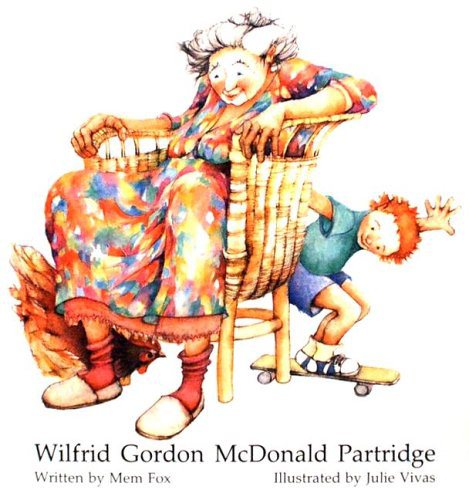
2. I was thrilled to have a Nerdy Book Club post published this week. I saw a request from Colby Sharp for some retro review posts to be shared on twitter a few weeks ago. I have written some other Nerdy posts but never one in this category. I asked Colby if I could share something a little different instead of a review of one specific title. I wanted to go “retro” and look back at titles treasured with my children (now 11!) when they were preschool age. It was a nostalgic look back at books we adored. Read the post here.

Wilfred Gordon McDonald Partridge  Celebration: All is Better with a Little Gold Dust

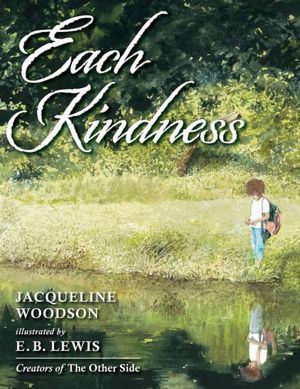
3. I read the powerful picture book Each Kindness by Jacqueline Woodson illustrated by E.B.Lewis to my class this week.The reactions and comments were quite incredible. I think I might share some of their thinking and writing on our classroom blog. But the most interesting moment came with the ending. If you have read this book, you know that it ends with Chloe standing at the shore of the pond feeling a mix of regret, sadness and guilt. Her opportunity to offer kindness to Maya is gone. The story ends with these words:

“I watched the water ripple as the sun set through the maples and the chance of a kindness with Maya was becoming more and more forever gone.”

At first there was silence in the room and then one girl erupted, “What?! That’s terrible! It’s a terrible ending!” It’s not terrible. It’s just not happy so it’s confusing a bit,” someone else added. Another child piped up,”It makes you think about drama and saying sorry. It makes us think. It’s good.” As we were getting ready to move on to Reading Workshop, another child said, “I liked it. I have been waiting for a bad ending in a book. Not bad like not good but every ending shouldn’t be happy – that’s not how life is.” This little girl asked me to help her find a new novel and we kept talking about the story. I asked her if she wanted to put her thoughts into a reader’s statement (we have a huge wall of these posted on a bulletin board). She came up with something that I think is quite brilliant:

Readers can’t always expect a happy ending.

That books inspire discussions and thinking like this – this, I celebrate!

 Celebration: All is Better with a Little Gold Dust

4. Ah . . . book love! My students were happy to be back to our classroom full of books. I sensed it on Monday morning when an instant hush fell upon the room when we started Reader’s Workshop. I did “book commercials” for new books all week and this generated lots of excitement.

I felt the book love when I saw “who reads it next” lists being created and stuck to new books.

 Celebration: All is Better with a Little Gold Dust

I felt it as I observed the wonderful engagement of one to one time with various adults who listen to children read and talk about stories and thinking with the students.

 Celebration: All is Better with a Little Gold Dust

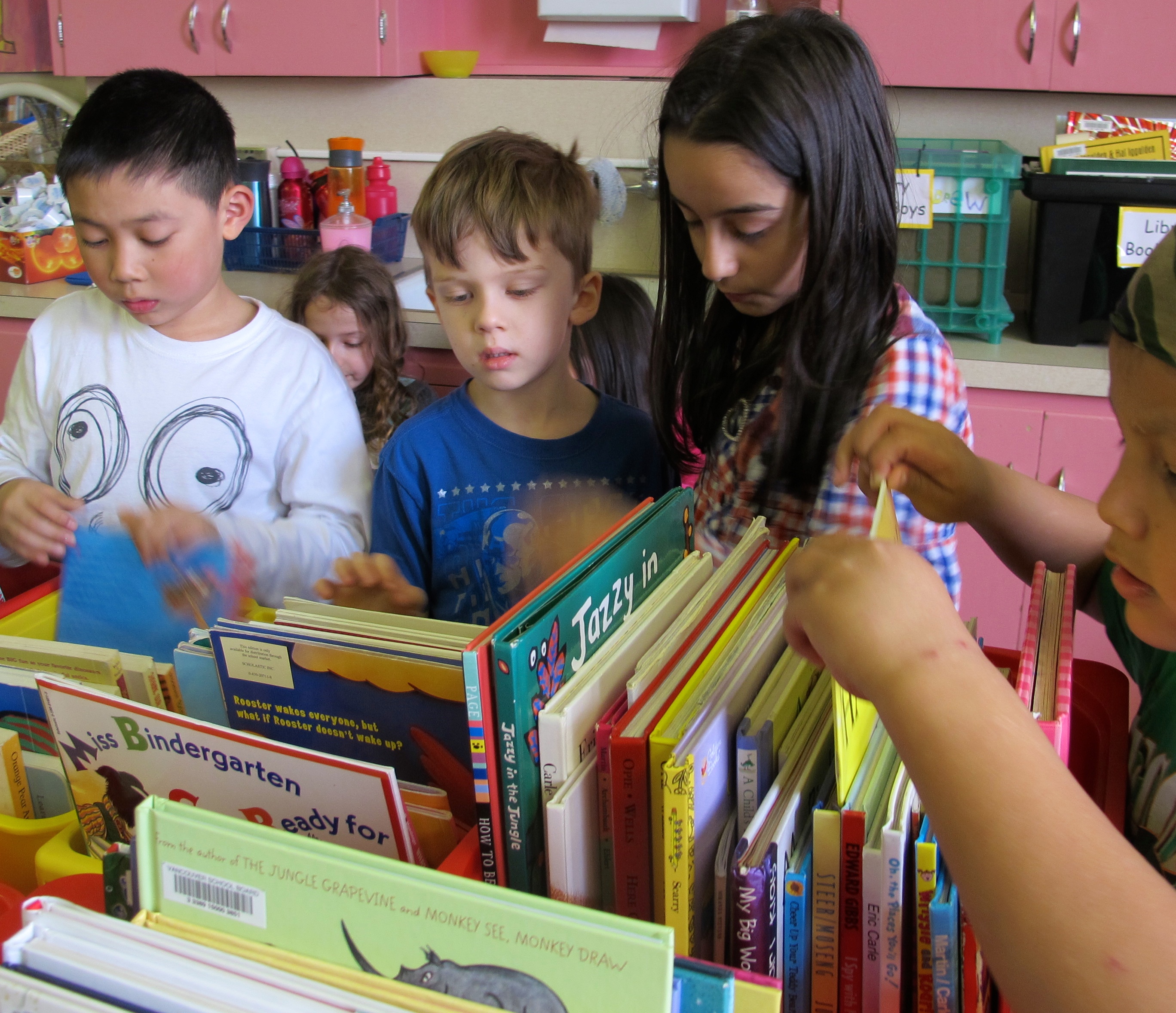
I sensed it when listening to the the buzz around the book bins during buddy reading time with the K/1 class.

 Celebration: All is Better with a Little Gold Dust

Ah .  . . book love!

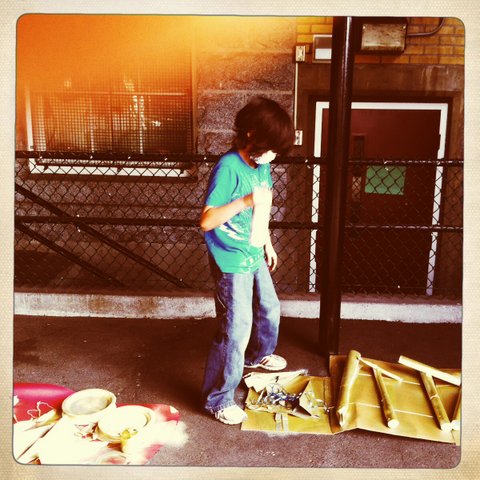
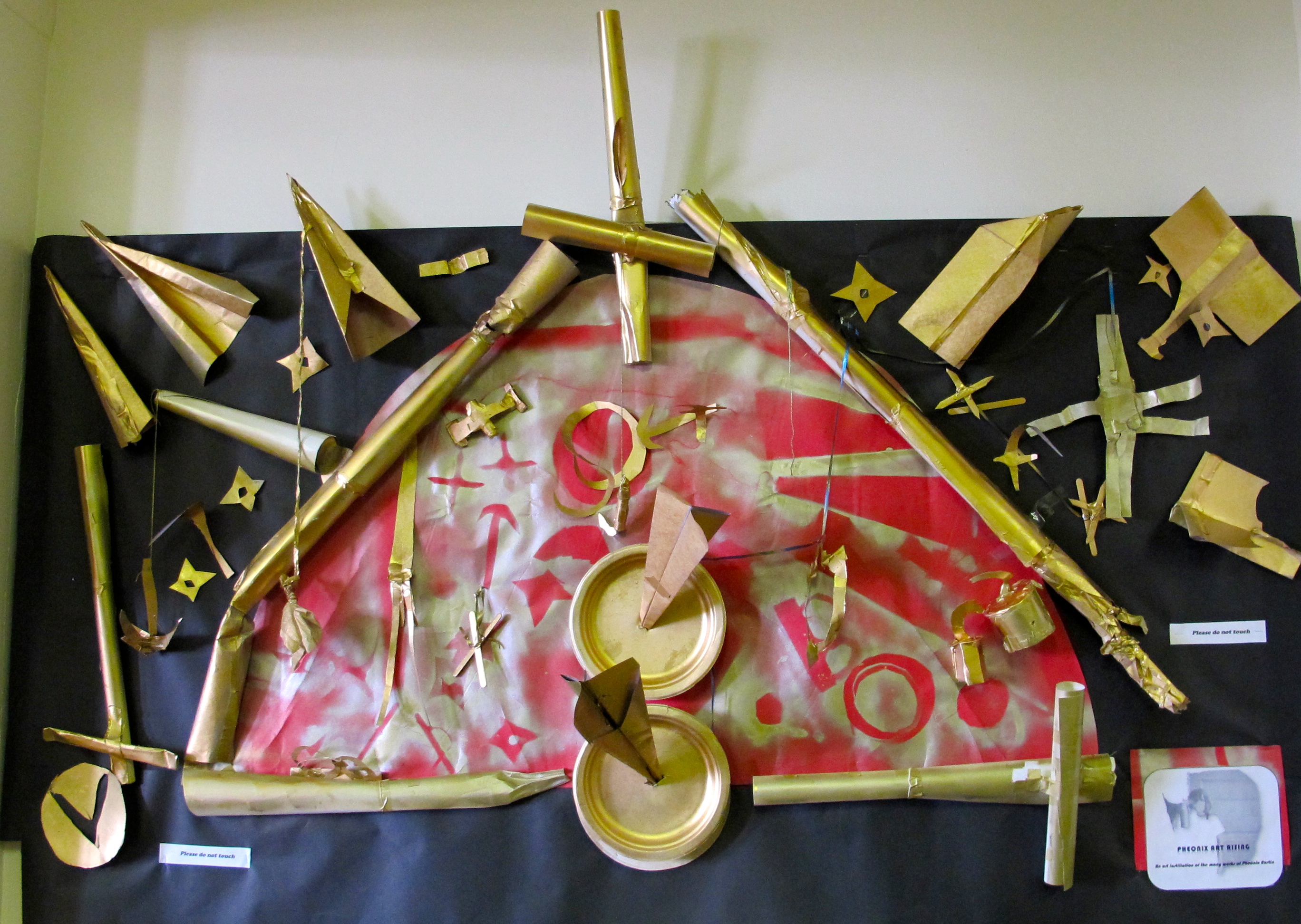
5. If you have hung in reading this very long Celebration post (it was a wonderful week!), here is the pot of gold 🙂 One of our students makes a lot of paper objects and sculptures all throughout the day. It helps him to focus and listen. We started thinking . . . Wouldn’t it be great to showcase some of his work? Wouldn’t it be better if it was spray painted gold? Absolutely! Here is the young artist at work, gold paint in action!

 Celebration: All is Better with a Little Gold Dust

And here is the installation. Thank you to the amazing Miriam (the Support Worker who I get to work with every day!) for her huge role in displaying and advertising the “piece.” There are flyers pasted up all over the school! When this boy’s Mom came in to see this art and got hugely proud and teary, we all got teary. It was a moment.

 Celebration: All is Better with a Little Gold Dust

I celebrate all the many ways this is golden . . .

What are you celebrating this week?

The Invisible Boy

I know when I read certain picture books that I have a powerful read aloud in my hands. Actually sharing the story with a classroom full of children can sometimes be so touching and illuminating, that I realize that I have underestimated the impact the story will have on listeners. Such was the case with this title:

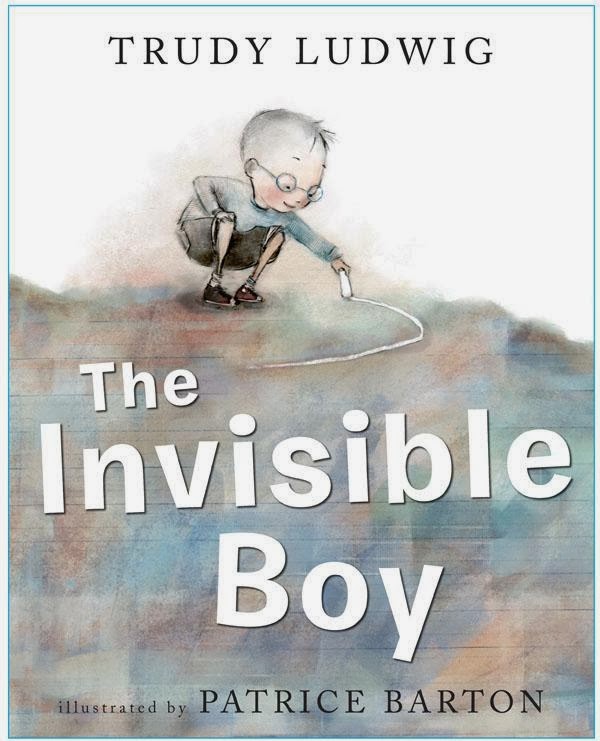
The Invisible Boy written by Trudy Ludwig and illustrated by Patrice Barton is a story that needs to be shared and discussed. In my class, the comments, questions and insights brought tears to my eyes. Children need to talk about this book! Adults need to listen.

The invisible boy There's a Book for That

Before I even began reading this book, I asked children to predict from the cover and title. Here is what was said:

  • “Maybe people don’t treat him well so he doesn’t show himself.”
  • “Maybe people treat him like he’s invisible.”
  • “He might be ignored.”
  • “Maybe they don’t pay attention to him.”
  • “He might be lonely because people don’t be his friend.”

The story begins with Brian who isn’t noticed in a class full of big personalities that demand a lot of attention. Brian, we learn, doesn’t take up much space. He isn’t included in recess games. He isn’t invited to parties. He isn’t able to contribute to lunchtime conversation. Brian loves his art and escapes into his drawings.

At this point n our read aloud, we stopped to talk about what we had observed.

  • “He’s a really good drawer.”
  • “He looks sad when he doesn’t get to play. He’s always on his own.”
  • “Does drawing calm him down?”
  • “What if he told how he felt, would he get to play?”
  • “That teacher didn’t see him right beside her because the other kids are loud and noisy.”
  • “Maybe a new kid will come and they might have something in common?
  • “Yeah and then he could have a friend!”

Students were delighted that on the very next page, a new boy, Justin, arrives in Brian’s classroom. Some of the kids wondered should they be Justin’s friend. Was he cool enough? When kids laugh at Justin’s food in the lunchroom, Brian notices. He wonders “which is worse – being laughed at or feeling invisible.” Brian makes Justin an encouraging note about his lunch. We stopped again to talk and share our thinking:

  • “Maybe if the new boy fits in, Brian will have to draw a friend. He’ll still be alone.”
  • “Do you think he will ask Justin to be his friend?”
  • “They only want to play with cool kids?! That’s not fair!”
  • “Will Justin fit in? Will he still be nice?”
  • “Justin and Brian do have something in common because they are both teased.”

At this point, the question was posed: “What does it mean to be cool?”

  • “In this book it seems to mean all popular and kinda mean to people. But a cool person should be nice and kind and sharing to everyone.”
  • “Why do we need to be cool to be friends? Kids who show off don’t seem cool.”
  • “Cool means people are being mean and making fun.”

When it seems like Justin is beginning to be included and Brian continued to be excluded, Justin steps up and insists Brian be part of a classroom trio to work on a project. The illustrator has begun to add colour to the drawings of Brian. Children noticed this immediately: “He has colour now because he is noticed.” Brian’s smile as he begins to be part of a friendship group lights up the final page. We asked the students the very important question suggested in the back of the book.

“How many kids did it take in this story to help Brian begin to feel less invisible?”

It was completely quiet and then little fingers went up showing one (Justin) or two (Justin & Emilio). Nobody talked as the children looked at each other. Some started to nod. Some shook their heads. One little voice spoke for all of us:

“Oh. I get it.”

Some written responses that need to be shared: 

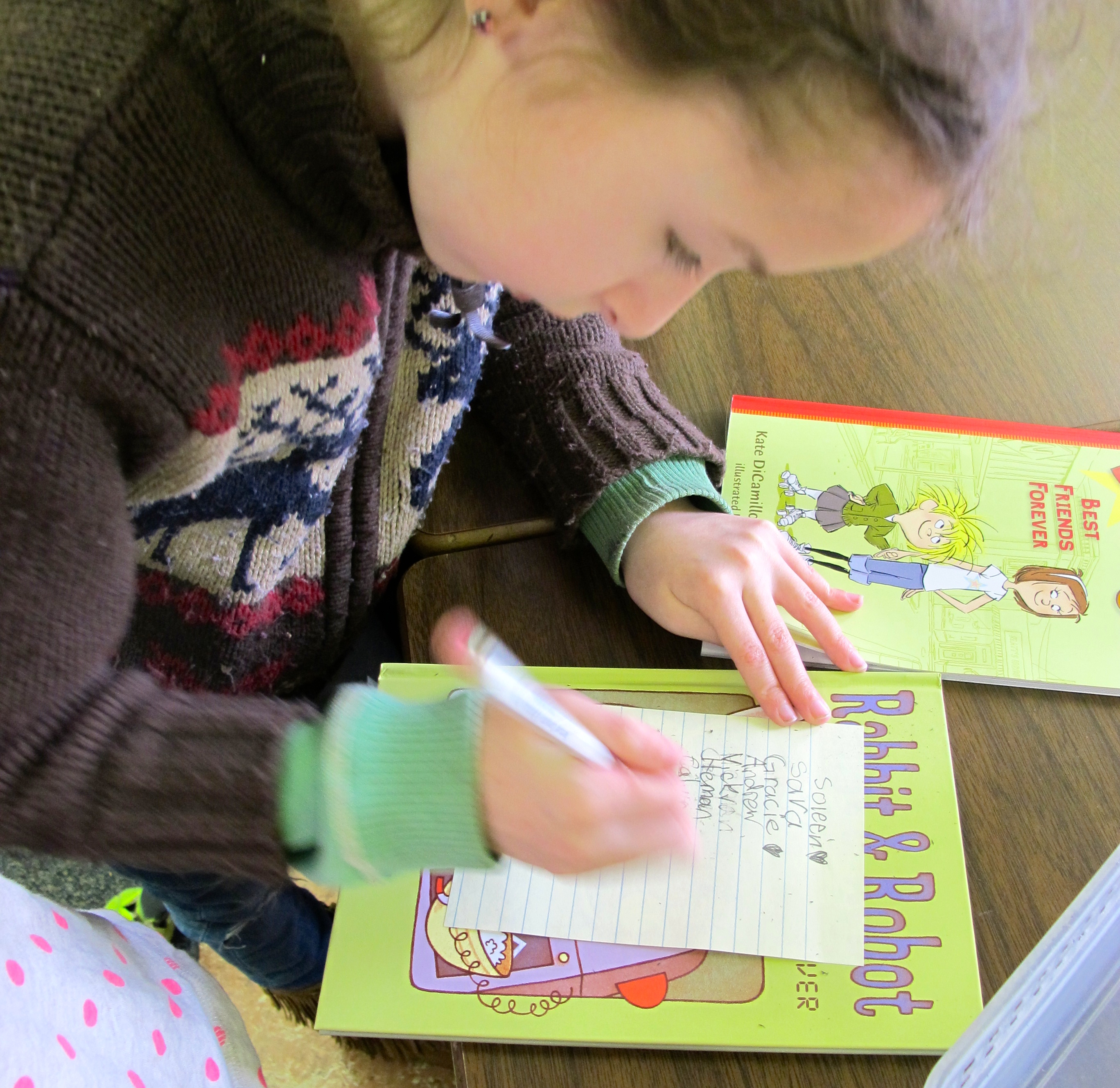
Joeli: Why does the teacher ignore him – even when the teacher can see where he is? Why did the popular kids tease Justin? They don’t know what he is even like. When that teacher was looking for Brian, why she did not look beside her or in front of her? I think she needs glasses.

Soleen: This book is interesting because it suggested that we can help others like ____________ because she is lonely.

Andrew: There was a boy named Brian who was invisible. Justin made Brian not invisible anymore.

Grace: This book inspired me to help kids in our school that feel the same way. Me and my friends are going to play with ________. I think she feels lonely. Even the tracher doesn’t notice Brian. My teacher would never do that. I noticed that when he was invisible, he was black and white. Then when Justin came along and they became friends, he had colour.

Sara: The kids think they are cool but why don’t they think they are all cool? He was invisible but when Justin came, they played together and he wasn’t invisible anymore, Maybe this book is trying to teach us treat others how you want to be treated.

Hyo Min: Brian was sad because no one can see him in his class. Justin and Emilio made friends with Brian. Why other kids need cool friends? I felt a little sad for Brian. Brian wanted to make friends. At the end of the story, he was happy with his new friends. I love the story.

Ibtihal: I learned that kids can make you feel better. When Justin and Emilio made friends with Brian, he turned into colours. The teacher didn’t see him because kids were being loud and noisy. The kids only played with the cool kids. The kids made fun of Justin’s food so Brian made a beautiful picture of his food and wrote “Yum!”

Pheonix: Brian, the invisible boy was gray at first. Then a different boy touched him and he got colour and he was not invisible anymore.

Brian: Justin had something in common with Brian because kids were teasing both of them. When Emilio started being their friends, Brian started to not be lonely anymore.

Heman: I noticed that Brian was feeling lonely. I noticed that Brian and Justin were both being teased at. The kids in Brian’s class only wants to be friends with cool people. Brian felt sad because he was left out. Justin made Brian feel better. Brian was a good drawer. Brian, Justin and Emilio made a story based on a picture and Brian drew the pictures.

Because there are children that don’t seem to take up space but actually have much to offer . . .

Because each child is important . . .

Because no one should feel alone in the middle of a classroom community . . .

Because each of us can make things different for someone else . . .

Share this book with your students.

Come on in and read with us!

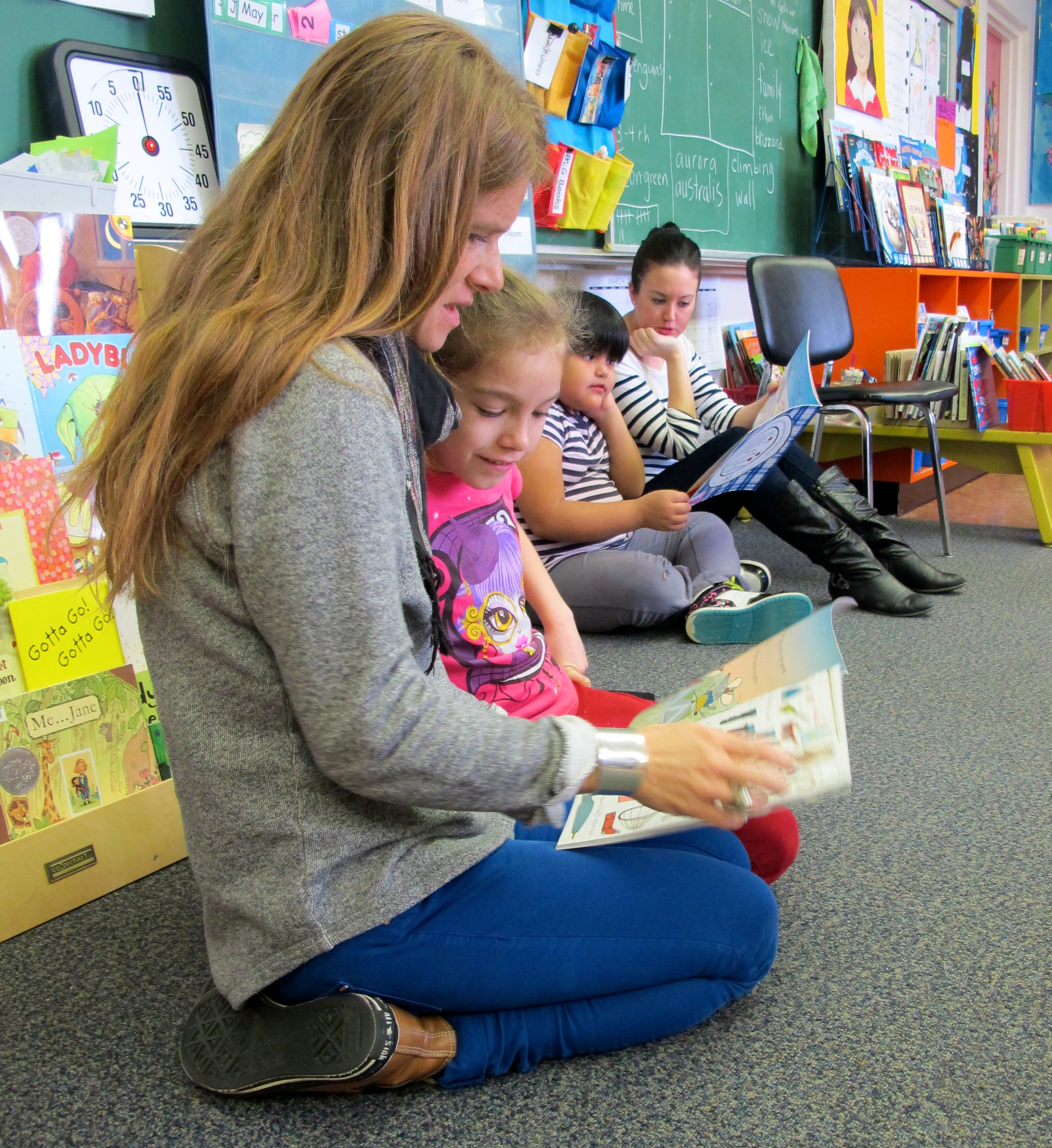
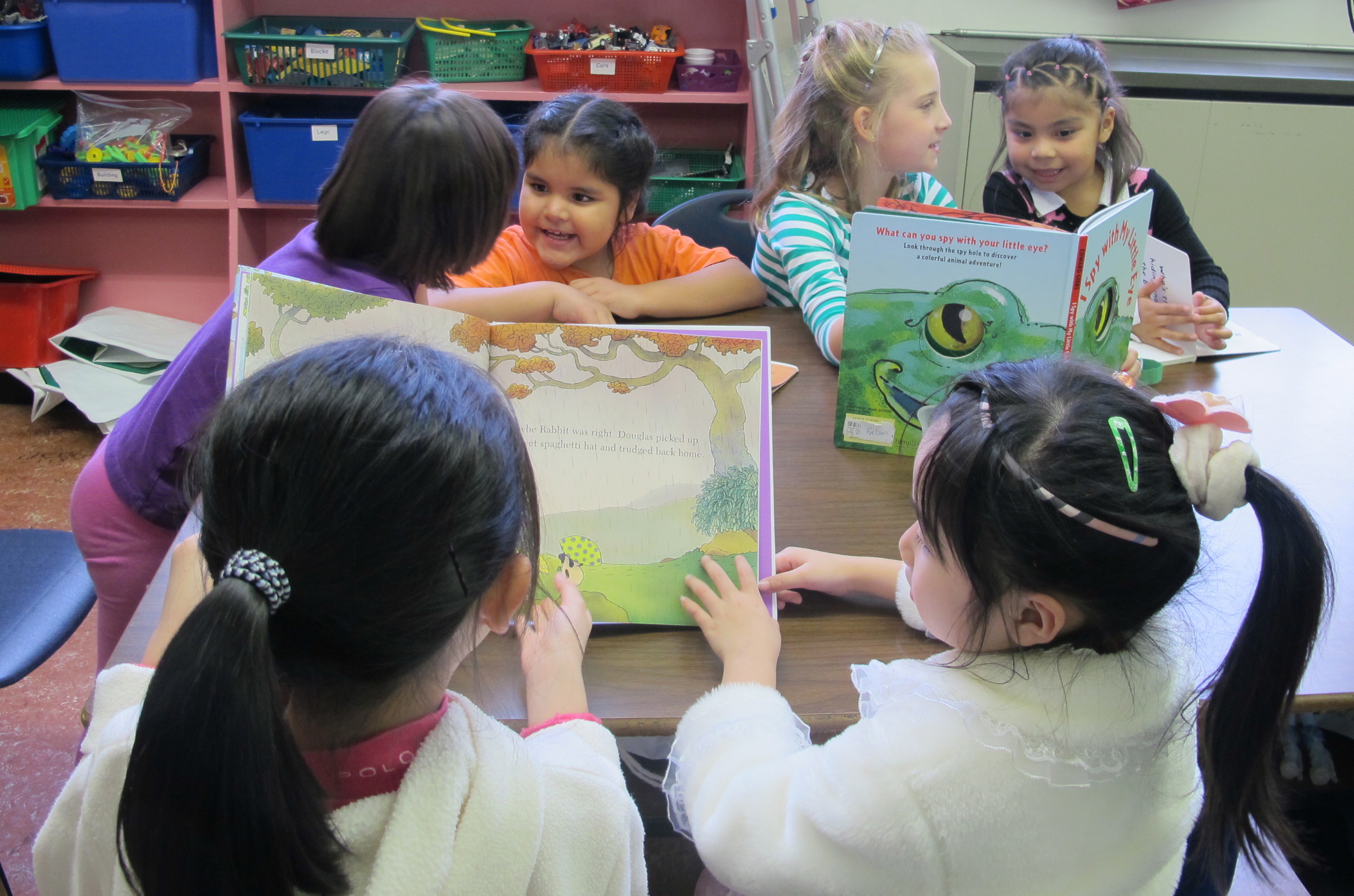
It is no secret that I love books. Books, books, everywhere you look! That is one way to describe our classroom. But the best thing about books is the readers who enjoy them. Sharing the reading experience is an important way to build a community of readers. Time exists everyday for reading and the adults who work in my classroom or visit regularly love to be part of the action.
 
Come on in and read with us! The top ten benefits of shared reading with adults. There's a Book for thatLucky for us, we have numerous volunteers who are a regular part of our week, spending time with us in the classroom. Often, that time involves a shared reading experience  When children and adults read together, everyone benefits – the adults, the children and the teacher (lucky me :-)). Shared reading builds community at the same time as it helps to develop reading skills and a positive attitude about literacy. There are so many benefits – here are my top ten!
1. Fluent models: Opportunity to listen to an adult read. We all know how important this is to help students become more fluent readers. When reading with an adult, there is often turn taking with a story and so the child has the opportunity to sit back and benefit from the modelling of a proficient adult reader who demonstrates the importance of phrasing, expression and enthusiasm as they read.
2. Oral Reading Practice: The students also have time to work on their own oral reading fluency. Reading aloud to an adult is wonderful practice!
Come on in and read with us! The top ten benefits of shared reading with adults. There's a Book for that
3. Enhancing conversation skills: All kinds of talking happens when sharing a book. “How about you read that page and I read this page?” “Can you help me if I get stuck on a  word?” “I’ll be Piggie and you be Gerald!” “What was your favourite part?”
4. Vocabulary Development: As stories are discussed, new words and concepts are introduced. Children are exposed to more new words through reading books than just having a casual conversation. When an adult is working one to one or with a small group, there is the opportunity to talk about unknown words or concepts that are not clear.
Come on in and read with us! The top ten benefits of shared reading with adults. There's a Book for that
5. Time for tangents: It is always wonderful when a story takes you off in a few directions, sharing stories and connections. “That reminds me of . . . ” “Did you know that I . . .?” “Have you ever . . .? ” Time reading with an adult means these important conversations can happen.
6. The gift of time: One to one attention that conveys, “You are important. I like this time we spend together. It matters.” Enough said.
Come on in and read with us! The top ten benefits of shared reading with adults. There's a Book for that
7. Bonding over books: Books are the bridge that help connections form. It is easy to share and talk about books, laugh about stories and learn new things together. As the reading and learning happens, the connections and bonding does too. Magic.
8. Pride: Positive feedback from an interested adult directly impacts the confidence and pride young readers feel about their growing skills.
 Come on in and read with us! There's a book for That
9. Making book love contagious: This happens when we share our love of reading with children. The more people sharing, the more that is shared! I am so thankful for all of the adults who help me ensure that students are catching the love of reading.
10. Reading = Enjoyment: The association of happy experiences and reading is essential if we are going to create life long readers. Not all children have had the experience of being read to by a loved one. Shared reading in the classroom with a caring adult helps students to have positive associations about books. And isn’t that what it’s all about?
Come on in and read with us! The top ten benefits of shared reading with adults. There's a Book for that
 During our busy school year, I don’t always have the time to properly celebrate all of the wonderful adults who share reading time with my students. This post is my tribute to all of them. What you do means so much!
A reading community is very important in my classroom.
Other posts on this topic:

Come and see what I celebrate

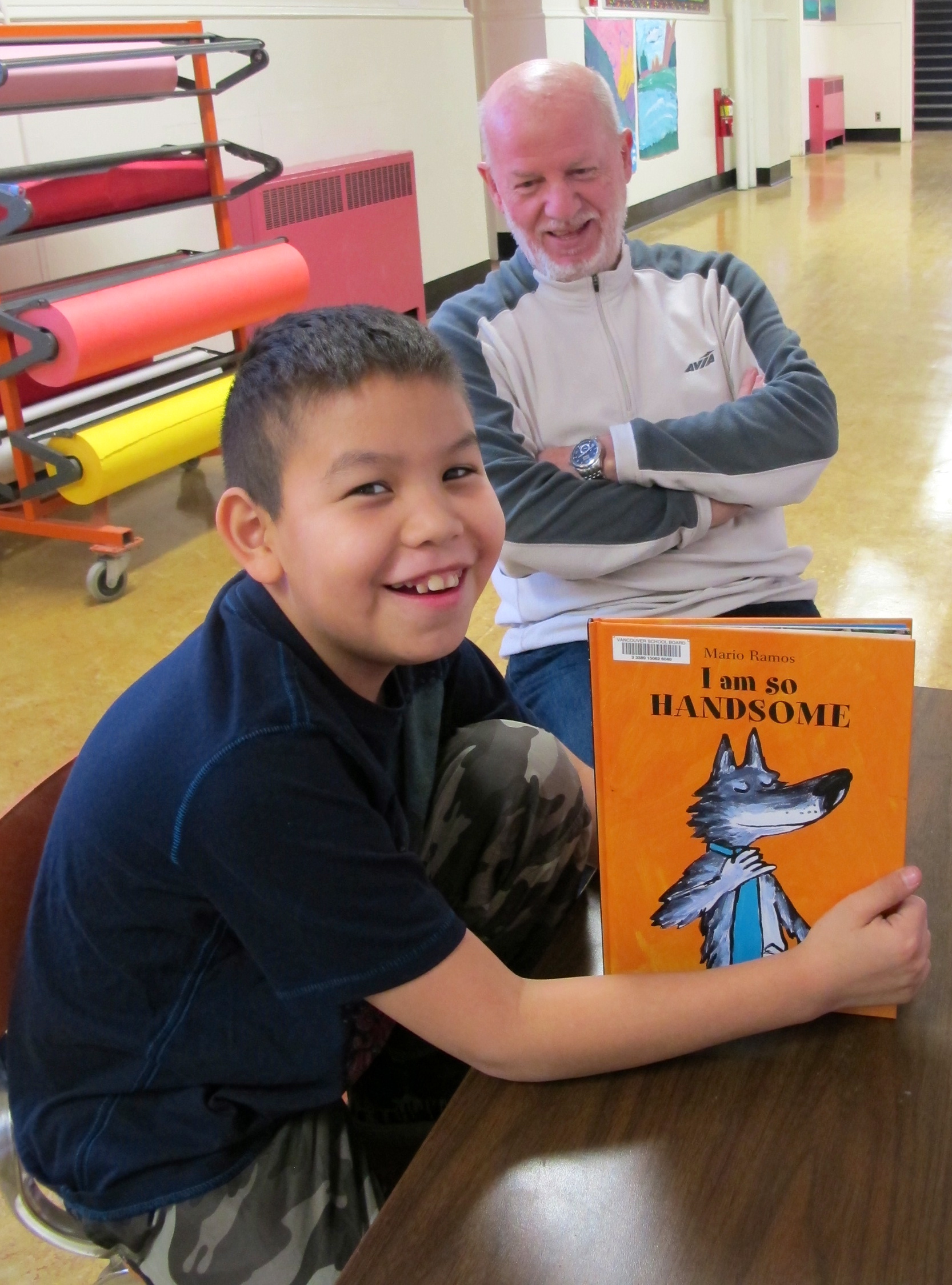
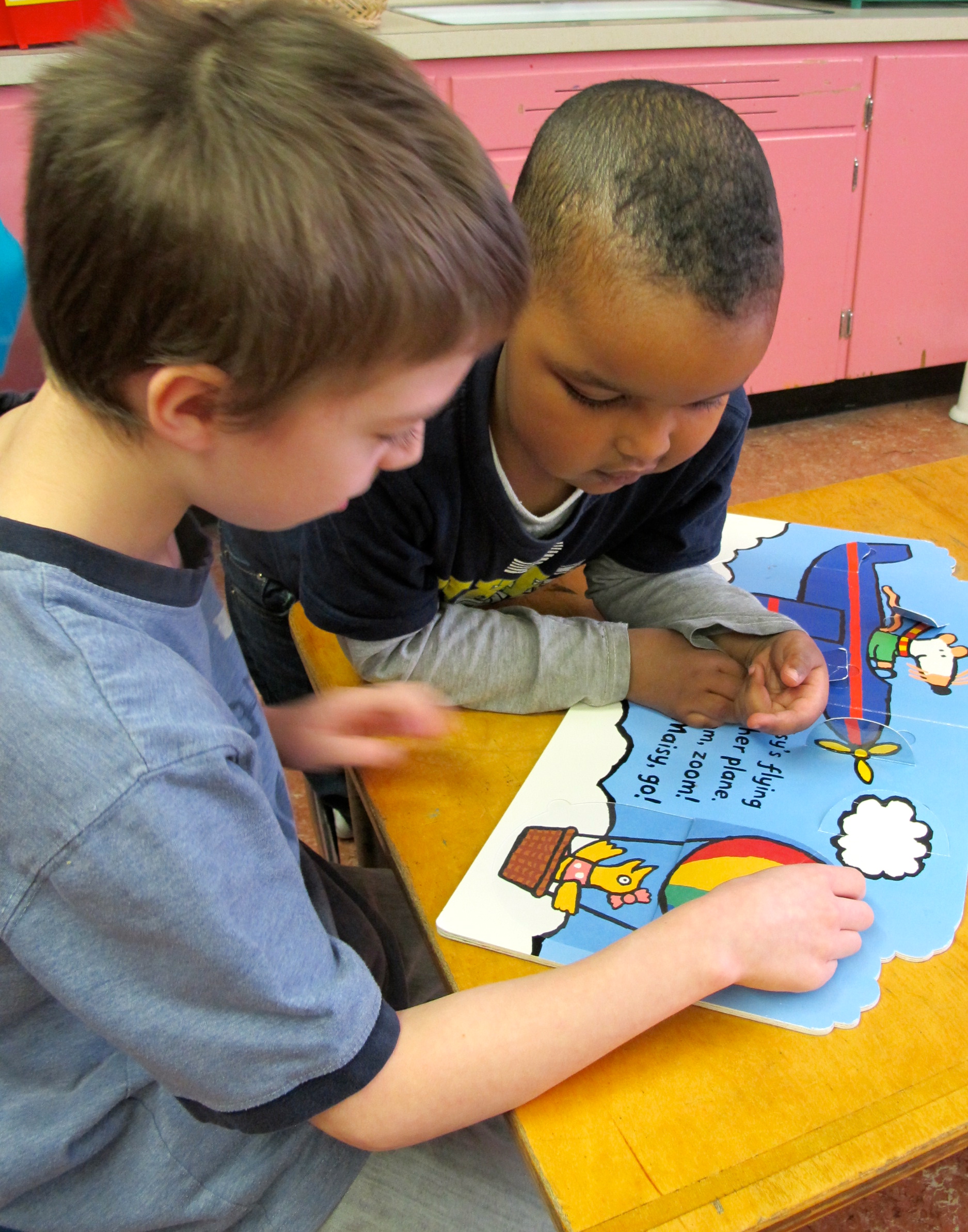
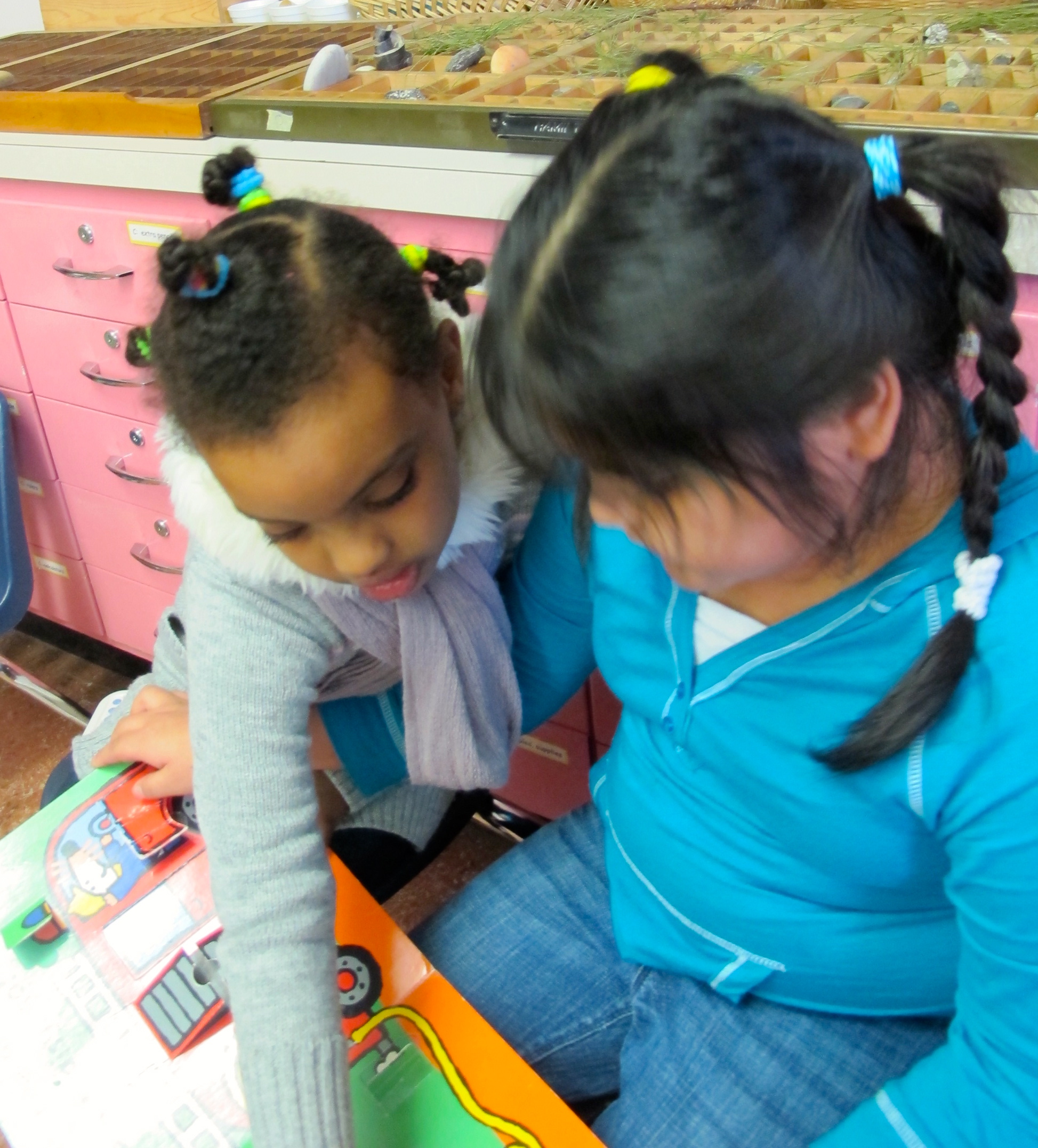
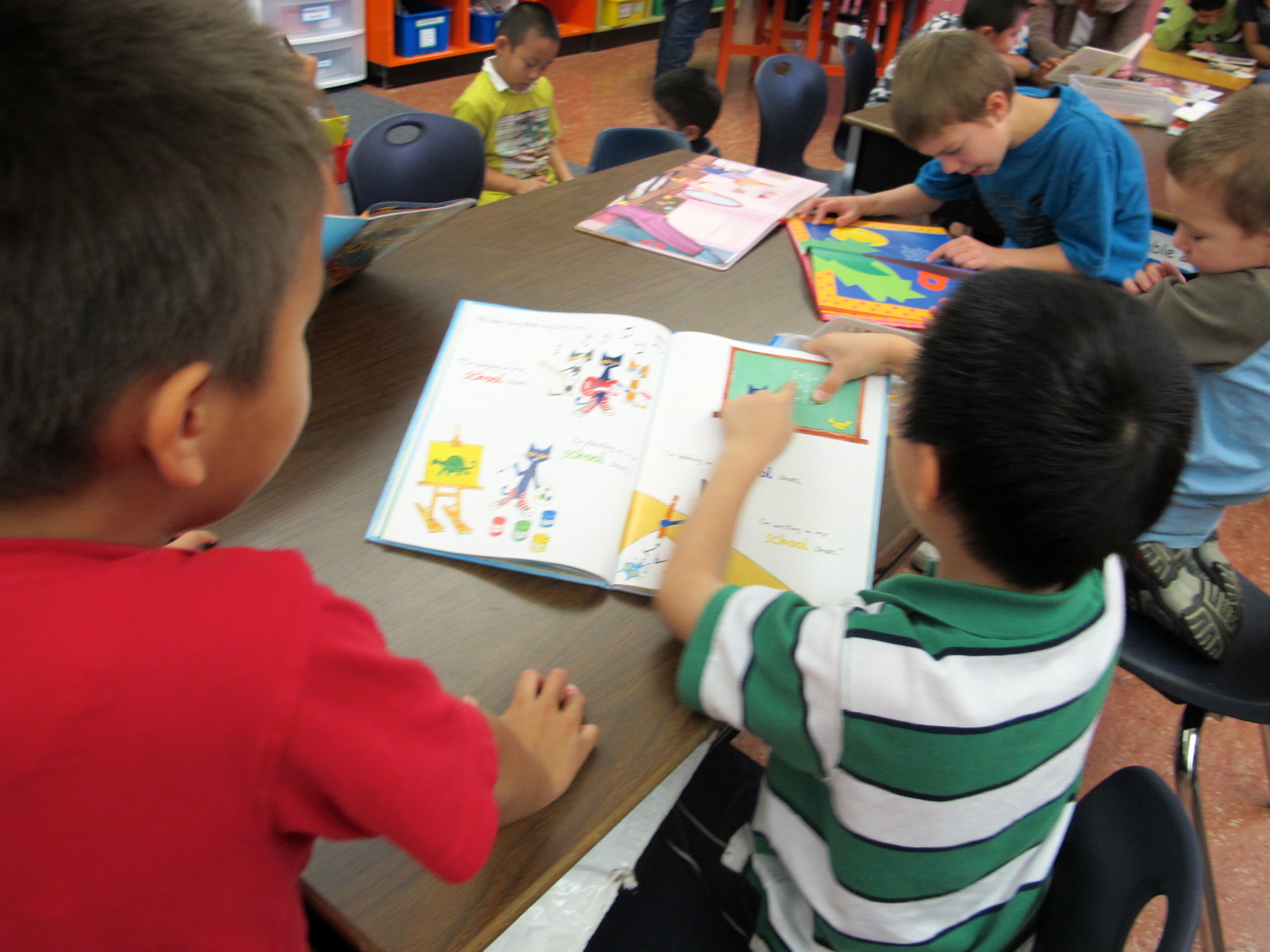
Every Wednesday afternoon the kindergarten class comes to my Grade 2/3 classroom for buddy reading. It is easily one of the highlights of my week. Smiles abound. We share books and spend happy time together reading, talking and learning. A peek at what I see:

  • huge amounts of oral language practice

IMG_6352

  • leadership skills developing

IMG_6332

  • giggling and laughing through a book

IMG_5422

  • playing games with books (Eye Spy, Can you find a . . .?)

IMG_4778

  • spontaneous songs

IMG_5558

  • excitement over books and learning

IMG_5433

  • turn taking, negotiating, working it out

IMG_4866

  • getting lost in a book

IMG_5403

  • growing confidence in reading skills

IMG_5434

  • beautiful fluency and expression

IMG_6146

  • “telling” a book

IMG_6151

  • building relationships

IMG_5152

Recently our kindergarten teacher and other classroom assistants have been absent and so various other adults have been attending buddy reading with the Ks. Some of them have made comments to me that made me think we couldn’t possibly be in the same room.

Well, they don’t really sit in their seats.”

They are jumping around so much, I don’t think they are concentrating.”

“So many of them don’t stick to a book.”

“Those two aren’t really reading the book. They are just talking.”

“They can’t focus for very long.”

Don’t they see what I celebrate? In a room of 5 – 8 year olds, there is energy, noise and movement. But look closely, it is all meaningful. Learning doesn’t look or need to look one way.

Children do so many wonderful things in a day of learning. If you can’t see this because you are looking for something you have decided is more important, wow are you missing out.

Celebrate children. Embace their growing, development and learning styles. Enjoy their smiles.  Notice their new skills. Laugh with them. Be with them where they are. Don’t rush them on to what is “next.” When you stop, slow down and notice what is in the now, it is often pretty great.

And every Wednesday, when I have a front row seat, my view is absolutely joyous.

For those who visited and saw something different. . . I wish, for you, to see what I see.

Developing visual literacy skills

The CLoud SPinner

What is visual literacy?

As defined by WikipediaVisual literacy is the ability to interpret, negotiate, and make meaning from information presented in the form of an image, extending the meaning of literacy, which commonly signifies interpretation of a written or printed text . Visual literacy is based on the idea that pictures can be “read” and that meaning can be communicated through a process of reading.

So how do we go about teaching students to use observation to notice the details and nuances in illustrated stories? As we learn how to ask questions and to infer to deepen our understanding of stories, I also want my students take time, slow down and really focus on their observation skills with the illustrations in picture books.

What do we see when we look closely at an illustration vs. quickly flipping the page? I remind students that these books are picture books for a reason – the story is told through a partnership between author and illustrator. Both pictures and words are important – together they make the story whole.

Wordless books are great to practice these visual literacy skills with but I wanted to have students use these strategies with picture books with text. The trick? Cover the text! So armed with sticky notes, and some fantastic picture books, we began to practice paying close attention to the illustrations and asking questions, inferring and predicting based on what we noticed.

Note: What is described below is what took place over a series of lessons with my Grade 2 reading group

We started with two picture books that I shared with my reading group and I charted our observations and questions as we discussed what we saw. Then the students went through the same process working with a partner and writing their own questions/predictions/inferences. It is always so interesting to go back and read the text to see how close our predictions were and which questions got answered.

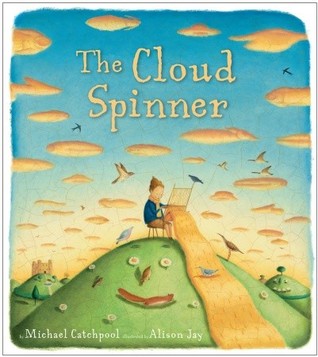
The first picture book we practiced with was The Cloud Spinner by Michael Catchpool, illustrated by Alison Jay. This book has so much going on in the pictures – we could have spent half the class just on the cover. Students wondered about the birds flying in all different directions. They wondered whether the boy was making clouds from his loom or making fabric/material from the clouds themselves. We noticed a castle in the background, birds flying in multiple directions, things looking one way but actually not what they initially seemed (for example the faces on the hillsides that are just objects temporarily grouped a specific way). Students had many questions and each wrote a prediction about the story before we sat down to read the book with both text and illustrations. Many of the children commented that we might have missed some details in the illustrations that were clues had we just read the text.

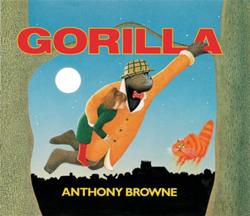
Next we used Gorilla by Anthony Browne. This title is the perfect book to use when Gorilla Anthoney Brownhaving students practice their ability to infer – even more powerful when we explored just the pictures.

With this story, each student had their own notepads to list their questions as we explored the pictures and we stopped frequently to discuss what we thought might be happening with this story.

For those who don’t know this classic Anthony Browne tale, a quick summary: In this story, Hannah wants to see a real live gorilla at the zoo but her busy father never has time to take her there. He gives her a toy gorilla on the night before her birthday. Hannah is upset and disappointed. But in the middle of the night, Hannah and her “toy” gorilla have an amazing adventure.

Some of the students questions included:

  • Does Hannah have a Mom?
  • Did her Mom die?
  • Does Hannah’s Dad have a job? Is he worried because he doesn’t have one?
  • If he does have a job, does he work too much?
  • Does her Dad never have time for her?
  • Is the gorilla lonely too?
  • Does the gorilla love Hannah?
  • Does the gorilla have magic?
  • Will the Dad freak out if he finds out Hannah is gone all night?
  • Will the gorilla save all of the apes and monkeys at the zoo?
  • Why does the gorilla seem sad?
  • Is this just all a dream?
  • Is it just in Hannah’s imagination?
  • Why are they out dancing in the middle of the night?
  • Did the Dad and Gorilla change places?

At the end, even when we read the story, we realized that the author does not tell us what is actually real. “Well,” one clever child observed, “if the author doesn’t tell us, we can choose. That’s the magic of books.” Again, students felt that we got so much more from the story by focussing first on the details in the pictures, asking questions and talking about what might be happening. Students loved listening to the story after this to see how close their idea of the story was to what actually happened.

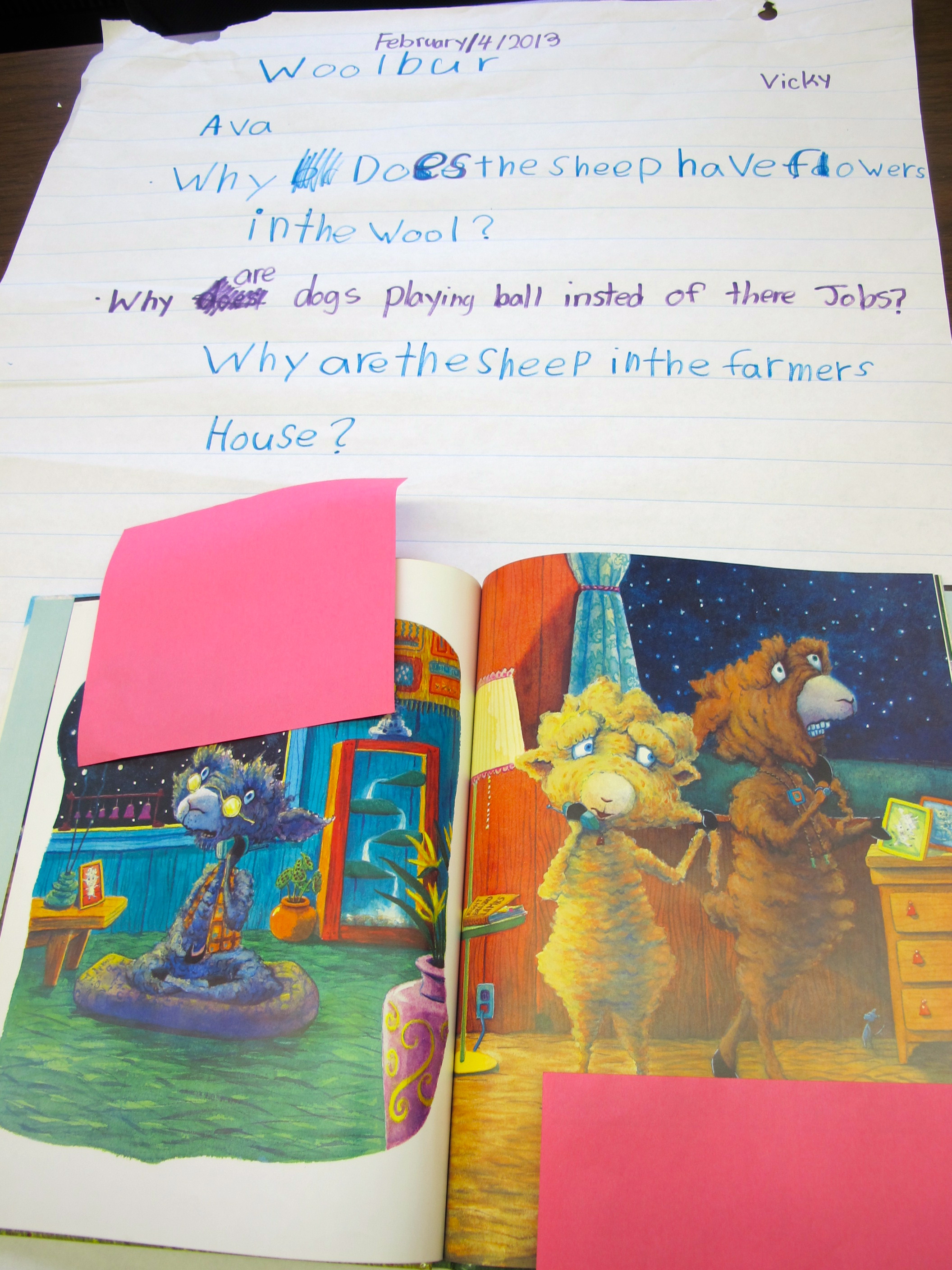
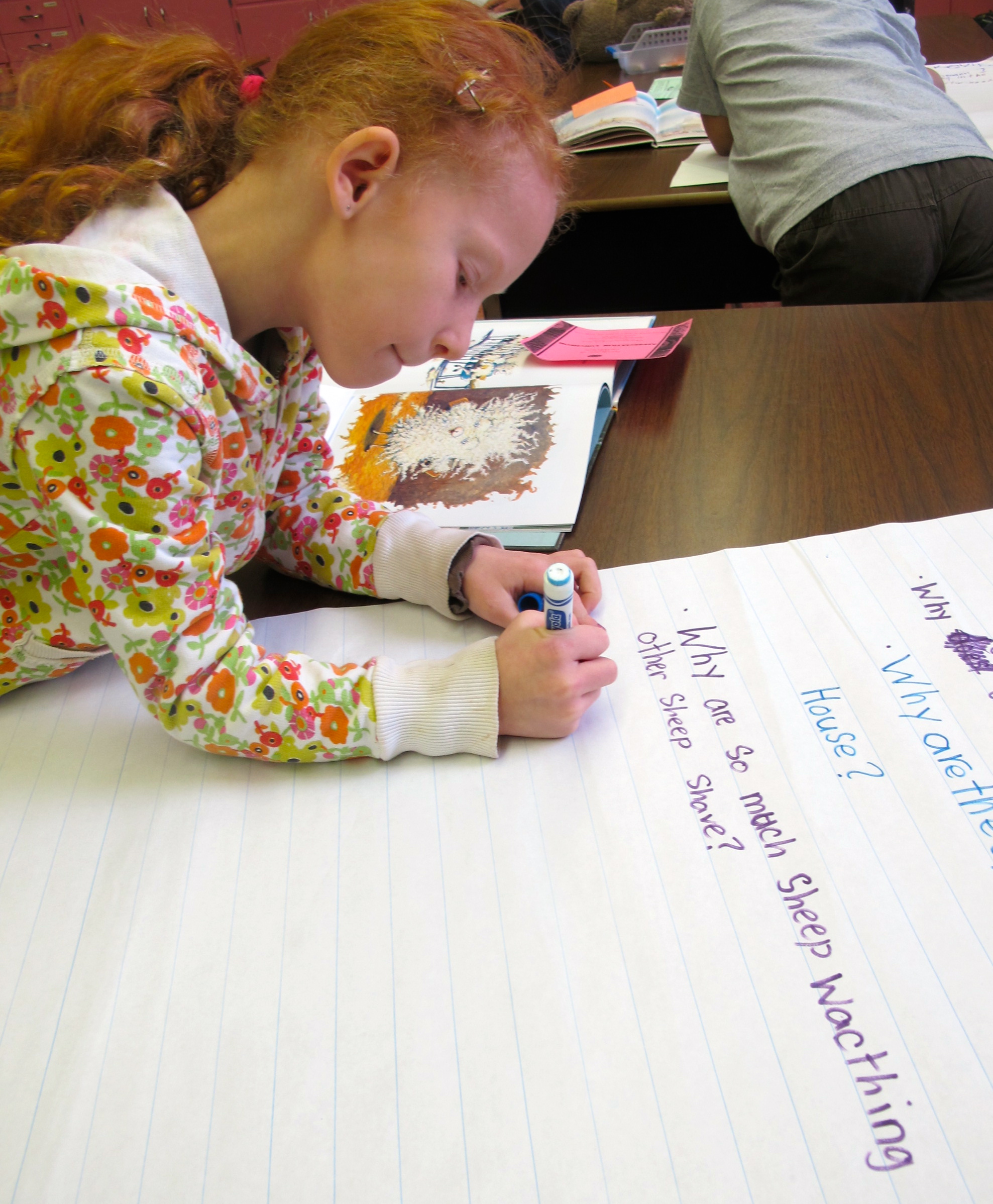
Now we were ready to begin to go through this process with more independence! Working in partners, the students chose a picture book, markers, chart paper and scrap paper to cover the text and got to work exploring just the pictures and noting down their questions. These students used the book Woolbur by Leslie Helakoski and illustrated by Lee Harper.

IMG_6284

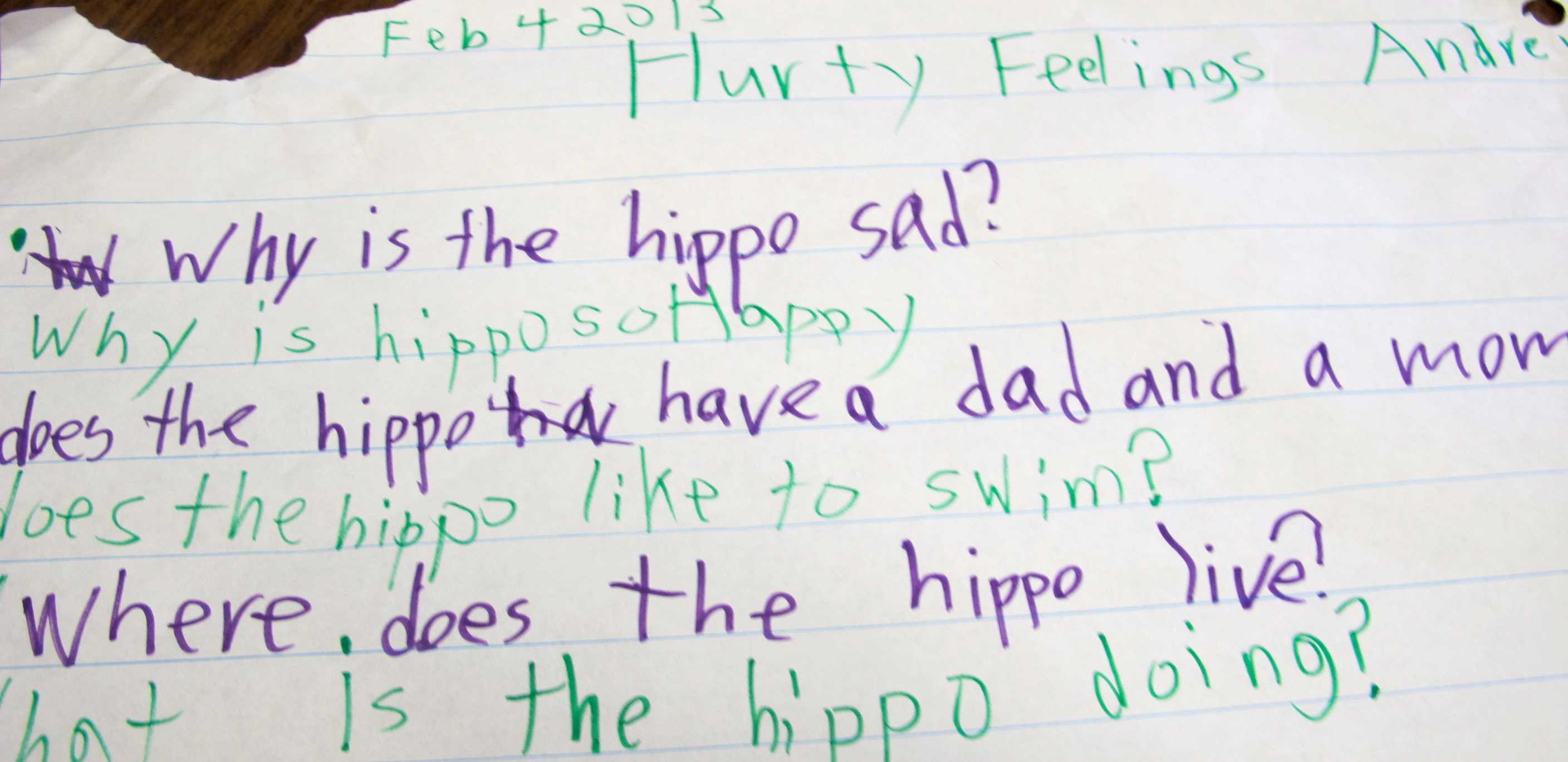
Questions started out quite simple, but as the children began to have a sense of the story, they started asking more complex questions. the questions below are about the book Hurty Feelings by Helen Lester.

IMG_6286

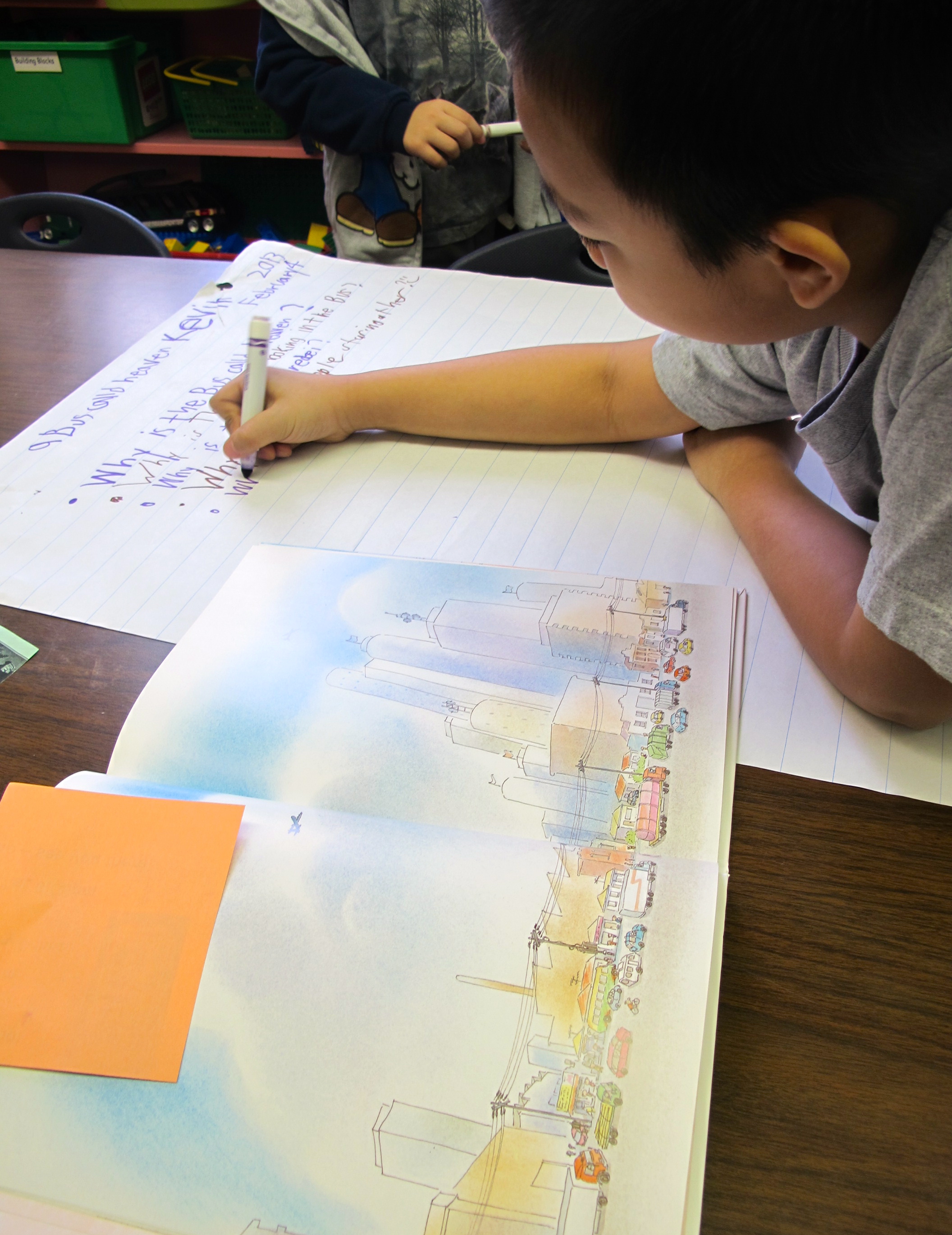
The story A Bus Called Heaven by Bob Graham inspired a lot of questions! There was so much in the details of what was happening inside and outside of this bus. The students who used this book read it two times through after exploring the illustrations.

IMG_6297

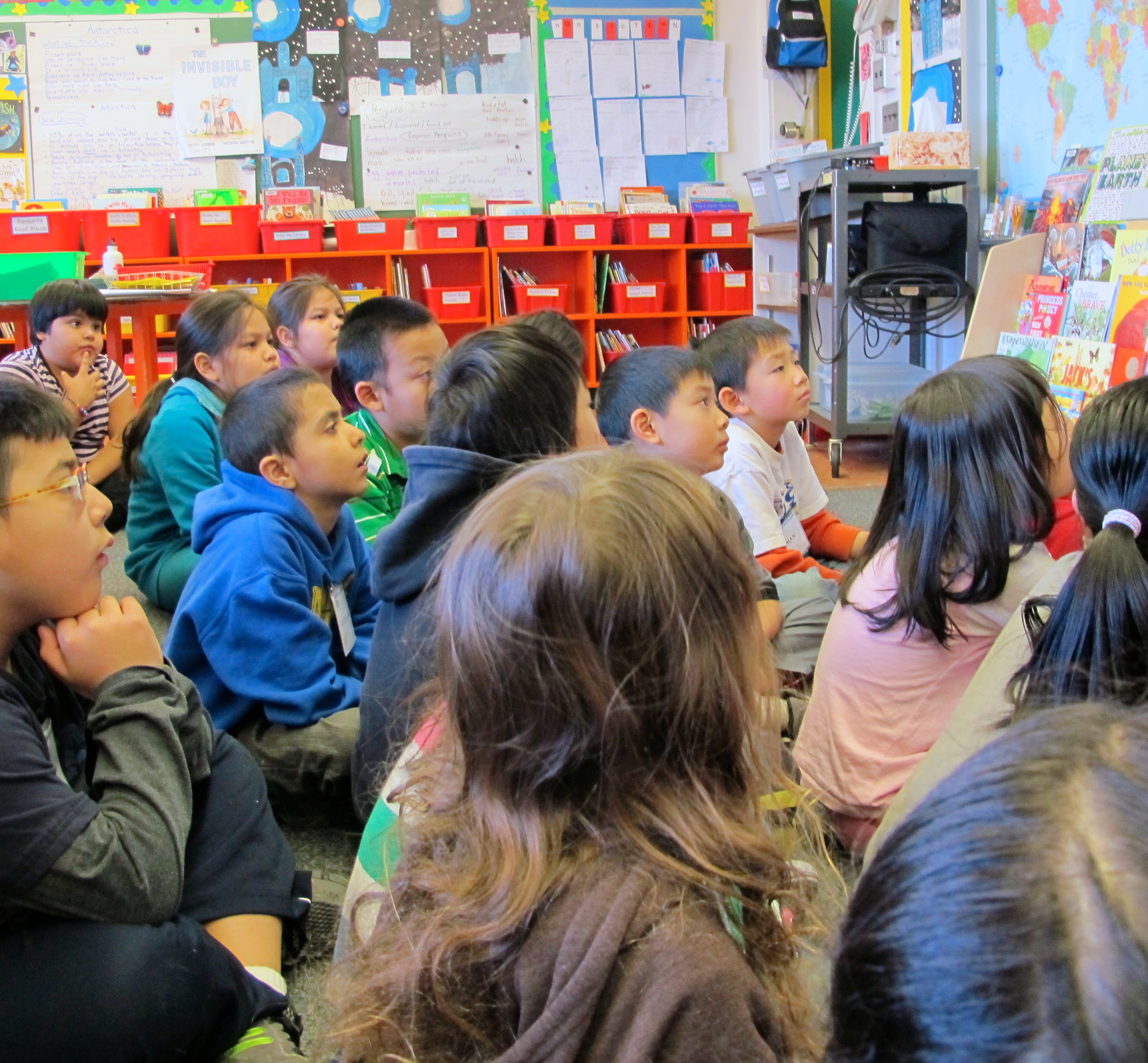
I was impressed by how focussed the students were. All of them were engaged with their books, their partner and the discussions that they were having.

IMG_6299

Snippets of conversations I heard as I circulated:

  • “Quick! Cover the text!”
  • “We have so many questions I can’t believe it.”
  • “We know so much!”
  • “We’re sure predicting so much stuff.”
  • “Look really closely. You will notice more.”
  • “I think I see better when I don’t get distracted by the words.”
  • “I think this makes us smarter.”

Really . . . what more do you want to hear during a lesson?

As I share picture books in whole class lessons, I have noticed that students who are in my reading group are raising their hands to share details they notice in illustrations. This keen attention to detail has become contagious and the whole class has been paying more attention to pictures. We have to stop frequently to share with those around us what we notice and what we predict! I love all of the talking this has inspired!